
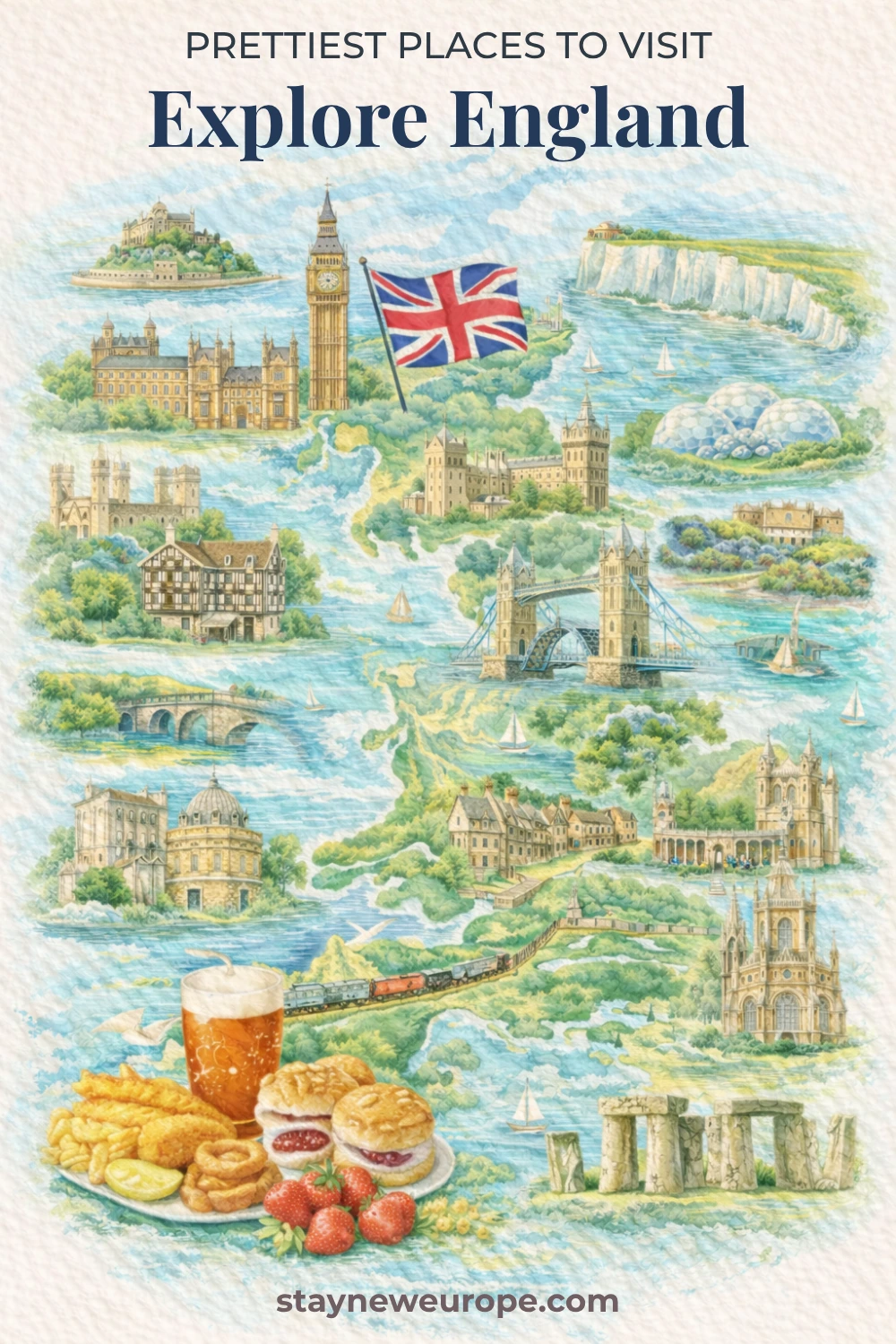
Okay, I’ll admit it upfront — I’m completely biased when it comes to England. I have been for years and I make no apology for it. There is something about this country that gets under your skin in a way that’s genuinely hard to explain to people who haven’t experienced it. The rolling countryside, the absurdly pretty villages, the history absolutely everywhere you look, the coastline that shifts character every twenty miles — England is one of those places that keeps revealing itself the more time you spend in it.
For the longest time I fell into the trap that a lot of people fall into, which is thinking you need to fly somewhere to feel like you’ve properly travelled. I’d be booking flights to far-flung corners of Europe while completely ignoring the fact that there were extraordinary places an hour and a half from my front door that I’d never bothered to visit. It took me a while, but I finally sorted that out, and now England is one of my favourite places to explore full stop — not just as a default when I can’t get abroad, but as an actual destination I actively look forward to.
Whether you’re visiting England for the first time and trying to figure out where to start, or you’ve lived here your whole life and want to tick off a few more things on the list, this is for you. These are the 20 prettiest and best places to visit in England — the ones that have stayed with me, the ones I keep going back to, and the ones I genuinely cannot recommend highly enough.
1. The Lake District
The Lake District is one of the most beautiful places in England and it honestly doesn’t matter how many times you visit — it still manages to stop you in your tracks. It became a UNESCO World Heritage Site a few years ago, which felt like the world finally catching up with what anyone who had been there already knew. The combination of the lakes, the fells, the dry stone walls running up into the mist, the ancient village pubs and the kind of light that painters have been trying to capture for centuries — it’s just extraordinary.
Windermere is the most famous lake and the largest in England, and it earns that reputation. The shores are lined with Victorian manor hotels and grand guesthouses that look out over the water, and a late afternoon boat trip with the fells reflected in the stillness is one of those quietly perfect English moments. That said, if you want to escape the crowds that gather around Windermere in peak season, Ullswater is the answer. It’s equally beautiful, considerably quieter, and has its own old-fashioned steamer service that has been running for over 150 years and remains one of the loveliest ways to travel anywhere in the country.
For hiking, the options are almost overwhelming. Harter Fell gives you views across the lake that are genuinely breathtaking on a clear day. Catbells above Derwentwater is a shorter, easier climb that delivers disproportionately magnificent views for the effort involved. And if you want to take in as much as possible in a single day, a guided tour that covers ten of the lakes is the kind of thing you’ll be talking about on the drive home.
The Lake District is also exceptional for afternoon tea, which might sound like a minor observation but really isn’t when you’re sitting on a stone terrace overlooking the water with freshly baked scones, proper clotted cream and a pot of something strong. That experience alone makes it one of the best places to visit in England.
2. The Cotswolds
The Cotswolds is the place that comes to mind when people imagine the English countryside at its most perfect, and the maddening thing is that it actually looks like that. The honey-coloured limestone villages, the rolling hills, the flower-draped cottages and the narrow lanes between hedgerows — it’s all completely real and it’s genuinely as beautiful as any photograph you’ve ever seen of it.
About two hours from London by car, the Cotswolds is an Area of Outstanding Natural Beauty covering parts of Gloucestershire, Oxfordshire, Warwickshire, Wiltshire and Worcestershire, and the best way to see it is by car because the villages that make it so special are spread across the hills in a way that buses and trains simply can’t connect efficiently. That said, if you don’t drive, guided tours from London and from Cheltenham run regularly and are genuinely excellent.
Bibury is the one that tends to make people gasp. Arlington Row, a terrace of 17th-century weavers’ cottages reflected in the stream beside them, is widely considered the most photographed street in England and it is every bit as beautiful in person as it looks in every picture you’ve ever seen of it. Go in the early morning before the cars pull up and you’ll have it almost to yourself, which makes the whole experience feel even more special.
The Upper and Lower Slaughters — which have the most dramatically misleading names in England given how peaceful they actually are — are two of the prettiest villages in the Cotswolds and sit close enough together that you can walk between them along the river in about twenty minutes. Bourton-on-the-Water has a series of low bridges spanning a shallow river running through the centre of the village and is particularly lovely in summer. Tetbury has the Chipping Steps, a beautiful ancient cobbled stairway, and a high street full of antique dealers that you can lose a very pleasant afternoon in.
3. Bath
There’s a reason Bath has been a destination since the Romans built their baths here in the first century AD and it’s still drawing visitors two thousand years later, which is really saying something. The whole city is built from the same warm Bath stone that glows golden in afternoon light, it sits in a natural bowl in the Somerset hills, and everywhere you look there’s architecture so beautifully conceived and so immaculately maintained that it feels almost theatrical.
The Roman Baths themselves are one of the finest ancient monuments in Britain and absolutely deserve the hype. The preserved bathing complex, the temple precinct, the museum of artefacts found on site — it’s a genuinely absorbing experience and one of those rare tourist attractions where you come out feeling you’ve actually learned something important. Book tickets in advance because the queues without them can be brutal, especially in summer.
The Royal Crescent is one of the most famous pieces of Georgian architecture in the world, a sweeping curve of thirty terraced townhouses arranged in a perfect arc above a sloping lawn. The Circus nearby, designed by John Wood the Elder in 1748 as a perfect circle of townhouses, is equally extraordinary. Walking between these two landmarks through the Georgian streets of Bath is one of the finest urban walks in England.
For food, Sally Lunn’s on North Parade Passage has been baking its famous large buns since 1680, which makes it one of the oldest baking establishments in the country. The buns are served with an assortment of sweet and savoury toppings in a building that has been there since the 15th century, and the combination of genuinely excellent food and extraordinary history makes it unmissable. Bath Abbey right in the city centre is beautiful from the outside and stunning inside, particularly the fan-vaulted ceiling which is one of the finest in England.
4. Cambridge
Cambridge is one of those cities where you arrive thinking you’ll give it half a day and leave three days later wondering where the time went. It’s been a university city since 1209, which means over eight hundred years of extraordinary minds have studied, argued, discovered and wandered along the banks of the River Cam, and that accumulated history is completely palpable in every college courtyard and every ancient lane.
King’s College Chapel is the building most people associate with Cambridge and it is genuinely one of the most magnificent Gothic buildings in England. The fan-vaulted ceiling, the Rubens painting behind the altar, the great west window, and somewhere hidden within all of that the faint graffiti left by Oliver Cromwell’s troops during the Civil War who were quartered here — there’s more to look at than you can take in on a single visit. The wooden rood screen in the centre of the chapel was a gift from Henry VIII to Anne Boleyn and is one of the finest pieces of Tudor craftsmanship in the country.
Punting on the River Cam is the thing most visitors are determined to do and they are absolutely right to be. The stretch of river behind the colleges known as the Backs, where the grounds of the great colleges run down to the water and the bridges crossing it are so beautiful they look designed for paintings, is one of the loveliest places to be on a sunny English afternoon. You can hire your own punt and do it yourself, which produces some highly entertaining results for onlookers, or book a guided punt tour with someone who actually knows what they’re doing and can tell you about the history as you glide past.
For breakfast before a day of exploring, Fitzbillies on Trumpington Street is a Cambridge institution that has been making its famous Chelsea buns since 1921, and the breakfast is exactly what you need before a day on your feet in one of England’s best cities.
5. Corfe Castle
Corfe Castle is one of those English places that makes you feel, almost immediately, that you’ve stepped back through time to somewhere that the modern world hasn’t quite caught up with yet. People have lived on this ridge in Dorset for over 8,000 years, which makes it one of the oldest continuously settled spots in England, and the ruined castle on the hill above the village has been watching over the surrounding countryside since the Norman Conquest.
The castle ruins are extraordinary. Corfe Castle was a major royal fortress for centuries until it was slighted by Parliamentary forces after a famous siege during the Civil War, and the resulting ruin — walls and towers leaning at dramatic angles on their hilltop, visible from miles around — is one of the most atmospheric historical sites in southern England. You can explore the ruins with the National Trust and the views from the top across the Isle of Purbeck and the Dorset countryside are genuinely magnificent.
The village below the castle is pretty in that completely effortless way that some English villages manage, with stone cottages lining the narrow streets and a selection of excellent pubs and tea rooms. Mortons House Restaurant does one of the finest Sunday roasts in Dorset, which in a county that takes its food seriously is saying something. The Swanage Railway runs from Corfe Castle station to Swanage on the coast using a restored heritage steam engine, which is one of those small English joys that is completely wonderful and not at all embarrassing to be excited about.
6. Stonehenge
Some places in England are famous enough that you worry they might be disappointing in person, and then you actually arrive and realise that was never going to be a problem. Stonehenge is one of those places. The stones are bigger than you expect, the landscape around them is wilder and more open than any photograph suggests, and standing near a monument that people were constructing 5,000 years ago while the purpose of it remains genuinely unknown is a strange and affecting experience.
The stones themselves were quarried in West Wales and somehow transported to Salisbury Plain — exactly how, and exactly why, remains one of the great unanswered questions of British prehistory. The theories involve ceremony, astronomy, healing, ancestor worship and community gathering, and possibly all of those things at once. The visitor centre does an excellent job of laying out what archaeologists know, what they suspect, and what they simply don’t understand, which turns out to be most of it.
If you want to visit without the crowds, the early morning or late afternoon sessions are significantly quieter than midday when the coach tours arrive in force. And if you’re coming from London, the half-day tours that leave from Central London are genuinely excellent value and take all the transport logistics out of the equation.
7. The Jurassic Coast
The Jurassic Coast is a UNESCO World Heritage Site running for 95 miles along the coastline of Dorset and East Devon, and it contains a geological record of 185 million years of Earth’s history exposed in the eroding cliffs and beaches. That sounds like something you’d read on a museum plaque and then walk past, but the thing about the Jurassic Coast is that the geological history is actually lying on the beaches waiting for you to pick it up.
Fossil hunting here is one of the genuinely special things you can do in England and it delivers in a way that surprises almost everyone who tries it. The cliffs erode constantly and as they do they scatter ammonites, belemnites, ichthyosaur vertebrae and all manner of prehistoric life across the beaches. Charmouth is the best spot for beginners, with a brilliant heritage centre that tells you what to look for and where to look for it. On a good day you can come away with a dozen fossils, which is an extraordinary thing when you consider that each one has been hidden in rock for between 65 and 185 million years.
Durdle Door on the Jurassic Coast is one of the most photographed natural arches in England, a limestone arch curving into the sea above a brilliant blue cove, and it is completely gorgeous in good weather. Old Harry Rocks at the eastern end of the Heritage Coast are equally dramatic — a series of chalk stacks jutting from the sea at Handfast Point that mark the end of the chalk ridge running from here all the way to the White Cliffs of Dover.
8. Bristol
I’ll be honest with you — Bristol didn’t grab me on my first visit. I’d been lazy about researching it and I hadn’t found the right parts of the city, and I came away thinking it was fine without being particularly exciting. I was wrong, and my second visit, properly planned, sorted that out completely.
Bristol is one of the most interesting cities in England and it has a creative, slightly independent energy that feels genuinely different from anywhere else in the country. The street art scene is extraordinary — Banksy is from Bristol and his work, along with that of dozens of other artists, covers walls throughout the city in a way that turns a walk through certain neighbourhoods into something approaching a gallery experience. The annual Upfest festival in Stokes Croft is one of the largest street art festivals in Europe and transforms whole streets in a matter of days.
The Clifton Suspension Bridge is one of the most beautiful pieces of Victorian engineering in Britain, spanning the Avon Gorge at a height of 75 metres with a span of 214 metres between the towers. It was designed by Isambard Kingdom Brunel and completed in 1864, five years after his death, and it is still in daily use and still genuinely spectacular to look at from both ends. Clifton village on the far side of the bridge from the city is beautiful — Georgian townhouses, independent coffee shops and restaurants, and a village green that on a summer afternoon makes you feel you’ve somehow wandered out of a city into a countryside village.
Wapping Wharf and the harbourside area are excellent for food, with a permanent market of shipping containers converted into independent restaurants and cafés that does the kind of casual, genuinely good food that Bristol specialises in. Spike Island nearby has a great contemporary arts centre in a converted tea warehouse. And the SS Great Britain, Brunel’s revolutionary iron steamship that now sits restored in the dry dock she was built in, is one of the finest museums in England and criminally undervisited.
9. Oxford
The Oxford versus Cambridge debate has been going on for centuries and I have no intention of resolving it here. What I will say is that Oxford is extraordinary and deserves to be visited on its own terms rather than constantly in comparison to its great rival.
The university has been here since the 12th century and the accumulated architectural beauty of over eight centuries of college building is something that you genuinely feel as you walk through the city. The golden Cotswold stone of the colleges, the quadrangles glimpsed through arched gateways, the Bodleian Library and the Radcliffe Camera dome rising above it all, the covered market that has been in continuous use since 1774 — Oxford has a density of beautiful and historically significant places that is remarkable even by England’s generous standards.
Christ Church is the grandest of the Oxford colleges and also contains Christ Church Cathedral, the smallest cathedral in England, within its grounds. The Great Hall, which served as the model for the Great Hall in the Harry Potter films, is open to visitors at certain times. The Bodleian Library complex, which includes the circular Radcliffe Camera and the 17th-century Schools Quadrangle, is one of the most magnificent architectural ensembles in England.
Punting on the Cherwell or the Isis is the Oxford equivalent of the Cambridge experience — similarly wonderful, similarly prone to comedic error if you take the pole yourself. For something more unusual, the Thirsty Meeples board game café is genuinely one of the best ways to spend a rainy Oxford afternoon, with hundreds of games available and excellent coffee to fuel the competition.
10. Watergate Bay, Cornwall
Cornwall does something to you the moment you drive over the Tamar and cross into the county — the light changes, the landscape opens up and there’s a quality to the air that you don’t get anywhere else in England. It has the highest concentration of coastline to inland of any English county and the variety of what that coastline offers is extraordinary.
Watergate Bay on the north coast near Newquay is one of those beaches that makes people who see it for the first time genuinely stop and stare. A vast, wide stretch of sand backed by cliffs, facing the full force of the Atlantic with waves that on the right day are some of the best in England for surfing. The surfing schools that operate from the beach are excellent for beginners, and even if you spend the whole lesson falling off the board with your face in the sand you will have the best time doing it.
The wider Cornwall coastline is filled with places that are equally worth your time. St Ives on the far west is one of the most beautiful small towns in England, with a harbourfront of whitewashed cottages, excellent galleries including the Tate St Ives, and beaches on three sides of the headland. The Minack Theatre, carved into the clifftop near Land’s End and running outdoor performances through the summer against a backdrop of the Atlantic, is one of the most extraordinary theatre venues in the world. And the coastal path that runs for 300 miles around the entire Cornwall coastline, if you can walk sections of it, delivers views that are simply some of the finest in England.
11. St Michael’s Mount
St Michael’s Mount is one of those sights in England that stops you mid-sentence when you first catch sight of it. A medieval castle and chapel on a rocky island, connected to the village of Marazion by a cobbled causeway that is walkable at low tide but disappears completely under the sea when the tide comes in — it is one of the most dramatically beautiful and romantic places in the whole country.
The mount has been occupied for well over a thousand years. Benedictine monks were here in the 12th century, it served as a fortress in the Tudor period, and the St Aubyn family have lived in the castle since the 17th century. It’s managed by the National Trust in partnership with the family, which means it’s open for visits while remaining a genuinely lived-in home. The castle rooms, the subtropical gardens clinging to the rocky slopes, and the views from the top across Mount’s Bay and the Cornish coast on a clear day are all extraordinary.
The folklore around the mount is wonderful too. According to local legend, a giant called Cormoran built the mount and was eventually slain by Jack the Giant Killer — a story rooted deeply enough in the Cornish imagination that even knowing you’re unlikely to encounter a giant somehow makes it feel appropriate to look twice when the mist comes in off the sea in the early evening. It is just that kind of place.
12. Robin Hood’s Bay
Robin Hood’s Bay is the kind of seaside village that makes you wonder how it’s managed to exist without being overrun, because it is completely beautiful and yet it retains an authenticity and local character that so many pretty English coastal villages lose when they become too popular.
It sits on the Yorkshire coast just south of Whitby, tucked into a steep-sided bay with the North Sea at its feet and a jumble of red-roofed fishermen’s cottages climbing the cliff above. The main street that runs through the village is so narrow that two people can barely pass each other, and at the bottom it simply ends at the beach, which has rock pools that are excellent for children and for anyone who hasn’t entirely grown up.
The village was a major smuggling centre in the 18th century when contraband goods including alcohol, tobacco and silk were landed here and moved through an underground network of tunnels and hidden passages that connected the cellars of the houses. You can’t go in the tunnels today but the history is told in brilliant detail at the local museum, and wandering the village knowing what was happening in every dark corner three hundred years ago gives it a slightly roguish atmosphere that is very appealing.
Tea, Toast and Post in the village makes excellent lunches and some of the best tea on the Yorkshire coast. The walk along the coastal path from Robin Hood’s Bay toward Ravenscar gives you views back over the bay that are genuinely spectacular.
13. Castle Howard
Castle Howard is one of the finest country houses in England and it is truly, breathtakingly beautiful. Just shy of York in the North Yorkshire countryside, it was designed by Sir John Vanbrugh and built between 1699 and 1712, and even by the extravagant standards of English country houses it is extraordinary — a vast baroque palace with a famous dome, formal gardens, a lake, a walled rose garden and grounds that seem to stretch on indefinitely in every direction.
The state rooms inside are magnificent. The Great Hall under the dome, the long gallery, the chapel and the various reception rooms contain art and furniture of exceptional quality and the whole thing is presented in a way that feels like a living house rather than a museum, which it still very much is — the Howard family has lived here for over three centuries. Castle Howard was the setting for both the original Brideshead Revisited television series and the more recent film, and walking through the rooms where those were filmed is one of those slightly giddy experiences that comes from visiting a place you feel you already know.
The gardens are worth as much of your time as the house. The walled rose garden is at its absolute best in June and July. The Temple of the Four Winds, placed at the end of a long grass walk from the house, is a perfect piece of Baroque garden architecture. The great Atlas Fountain in the south parterre is one of the finest in England. And the cafe in the stables does an afternoon tea that is properly good.
14. Holy Island of Lindisfarne
Lindisfarne is one of those places in England that genuinely feels like a different world. It’s a tidal island off the Northumberland coast, connected to the mainland by a causeway that is covered by the North Sea twice every day and opens for a few hours each side of low tide, which means that visiting it requires a bit of planning and creates a genuinely dramatic approach — driving across the exposed seabed with water visible on both sides and the island ahead.
The history of Lindisfarne is remarkable. Christian monks established a monastery here in 635 AD, making it one of the earliest and most important centres of Christianity in England. The Lindisfarne Gospels, one of the greatest surviving examples of medieval illuminated manuscript, were produced here around 715 AD and are now in the British Library in London. The ruins of the 12th-century priory that replaced the original monastery are hauntingly beautiful and deserve a good hour of your time.
Lindisfarne Castle on its rocky crag at the far end of the island is spectacular from a distance and equally interesting up close — it was converted from a Tudor fort into a private house by Edwin Lutyens in 1901 and has an intimate, surprisingly cosy quality inside given its dramatic exterior. Before you leave the island, pick up a bottle of Holy Island Mead from one of the local producers — a honey-based alcoholic drink made to a monastic recipe that has been produced on the island for centuries and is the kind of thing you sip on a cold afternoon and feel absolutely certain the monks knew what they were doing.
15. Northumberland
Northumberland is regularly voted the happiest county in England in lifestyle surveys, which sounds like the kind of statistic you’d be sceptical about until you actually visit and then find completely plausible. It has the most castles of any county in England, an extraordinary stretch of coast with some of the best beaches in the country, two Areas of Outstanding Natural Beauty, the largest dark sky park in England, and a character that feels genuinely wild and open in a way that the more famous rural areas of England sometimes don’t.
Bamburgh Castle on the Northumberland coast is one of the most dramatic castles in England, a vast medieval fortress perched on a rocky outcrop above a wide sandy beach with the Farne Islands visible offshore. It looks, on a stormy day with the sea grey and the sky low, like something from a Viking saga, which is appropriate given that this coast saw more than its share of Viking activity over the centuries.
The Farne Islands themselves are a National Nature Reserve accessible by boat from Seahouses and home to one of the largest grey seal colonies in England as well as enormous seabird colonies including puffins, which are best seen from May through July when they are nesting. A boat trip out to the Farnes is one of the finest wildlife experiences available in England. Alnwick Castle, which has appeared as Hogwarts in the Harry Potter films, is a working castle of considerable historic significance as well as being thoroughly enjoyable to visit. And Hadrian’s Wall, built by the Romans in 122 AD as the northern frontier of their empire, runs through the southern part of the county and offers some of the most dramatic walking in northern England.
16. Cirencester
Cirencester is one of those market towns that you expect to be pleasant and discover is actually genuinely brilliant. It was the second-largest city in Roman Britain after London — known as Corinium — and the remains of that Roman heritage are layered throughout the town in a way that makes it endlessly interesting to explore.
The Corinium Museum is one of the finest Roman museums in England, with an exceptional collection of mosaics, sculptures, coins and everyday objects from the Roman town that give you a vivid sense of what life was like here two thousand years ago. The amphitheatre earthworks on the edge of the town are among the largest surviving Roman amphitheatre remains in Britain.
The Parish Church of St John the Baptist, one of the great Perpendicular Gothic wool churches of the Cotswolds, is magnificent and largely contains a whole range of extraordinary medieval and Tudor features. The Elemental Sculpture Park in the grounds of Cirencester Park is a wonderfully unusual attraction, and the town’s weekly markets bring a genuine local bustle to the streets in a way that makes you feel you’ve arrived somewhere that actually functions as a real community rather than just a heritage attraction. The Fleece on Market Place is the best pub in town and serves exactly the kind of honest, unpretentious food that a proper English market town pub should.
17. Rye
Rye is the kind of place that makes you want to move there. I say that about a number of English places but I mean it particularly about Rye, which manages to combine extraordinary medieval history with a genuinely vibrant independent culture of artists, writers, food producers and antique dealers in a way that feels completely organic and not at all manufactured.
The town sits on a hill in East Sussex, what was once an island before the surrounding marshes silted up, and its medieval street plan survives almost intact. Mermaid Street is the one that everyone photographs — a steep cobbled lane of medieval and timber-framed houses, including the famous Mermaid Inn which has been offering hospitality on this street since 1420 and is one of the most atmospheric and historically significant places to stay in England. If you can book a room there, do. The rooms are full of character, the bar is ancient and genuine, and waking up in Mermaid Street on a quiet Rye morning is a very special experience.
The town has a remarkable number of good independent shops and galleries concentrated into a small area, the Rye Castle Museum tells the history of the town in excellent detail, and the views from the church tower of St Mary the Virgin across the Romney Marsh and the surrounding countryside are wonderful. Camber Sands, a vast stretch of dunes and beach a few miles away, and Bodiam Castle, a perfectly moated medieval castle nearby, make Rye the natural centre of a very enjoyable few days in a part of England that not enough people bother to explore.
18. Norwich
I left Norwich too long before visiting, which is something I regret, because it is a genuinely excellent city and one that consistently gets overlooked in favour of the more famous English destinations. It was one of England’s most important medieval cities — for a time the second city of England after London — and that medieval heritage is still overwhelmingly visible and largely intact in a way that is extraordinary.
The Norman cathedral is one of the finest in England, with the second-tallest spire in the country and extraordinary Romanesque architecture throughout. The cobbled lanes of the old city around Elm Hill, with their medieval and Tudor buildings, are some of the most beautiful urban streets in England. And the market in the central market place has been held permanently on the same site for over a thousand years — since it was a Saxon trading post — which is the kind of historical continuity that takes a moment to fully absorb.
For food, the Fur and Feathers outside the city uses local Norfolk ingredients in a genuinely excellent restaurant that feels properly rooted in the landscape around it. And the Grosvenor Fish Bar in the city centre does proper English fish and chips — lashings of vinegar, the lot — that is consistently ranked among the best in the country. It would be wrong to visit Norwich without having both.
19. London
I love London more than any other city in the world and I am not even slightly embarrassed about that. I know it’s enormous and expensive and occasionally infuriating, but it is also one of the most extraordinary cities on earth and the range of things it offers — culturally, historically, culinarily, architecturally — is simply unmatched in England and rivalled by very few cities anywhere.
If it’s your first time, the iconic sights deserve your attention before anything else. The Tower of London and Tower Bridge together make one of the finest historic riverside walks in the world. St Paul’s Cathedral from the Millennium Bridge, the Tate Modern on the far bank, and the whole South Bank stretch that connects it to Borough Market and Southwark Cathedral make for an afternoon that covers art, history, architecture and excellent food in a single walk. The British Museum contains one of the greatest collections of human history ever assembled in one building and is completely free, which is one of the genuinely great things about London’s museums.
But the London that gets under your skin is the neighbourhood London — Notting Hill on a Saturday with the Portobello Road market in full swing, Shoreditch on a Sunday morning when the Brick Lane market is loud and the coffee is excellent, Greenwich with the Cutty Sark and the Royal Observatory and the best views over the city skyline from the hill in the park, Peckham on a Friday evening when the rooftop bars fill up and the whole neighbourhood hums with energy. These are the versions of London that people who live here love, and they are the versions that visitors who push beyond the tourist circuit discover and then spend the rest of their lives telling people about.
20. Manchester
Manchester has a cool that it wears without effort, which is the best kind of cool. It’s the kind of city that doesn’t feel the need to impress you because it’s too busy being itself, and the result is one of the most enjoyable and genuinely energetic cities in England.
The music history alone is worth a trip. This is the city that gave the world The Smiths, Oasis, The Stone Roses, Joy Division, The Verve and more, and that musical heritage is woven into the fabric of the city in the venues, the record shops, the general attitude of people who live here and the pride the city takes in the culture it has produced. The Northern Quarter is the neighbourhood that carries this history most visibly — independent record shops, vintage clothing, excellent coffee shops and a density of good bars that makes an afternoon here very easy to extend into an evening.
For football fans, a tour of Old Trafford is the obvious pilgrimage, and it delivers on the history and the emotion in equal measure. But the city’s football goes beyond one club, and the Etihad campus and museum is equally impressive for a different set of loyalties.
Manchester Cathedral in the city centre is one of the finest medieval buildings in the north of England, and the Manchester Art Gallery houses an exceptional collection of Pre-Raphaelite painting and contemporary work. The Science and Industry Museum in Castlefield — built on the site of the world’s first railway station — is excellent, particularly for anything involving the Industrial Revolution that Manchester essentially started. And Salford Quays, a ten-minute tram ride from the city centre, has the Imperial War Museum North and The Lowry arts centre, which between them constitute one of the best arts and culture afternoons available in the north of England.
England keeps giving you reasons to stay and reasons to come back. Whatever brings you here, I genuinely hope you love it as much as I do.
