
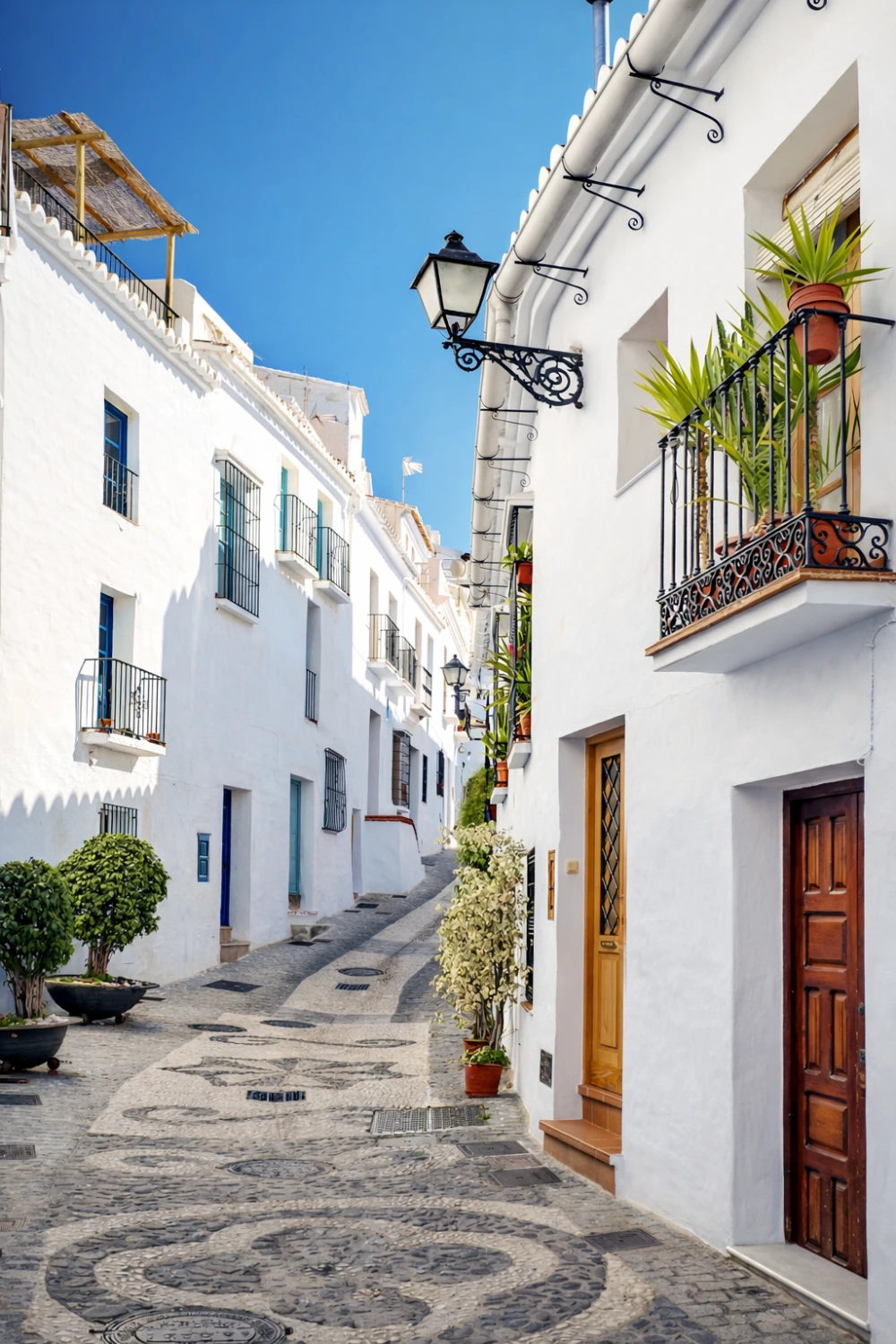
If you’ve been scrolling through photos of whitewashed villages in southern Spain and wondering which one is actually worth visiting — let me stop you right there. It’s Frigiliana. Every single time.
There’s something about this tiny hillside village, just 15 minutes above Nerja on the Costa del Sol, that gets under your skin from the very first cobblestone. Narrow streets that barely fit two people walking side by side. Walls draped in tumbling geraniums. Blue doors that look like they were painted specifically for your camera. And above it all, sweeping views stretching all the way to the Mediterranean Sea.
Frigiliana has a population of around 3,000 people, a history that goes back to the Moors, and a quiet magic that most of the big, famous Spanish cities can’t come close to. It’s been named one of the most beautiful villages in all of Spain — and honestly? It earns that title every single day.
Whether you’re popping in for a few hours on a day trip from Nerja or Málaga, or you’ve decided to stay overnight (which I highly recommend, by the way), here are the 10 best things to do in Frigiliana that will make your visit truly unforgettable.
A Few Things to Know Before You Go
The historic old town — Centro Histórico de Frigiliana — is where all the magic happens. Everything is built on different levels connected by steep staircases and winding lanes, so wear comfortable shoes. You will be walking uphill. Quite a bit of it.
Getting there: From Nerja, it’s a 15-minute drive or a short local bus ride (around €1.30 each way — absolute bargain). From Málaga, it’s just under an hour by car. If you’re driving, park at Plaza de las Tres Culturas or find free street parking near Av. de Andalucía. Once you’re inside the old town, everything is on foot.
Best time to visit: Spring (March–May) is absolutely dreamy — the flowers are in full bloom, the temperatures are perfect, and the crowds haven’t arrived yet. If you go in summer, start early in the morning to beat the heat and the tourist rush. Arriving around 9 AM on a weekday? You might have those flower-lined streets almost entirely to yourself.
Now, let’s get to the good stuff.
1. Wander the Barrio Mudéjar (Old Moorish Quarter)
This is the heart of Frigiliana and the reason most people come here in the first place. The Barrio Mudéjar, also called Barrio Alto, is the Moorish old town — a labyrinth of white lanes, arched doorways, and staircases that seem to go on forever, each one more photogenic than the last.
Start at Plaza de las Tres Culturas (the main square where the bus stops and parking is) and head uphill on Calle Real. From there, just let yourself get gloriously lost. The streets are so narrow, some only accessible on foot, and there’s something beautiful waiting around every corner — a terracotta pot overflowing with pink flowers, a cat napping on a sun-warmed step, a hand-painted ceramic tile that catches the light just right.
Local tip: Don’t rush this part. Seriously. This is not the kind of place where you tick things off a list and move on. Slow down. Sit on a step. Let a local walk past with their groceries. This is real Andalusian village life and it’s beautiful.
The higher you climb, the better the views become — and the quieter it gets. Most day-trippers don’t make it all the way to the top, which means the upper streets often feel like your own personal secret.
2. Visit Mirador de Frigiliana for the Best View in Town
If you only make it to one viewpoint, make it this one. Mirador de Frigiliana sits at the bend where Callejón del Peñón turns into Calle Santo Cristo, and the view from here will stop you in your tracks.
From this spot, you look out over the rooftops of the white village cascading down the hillside, with the surrounding mountains behind and, on a clear day, a glimmer of the Mediterranean in the distance. There’s a beautiful flower bush right at the viewpoint that adds a perfect pop of colour to any photo.
There are a few other viewpoints scattered around the upper streets — including Mirador de Santo Cristo — but this one tends to have the best angle and light, especially in the afternoon.
Local tip: Head up here in the late afternoon when the light turns golden and warm. The whole village practically glows. If you’re staying overnight, this spot is equally stunning at sunrise — the soft morning light on those white walls is something you genuinely won’t forget.
3. Climb Calle El Garral — The Most Beautiful Staircase Street
If Frigiliana has one street that captures everything magical about this village in a single image, it’s Calle El Garral. This narrow staircase street is festooned with hanging flowerpots, lanterns, colourful doors, and so many plants you almost feel like you’re walking through a garden rather than a street.
It connects the upper level of the village to the lower streets, and the view looking both up and down from the middle of those stairs is one of the most photographed spots in all of Andalusia — for very good reason.
Local tip: Come here early morning when the light is soft and there are fewer people around. The flowers look especially vibrant right after watering time (usually early morning). Also stop at the bottom of the stairs to see La Casita — a beautiful whitewashed house with a striking blue arched window and a cactus beside the door. It’s become something of an unofficial symbol of Frigiliana, and you’ll understand why the moment you see it.
4. Follow the Ceramic Tile Trail Through History
This is one of those hidden gems that many visitors walk straight past without realising what they’re looking at. Embedded into the walls of the old town, you’ll find 12 beautiful hand-painted ceramic panels that tell the story of the Moorish Rebellion of 1569 — one of the most significant and tragic events in Frigiliana’s history.
After the Reconquista, the Muslim inhabitants of Frigiliana — who had lived here peacefully for generations — rose up against the Christian armies. The rebellion was brutally crushed, and the Moors were expelled from the region. These ceramic panels depict the story in striking illustrated detail, from peaceful life in the village to the battles that changed everything.
Following the trail takes you all over the old town and is a wonderful way to understand the layers of history beneath those pretty white walls. Frigiliana was shaped by three cultures — Jewish, Christian, and Muslim — and you can feel that layered past everywhere you look.
Local tip: Pick up a free map of the tile trail from the tourist information point near Plaza de las Tres Culturas. The panels aren’t always easy to spot if you’re not looking for them — some are tucked into corners and archways.
5. Find the Fuente de las Tres Culturas (Three Cultures Fountain)
Tucked away in a small square at the foot of the Calle El Garral staircase, this modest but deeply meaningful fountain is one of the most symbolic spots in the village. Above the water basin, you’ll see three carved symbols: the Jewish Star of David, the Christian cross, and the Islamic crescent.
These three symbols represent the three cultures that co-existed in Frigiliana and shaped everything from its architecture to its food to its festivals. It’s a quietly moving spot — not grand or flashy, just honest and real.
Local tip: The square around the fountain is usually calm and shaded, making it a lovely spot to rest for a few minutes before heading back out into the sun. Look for the little tunnel in the corner of the square — it leads through to Calle Real and the Church of San Antonio de Padua, and it’s a wonderfully atmospheric little shortcut.
6. See La Fuente Vieja — The Village’s Oldest Fountain
On Calle Real, heading slightly downhill from the church, you’ll find La Fuente Vieja (the Old Fountain). Built around 1640 on the orders of Don Íñigo Manrique de Lara, the first Count of Frigiliana, this fountain was the village’s main water source for both residents and their animals for centuries.
What makes it special isn’t just the history — it’s the fact that it still works today. You can hear the water trickling, exactly as it has for nearly 400 years. The coat of arms of the Count is carved into the stone above the basin.
Local tip: Don’t breeze past this one. It’s easy to walk by without a second glance, but take a moment to read the small information plaque and appreciate the fact that this water source outlasted an entire era of history.
7. Stop at the Palacio de los Condes de Frigiliana (El Ingenio)
You can’t miss this building — it’s one of the first things you see when you walk from the parking area up towards the old town. The Palacio de los Condes de Frigiliana, also known as El Ingenio, is a 16th-century Renaissance palace that was later converted into a sugarcane molasses factory.
And here’s the truly remarkable thing: it’s the only remaining factory in all of Europe still producing cane molasses (miel de caña) using traditional methods. The building is still operational. You’ll see the tall brick chimney above it, you might smell the sweet, slightly smoky scent of the molasses being processed, and in the small shop, you can learn about the centuries-old process and buy a bottle to take home.
Local tip: Buy a bottle of miel de caña from the shop. It’s one of those truly local products you simply won’t find elsewhere. Drizzle it over fried aubergines (berenjenas fritas), fresh goat cheese, or even toast at breakfast — it’s dark, deeply sweet, and absolutely delicious. It makes a far better souvenir than a fridge magnet, I promise you.
Also look up at the Secco paintings on the exterior walls of the building — intricate frescoes that have somehow survived the centuries remarkably well.
8. Explore Calle Zacatin for Flowers, Photos & Hidden Corners
Back on Calle Real heading towards the starting point, you’ll reach one of the most photographed streets in the village — Calle Zacatin. It’s a stepped street draped in flowers and plants, best viewed from below looking up, where the cascading colour against the white walls makes for an incredible shot.
But don’t just photograph it from the bottom — walk up and down it. Along the way you’ll pass beautiful painted doors, cheerful tiled house numbers, and wonderful hidden corners. Keep an eye out for La Tahona restaurant, which has a gorgeous terrace overlooking the village — more on that in the food section.
Near the bottom of Calle Zacatin, there’s also a charming little corner next to El Colmao wine shop with a small staircase leading to an old wooden door. Easy to miss, totally worth finding.
Local tip: The view from the bottom of Calle Zacatin is especially good in the morning when the sun hits the flowers on the upper part of the street. It’s one of those shots that looks almost unreal.
9. Taste Local Food and Wine — Don’t Rush Lunch
Frigiliana isn’t just for looking at. It’s for eating in. The village has a surprisingly good restaurant and tapas scene for its size, with several terraces offering views over the rooftops or out to the sea.
Here are some local favourites worth knowing:
- La Tahona — set in an old olive press, gorgeous terrace, great traditional Andalusian food. Try the plato de embutidos (cured meats board) or anything with local goat cheese.
- El Mesón — known for its terrace views and hearty portions. A great spot for grilled fish or lamb.
- Punto de Encuentro — a lively bar near the Calle Hernando el Darra stairs, perfect for a cold beer and a tosta (toasted bread with toppings).
- Restaurante El Adarve — tucked behind one of the village’s famous brick tunnels with a wooden ceiling. Lovely terrace with a quieter, more intimate feel.
For sweet treats and gifts, Frigiliana Chocolates Artesanos is a must-stop — handmade chocolates with local flavours, some infused with the famous miel de caña. Nearby, El Colmao and Lola la de Los Vinos are excellent for local wines from the Axarquía region, which produces some underrated but genuinely delicious varieties.
Local tip: Lunchtime in Frigiliana runs late by northern European standards — most places don’t really get going until 1:30 or 2 PM. If you arrive earlier, grab a coffee and a tostada con aceite (toast with olive oil and tomato) and enjoy the quieter streets before the midday crowds arrive.
10. Stay for Sunset — Or Better Yet, Spend the Night
I’ve saved the best for last. If there’s one thing I’d beg you to do in Frigiliana, it’s this: don’t leave before sunset.
As the day-trippers start filtering back to the coast, the village transforms. The streets go quiet. The golden light hits those white walls at an angle that turns everything warm and amber. Locals come out to sit on their doorsteps. The cats reappear. It feels like a completely different place.
The Mirador de Frigiliana is an incredible spot for sunset views — arrive about 30 minutes before the sun goes down and just wait. If you can see the sea from up here, the light reflecting off the water as the sun drops is something truly special.
And if you really want to fall in love with Frigiliana? Stay overnight. The village in the early morning, before anyone else is awake, with mist still clinging to the mountains and the streets entirely to yourself — it’s the kind of thing that stays with you for years.
Local tip: If you’re staying, look for accommodation on the upper level of the village — some apartments and guesthouses have private roof terraces where you can watch both sunrise and sunset without leaving your home for the evening. The Algarabí Holiday Home is a traditional Andalusian apartment with a rooftop terrace that’s been described as magical more than once — and that seems about right.
Practical Tips for Visiting Frigiliana
Getting there from Nerja: Bus from Nerja bus station, approximately €1.30 each way. Takes 15–20 minutes. Buses run regularly but can get busy in summer — arrive early at the stop.
Getting there from Málaga: Around 55 minutes by car. No direct bus — change in Nerja.
Parking: At Plaza de las Tres Culturas (paid) or free street parking near Av. de Andalucía. No cars allowed inside the historic centre.
How long do you need? A minimum of 2–3 hours for the highlights. Half a day is comfortable. A full day or overnight is ideal.
When to visit: Spring (March–May) for flowers and mild temperatures. Avoid weekends in July and August if you dislike crowds — the village gets very busy.
Wear good shoes. Cobblestones, steep stairs, uneven surfaces. Fashion trainers will work. Flip-flops will not.
Respect the locals. Frigiliana is a living village, not a theme park. People live in those houses. Be quiet on the upper streets, especially early in the morning.
Final Thoughts
Frigiliana is the kind of place that makes you want to slow down, put your phone in your pocket for a moment, and just be there. The whitewashed walls, the flower-draped stairs, the smell of jasmine in the air, the distant glint of the sea — it all adds up to something genuinely enchanting.
Whether you’re spending a couple of hours on a day trip or a few days soaking it all in, Frigiliana will find a way to get under your skin. And you’ll probably find yourself, somewhere down the line, showing someone a photo of those flower-pot stairs and saying: you really have to go.
So go. It’s worth every single cobblestone.
