
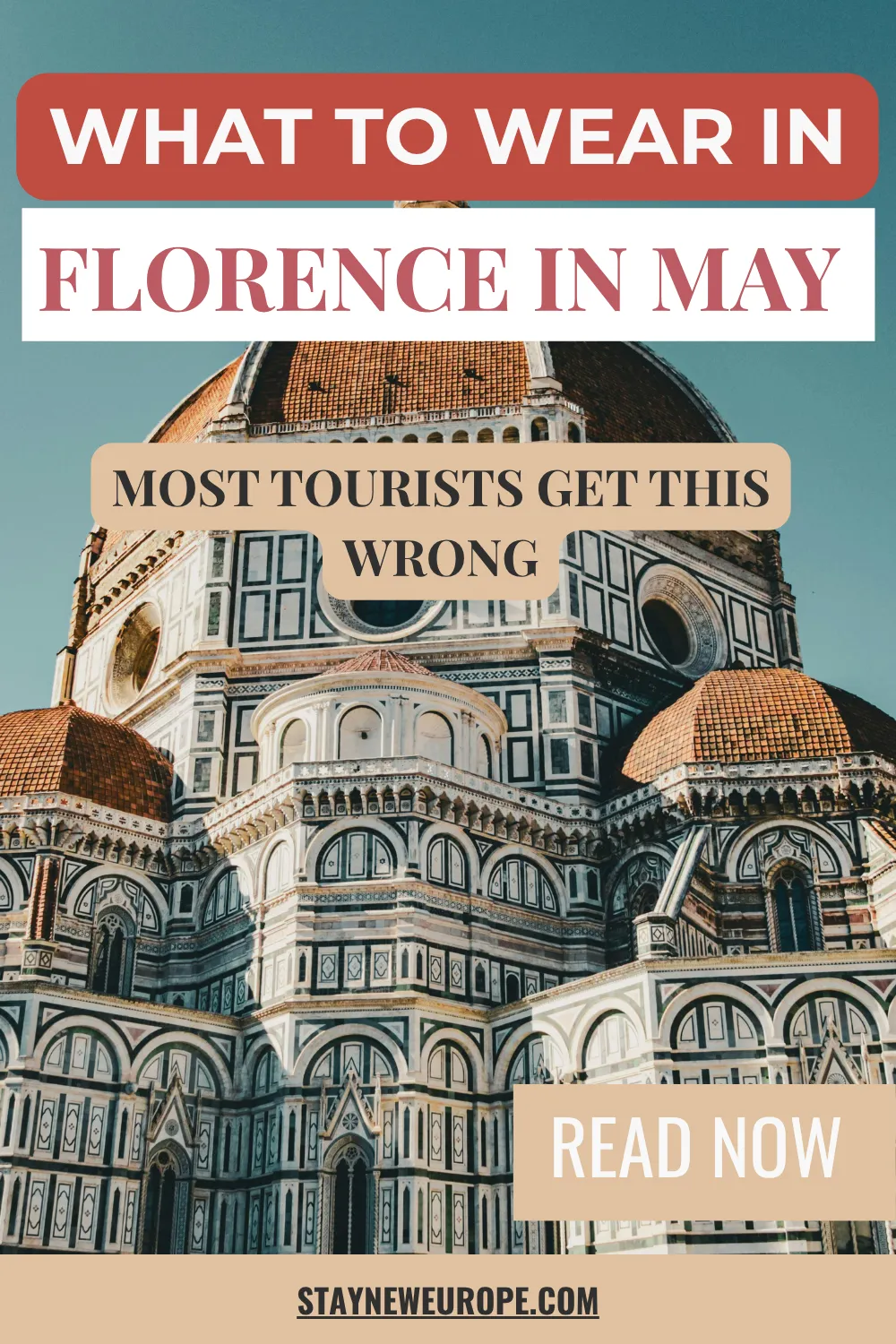
Florence in May is, honestly, one of the best travel decisions you can make. The city hasn’t yet tipped into the sweltering madness of July, the light is golden and long, and the Piazzale Michelangelo at dusk feels almost unfairly beautiful. But here’s the thing — it’s also gloriously unpredictable. One morning you’re sweating through a linen shirt on the Ponte Vecchio, and by 4pm you’re shivering outside the Uffizi wishing you’d brought literally anything with a zip.
I’ve visited Florence in May twice now, and both times I got it wrong on day one. Overpacked a suitcase full of “options,” wore the wrong shoes, looked unmistakably like someone who had just arrived from the airport. So this is the guide I wish I’d had — honest, specific, and written for real humans who want to look decent without treating their holiday like a fashion shoot.
Florence is not a city that forgives lazy dressing. Italians notice. And while nobody is going to say anything to your face, there’s a reason you can spot a tourist from fifty metres away. Let’s fix that.
Before We Dive In: What May in Florence Actually Looks Like
Let me be honest about the weather first, because it will determine everything.
May temperatures in Florence typically sit between 14°C and 24°C (57°F–75°F), but that range is almost meaningless on its own. Mornings can feel genuinely chilly — especially if you’re heading out before 9am to beat the crowds at the Accademia. By midday, the city heats up fast, particularly in the open piazzas where the stone radiates warmth and there’s no shade. Then a cloud rolls in off the Apennines and suddenly it’s jacket weather again. In a single day.
Rain is also a real possibility. May is one of the wetter months — not monsoon territory, but you will almost certainly experience at least one shower during a week-long visit. The kind of rain that starts suddenly, soaks you in minutes, and stops twenty minutes later as if nothing happened.
Florence is also a walking city — and I mean that seriously. You will walk more than you think. The cobblestones in the historic centre (the sampietrini, as they’re called) are beautiful and absolutely brutal on the wrong shoes. Bridges, uneven stones, marble church floors — your feet are going to work hard. Factor this into every outfit decision you make.
And finally: Florentines dress well. Not flashily — there’s nothing ostentatious about the local style — but neatly, thoughtfully, with an obvious eye for fit and quality. Rocking up in basketball shorts and a novelty t-shirt is technically allowed, but you’ll feel it. The city has aesthetic standards, and it’s worth meeting them halfway.
Lightweight Layers Are Your Best Friends
This is the advice I give everyone who asks, and it sounds boring, but I mean it more than anything else on this list.
The reason layers matter in Florence in May isn’t just the temperature swings — it’s the contrast between environments. You’ll walk into the cool marble interior of Santa Croce and immediately want a light jacket. You’ll step back outside into the noon sun and want to shed everything. You’ll sit down for a two-hour lunch with a glass of Chianti in a shaded courtyard and feel the temperature drop around you. Your outfit needs to handle all of this without making you look like you’re carrying your wardrobe on your back.
The ideal layering system for Florence in May goes something like this: a breathable base (a linen shirt, a fitted cotton top, a light knit), a mid-layer you can tie around your waist or stuff into a bag (a cotton cardigan, a thin zip-up, a denim jacket), and a slightly more substantial outer layer for evenings or rainy days (a trench, a light blazer, a packable anorak). That’s it. You don’t need more than that.
The mistake most people make is bringing a big, warm coat “just in case.” I’ve done it. It becomes an anchor. Leave the puffer at home.
Local tip: A linen-blend button-down shirt in a neutral colour is probably the single hardest-working item you can bring. It looks put-together for churches and dinners, breathes in the heat, layers under a jacket in the evening, and doesn’t show sweat the way a jersey does.
The Great Dress vs. Jeans Debate
Women always ask me this, and the answer is: both, but not equally.
Dresses are genuinely brilliant for Florence in May. A midi dress in a breathable fabric — linen, cotton, even a lightweight rayon — is comfortable to walk in, cool enough for warm afternoons, and looks effortlessly good in a way that jeans rarely match. Plus, if you’re going in and out of churches (which you will be, constantly), a dress that covers your knees saves you carrying a separate cover-up.

That said, jeans have their place. On cooler days — and there will be cool days — a well-fitting pair of straight-leg or slim jeans with a nice top and a blazer looks genuinely elegant. What doesn’t work is ultra-casual denim: ripped jeans, overly distressed styles, or that specific kind of baggy cargo jean that’s everywhere right now. It reads tourist immediately, and it also looks a bit odd next to the quietly stylish Italian women you’ll be sharing a pavement with.

My honest recommendation: pack one or two dresses and one pair of jeans. Use the dresses for warm days and church visits, the jeans for cooler days or evenings when you want to feel slightly more put-together.
Local tip: A wrap dress is particularly useful because it ties at the side, meaning you can adjust the neckline if a church requires more coverage — no scarf required.
Shoes: The Decision That Will Make or Break You
I learned this the hard way on my first trip. I walked eight miles on the first day in a pair of otherwise-excellent leather sandals that I hadn’t broken in. By day two I had blisters in places I didn’t know could blister.
Here’s the shoe truth of Florence: comfort is non-negotiable, but you don’t have to sacrifice style to get it. The city has made an art form of looking good on your feet, and there are plenty of options that are both wearable and actually attractive.

For women, a pair of well-cushioned leather or leather-look sandals with a slight heel or flatform works beautifully — think classic Italian-style slides, not flip-flops. Alternatively, clean white leather sneakers are practically a Florentine uniform at this point. For men, clean leather trainers or loafers are the sweet spot. I wore a pair of HOKA Clifton 9s on my last trip and while they are admittedly not the most elegant shoe in the world, I was able to walk 15,000 steps a day without thinking about my feet once. There’s a case for that.

Whatever you choose: wear them before you go. Break them in. Do not bring brand-new footwear to Florence.
Local tip: Avoid stilettos, platform boots, or any heel that isn’t flat or wedged. The sampietrini cobblestones are extremely good at catching thin heels and sending you sideways. You will see this happen to someone during your trip. Do not let it be you.
What NOT to Wear (Tourist Mistakes I’ve Witnessed with My Own Eyes)
Let me be blunt here, because nobody else will be.
Sports shorts and athletic wear outside of an actual gym. Baseball caps worn backwards or with sports team logos. Socks with sandals — specifically white athletic socks with sandals. Matching luggage-brand tracksuits. Those shoes with individual toe slots. “I ❤️ Firenze” anything. Novelty t-shirts. Fanny packs worn across the chest over a hoodie.
I’m not saying any of these things will ruin your holiday — they obviously won’t. But Florence is a city that cares about aesthetics at a cellular level. The architecture, the art, the food presentation, the gardens — everything here is considered and beautiful. Showing up in a moisture-wicking polyester tank feels a bit like wearing headphones to a concert. You can do it, but you’re missing the point.
The other mistake — and this one is more forgivable — is wearing overly formal clothes that make it impossible to actually enjoy the city. Women in full-length gowns climbing up to Piazzale Michelangelo. Men in full suits sweating through the Boboli Gardens. You can be stylish and relaxed at the same time. Florence has figured this out. We can too.
Local tip: The easiest way to look more local is simply to be less branded. Fewer logos, less athletic wear, more solid colours and simple cuts. That’s genuinely most of it.
Jackets for Unpredictable Days
Florence in May is the kind of city where you need to think about your jacket the way you think about your phone battery — always make sure you have enough.
A trench coat is close to the perfect Florence jacket. It layers over everything, looks intentional rather than practical, handles light rain, and comes off easily when the sun comes out. A classic beige or camel trench is particularly Florentine — you’ll see them everywhere. A slightly oversized denim jacket is a good casual alternative, especially if you’re going for a more relaxed vibe.

What I’d avoid is anything that reads too technical — North Face puffies, Gore-Tex hiking shells, those extremely practical but extremely ugly rain parkas with seventeen pockets. These things are brilliant for hiking the Cinque Terre, not for wandering through the Oltrarno neighbourhood looking for a good aperitivo.
For evenings, consider packing a lightweight blazer. It works over everything — a simple t-shirt, a linen shirt, even a dress — and it elevates the whole outfit in about thirty seconds. It also makes you feel better about yourself, which is underrated when you’re tired and your feet hurt.
Local tip: If you end up with only one jacket, make it a trench. The versatility is unmatched and it folds reasonably flat in a bag.
Evening Outfits in Florence
Florence evenings call for a slight gear-change, and I mean that in the best possible way.
The city comes alive after 7pm. The light goes golden, the piazzas fill up, the restaurants start buzzing, and there’s a collective energy of people who have spent the day absorbing beauty and are now ready to eat and drink well. This is not the moment to be still wearing your sightseeing clothes. Change into something that feels a little more deliberate.
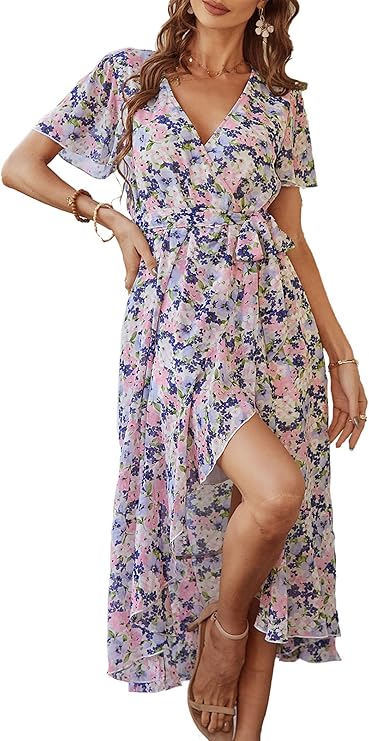
For women, a silk or satin slip dress with low-heeled sandals and a lightweight cardigan is essentially ideal. Alternatively, wide-leg trousers with a tucked-in blouse hit a similar note — relaxed but clearly considered. For men, dark well-fitting trousers (or quality chinos) with a linen or cotton shirt, either tucked or half-tucked, and leather loafers. The detail is everything: no crumpled shirts, no trainers (unless very clean and clearly worn with intention), nothing that looks like you just came from the gym.

The Florentine dinner dress code at mid-to-higher-end restaurants is smart casual at minimum. Not black tie, but absolutely not casual-casual.
Local tip: Italians eat late. If you’re heading to dinner at 8:30pm, it’ll be cooler than the afternoon — bring that blazer or light layer, especially if you’re sitting outside.
What to Wear for Churches (The Rules Are Real)
This catches people off guard more than anything else. I’ve seen couples turned away from the entrance of Santa Croce because they were wearing sleeveless tops and shorts. It’s awkward, and it’s entirely avoidable.
The rule is consistent across all of Florence’s major churches: shoulders must be covered, and knees must be covered. That’s it, essentially. It doesn’t need to be formal — a light cotton scarf thrown over bare shoulders is perfectly accepted. But exposed shoulders and shorts above the knee will get you refused entry, full stop.

The easiest solution is to travel with a lightweight scarf or pashmina that lives in your bag. You won’t need it all day, but the moment you’re standing in front of the Duomo deciding whether to go in, you’ll be glad it’s there. A pair of lightweight linen trousers or a midi skirt is also a good option for days when you know you’ll be doing a lot of church-visiting.

For men: a t-shirt with shorts will often get you turned away. A short-sleeved collared shirt with trousers, or even shorts that hit below the knee, is generally fine.
Local tip: The Duomo — the Cathedral of Santa Maria del Fiore — enforces the dress code strictly. Security genuinely does check. Don’t plan to wing it.
Bags: What Actually Works
I’m a crossbody convert. Florence converted me.
The city is genuinely beautiful but it’s also, in the tourist-heavy areas, a pickpocket environment. Not dramatically so — nobody is going to sprint past you on a Vespa and snatch your bag (probably) — but a backpack worn on your back in a busy crowd is an invitation you don’t need to send.
A crossbody bag worn in front of your body is the gold standard. Small enough to not be cumbersome, secure enough to give you peace of mind, and stylish enough to look like a considered choice rather than a nervous one. Leather or leather-look crossbodies are everywhere in Florence — it would be almost rude not to have one.

Backpacks are fine for day trips outside the city, for hiking, or for carrying heavier loads. Just wear them in front of you in crowded spaces, or at least stay aware.
Tote bags work for casual use but aren’t secure — they’re easy to get into and easy to lose things from. If you use one, keep it in front of you and don’t put your phone or wallet near the top.
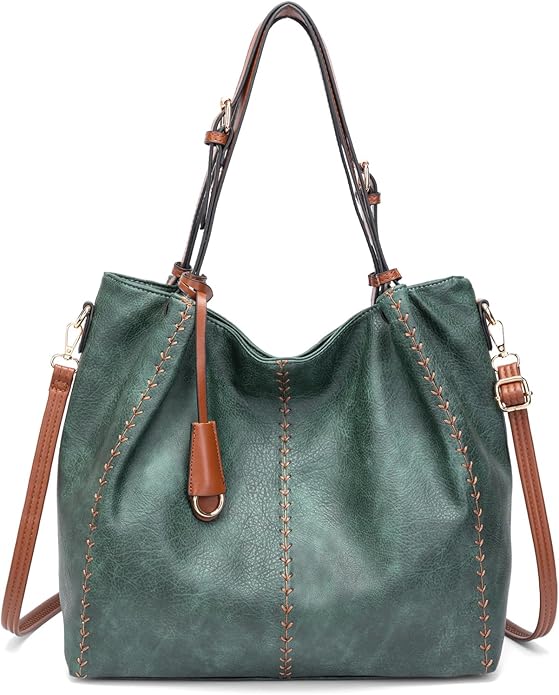
Local tip: The leather market near San Lorenzo sells genuinely good-quality leather bags at reasonable prices. If you’re looking for a Florence souvenir, a small leather crossbody is far more useful than a ceramic plate.
Accessories That Do a Lot of Heavy Lifting
This is where you can make a very simple outfit look significantly better with almost no effort.
A good pair of sunglasses is essential — practically and aesthetically. May in Florence gets bright, and squinting all day is terrible both for your eyes and for your general vibe. A classic frame (tortoiseshell, black, or gold-rimmed) does the job without competing with the rest of your outfit.
A silk scarf is genuinely versatile in a way that sounds like a cliché but is true: tied around your neck, worn as a headscarf, draped over bare shoulders for churches, wrapped around your bag handle. It’s a light item that earns its place in a way few accessories do.
Simple jewellery over statement jewellery, always. One good piece — a quality watch, a delicate gold necklace, a pair of understated earrings — looks better than many loud ones. Florentine style is about restraint.
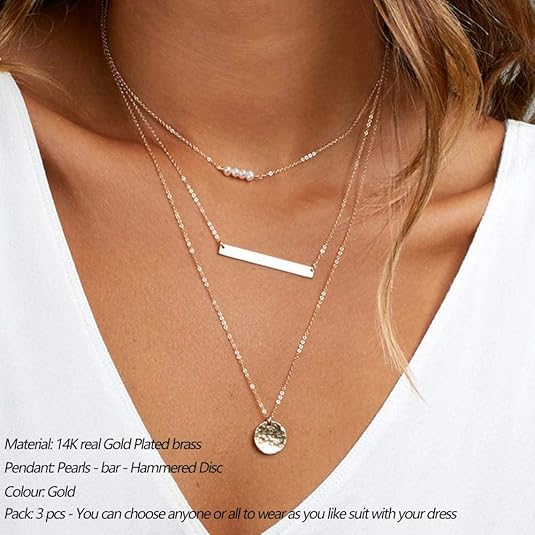
Local tip: Leave the chunky costume jewellery at home. It reads busy in a city where the beauty is in the details.
Rain Preparation (The Part People Skip Until It’s Too Late)
Nobody packs for rain when they’re mentally in Florence in May. I understand. But you’ll need to.
The kind of rain Florence gets in May is often sudden and heavy — a proper downpour rather than a drizzle. It passes relatively quickly, but in the twenty minutes it lasts you can get comprehensively soaked. The cobblestones also become slippery when wet, which is worth knowing if you’ve already ignored my advice about heels.
A compact, packable waterproof layer is a very good idea. Not a massive cagoule, but a lightweight anorak or windbreaker that folds into its own pocket and lives in your bag. Alternatively, a trench coat in a water-resistant fabric covers this function while also being a stylish outer layer the rest of the time.

A small travel umbrella is worth packing. The ones sold outside the Uffizi during a rainstorm are expensive and flimsy. Bring your own.
Local tip: If you get caught in rain, the cafés under the covered arcades along Via dei Tornabuoni are a genuinely lovely place to wait it out with a coffee. Treat the rain as an excuse to sit still.
Fabrics to Choose (and Ones to Avoid)
Fabric choice makes a bigger difference than most people realise, and it’s the kind of thing you only figure out the first time you sweat through a polyester top at 11am on a Tuesday and have to spend the rest of the day in it.
Choose: Linen (breathes beautifully, wrinkles acceptably and in a way that looks intentional rather than sloppy), cotton (classic, reliable, washes easily), linen-cotton blends (the best of both), light wool (works surprisingly well for cooler evenings, breathes, doesn’t smell), silk or silk-look fabrics for evenings.
Avoid: 100% polyester in anything worn close to the skin — it doesn’t breathe and holds odour in the heat. Thick denim in warm weather — it’s heavy and slow to dry if caught in rain. Anything that needs dry cleaning, because you will not be near a dry cleaner. And anything with a lot of structure that can’t be squashed into a bag — you need mobility and flexibility.
Local tip: Linen wrinkles. This is a fact. But in Florence, lightly wrinkled linen looks considered, not sloppy. Lean into it.
A Capsule Wardrobe for Florence in May
Here’s what I’d actually pack for a seven-day trip. This is specific on purpose.
For tops: two linen or cotton shirts (one white, one a neutral or earth tone), two fitted cotton t-shirts in simple colours, one slightly nicer blouse or silk top for evenings. For bottoms: one pair of well-fitting straight-leg jeans or quality chinos, one pair of wide-leg linen trousers, one midi dress or two if you’re a dress person. For layers: one lightweight blazer (doubles as smart outerwear and evening layer), one trench coat or packable waterproof layer. For shoes: one pair of comfortable leather sandals or clean leather trainers for day, one pair of slightly smarter shoes or loafers for evenings. One crossbody bag, one small packable tote for daytime shopping, one compact umbrella.
That’s it. That’s a week in Florence without checking a bag.
Packing Light vs. Overpacking: A Conversation With Myself
I have overpacked for Florence. I have stood in my hotel room on day two, looking at a suitcase full of things I hadn’t touched, and had a very honest conversation with myself about it.
The temptation to overpack comes from uncertainty — what if it’s cold? What if we go somewhere fancy? What if I spill something? — but Florence is actually excellent for packing light. There are good laundries. The shopping is extraordinary if you genuinely need something. And the truth is, you will repeat outfits, and nobody will care, because nobody is watching you as closely as you think.
Seven days requires roughly five outfit combinations, not seven. Factor in a laundry day or use a travel laundry bag for a mid-trip refresh. Pack pieces that mix and match rather than complete, standalone outfits. And resist the “just in case” additions — they’re almost never worth the extra weight.
The other packing mistake: forgetting that you will buy things. Florence is full of beautiful stuff. Leave room.
Local tip: If you’re flying carry-on only, pack your shoes in first and build around them. Shoes are the bulkiest items and the ones people forget to account for.
A Final Note
Florence in May doesn’t require a perfect wardrobe. It requires a thoughtful one — clothes that let you move comfortably through a city built for beauty, that won’t let you down in a church doorway or a rain shower, and that show enough care to feel appropriate in one of the most aesthetically refined cities in the world.
Dress as if you respect the place. Wear comfortable shoes. Bring layers. Pack that scarf.
And then stop thinking about your clothes entirely and go stand in front of Botticelli’s Primavera and let it rearrange your understanding of what a painting can do. That’s why you’re really going.

