
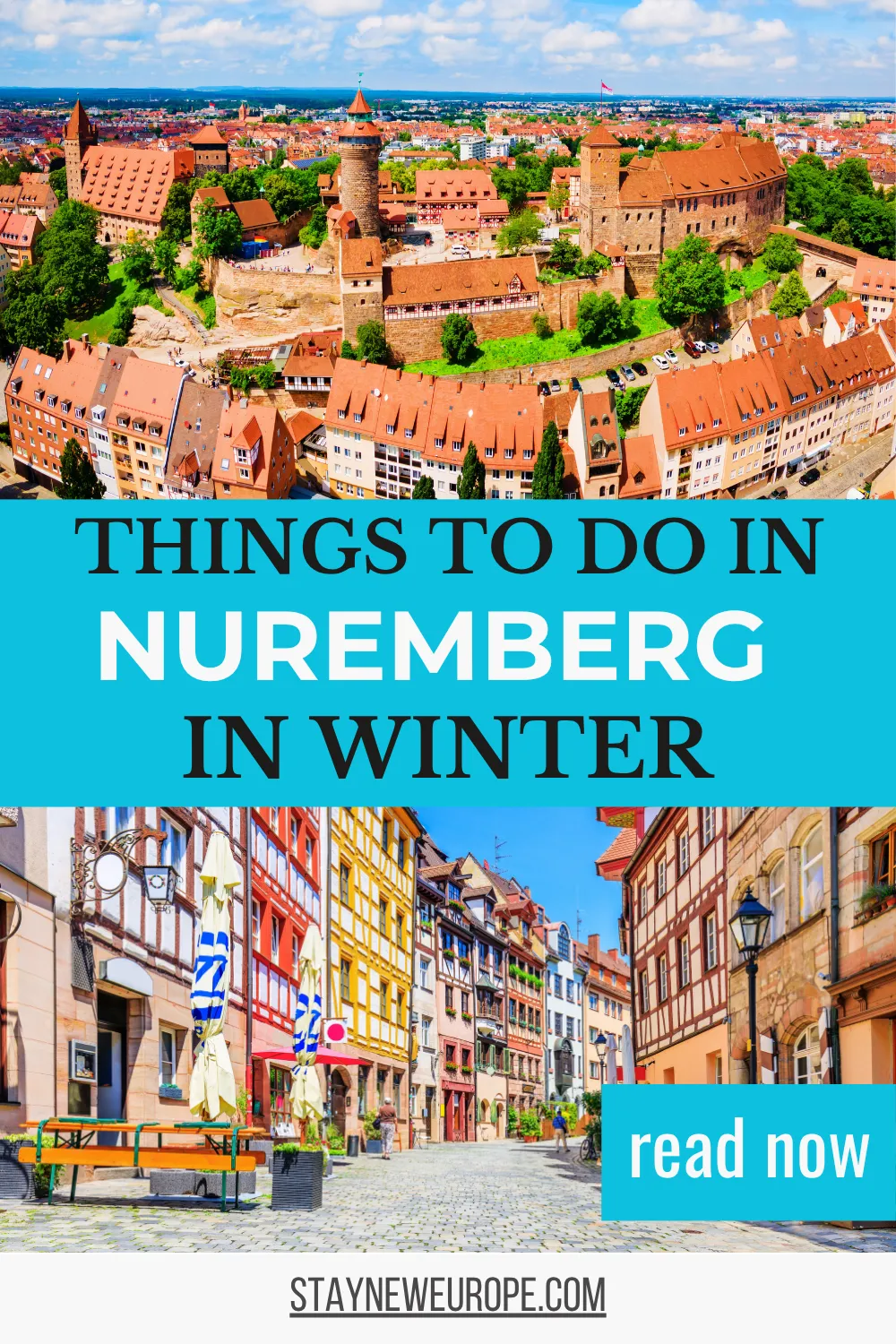
There’s a moment — and if you’ve been to Nuremberg in winter, you’ll know exactly the one I mean — when you round a corner in the Altstadt and the whole medieval cityscape suddenly reveals itself through a veil of falling snow. The fortress looms above you, the half-timbered houses glow amber from within, and somewhere in the middle distance, a brass band is playing a carol you half-recognise. You stop. You breathe. You wonder why it took you this long to come here.
Nuremberg doesn’t do winter half-heartedly. This is a city that seems to have been designed with December in mind — all cobblestones and castle walls and smoky sausage stands — but there’s far more to it than the famous Christmas market, spectacular as that is. Stay a few extra days (trust me, you’ll want to), and you’ll find a city that rewards curiosity with extraordinary food, overlooked museums, baroque churches, and an honest reckoning with one of the most complicated chapters in modern history.
This is everything I’d tell a friend who was heading there for the first time — and a few things I’d tell myself if I were going back.
Before You Go: What You Actually Need to Know About Nuremberg in Winter
Nuremberg sits in Bavaria’s Franconia region, which is a detail worth knowing because Franconia has its own distinct identity, its own dialect, and — crucially — its own food and beer culture that differs meaningfully from Munich-style Bavaria. People here are proud of that distinction. The city’s winter season runs roughly from late November through February, with December being the absolute peak for visitors thanks to the Christkindlesmarkt.
Temperatures hover between -2°C and 7°C through most of the season, dropping colder in January and February when the tourist crowds thin out and the city becomes, if anything, even more atmospheric. Snowfall is possible but not guaranteed — I’ve visited in years with deep snow and years with just grey skies, and it’s been magical both times. Dress in proper layers, wear boots with grip, and you’ll be fine. The city is walkable in a way that surprises first-timers: the Altstadt is compact, most major sights cluster within a 20-minute walk of each other, and the public transport system (U-Bahn and trams) makes the outlying neighbourhoods easy to reach.
One more thing: don’t try to see everything in a weekend. Nuremberg in winter deserves at least four or five days if you want to move at a pace that lets the city actually land.
1. The Christkindlesmarkt — Yes, It Really Is That Good
Let me get this out of the way first because you’re going to ask: yes, the Christkindlesmarkt lives up to its reputation. I know that every European city claims to have the best Christmas market, and I know you’ve probably heard it so many times the words have lost meaning, but Nuremberg’s market — held on the Hauptmarkt square in the shadow of the Frauenkirche — is genuinely something else.
It’s been running since 1628, which gives it a continuity and a gravity that the pop-up markets can’t replicate. The stalls sell real, handcrafted things: Nuremberg’s famous Zwetschgenmännle (little figures made from dried prunes), delicate glass ornaments, hand-painted nutcrackers, and the city’s iconic Lebkuchen (gingerbread) that you’ll find has an almost savoury depth to it, thanks to centuries-old recipes using cardamom, anise, and cloves. Every December, the market opens with a ceremony where the Christkind — a young woman chosen to represent the spirit of Christmas — reads a prologue from the gallery of the Frauenkirche to a crowd below. The whole square goes quiet. It’s one of those rare moments in modern tourism where a tradition feels completely unironic.
The market runs from late November to Christmas Eve. Go in the early evening when the lights come up and the square fills with mulled wine steam, but also go at 9am on a weekday if you can — the stalls look spectacular in the winter morning light, half-empty, and the vendors are chatty and relaxed.
Local tip: Skip the Glühwein at the biggest, most central stalls and instead find one of the smaller stands on the perimeter. Same wine, half the queue, and you’ll get a proper souvenir mug rather than the disposable cups they hand out mid-market when they run low.
2. Nuremberg Castle (Kaiserburg) — The City’s Beating Heart
The castle sits on a sandstone ridge at the northern edge of the Altstadt, and in winter it looks almost otherworldly — battlements dusted with frost, the valley below disappearing into cold mist, the whole structure seeming to grow organically from the rock beneath it.
The Kaiserburg was one of the most important imperial palaces in the Holy Roman Empire, serving as a residence for German kings and emperors from the 11th century onward. Walking through its deep vaulted rooms in the quiet of a January afternoon, it’s easy to feel that weight of history — and easy to understand why the city of Nuremberg was considered, for a long stretch of medieval history, an unofficial capital of Germany. The double-chapel is the architectural highlight: two storeys built directly atop each other so that the emperor worshipped on the upper level while the court worshipped below, a spatial hierarchy made literal in stone.
The views from the castle walls over the Altstadt are reason enough to make the climb in any season, but in winter, with the red-roofed city spread beneath you under a low grey sky, they’re extraordinary. Allow an hour inside the museum, then spend another half-hour just walking the outer walls.
Local tip: The castle well — 47 metres deep and hand-cut through solid sandstone — is often skipped by visitors rushing to the views. The guide’s demonstration of how they used to draw water from it is genuinely fascinating. Don’t miss it.
3. The Documentation Centre Nazi Party Rally Grounds — Essential, Not Easy
This one is harder to write about, but it’s the reason many people should visit Nuremberg in winter, when the crowds are smaller and there’s space to actually think.
The Nazi Party Rally Grounds on the southern edge of the city are vast — 11 square kilometres of partially preserved grounds where the annual Nuremberg Rallies took place between 1933 and 1938, with hundreds of thousands of participants. The ruins of Albert Speer’s unfinished Congress Hall now house one of the best documentation centres in Europe examining the rise of National Socialism. The permanent exhibition, called “Fascination and Terror,” walks you through the mechanisms of propaganda, the staging of mass spectacle, and the ideology that made all of it possible. It’s rigorous, uncomfortable, and completely necessary.
What strikes many visitors is the sheer scale of the remaining structures — the Zeppelin Field, the partially demolished grandstand, the vast open tribune. Walking those grounds in winter, when there are few other visitors and the concrete is cold underfoot, has a quality that feels almost like ethical duty. The city of Nuremberg has handled the legacy of this space with more honesty than almost anywhere else in Germany.
Local tip: Allow at least three hours for the documentation centre and a walk around the grounds. The tram from the city centre drops you close. Many visitors combine it with the Nuremberg Trials Memorial (in a still-functioning courthouse), which is about a 20-minute walk away and equally essential.
4. The Germanisches Nationalmuseum — Germany’s Biggest, Most Overlooked
I’ll be honest with you: before my first trip to Nuremberg, I had no idea this museum existed, and it turned out to be one of the best museums I’ve visited in Germany, full stop.
The Germanisches Nationalmuseum is the largest museum of German cultural history in the world — a sprawling complex that incorporates a 14th-century monastery as part of its structure, and runs from prehistoric artefacts all the way through to 20th-century design. The medieval collection is extraordinary: altarpieces, armour, goldsmiths’ work, and furniture that range from the mundane to the astonishing. There’s a globe made in 1492 — before Columbus returned from the Americas — that shows the known world as Europeans imagined it, and it stops you cold. There are also paintings by Dürer, instruments by historical craftsmen, and an entire wing devoted to children’s toys that somehow manages to be both charming and slightly unsettling.
In winter, when daylight is short and the outdoor temperature discourages extended wandering, this museum is where I head for an entire afternoon. Take the audio guide. The building alone is worth the entry price.
Local tip: The museum shop sells excellent reproductions of historical maps and prints at reasonable prices — far better souvenirs than anything you’ll find in the Christmas market souvenir stalls.
5. The Nuremberg Bratwurst Trail — This Is Research, Not Gluttony
Nuremberg’s bratwurst are not like other bratwurst. They’re smaller — famously the length of a hand span — and traditionally grilled over beechwood charcoal, which gives them a faint smokiness that you won’t find anywhere else. They’re served in threes or sixes, sometimes in a bread roll, sometimes on a pewter plate with sauerkraut and horseradish, and they’ve been made in this city since at least the 14th century.
The best place to try them is either one of the small street stalls inside the Christmas market (the smell will guide you from 50 metres away) or the old grillhouses in the Altstadt. Bratwursthäusle near St. Sebaldus church is often cited as the classic, with a narrow interior that was built inside a former guardhouse and feels like eating inside a piece of living history. Zum Gulden Stern claims to be the world’s oldest bratwurst kitchen, in business since 1419. Both claims are contested. Both bratwursts are excellent.
A word on accompaniments: the local Franconian mustard, darker and more savoury than yellow English mustard, is the correct condiment. Do not request ketchup in a serious establishment. I’m telling you this as a friend.
Local tip: Nuremberg sausages have Protected Geographical Indication status under EU law, meaning the real thing can only be made within the city limits. If you’re buying to take home (and you should — they travel well), buy from an established butcher like Metzgerei Gügel rather than a tourist shop.
6. St. Sebaldus Church — The City’s Spiritual Core
Before there was a Christmas market, before there was a castle in its current form, there was St. Sebaldus. The oldest church in Nuremberg dates from the 13th century, and its interior is a quiet masterwork of Gothic stonework that most visitors walk past on their way to the market.
The church’s greatest treasure is the Sebaldus Shrine — a magnificent bronze structure by the sculptor Peter Vischer and his sons, completed in 1519, that contains the relics of the city’s patron saint. It’s one of the finest examples of Renaissance metalwork in existence, and it stands in the eastern choir with a quality that rewards slow attention: the figures of the twelve apostles, the organic decorative forms, the sheer confident ambition of the thing. Vischer apparently included a self-portrait in the base, kneeling humbly in a craftsman’s apron.
In winter, the church is lit warmly against the cold exterior, and attending an Advent concert here — usually held on Sunday afternoons — is one of those experiences that justifies the entire trip.
Local tip: The church is free to enter, but the occasional guided tour in English is worth the small fee for the access it provides to the upper galleries and the guide’s contextual knowledge about the Reformation controversies that shaped the building.
7. St. Lorenz Church — Gothic Grandeur Across the River
If St. Sebaldus is the city’s northern anchor, St. Lorenz balances it on the southern bank of the Pegnitz river. The two churches face each other across the old merchant quarter, and the competition between them — theological, artistic, civic — runs through the city’s whole medieval history.
St. Lorenz is, if anything, the more dramatic building: the twin towers of its west facade visible from across the Altstadt, the interior a soaring Gothic space with stained glass that turns extraordinary on the rare winter days when sunlight actually penetrates the clouds. The centrepiece is Veit Stoss’s carved limewood Annunciation, suspended from the ceiling like a large-scale altarpiece in weightless orbit. It was carved in 1517, the same year Luther nailed his theses, and the timing feels significant — a last flourish of a visual culture that would soon be transformed.
Walking between the two churches, through the narrow Altstadt streets and across the historic Fleischbrücke bridge, is one of the best short walks in any German city.
Local tip: Late afternoon on a clear December day, when the setting sun hits the western rose window of St. Lorenz, is the single most beautiful interior light moment I’ve experienced in Nuremberg. Aim for around 3pm.
8. The Toy Museum (Spielzeugmuseum) — Surprisingly Captivating for Adults
I went to the Toy Museum prepared to spend 40 minutes doing it politely. I stayed for two and a half hours.
Nuremberg has been a toy-making capital since the Middle Ages — the combination of skilled metalworkers, woodcarvers, and an established trade network made it the natural centre of European toy production for centuries. The museum’s five floors tell that story in an endlessly engaging way, from the oldest surviving tin toys in existence through to Barbie’s complete cultural history and a basement full of working model train layouts that will stop anyone dead in their tracks regardless of age.
The historical toys are what stay with you: the mechanical toys of the 18th century, operated by springs and gears with a craftsman’s precision; the dollhouses that replicate bourgeois domestic life in obsessive detail; the paper theatre kits that were the Minecraft of the 1820s. There’s a whole section on the Nuremberg toy industry’s role in developing construction kits that preceded modern design thinking by a century.
Local tip: The museum is housed in a beautiful Gothic building near the Pegnitz river. Visit midweek in winter if possible — school groups are less frequent and you can linger over the best displays without navigating around Year 4 classes on a field trip.
9. The Pegnitz River Walk — The City’s Secret Beautiful Side
Most winter visitors to Nuremberg spend their time on the main squares and the castle hill. The ones who wander along the Pegnitz river find something quieter and, in its way, more beautiful.
The river runs through the heart of the Altstadt, and the banks along the old tanners’ quarter (Weissgerbergasse) and the island of Trödelmarkt are lined with half-timbered houses that haven’t changed much since the 16th century. The Heubrücke bridge offers a view that appears in a hundred historical paintings: the towers of the old city gate reflected in the slow-moving water, the buildings cantilevered over the river on wooden piers, the whole thing somehow still standing. In winter, with frost on the timbers and low light on the water, it’s the Nuremberg that doesn’t make it onto tourist posters but that actually lodges in your memory.
The Heilig-Geist-Spital — the old hospital that straddles the river on two stone arches — now houses a good traditional restaurant on its ground floor, and eating there while watching the river move beneath the windows is one of the genuinely atmospheric dining experiences in the city.
Local tip: The Trödelmarkt island hosts a small antiques and flea market on most Saturday mornings, even in winter. Arrive early for the best finds — old Bavarian postcards, vintage tin toys, and Franconian ceramics are the things worth looking for.
10. Albrecht Dürer’s House — Inside the Mind of a Genius
Nuremberg’s most famous son was born here in 1471, and the house he lived in from 1509 until his death in 1528 still stands at the foot of the castle hill — a large, well-preserved Gothic-Renaissance building that now functions as one of the most thoughtfully presented house museums I’ve visited.
Dürer was the artist who brought the Italian Renaissance north — who introduced mathematical perspective, classical proportion, and a new conception of the artist as intellectual to German painting. Walking through his house, from the ground-floor workshop where the printing press would have stood to the upper-floor painting rooms with their north-facing windows, you get a genuine sense of how work and life were intertwined. The museum uses actors to portray Agnes Dürer (Albrecht’s wife) giving guided tours, which sounds gimmicky but actually works remarkably well.
The prints and drawings displayed throughout — high-quality reproductions of the originals in museums across Europe — let you see how his work evolved and what he was thinking about from room to room.
Local tip: The museum is steps from both the castle and a quiet square called Tiergärtnertor, which is ringed by beautiful old buildings and, during the Christmas season, hosts a small, less-touristy alternative market that locals actually use. It’s one of the nicest spots in the city.
11. The Nuremberg Trials Memorial — Justice in a Working Courthouse
Courtroom 600 in the Palace of Justice is where, between 1945 and 1946, Allied prosecutors tried 24 senior Nazi leaders in proceedings that established the precedent for international criminal law. The room has been preserved largely as it was. You sit in the public gallery looking down at the same space where Göring, Ribbentrop, and the others sat, where the headphones for the simultaneous translation (itself a major technical innovation) were first used in a court of law.
The permanent exhibition documents the trials with extraordinary thoroughness: the legal arguments, the evidence gathered, the judgements, the executions, and the longer history of how international justice has developed from this starting point. It’s quieter and less visited than the Documentation Centre, and in some ways more affecting precisely because it’s still a functioning courthouse — the same building still seeing regular cases.
Combined with the rally grounds documentation centre, a full day engaging honestly with Nuremberg’s 20th-century history is one of the most important things you can do in Germany.
Local tip: The memorial is only accessible by guided tour or timed entry, and places do sell out in advance even in winter. Book online a few days before — the English-language tours are excellent and worth the small fee.
12. Franconian Wine Country — A Day Trip Worth Planning
An hour south and west of Nuremberg, the Franconian wine region produces wines in a bottle shaped like a flattened sphere — the Bocksbeutel — that you’ll see in every wine shop and restaurant in the city. Franconian wines, particularly the dry Silvaner whites, are some of Germany’s most interesting and least exported, which means they’re a genuine discovery for most international visitors.
In winter, the wine villages around Würzburg are quiet and achingly beautiful: bare vines on steep terraced slopes, medieval villages with painted facades, cellars dug deep into the sandstone hills. The Würzburg Residence — a UNESCO-listed baroque palace with ceiling frescoes by Tiepolo — is one of the greatest secular buildings in Europe, and in winter you have it almost to yourself.
The train from Nuremberg to Würzburg takes about an hour on the ICE — fast enough to make it a comfortable day trip, and substantial enough to feel like a genuine escape from the city.
Local tip: Most Franconian wineries open their cellars for tastings even in winter, but call ahead — hours are reduced between December and March. The wine villages of Volkach and Iphofen are the most scenic and have the warmest welcome for unannounced visitors.
13. The Handwerkerhof — Medieval Craft Quarter
Tucked just inside the old city walls near the main train station, the Handwerkerhof is a reconstruction of a medieval craftsmen’s courtyard that could easily be dismissed as a tourist trap — and sometimes it is. But visit at the right moment (early afternoon on a weekday, when the day-trippers have moved on) and you’ll find working craftspeople doing genuinely impressive things.
The tinsmith hammering traditional Christmas decorations, the glass-blower working in the open with practiced ease, the goldsmith at her bench — these aren’t purely performative. The things they make are for sale, and they’re made by hand, and you can watch the process. The Nuremberg toy-making tradition is represented too, with a small workshop producing the traditional wooden figures that have been made in the same style for 300 years.
The half-timbered buildings of the courtyard, strung with lights in the winter months, have an undeniable charm even if some of the shops are more gift-store than craftsmen’s studio. Pick carefully, and you’ll take something home that has actual skill behind it.
Local tip: The courtyard closes earlier in winter than the signage might suggest — aim to visit between 12pm and 4pm for the best chance of seeing all the workshops in operation.
14. Lorenzer Altstadt — The Quarter That Rewards Wandering
The southern part of the old town, around St. Lorenz church, has a slightly different character from the castle district: more residential, more lived-in, with independent bookshops and old pharmacy facades and wine bars in cellars that you’d only find if you were looking. This is where Nuremberg reveals itself as an actual city rather than a heritage theme park.
The Karolinenstrasse and the streets radiating from it are where the better independent shops cluster — Franconian wine merchants, proper delicatessens selling Lebkuchen and local preserves, a knife-maker who will sharpen your knives while you wait, an art bookshop that takes up two floors of a crooked medieval building. In winter, these streets are quieter and more intimate, with steam rising from gratings and the smell of roasting chestnuts drifting from a corner stall.
The Nassau Haus on the Karolinenstrasse is one of the oldest surviving civic buildings in the city, its corner turret projecting over the street at first-floor level in a display of medieval architectural confidence that still looks bold today.
Local tip: The wine bar Barfüsser, in the vaulted cellar beneath the Altstadt, serves Franconian wines by the glass with a confidence in the local product that’s infectious. It’s the kind of place that appears on no official tour but that locals consider one of the city’s essential addresses.
15. The Children’s Christmas Market (Kinderweihnacht) — Gentler Than You’d Think
Nuremberg runs a second, smaller Christmas market specifically designed for children, in Hans-Sachs-Platz, and here’s the thing: it’s charming for adults too. The scale is different — smaller stalls, a carousel, a little train that circles the square — and the atmosphere is noticeably calmer than the main Christkindlesmarkt, which by December’s second week can feel genuinely overcrowded.
The handmade toys sold here have a different character from the main market — more whimsical, more colourful, aimed at a generation of children who might otherwise receive only plastic. And the Lebkuchen decorated for children, with simple icing pictures and warmer spicing, taste different too — or maybe that’s nostalgia doing the work.
Going to the Kinderweihnacht without children, just to watch the expressions on the faces of the kids who encounter the gingerbread trail or the mechanical toy displays for the first time, is a genuinely restorative experience in an age that can feel quite short on genuine wonder.
Local tip: The market usually has an ice rink adjacent to it where locals — of all ages — skate in the evenings under market lights. Skate hire is cheap and the skill level of fellow skaters ranges widely, which makes it very good company.
16. The Rock-Cut Cellars (Felsengänge) — Underground Nuremberg
Beneath the Altstadt, the sandstone bedrock is riddled with tunnels — a network of cellars and passages cut over centuries, initially for storing beer (Nuremberg was a major brewing city before the Bavarian purity law changed local brewing economics) and later used as air raid shelters during WWII.
The guided tours of the Felsengänge are one of winter’s better reasons to go underground — partly because you’re out of the cold, partly because the history down here is unexpectedly rich. The beer cellars at their peak were the size of warehouses, and the guide explains how the ice trade worked (ice cut from the Pegnitz in winter, stored in the cellars for summer), how the brewing industry shaped the city’s economy, and what the shelters were actually like during the bombing raids of 1943 and 1944, which destroyed much of the medieval city above.
The tour ends in a room where you can taste the amber-coloured Tucher Lagerbier that’s brewed according to a historical recipe — cold and slightly sweet and very good.
Local tip: Tours run in English on select days — check the schedule before going. The temperature underground is a steady 10°C regardless of season, so the thermal advantage of a winter visit is real.
17. The Volksfestplatz Winter Breweries — Local Beer in the Right Atmosphere
Nuremberg has its own beer culture that exists quietly alongside — and sometimes in gentle competition with — Munich’s more famous brewing traditions. The local Franconian lagers and Kellerbiers (unfiltered, served from the barrel, slightly hazy) are worth seeking out in the right setting.
In winter, that setting is best found in the traditional Gasthäuser of the Altstadt and the Gostenhof quarter just west of the old city — a neighbourhood with a more multicultural, slightly rougher-edged character that gives you a Nuremberg well outside the tourist circuit. The beer halls here aren’t designed for Instagram. They’re designed for drinking beer with other people in warm, low-lit rooms while the winter happens outside, which is, honestly, one of the most civilised things a building can offer.
Hütt’n, in Gostenhof, is the kind of local institution that has been serving Franconian beer to the same families for generations and treats new visitors with straightforward Franconian pragmatism — no fuss, no performance, just good beer and proper food.
Local tip: Order a Schäuferle if it’s on the menu — a slow-roasted pork shoulder with crackling and potato dumplings that’s the definitive Franconian winter dish. It takes a good two hours to eat properly. Plan accordingly.
18. Advent in the Suburbs — The Schönlaterngasse and the Craftsmen’s Streets
One thing that separates a real visitor to Nuremberg from a day-tripper is the willingness to walk beyond the established sights and find the streets where Advent is celebrated at a residential scale.
The Wöhrder Wiese and Johannis districts, northeast of the Altstadt, have a particularly beautiful Advent atmosphere: streets lined with wreaths and candles in windows, small neighbourhood markets that serve the actual community rather than tourists, churches staging simple concerts for parishioners. Walking here on an Advent Sunday morning — the bells ringing, the smell of coffee from someone’s open window, the first light catching the frost on the garden hedges — is the kind of experience that doesn’t make it into travel guides because it can’t be scheduled or ticketed.
Take the tram out, walk without a map, let the city lead you somewhere unexpected. In Nuremberg in winter, unexpected is almost always good.
Local tip: The Johannisfriedhof cemetery, where Dürer is buried alongside other notable Nuremberg citizens, is unusually beautiful in winter and completely overlooked by tourists. The graves of medieval craftsmen and Renaissance artists are marked with remarkable sculptural work. It’s open to visitors year-round.
Practical Tips for Visiting Nuremberg in Winter
Getting there is easy: Nuremberg has its own international airport with direct connections from across Europe, and the city sits on a major rail corridor with fast ICE trains from Munich (about 1 hour), Frankfurt (about 2 hours), and Berlin (about 3 hours). The Hauptbahnhof drops you right at the edge of the Altstadt.
Getting around is mostly on foot — the old city is compact and best experienced at walking pace. The U-Bahn and tram network handles everything beyond the Altstadt efficiently, and the city is cyclist-friendly even in winter if you can handle the cold.
Where to stay: The Altstadt hotels put you closest to everything, but they book out fast for December and charge accordingly. The Hotel Drei Raben on Königstrasse is a personal favourite — a thoughtfully designed boutique hotel with a Nuremberg legend theme in each room. More budget-conscious visitors do well in the Gostenhof district, a 15-minute walk from the market and considerably cheaper.
What to eat beyond sausages: Sauerbraten (sweet-sour marinated beef) is the other Franconian essential. Lebkuchen is everywhere and ranges from excellent to forgettable — buy from a maker rather than a market stall for the better end of that range. The local Nürnberger Lebkuchen mit Oblate (with a rice paper base) travel beautifully and make the best food souvenirs.
When to visit: December is peak season, magical but crowded. January and February offer the same architecture, the same excellent food, a fraction of the visitors, and significantly lower hotel prices. If you can handle the idea of a Christmas market being a memory rather than a current event, January Nuremberg is genuinely wonderful.
One Last Thing
Come back from the castle hill as it gets dark. Stop on the steps above the Aldtstadt, with the city spread below you and the lights coming on one by one in the windows, and the cold air carrying just a hint of smoke from somewhere below. Listen for a moment.
Nuremberg has been through extraordinary things — the heights of medieval power, the depths of 20th century darkness, the rebuilding that followed. It wears all of it with an honesty that’s unusual in heritage tourism, and with a warmth that you don’t always expect from cities that have complicated histories to account for.
You came for the Christmas market, probably. You’ll leave thinking about the sausages, the beer cellars, the Dürer prints, and the way the fortress looks in fading winter light. That’s exactly how it should be.

