
Planning a trip to Italy is exciting — and slightly overwhelming. Between booking trains, figuring out which Vatican ticket is real and which is a scam, and Googling whether you’re allowed to sit on the Spanish Steps (you’re not, by the way), it’s easy to forget the basics.
That’s why we put together this complete, printable Italy travel checklist — so you can stop panicking and start packing.
Whether this is your first time in Italy or your fifth, this list covers everything from documents and euros to cultural etiquette and food tips. Save it, print it, and tick it off as you go.
Why You Need a Checklist for Italy Specifically
Italy isn’t like other European destinations. It has its own rhythm, its own rules, and its own very particular way of doing things. You can’t just roll up to the Colosseum without a ticket. You cannot order a cappuccino after 11am without getting a look. And if you drive into a ZTL zone in Florence, you will get a fine — weeks after you’ve gone home.
A good Italy checklist doesn’t just remind you to pack sunscreen. It prepares you for the quirks.
Before You Leave: Documents & Admin
This is the section most people think they’ve already handled — until they’re at the airport.
- Valid passport with at least 6 months validity beyond your return date. EU citizens can use a national ID card.
- Travel insurance documents — print a copy and keep one in your email. Italy is safe, but pickpocketing is real in Rome, Florence, and Venice.
- Hotel and accommodation confirmations — some hotels in Italy require you to present these at check-in along with your passport.
- Flight itinerary printed or downloaded offline.
- EHIC card (European Health Insurance Card) if you’re an EU traveller, or equivalent private health cover.
- International driving licence if you plan to rent a car. Italy requires it alongside your national licence.
- Emergency contacts written down — not just saved in your phone.
Pro tip: Make photocopies of your passport photo page and store them separately from the original. If your passport is stolen, this speeds up the process at your country’s consulate enormously.
Packing Your Bag for Italy
Italy spans climates. A week in Sicily in July is not the same as a long weekend in Milan in October. That said, there are a few universal truths for packing Italy.
Clothes
- Light, breathable clothes for the heat — particularly in summer in Rome, Naples, and the south.
- A modest cover-up (scarf, cardigan, or long trousers) for entering churches, basilicas, and cathedrals. No bare shoulders or knees allowed. This is strictly enforced at the Vatican and many other sites.
- Comfortable walking shoes — and we mean genuinely comfortable, not “cute but manageable.” Rome and Florence are brutal on your feet. Cobblestones are uneven, beautiful, and merciless.
- Sun hat and sunglasses — non-negotiable from May to September.
- A small day backpack for sightseeing. Wear it on your front in crowded areas.
- A light rain jacket — even in summer, Italian afternoons can deliver a short but heavy downpour.
- A Type F or Type L plug adapter — Italy uses the three-round-pin Type L in many older buildings, though Type F is increasingly common.
- Portable charger / power bank — you’ll be using maps, booking apps, and your camera constantly.
Health, Safety & Toiletries
- Prescription medications packed in carry-on luggage, with an extra supply in case of delays.
- High-SPF sunscreen — buy it at home because Italian pharmacies are wonderful but expensive.
- Blister plasters — you will use them. Trust us.
- Insect repellent if you’re visiting Tuscany, Lake Garda, or any rural area in summer.
- Hand sanitiser and wet wipes — handy for long travel days and outdoor eating.
- Antihistamines — particularly useful in spring when pollen counts across Italy are high.
- Reusable water bottle — Italy has thousands of free public drinking fountains called nasoni (especially in Rome). The water is excellent.
Money & Budgeting in Italy
Italy is a cash-friendly country. While major restaurants and hotels accept cards, smaller trattorias, market vendors, and some local bars will expect cash.
- Carry €50–100 in euros for small vendors, markets, and anywhere with a handwritten “solo contanti” (cash only) sign in the window.
- Travel credit card with no foreign transaction fees — Revolut, Wise, and similar cards work well here.
- Notify your bank before you travel to avoid having your card blocked.
- Budget for museum entry fees — Rome alone can run you €60–80 per person if you’re visiting the Colosseum, Vatican Museums, and Borghese Gallery.
- Budget for the coperto — this is a small cover charge (usually €1.50–3.50 per person) added to restaurant bills. It’s not a scam; it’s normal.
- Keep a few small coins for public toilets, which often require 50 cents to €1.
Getting Around Italy
Italy’s transport system is wonderful once you understand it. It’s chaotic if you don’t.
Trains
Italy has two high-speed rail operators: Trenitalia and Italo. Both are fast, affordable, and run between all major cities. Book early — prices rise significantly as the date approaches.
- Validate your train ticket before boarding on regional trains (not required on high-speed). Failing to do so can result in a €50+ fine even if you have a valid ticket.
- Download the Trenitalia or Italo app and save your booking to your phone.
Driving
If you’re renting a car to explore Tuscany, Puglia, or the Amalfi Coast, read this carefully:
- ZTL zones (Zona Traffico Limitato) are restricted traffic areas in almost every Italian city centre. Driving into one without a permit will result in a fine — often arriving home weeks after your trip. Research ZTL boundaries before you drive anywhere near a historic centre.
- Book your rental car early, especially in summer.
Getting Around Cities
- Google Maps offline — download the areas you’re visiting before you land.
- Rome: Use the metro for longer distances, walk for everything else.
- Venice: Buy a multi-day vaporetto pass rather than paying per journey. The single-trip fare is eye-watering.
- Florence: Almost everything worth seeing is walkable.
- Naples: Use the Metro Line 1 (elegant, air-conditioned, and with beautiful station art).
Eating & Drinking in Italy
Food in Italy is serious business. Here’s how to do it right — and avoid the tourist traps.
The golden rules
- Never eat directly next to a major tourist site. The restaurants on the street leading to the Trevi Fountain, the Uffizi, or the Colosseum exist to take your money. Walk two streets away and prices drop dramatically.
- Gelato from a gelateria, not a café. Real gelato is kept in covered metal containers (not piled high in fluorescent mounds). If it looks like a mountain of coloured foam, keep walking.
- Espresso standing at the bar is cheaper and more authentic than sitting down. In Rome, a standing espresso is about €1. Sitting at a table can cost €3–5.
- Cappuccino is a morning drink. Italians do not drink milk-based coffees after about 11am. You can — no one will stop you — but you’ll identify yourself as a tourist immediately.
- Ask for acqua del rubinetto (tap water) at restaurants. It’s free and perfectly safe. Restaurants will always try to sell you bottled water; you’re not obliged to buy it.
- Visit a local mercato (market) at least once. The Mercato Centrale in Florence, Campo de’ Fiori in Rome, and Mercato di Rialto in Venice are all genuinely wonderful.
Regional dishes to try per city
- Rome: Cacio e pepe, carbonara, supplì (fried rice balls), maritozzo
- Florence: Bistecca alla Fiorentina, ribollita, lampredotto (if you’re brave)
- Venice: Cicchetti (Venetian tapas), sarde in saor, risotto al nero di seppia
- Naples: Pizza (obviously), sfogliatella, fried pizza
- Bologna: Tagliatelle al ragù (the real bolognese), mortadella, tortellini in brodo
Must-See Sights (With Booking Tips)
Always pre-book these:
- Colosseum & Roman Forum — no queue, no same-day availability in peak season. Book on the official site (coopculture.it).
- Vatican Museums & Sistine Chapel — the queues without a booking are genuinely hours long. Book directly at museivaticani.va.
- Borghese Gallery, Rome — entry is strictly timed and limited. Book weeks ahead.
- Uffizi Gallery, Florence — pre-booking is not mandatory but strongly recommended in summer.
- Last Supper, Milan — sells out months in advance. Plan early.
Don’t miss:
- The Grand Canal at dawn or dusk in Venice — before the crowds arrive
- Climbing the dome of St Peter’s Basilica for free (no reservation needed, just the queue)
- The Cinque Terre coastal hiking trail
- A day trip to Pompeii if you’re near Naples
- The Trevi Fountain at night, when it’s quieter and beautifully lit
Culture, Etiquette & the Unwritten Rules of Italy
Italy rewards those who make even a small effort to understand the culture.
- Dress respectfully for churches and religious sites. This means covered shoulders and knees for everyone, regardless of gender. Many churches have shawls available to borrow at the entrance.
- Learn five Italian phrases at minimum: grazie (thank you), prego (you’re welcome), mi scusi (excuse me), quanto costa? (how much does this cost?), and il conto, per favore (the bill, please). Locals genuinely appreciate it.
- Riposo is real. Many small shops, restaurants, and attractions close between 1pm and 4pm for a midday break. Plan your sightseeing accordingly.
- Tipping is appreciated but not expected the way it is in the US. Rounding up or leaving a euro or two is perfectly generous.
- Watch your belongings in crowded areas, particularly on the Rome Metro, near the Colosseum, on the Ponte Vecchio in Florence, and around the main train stations. Pickpockets operate in groups and are professional. Keep phones in front pockets and bags zipped.
Your Free Printable Italy Travel Checklist
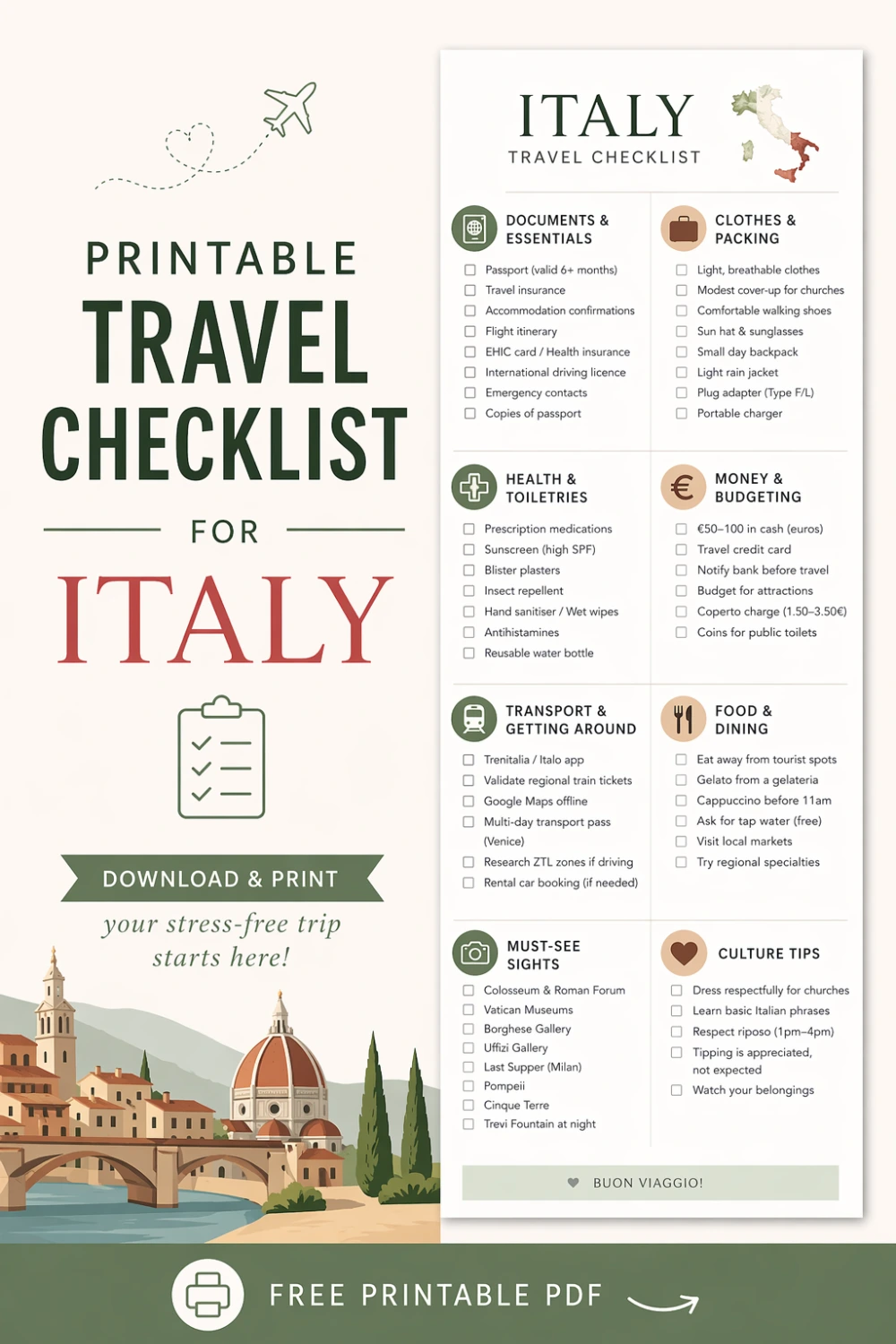
We’ve put together a clean, one-page printable version of everything above — designed to be printed at home and taken with you. It covers all 8 categories:
✅ Documents & Essentials
✅ Clothes & Packing
✅ Health & Toiletries
✅ Money & Budgeting
✅ Transport & Getting Around
✅ Food & Dining
✅ Must-See Sights
✅ Culture Tips
[Download the free printable Italy travel checklist →]
Final Thoughts
Italy is one of those destinations that reveals itself slowly. The more you know before you arrive, the more you enjoy when you’re there. And the less time you spend Googling “is it okay to sit on the Spanish Steps” (again: no).
Save this checklist, print it, fold it into your passport wallet, and go have the trip you’ve been dreaming about.
Buon viaggio!
