
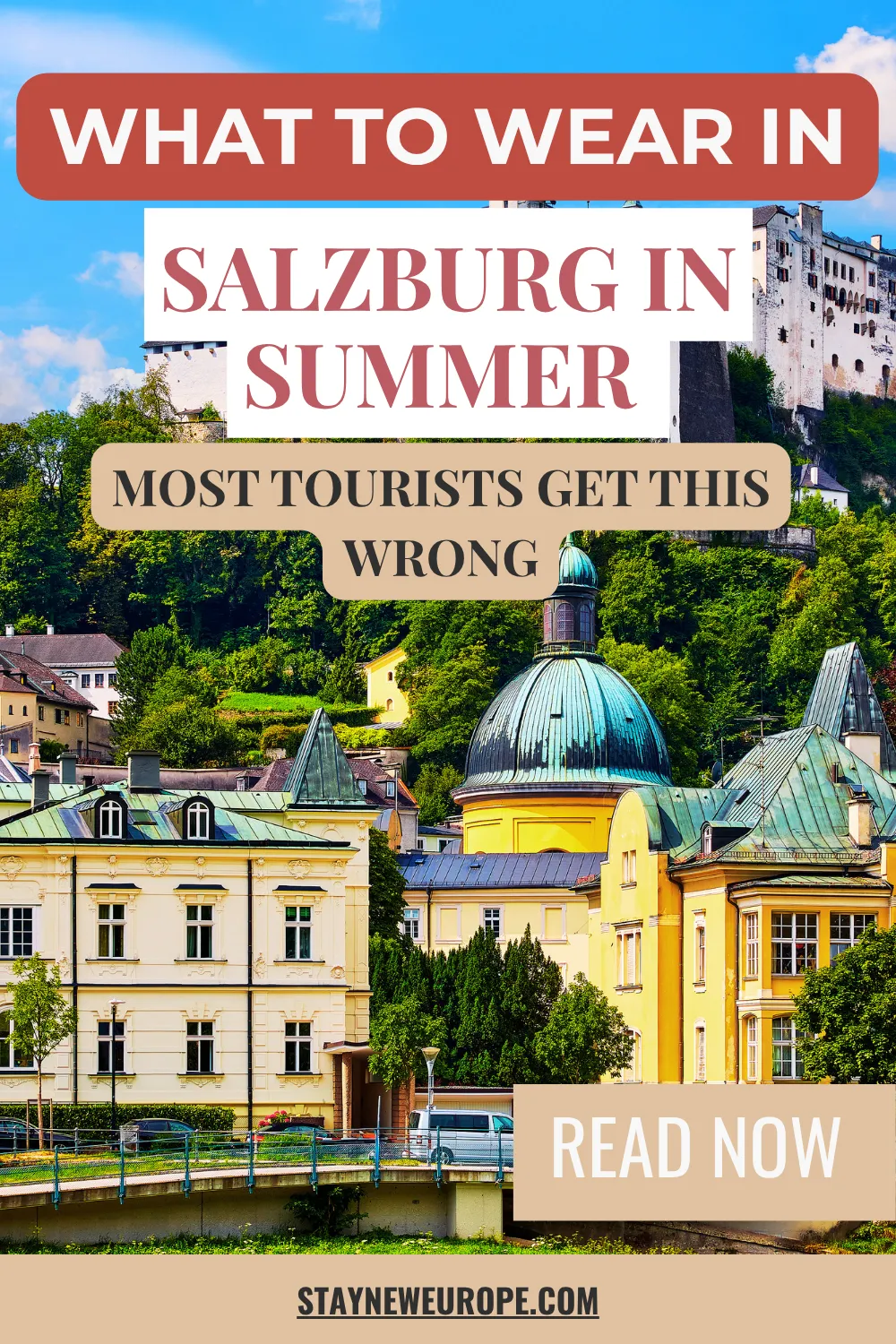
Salzburg in summer is, frankly, one of the most beautiful places you can find yourself in Europe. The old city glows golden in the long evening light, the Salzach river runs fast and green below the fortress, and every street in the Altstadt feels like it was designed specifically to make you want to take photographs. It is gorgeous. It is also, let me be honest, completely unpredictable when it comes to weather.
This is the Austrian Alps we’re talking about. Summer here means warm, even hot, sunny mornings followed by the very real possibility of a dramatic afternoon thunderstorm rolling in over the mountains. Temperatures swing between genuinely warm and “did I pack the right things?” cool — sometimes within the same afternoon. The tourists who arrive expecting a breezy Mediterranean summer and pack accordingly spend a meaningful portion of their trip damp and slightly cold.
The other trap? Packing for pure practicality at the expense of everything else. Salzburg is an elegant, cultured city — Mozart’s birthplace, a UNESCO World Heritage site, a place with opera, fine dining, and an aesthetic standard that locals take quietly but seriously. Showing up in full hiking gear when you’re just wandering the Getreidegasse is a choice, and not a great one. What you actually need is the clever middle ground between stylish and genuinely prepared. That’s what this guide is for.
Before We Dive In: What Salzburg Summer Actually Looks Like
Getting the context right makes packing infinitely easier, so let’s be specific about what you’re dealing with.
The weather in June, July, and August averages around 20°C–25°C (68°F–77°F) on good days, occasionally climbing toward 28°C–30°C in July. Mornings can be beautifully warm; evenings reliably cool down to around 14°C–16°C. The critical variable is rain — and not polite rain. Salzburg is one of the rainiest cities in the Alps, receiving some of Europe’s highest summer rainfall. Afternoon thunderstorms arrive fast and leave thoroughly. You can go from blazing sunshine to a proper downpour in about twenty minutes, which is thrilling when you’re inside a café and miserable when you’re not.
The walking is significant and occasionally demanding. The Altstadt (old city) is largely flat but extensively cobblestoned — beautiful to look at, less beautiful to navigate in the wrong shoes. The Mönchsberg and Festungsberg (the hills on which the Hohensalzburg Fortress sits) involve real climbs if you choose to walk rather than take the funicular. Day trips to Hallstatt, the Salzkammergut lakes, or the Berchtesgaden area involve different terrain entirely. Your footwear needs to be genuinely capable, not just attractive.
The style culture is important to understand. Salzburg is not Vienna — it’s a smaller city with a slightly more relaxed approach — but it has genuine aesthetic sensibility. The Salzburg Festival in July and August brings an international crowd of opera-goers who dress beautifully; the city’s cafés and restaurants maintain a standard; and locals, especially older ones, dress with the kind of understated quality that makes tourists in fast-fashion looks feel slightly underdressed. You don’t need to be formal. But “put-together” is always the right direction here.
Lightweight Layers: The Entire Philosophy in One Concept
If there is one packing principle for Salzburg in summer, it is this: build everything around lightweight layers. Not heavy ones. Not bulky ones. Ones you can add, remove, fold into a bag, and add back again without looking like you’re assembling a camping expedition.
The reason is simple: your day will almost certainly span multiple temperature zones. You might start at 9am in sunshine warm enough for just a t-shirt, spend the afternoon in a museum that’s been refrigerated to protect the exhibits, get caught in a 4pm thunderstorm, and then find the evening gloriously warm again as the storm clears. One outfit approach — either always warm or always cool — cannot handle this. Layers can.
The formula that actually works is a thin base (a quality t-shirt or light blouse), a mid-layer you can add or remove easily (a fine-knit jumper, a linen shirt worn open, or a lightweight cardigan), and an outer layer for when it matters (a light jacket, a trench, or a packable waterproof). Every piece should work independently and together. If you pack five tops that all work with the same two bottoms, you’ll have more outfit options than someone who packed ten mismatched pieces.
Local tip: Salzburg’s mountains mean temperature drops can feel sudden rather than gradual. Always have a layer accessible in your bag — not packed at the bottom of it — because you will need it without much notice.
The Trench or Light Jacket: Non-Negotiable
This is not up for debate. A light jacket or trench coat is the single most important outer layer you can bring to Salzburg in summer. It handles the evening chill, the post-storm cool, and the mountain breeze in equal measure — and in a classic cut, it looks right in a city with Salzburg’s aesthetic.
A camel or stone trench coat is the ideal choice: water-resistant, breathable, versatile across every outfit in your wardrobe, and genuinely stylish. Paired with jeans and a blouse for an evening walk along the Salzach, or thrown over a summer dress for a concert at the Mozarteum, it does everything. I’ve worn the same trench coat to dinner, to a morning at the Residenz gallery, and through a surprise afternoon downpour all in the same trip and it looked right every time.

A lightweight down gilet is worth considering as a supplementary layer — it adds genuine warmth on cooler evenings without bulk, and collapses into almost nothing in a bag. Particularly useful for day trips into the Salzkammergut where lake breezes can be brisk even in August.

What I’d steer away from: heavy parkas, enormous hiking jackets, or technical waterproofs as your main outer layer for city days. They’re practical for the mountains; they look out of place browsing the Getreidegasse or sitting at a Café Tomaselli terrace table.
Local tip: If you’re attending the Salzburg Festival (late July through August), your jacket becomes part of your evening look. A well-cut blazer or a tailored light coat reads beautifully in festival context and transitions directly from daytime to concert without changing.
Summer Dresses: Yes, Absolutely, With Caveats
A summer dress is one of the easiest, most compact, most versatile things you can pack for Salzburg — but the type of dress matters enormously, and this is where I see tourists go wrong.
A midi wrap dress or a structured shirt dress in a medium-weight fabric works brilliantly. It’s cool enough for warm days, covers enough for church visits (more on that shortly), and with a light layer over it transitions seamlessly into evenings. Pair it with leather sandals or loafers for daytime, swap to a slightly smarter flat or low heel for dinner, add your trench coat when the temperature drops.

What doesn’t work as well: very short sundresses that require constant adjustment on cobblestones, ultra-thin spaghetti-strap styles that offer nothing when the evening cools, and overly flowy boho silhouettes that pick up wind beautifully and look dishevelled after a long day of walking. I wore a lightweight, tiered maxi dress through a breezy afternoon on the Mönchsberg and spent most of it managing the fabric rather than enjoying the view. Lesson learned.
A cotton or linen shirt dress is particularly good for Salzburg’s combination of style and practicality — smart enough for the city, cool enough for warm days, structured enough to look intentional.

Local tip: Austrian women tend to dress with a mix of classic and directional — quality fabrics, clean lines, nothing too chaotic. A well-cut dress in a solid colour or subtle print will always look more “at home” in Salzburg than something very loud or trend-led.
Dirndl: To Wear or Not to Wear
This question comes up, so let’s address it directly. Should you wear a dirndl in Salzburg?
The honest answer: it depends entirely on context, and the context matters here. A dirndl is traditional Austrian dress — genuinely part of the culture and worn by locals, not just a costume. At a festival, at a traditional tavern (a Gasthaus or Heurige-style venue), or for an event where traditional dress is appropriate, wearing one respectfully is perfectly fine. Salzburg’s old city markets and the area around the Domplatz during festivals can feel genuinely festive in traditional dress.
What’s less ideal is wearing a dirndl as a general tourist outfit for a day of sightseeing — it can tip into costume territory rather than cultural appreciation, and Salzburg locals are quietly perceptive about the difference. If you want to try one, hire rather than buy, and wear it for the right occasion.
If you’re visiting in late July or August during the Salzburg Festival, an elegant summer dress or well-chosen smart outfit is actually more in keeping with the atmosphere than traditional dress. Festival-goers dress beautifully in all manner of styles, traditional and otherwise.
Local tip: If you want to incorporate traditional Austrian style without the full dirndl, a loden green or alpine-inspired detail (a simple embroidered trim, a quality wool or felt accent) nods to the aesthetic without dressing up.
Jeans in Summer: Smarter Than You’d Think
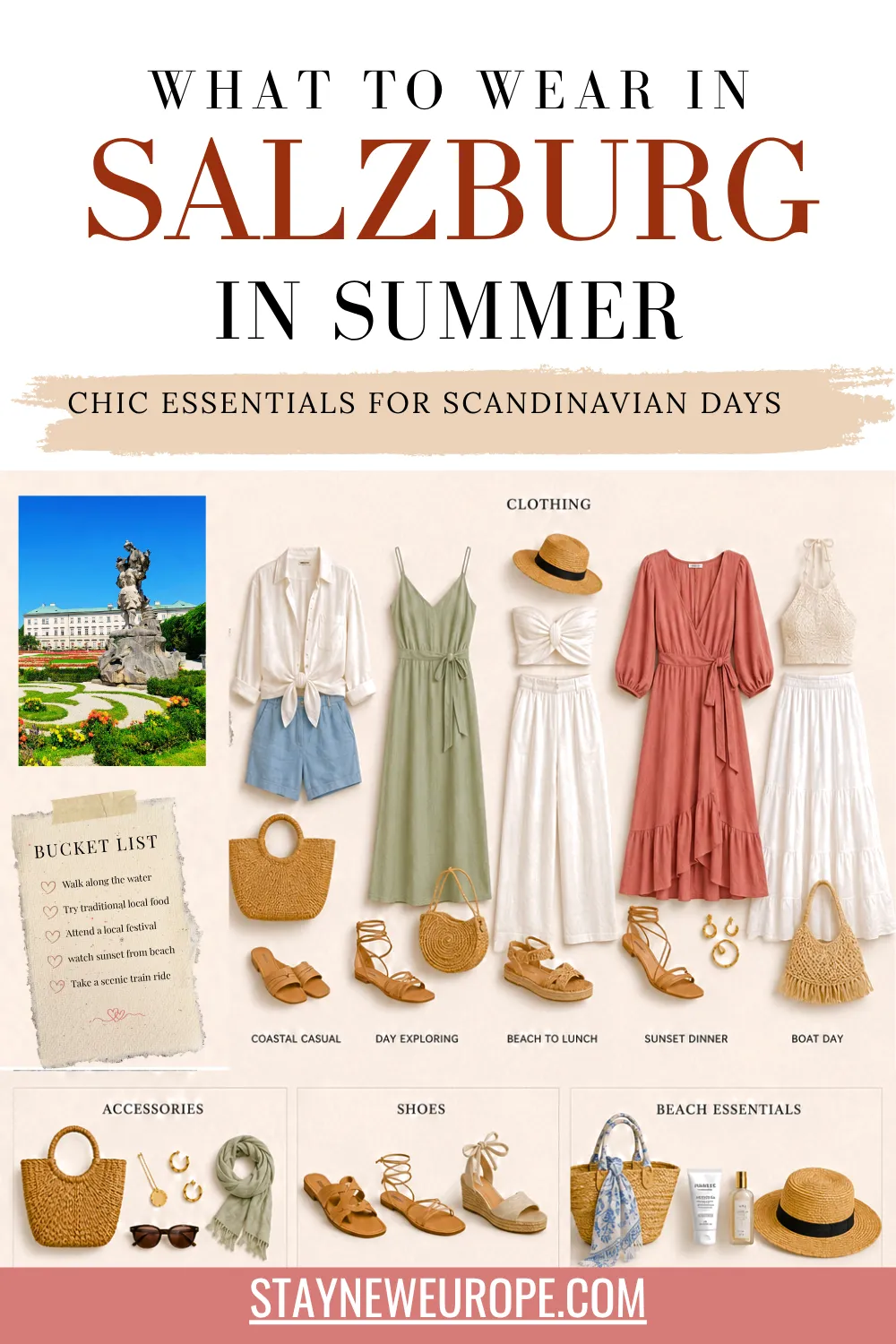
This might feel counterintuitive for summer, but a good pair of jeans earns its place in a Salzburg summer wardrobe — particularly for evenings and cooler days.
The key is weight and fit. Lightweight denim (not the heavy, structured kind) in a slim or straight-leg cut works well. Dark wash reads smart enough for restaurants and evening outings; it won’t show the city’s inevitable dust and pavement grime the way light-wash will. On a warm day, jeans feel hotter than a dress or linen trousers, but on a cool evening or after a thunderstorm, they feel like a sensible decision.
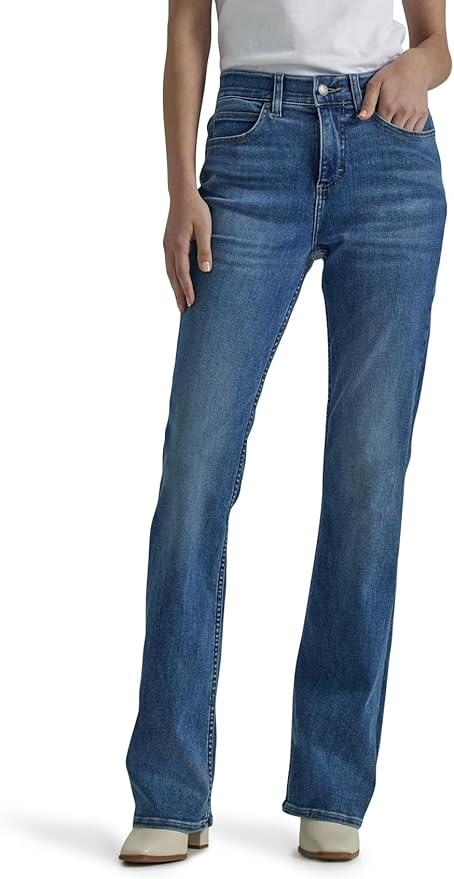
Pair them with a silk or satin blouse for evenings in the Altstadt, a Breton-stripe top for afternoon café-hopping, or a fine-knit jumper for museum visits. A good pair of dark jeans with a blazer and smart flats will pass for smart-casual almost anywhere in Salzburg — including dinner at some of the city’s nicer restaurants.
The thing I’d avoid: very casual denim (heavily distressed, baggy, acid-washed) for evenings. Salzburg has a style standard that doesn’t require formality, but does expect effort.
Local tip: Linen or cotton-linen trousers in a neutral colour (camel, ecru, navy, olive) are arguably even more useful than jeans in summer — they’re cooler, pack well, and look appropriately smart for the city’s atmosphere.
Shoes: This Is Where Trips Succeed or Fail
I will be direct: the wrong shoes will ruin your Salzburg trip, and I mean this practically, not aesthetically. You will walk on cobblestones, you may climb to the Hohensalzburg Fortress, you will possibly navigate a slippery post-rain street, and you will do all of this while trying to enjoy one of Europe’s most beautiful cities. Shoes matter enormously.

Leather or leather-look loafers are probably the single most useful shoe you can bring. They’re smart enough for evenings and concerts, comfortable enough for long days of walking, and handle light rain without drama. A pair of well-made leather sandals (not flip-flops — real sandals with a structured sole and proper straps) work beautifully on warm days. Clean white leather trainers are the European city-walking default for a reason — keep them clean and they look right almost everywhere.

What doesn’t work: new shoes (break them in at home first, please — cobblestones and blisters are a terrible combination), high heels for any significant walking, and flat canvas shoes with no support for long days. Flip-flops are fine for getting between your accommodation and the pool; they are not fine for a day in the Altstadt.
If you’re planning any hiking or mountain day trips — and you really should, because the Salzkammergut is extraordinary — pack a pair of proper walking shoes or lightweight hiking boots. Not trail runners, not trainers. Something with actual grip and ankle support.
Local tip: The climb up to Hohensalzburg Fortress via the footpath is genuinely steep in places and can be slippery after rain. If you’re planning to walk it (rather than taking the funicular), wear proper shoes that morning rather than sandals.
What NOT to Wear in Salzburg
Let me be honest about this, because it’ll save you some embarrassment.
Full hiking gear in the city. I see this constantly — tourists who’ve come from or are heading to a mountain day trip wearing technical hiking trousers, trail boots, and a moisture-wicking base layer through the Altstadt. If you’re heading straight to the mountains, fine. If you’re spending the day in the city and going for dinner in the evening, there’s no reason to look like you’re summiting something. Change. It takes ten minutes.
Visible athletic wear as city clothes. Leggings as trousers, sports shorts, gym trainers — these read as underdressed in Salzburg’s context, particularly in the smarter restaurants and cultural venues. Austrians dress with a quiet respect for place; reciprocating that is simply good travel manners.
Very short shorts or micro-miniskirts are a practical problem here beyond any style question — you will be refused entry to the Dom, the Kollegienkirche, and other churches wearing them, and Salzburg’s churches are genuinely worth seeing inside.
Overly branded tourist merchandise. The “I ♥ Salzburg” t-shirt is available approximately every twenty metres in the Getreidegasse. Nobody who actually loves Salzburg buys it.
Local tip: When in doubt, ask yourself: would this outfit be appropriate for a nice lunch? Salzburg broadly operates on that standard across most of the day. If the answer is yes, you’re fine.
Church Dress Codes: Plan Ahead and Save Yourself the Hassle
Salzburg’s Dom (Cathedral), the Kollegienkirche, the Franziskanerkirche, the Peterskirche — these are among the most beautiful baroque church interiors in the world, and you absolutely want to go inside them. They also all have dress codes. Shoulders covered. Knees covered. No sleeveless tops without a covering layer.

In summer, this is a live issue. If you’re wearing a sundress, a sleeveless top, or shorts on a warm day (and you will be, because it will be warm), you need a covering layer in your bag. A lightweight scarf or pashmina is the obvious solution — it takes up virtually no space, weighs almost nothing, and can be draped over your shoulders in seconds. A lightweight cardigan works equally well.

The sellers outside the Dom do a brisk trade in scarves to tourists who didn’t plan for this. Don’t buy from them — not because they’re doing anything wrong, but because you’ll end up with an overpriced souvenir you didn’t particularly want when you could have packed something you actually like.
Local tip: The Stiftskirche St Peter (attached to St Peter’s Abbey, the oldest monastery in the German-speaking world) is often overlooked by tourists focused on the Dom. It’s extraordinary inside and usually quieter. Worth a detour.
Evening Outfits: Salzburg Rewards the Effort
This surprised me on my first visit: Salzburg’s evening culture is genuinely elevated. Not every restaurant or bar requires dressing up, but the city has a culture of effort that makes getting dressed for dinner feel like part of the experience rather than a chore.

For a dinner in the Altstadt — say, at one of the restaurants near the Domplatz or along the Getreidegasse — smart-casual is the expectation and something slightly smarter than that is always appreciated. A midi dress with flat sandals or elegant loafers, or tailored linen trousers with a silk blouse, will feel completely right. For men, dark trousers and a clean shirt with a light jacket hits the mark.

For Salzburg Festival performances — which run late July through August and draw an internationally elegant crowd — the standard rises. Cocktail-dress level is normal for evening performances; beautiful summer dresses, trouser suits, and elegantly casual combinations all work. Some people go full evening wear; many don’t. The key is looking intentional. A well-chosen outfit rather than something thrown on.
For casual evenings in the less formal parts of the city — the bars along the Rudolfskai, a beer garden in the Augustinerbräu — the standard relaxes considerably. Good jeans and a nice top are perfectly at home.
Local tip: The Augustinerbräu (a legendary beer hall run by monks, essentially) is one of Salzburg’s most wonderful experiences and operates on a refreshingly casual dress code. It is, however, a genuine institution — not a tourist trap. Dress comfortably but respect the place.
Rain Preparation: It Will Rain, So Be Ready
Salzburg has a reputation as one of the rainiest cities in the Alps, and that reputation is earned. In summer specifically, afternoon thunderstorms are a routine feature rather than an exception. They arrive fast, they’re often dramatic, and they leave the cobblestones genuinely slippery.
You need two things: a compact umbrella that lives in your bag from the moment you leave your accommodation, and a water-resistant outer layer. The umbrella should be treated as non-negotiable. A good quality compact umbrella weighs almost nothing and folds small — there’s no sensible reason not to carry one every day. The water-resistant layer (your trench, your light mac, your packable waterproof) should be accessible, not buried at the bottom of your bag.

Shoes become relevant here too. Suede, canvas, and fabric shoes in a Salzburg summer rainstorm are a bad time. Leather or synthetic materials that can be wiped dry are significantly smarter.
One more thing worth knowing: the post-storm light in Salzburg is genuinely one of the most beautiful things you’ll see. The city after a summer thunderstorm, with everything washed clean and the fortress glowing above the old town — it’s worth getting slightly damp for. Just not completely drenched.
Local tip: Café Tomaselli on the Alter Markt is Salzburg’s oldest café (founded 1705) and one of the finest places in Europe to wait out a rainstorm. It is not cheap. It is absolutely worth it.
Bags: Crossbody Is the Answer
The right bag for Salzburg is a crossbody bag of medium size, and I’ll save you the deliberation. Here’s why it wins.
It keeps both hands free, which matters on cobblestones, on the Festungsberg path, at market stalls, and when you’re navigating the Altstadt’s narrow lanes. It keeps your belongings secure — Salzburg isn’t particularly known for pickpocketing, but crowded festival season brings the usual risks. It sits close to your body. And a good leather or leather-look crossbody in a neutral colour (tan, black, or cognac) works from daytime to evening without requiring a bag change.

A tote is fine for museum days when you’re carrying more, or for a relaxed afternoon at the Naschmarkt-adjacent areas. A backpack is ideal for hiking and mountain day trips. For city days, though, the crossbody is the practical and aesthetic winner.

One thing I’d specifically suggest for Salzburg: a slightly sturdier base than a soft fabric bag. The city’s weather means your bag will encounter rain at some point, and a leather or coated canvas bag handles that considerably better than unprotected fabric.
Local tip: During Salzburg Festival season, a small, elegant evening bag (clutch or slim crossbody) is worth packing separately if you’re attending evening performances — it completes the look and you won’t want to carry a practical daypack to the Grosses Festspielhaus.
Fabrics That Work (and the Ones You’ll Regret)
The right fabrics for Salzburg summer are the ones that handle a temperature range, resist wrinkling after a day in a bag, and dry quickly when they inevitably get caught in a shower.
The ones that work: Merino wool is genuinely remarkable — temperature-regulating, wrinkle-resistant, odour-resistant, and available in summer-weight versions that are cool enough for warm days and warm enough for cool evenings. Linen and linen blends are breathable and beautiful but wrinkle readily (factor that in). Cotton-modal blends are soft, comfortable, and more wrinkle-resistant than pure cotton. A small amount of stretch in any fabric makes walking significantly more comfortable.
The ones to reconsider: Heavy cotton (absorbs rain, takes forever to dry), pure silk for everyday wear (marks easily, requires careful handling, doesn’t cope well with a bag), and synthetic fabrics that trap heat in warm museums. Very thick denim will feel heavy on genuinely hot days — opt for lightweight denim if you’re bringing jeans.
The ironing question is practical: you probably won’t have easy access to an iron, especially in shorter-stay accommodation. Pack fabrics that look reasonable without one, or be realistic about whether you’ll actually deal with wrinkles.
Local tip: A merino base layer or fine-knit is worth investing in if you travel regularly to cities with variable climates. One good merino piece packs to almost nothing and replaces three cotton equivalents. Salzburg in summer is precisely the climate it was made for.
What to Wear for Day Trips
Salzburg is brilliantly positioned as a base for day trips — Hallstatt, the Wolfgangsee, Berchtesgaden, the Salzkammergut lakes — and each of these destinations has slightly different wardrobe requirements than a city day.
For lake villages like Hallstatt: comfortable walking shoes (the village is small but hilly in places), layers for the lake breeze, and whatever you feel most comfortable in for a long day of wandering and photographing. A lightweight dress or smart casual look works perfectly — it’s a beautiful but relaxed setting.
For any mountain hiking or serious walking: this is where your dedicated walking shoes earn their place. Add technical layers if you’re going high — even in August, altitude changes the equation significantly. Leave the white linen in the accommodation.

For Berchtesgaden and the Königssee: similar logic — comfortable shoes, layers, something you don’t mind getting slightly muddy or wet near the lake.
The key is not letting your day trip needs dictate your entire packing list. You need one walking-capable outfit and one pair of proper shoes. The rest of your wardrobe can remain oriented around the city.
Local tip: Hallstatt is one of the most photographed villages in the world and in summer it is genuinely very busy. Go early (first boat or bus) and wear whatever makes you feel good — the light is extraordinary at 8am and the crowds haven’t arrived yet.
Accessories That Quietly Do the Work
The right accessories in Salzburg don’t need to be dramatic — the city provides more than enough visual interest without you competing with it. What they do need to do is work practically while looking intentional.
A lightweight scarf or wrap has already appeared in this guide as essential for church visits, but it does double (triple) duty: as a layer when the evening cools, as a bag accessory for instant polish, and as a quick colour injection if your outfit is primarily neutral. A classic silk-look scarf in a simple print or solid colour is endlessly useful.
Sunglasses are non-negotiable in a city where you’ll spend significant time outdoors and where the post-storm Salzburg light is genuinely brilliant. A classic frame — tortoiseshell, black, or gold-metal — pairs with everything.

Simple, quality jewellery suits Salzburg’s aesthetic. Small gold hoops, a clean chain, a good watch. Nothing too loud or statement-heavy. The city’s style is understated refinement, not maximalist decoration.
A compact umbrella, as mentioned, functions as a mandatory accessory rather than an optional one.
Local tip: The quality of small leather goods (belts, card holders, key fobs) in Salzburg’s independent shops — particularly in the side streets off the Getreidegasse and in the Linzergasse on the right bank — is genuinely excellent. Leave space in your packing for something you find here.
Your Salzburg Summer Capsule Wardrobe
Here’s what I’d actually pack for seven to ten days in Salzburg in summer — covering city days, an evening performance, a lake day trip, and the full range of weather Salzburg’s summer can produce.
Tops: 2 lightweight quality t-shirts (one white, one neutral), 1 silk or satin blouse for evenings, 1 linen or cotton button-down shirt (worn open as a layer or done-up as a top), 1 fine-knit merino or cotton-blend jumper
Bottoms: 1 pair of slim lightweight dark jeans, 1 pair of linen or tailored trousers in a neutral, 1 skirt (midi length, works day to evening)
Dresses: 1 shirt dress or wrap dress that covers knees (day to evening versatility, church-appropriate with a layer), 1 slightly dressier option if attending Festival performances
Layers: 1 classic trench or light mac, 1 fitted blazer (navy or neutral), 1 lightweight packable waterproof or gilet
Shoes: 1 pair of leather loafers or low-heeled ankle boots (city walking + evenings), 1 pair of structured leather sandals (warm days), 1 pair of walking shoes or light hikers (day trips), 1 pair of smart flats or low heels (evenings/concerts)
Accessories: 1 crossbody bag (daily), 1 small evening bag if attending Festival, 1 lightweight scarf/wrap, compact umbrella, sunglasses, simple jewellery
This is enough for ten days. Everything works with everything else. The shoes are the heaviest consideration, but all four have distinct jobs and you’ll use them all.
Packing Light Without Under-Packing
The fear on every trip: did I bring enough? The reality on every trip: you brought too much of some things and not enough of others.
Salzburg’s summer climate makes this manageable if you approach it strategically. Lay out everything you intend to pack, then remove roughly a third of it. You’ll find that several items are “just in case” rather than “I’ll definitely wear this,” and those are the ones to leave.
Plan outfits deliberately before you pack — morning city exploring, afternoon museum visit, evening dinner, concert night, lake day trip. Each of those needs a look, not a new wardrobe. Many of them share pieces. One good trench coat serves all of them. One pair of loafers handles at least three.
If you’re staying for more than a week, accept that you’ll rewear things and plan for it. The merino jumper on day two and day six is not a failure — it’s just sensible. Do a small laundry run midway through if needed; almost all accommodation will have facilities or be near a laundrette.
The biggest mistake, as always: too many shoes. They’re heavy, they don’t compress, and you will wear the same two pairs every day. Four pairs for Salzburg summer (loafers or boots, sandals, walking shoes, evening shoes) is the upper limit. Be firm about this.
Local tip: Salzburg’s Linzergasse on the right bank of the Salzach has genuinely good independent shops. Pack with a little intentional space — you may want to bring something home.
A Final Thought Before You Go
Salzburg in summer is the kind of place that stays with you. The fortress above the old city at golden hour. The sound of Mozart floating out of an open concert hall window. A thunderstorm clearing over the Alps while you sit dry and entirely content inside a 300-year-old coffee house.
You don’t need to overthink the clothes. Pack thoughtfully, build in flexibility for the weather’s moods, and choose pieces that make you feel good rather than just prepared. A city this beautiful deserves to be enjoyed, not just survived in practical layers.
Go. Walk everywhere. Dress well enough to feel like you belong. You will.

