
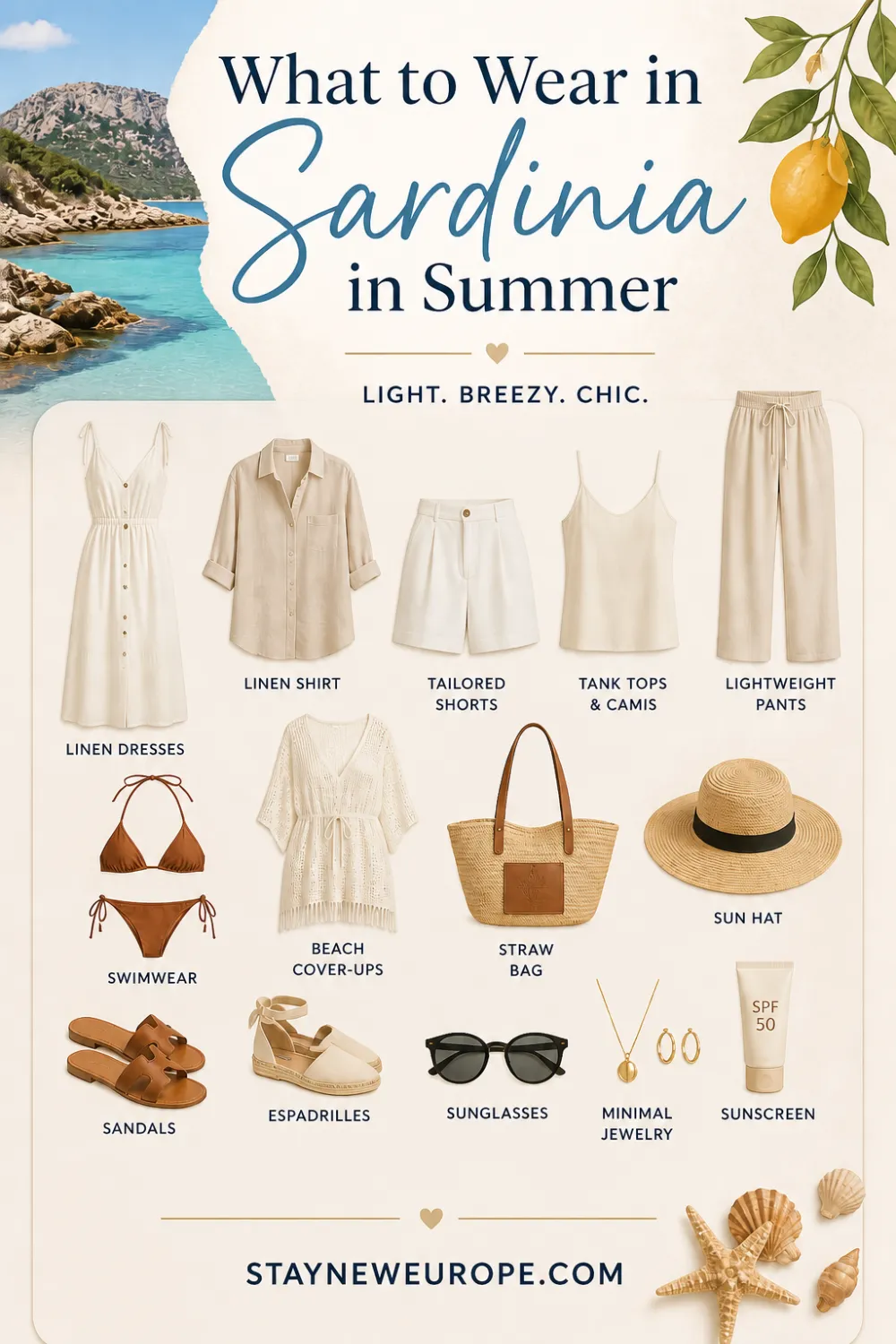
Sardinia in summer is a lot. The light is almost aggressive — bouncing off white limestone cliffs, turquoise water, and bleached sand in a way that makes every photo look edited. The heat is serious. And the people? Effortlessly, quietly, almost annoyingly stylish in the way that Italians just are without trying.
I learned a few things on my first trip that I wish someone had told me before I packed—key things to know before traveling to Italy that apply directly to Sardinia. Like the fact that July temperatures can genuinely hover around 35°C and your favourite denim shorts will feel like a punishment by noon. Or that turning up to a harbour-front restaurant fresh from the beach, in a slightly damp bikini top and flip flops, is not really the done thing here even though it’s technically a beach town.
Sardinia isn’t a difficult place to dress for — but it rewards the people who’ve thought about it, even slightly. Here’s what actually works.
Before You Start: Understanding Sardinia’s Summer Vibe
Summer in Sardinia runs from June through September, and the experience shifts meaningfully across those months. June is warm and increasingly busy, with temperatures around 25–28°C — genuinely lovely. July and August are peak season in every sense: hot (regularly 32–36°C), crowded, and blazing from about 10am until late afternoon. September brings some relief — still warm and sunny, but with a noticeable softening in the heat and the crowds.
The island’s landscape is diverse in a way that affects how you dress. There are long sandy beaches (Spiaggia della Pelosa, the Costa Smeralda) but also rocky coves, pebbly shores, ancient hilltop towns like Orgosolo, chic marina towns like Porto Cervo, and traditional cities like Cagliari and Alghero with proper cobblestone streets and historic centres. Your outfit for a day on the beach at Cala Goloritzé looks quite different from your outfit for an evening in the old town of Bosa.
The cultural backdrop matters too. Sardinians have their own identity distinct from mainland Italy — proud, traditional, and genuinely stylish in an understated way. The island’s fashion sense is built on what you might call casual elegance: relaxed but intentional, comfortable but considered. Nobody is overdressed. Nobody is underdressed. It just… looks right. That’s what you’re aiming for.
The Heat Is Not Negotiable — Dress Accordingly
Let me just say this plainly because it affects everything else on this list: Sardinian summer heat is not European-summer-warm. It is Mediterranean-island hot, particularly in July and August, and if you pack the wrong fabrics you will be miserable by midday.
The two rules that override everything else: natural fibres only, and loose over fitted. Linen, cotton, and lightweight cotton blends breathe. Polyester, nylon, and anything marketed as “stretchy travel fabric” trap heat against your body in a way that becomes genuinely unpleasant after twenty minutes of walking in direct sun. I have made this mistake. It’s not worth it.
Looser silhouettes also keep you cooler than fitted ones — counter-intuitive if you’re used to thinking of summer as the time for body-conscious dressing, but the physics are real. A floaty linen midi dress actually keeps you cooler than denim shorts and a tight tee, and it looks significantly more like you belong here.
Local tip: If you find yourself sweating through everything by 11am, the problem is almost certainly fabric, not temperature. Switch to 100% linen or a loose cotton gauze and see what happens.
Dresses: The Real Sardinian Summer Uniform
If there’s one thing to take from this entire article it’s that dresses are the answer for Sardinia in summer, and not just beach dresses — proper, wear-everywhere dresses that take you from a morning walk through town to a harbour lunch to an evening aperitivo without a full outfit change.
A linen midi dress is the most versatile piece you can pack. Wear it with flat sandals and a straw bag during the day; add gold jewellery and swap the sandals for something slightly more elegant in the evening. It handles the heat beautifully, it photographs well against Sardinia’s colourful backdrops, and it reads as effortlessly put-together in a way that takes almost no effort at all.

Maxi dresses work for beach days and evenings but can be heavy for daytime town walking in intense heat — go for the lightest fabric you can find if you’re packing one. Wrap dresses are lovely but make sure yours ties securely; the sea breeze along the coastal promenades has a personality. Mini dresses are absolutely fine for evenings and more casual beach towns, but cover up before you step into a church or wander into a traditional inland village. (For more context on dress codes across Europe, see our Greece travel guide.)

What to avoid: very tight bodycon shapes in the midday heat (you’ll feel trapped), and anything that requires ironing after being in a suitcase (linen is forgiving; structured fabrics are not).
Local tip: Sardinian women love a simple slip dress in a solid colour — cream, terracotta, sage, navy — worn with minimal accessories and good sandals. It’s not a trend, it’s a permanent fixture of the island’s summer aesthetic.
Swimwear: More Considered Than You’d Think
Sardinia has some of the most beautiful beaches in the Mediterranean, and the beach culture here is real — people take their beach days seriously. Swimwear matters.
The local approach is a classic one: a well-fitting bikini or a chic one-piece in a solid colour or a clean print, paired with a proper cover-up, a straw bag, and sandals. That’s it. The Costa Smeralda crowd leans more glamorous — you’ll see more statement swimwear and designer beach accessories up there. Everywhere else, simple and well-chosen is the right note.

One-pieces are genuinely having a moment in Italian beach culture and they look fantastic — no need to feel you have to pack a bikini if that’s not your preference. A high-cut one-piece in a bold colour against that water is an objectively good image.
Cover-ups are not optional, I’d argue. Italians do not generally walk through town in swimwear, and away from the beach itself — in a café, at a market stall, along the main street — you’ll want to be covered. A lightweight kaftan, a loose linen shirt, or a simple sarong-style wrap all work. Choose something you’d actually want to wear rather than a shapeless beach towel with sleeves.

Local tip: The beaches on the west and south of the island (around Oristano, Iglesias, and Carbonia) tend to be rockier and more pebbly than the postcard-perfect north. Water shoes are quietly essential if you’re headed there — flat sandals will not survive the approach to the water gracefully.
Shorts: The Summer Staple With One Important Caveat
Shorts are completely appropriate for Sardinia in summer — but choose wisely, because not all shorts behave well in 35°C heat.
Linen or cotton shorts in a mid-length (just above the knee or slightly longer) are the sweet spot: cool, comfortable, versatile enough for a beach town and a café, and they photograph well. Very short denim cutoffs can feel too tight and too hot by midday, and they limit where you can go — a lot of Sardinia’s churches and inland villages expect covered knees.
Tailored linen shorts in a neutral or earthy tone — sand, white, olive, terracotta — dress up easily with a nice top and sandals for evening. This is a useful feature when you’re travelling light and don’t want to pack separate day and night wardrobes.

Men’s linen or cotton shorts with a tucked-in linen shirt and leather sandals is one of those looks that reads as genuinely stylish on Sardinian streets. It’s not complicated. It’s just the right fabric and a bit of intention.
Local tip: Bermuda-length shorts (landing at or just below the knee) are the most versatile length for Sardinia specifically because they work for beach towns, churches, and evening dining without a second thought.
Tops and Shirts: Light, Simple, Italian
The tops that work best in Sardinian summer heat are the ones that prioritise airflow over everything else. A loose cotton or linen tee, a flowy blouse with a bit of movement, a breezy button-down linen shirt worn open over a swimsuit or a simple tank — these are the building blocks.

Plain colours and simple prints read better here than loud graphics or heavy patterns. Not because there’s a rule, but because the island’s palette — whitewashed walls, cobalt sea, sun-bleached stone, bougainvillea pink — is already doing a lot of visual work. Quiet clothing lets you be in the landscape rather than competing with it.

For men: a linen shirt with the sleeves rolled, top buttons undone, worn with tailored shorts or linen trousers is the Sardinian summer formula and it’s correct. In the evenings, switch to a slightly crisper shirt, add a watch, and you’re dinner-ready without trying.
Local tip: White and cream tops photograph beautifully against Sardinia’s blue and terracotta tones but will pick up dust on coastal paths. Pack a couple of darker alternatives for exploring rather than risking your nicest white linen on a rocky trail.
Shoes: What the Island Actually Demands
Sardinia’s terrain is varied and your shoes need to reflect that across a summer trip. Here’s the honest breakdown:
Flat leather sandals are the everyday anchor — for village wandering, harbour lunches, evening strolls, and anything that doesn’t involve challenging terrain. They look right, they’re comfortable in heat, and they work with almost every outfit on this list. Spend money on a good pair. Your feet will clock significant kilometres on stone streets.

Espadrilles are the other quintessentially Mediterranean option and look wonderful here, but be aware they don’t handle water well. Great for dry evenings, not ideal if you’re doing coastal walking where sea spray is likely.

Chunky sandals or strappy flat platforms read well for evenings without the impracticality of heels on cobblestones. A low block heel on a nice sandal works for dinner; stilettos don’t really work anywhere in Sardinia’s old towns without significant suffering.

Water shoes for rocky beaches — underestimated, essential for some of the island’s most beautiful spots. Don’t let pride get in the way of comfortable beach entry.

A pair of clean trainers or sneakers for cooler mornings, inland excursions, or days where you’ll be walking more seriously. White leather trainers are everywhere in Italy right now and they look great with everything. Check out what to wear in Italy in July for more seasonal styling tips.

Local tip: Leave heels at home unless you’re staying at a resort where flat surfaces are guaranteed. The combination of cobblestones and summer heat is not a forgiving environment for anything with a pointed heel.
What NOT to Wear in Sardinia This Summer
This is the section that could save you a lot of regret, so I’m going to be direct about it.
Swimwear off the beach. This is genuinely the number one tourist tell in Sardinia. Walking through a village or into a café in a bikini top and a wet coverup reads as disrespectful in local eyes. Keep swimwear to the beach and the pool; put a proper cover-up on before you rejoin the rest of the world.
Synthetic fabrics in July and August. You will not survive them comfortably. The humidity combined with that heat level makes polyester feel like a punishment.
Tight, heavy denim. A floaty linen dress weighs less, breathes more, and looks more intentional. Save proper jeans for cooler evenings in September.
Very skimpy or revealing clothing in inland villages or churches. Sardinia’s traditional communities are conservative by Italian standards, and turning up to a hilltop village or an ancient church in something very revealing is simply not the right call. Keep a light layer or scarf to hand.
Athletic gear as general sightseeing attire. Running shoes and compression shorts are for running. If you’re doing a hike, great — but change before you head to dinner or the evening passeggiata.
Loud, heavily branded streetwear. It looks out of place in a way that’s hard to ignore on this particular island. Sardinia’s aesthetic is quiet confidence, not branding.
Local tip: The simplest test — before leaving your accommodation, ask yourself: “would this look appropriate at a nice outdoor café?” If not, either change or throw a layer over it.
Evenings in Sardinia: The Aperitivo-to-Dinner Transition
Sardinian evenings have a distinct rhythm and dressing for them is genuinely enjoyable once you know the formula.
The passeggiata — the evening walk — starts around 7pm in most towns and it’s a genuine social ritual. People get dressed. Not formally, but thoughtfully. A sundress gets a better pair of sandals and some gold jewellery. Linen trousers come back out after a beach day. A linen shirt gets slightly more carefully chosen. The overall effect is that everyone looks a bit more considered than they did during the day, without anyone looking like they’re heading to a gala.

For women: a silk or satin blouse with linen trousers and flat sandals is one of the strongest evening formulas I know for Sardinia. A midi or maxi dress with accessories reads beautifully. A simple knit (yes, even in summer — evenings can cool) over a sundress gives you options.

For men: the linen shirt and tailored shorts or trousers formula continues into the evening, perhaps in a slightly more pressed version. Loafers or leather sandals instead of trainers complete it.
One thing worth noting: the Costa Smeralda area (Porto Cervo, Porto Rotondo) operates on a noticeably higher style register than the rest of the island. If you’re dining at a proper restaurant there, lean slightly more polished than you would elsewhere. Everywhere else, smart-casual is genuinely the ceiling.
Local tip: A good pair of gold hoops and a simple gold necklace will elevate almost any simple summer outfit from “I put this on” to “I dressed intentionally.” Pack them. They weigh nothing.
Bags: Straw, Leather, and What Actually Works
The bag question in Sardinia has a pretty clear answer that covers most situations. For summer packing guidance across Europe, check our carry-on packing tips.
A straw or woven tote is the beach and casual daytime bag — it’s practically part of the island’s aesthetic, it’s lightweight, and it holds everything you need for a day by the sea. Opt for one with enough structure that it doesn’t look like it’s collapsing. It doesn’t need to be expensive; it needs to look intentional.
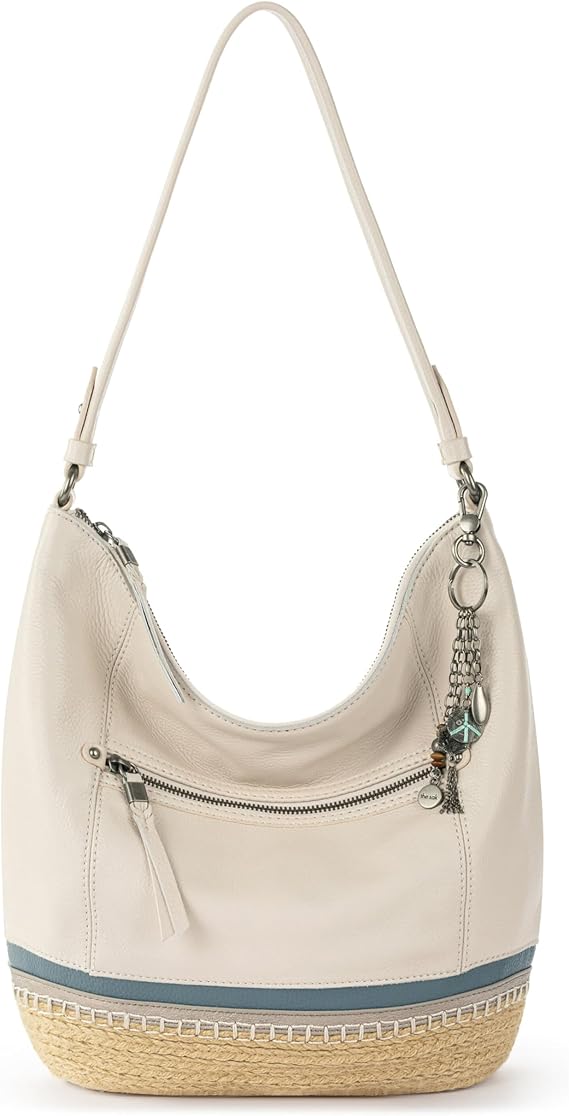
A small leather or canvas crossbody handles town days and evenings — keeps your hands free, sits close to your body (useful in busier tourist areas where pickpocketing exists), and goes with everything. Choose a neutral or earthy tone that works across your outfits.

A small clutch or mini bag for the evenings, especially if you’re in a nicer restaurant or doing the passeggiata.
What not to bring: a massive hiking backpack as your daily bag for beach towns — it changes your whole silhouette and makes navigating crowded harbour promenades unnecessarily physical. Leave it for actual hiking days.
Local tip: Buy a straw bag when you arrive. The local markets and shops stock them abundantly and beautifully, they make excellent souvenirs, and you’ll use it every day you’re there.
Accessories That Pull Everything Together
In Italian style generally and Sardinian style specifically, a small number of well-chosen accessories do more work than a complicated outfit. Here’s what earns its packing weight:
Sunglasses — non-negotiable. The sun here is intense and beautiful and you’ll be in it for hours. Get a pair you actually like; you’ll be wearing them almost constantly.

A wide-brimmed hat for beach days and midday exploring. A structured straw hat looks gorgeous against the Sardinian backdrop and offers real sun protection. Bring one that sits securely — the coastal wind makes flyaway hats more stressful than they’re worth.

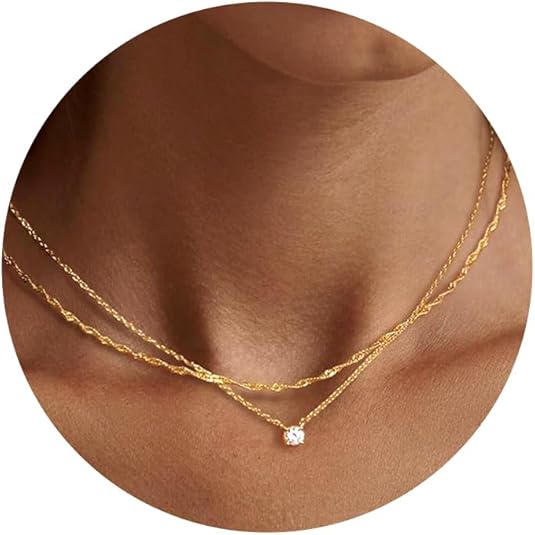
Gold jewellery — earrings, a simple chain, maybe a ring or two. The Italian coastal aesthetic is warm metals against tanned skin, and it doesn’t take much to get there. A pair of hoops goes with everything.
A light scarf or pareo for churches, cooler evenings, wind cover on boat trips, and impromptu beach picnics. One item, five uses.

A small crossbody bag (see above — it doubles as both practical accessory and outfit component).
Local tip: A colourful hand-painted ceramic piece from one of Sardinia’s artisan shops makes both a great souvenir and a visual reference for your whole colour palette for the trip. The island runs on terracotta, cobalt, sun-yellow, and deep green — let that guide your accessory choices.
The Summer Capsule Wardrobe: Packing It All Together
The goal is a bag that handles every version of Sardinia’s summer — beach days, town wandering, evening aperitivi, a spontaneous boat trip, a hilltop church — without weighing more than you want to carry.
Here’s what covers everything for a week to ten days:
Bottoms: Two linen or cotton midi skirts (one neutral, one with a bit of colour), one pair of tailored linen or cotton shorts, one pair of lightweight cotton trousers or jeans for cooler evenings in September.
Tops: Three or four simple tees or blouses in plain colours that work with all your bottoms. One or two slightly dressier options for evenings (a satin blouse, a cotton cami).
Dresses: Two versatile dresses — one casual linen midi for daytime, one slightly dressier option that can do real evening work with the right accessories.
Swimwear: Two swimsuits (so one can dry), a cover-up or kaftan, a straw bag.
Shoes: Flat leather sandals for everyday, water shoes for rocky beaches, a clean pair of trainers for longer walking days, a slightly dressier pair of sandals for evenings.
Outer layers: One light cotton or linen overshirt, one thin cardigan or knit for evenings — yes, even in summer, September evenings have a cool edge — a consideration for summer travel to Europe.
Accessories: Sunglasses, wide-brimmed hat, gold jewellery, scarf, small crossbody bag.
That’s it. Everything mixes. Nothing is wasted. You’ll actually use all of it.
Practical Packing Advice
Pack lighter than you think you need to. Sardinia’s cobblestoned hills and accommodation stairs will remind you of every extra kilo. For more packing tips for Mediterranean destinations, see our guide to packing for summer in Europe.
Roll linen — don’t fold it. Folded linen makes hard creases; rolled linen makes soft ones that look intentional.
Leave room for what you find there. Sardinia’s markets and boutiques have genuinely beautiful things — ceramics, local textiles, handmade jewellery. Buy the straw bag. Pick up a hand-painted scarf. You’ll need the space.
Sunscreen is the one thing you can always find in Sardinian pharmacies and supermarkets, and often at better prices than at home. Don’t let it take up half your liquids bag.
Mosquitoes are real — particularly in sheltered harbour areas and near salt flats. Light, loose long-sleeve layers for evenings are not just stylish, they’re functional.
One Last Thing
Sardinia is the kind of place that makes you feel like a slightly better version of yourself. The light is flattering, the food is extraordinary, the sea is the kind of blue that doesn’t feel real until you’re standing in it.
Dress for the experience — comfortably, thoughtfully, with a bit of the island’s quiet elegance in mind — and the rest takes care of itself. Pack your linen, bring your gold jewellery, find yourself a straw bag at the first market you pass, and go.
Sardinia does the rest.


One Response