
Let me be honest with you — I almost got this completely wrong the first time I packed for Spain in July. I loaded up a suitcase full of “just in case” layers, a denim jacket I was convinced I’d need for cool evenings, and two pairs of jeans that I ultimately folded back up, unworn, at the end of the trip. Spain in July is a different beast entirely. It is hot in a way that feels personal — like the sun has made a decision about you specifically.
The vibe is full summer mode across the entire country. Barcelona buzzes with energy and golden light until well past 9pm. Seville turns into something approaching a furnace (I mean that affectionately). Madrid radiates heat off its stone streets from about 11am onwards. And yet somehow, Spaniards still manage to look effortlessly stylish while you’re standing there in your wrinkled linen shirt wondering what you missed.
The mistakes tourists make are predictable and avoidable: too many clothes, the wrong fabrics, shoes that look fine in a hotel mirror but destroy your feet by noon, and a total underestimation of just how long the evenings last and how much the temperature can actually drop once the sun goes down. This guide fixes all of that.
Before We Dive In: What July in Spain Actually Feels Like
Spain in July is not a uniform experience — and that matters when you’re packing. The country is enormous, and the climate varies more than most people expect. Barcelona sits on the coast and catches a sea breeze that keeps things just about bearable. Madrid is landlocked and intense, regularly hitting 38°C (100°F) or above. Seville and Córdoba in Andalusia can clock temperatures that make you rethink all your plans between 1pm and 5pm. Even San Sebastián in the north feels warm and sunny in July, though nothing like the south.
What this means practically is that July in Spain is genuinely hot — averaging between 28°C and 36°C (82–97°F) depending on where you are — and it stays light and lively until late. Sunset doesn’t happen until around 9:30pm, and dinner before 9pm marks you as a tourist faster than a selfie stick. Humidity is moderate in most cities but notably higher on the coasts, which means your fabrics really matter.
The style culture here is worth paying attention to. Spaniards take pride in dressing well, and even in the heat they’re rarely dishevelled. You’ll see put-together outfits, clean shoes, and thoughtful accessories on the streets of Madrid or Granada. Nobody expects you to dress like a local, but you’ll feel more comfortable — socially and physically — if your clothes look intentional rather than desperate.
If you’re already thinking about which Spanish cities you’ll be visiting, the 15 best places in Spain to visit this year is a brilliant starting point for planning your route.
Lightweight Linen: The Fabric That Actually Saves You
Some packing advice you assume will be obvious turns out to be the most important thing on the list — and linen is that thing for Spain in July.
I arrived in Seville wearing a cotton shirt on my first day and lasted about forty minutes outside before I felt like I was wearing a damp towel. The switch to linen the next morning was genuinely life-changing. Linen breathes in a way that other fabrics simply can’t match in dry, intense heat. It wicks moisture, it dries quickly, and it keeps you feeling — if not actually cool — at least human.
Pack linen shirts, linen trousers, and if you can find them, linen-blend dresses or shorts. The slightly rumpled look that linen gets within twenty minutes of wearing it is not a flaw in Spain. It’s practically the national texture. A loose linen shirt in white, cream, or a dusty terracotta works for sightseeing in the morning and dinner in the evening with almost no effort.
Local tip: Look for linen-blend fabrics (linen mixed with a small percentage of cotton or viscose) if you want a bit more structure without sacrificing breathability. Pure linen wrinkles dramatically if you’re sitting for long periods, which matters on buses or during long lunches.
Dresses: The Smartest Decision You Can Make
If you wear dresses, Spain in July is your moment. Pack at least two or three — they are genuinely the most versatile, comfortable, and heat-appropriate thing you can bring.

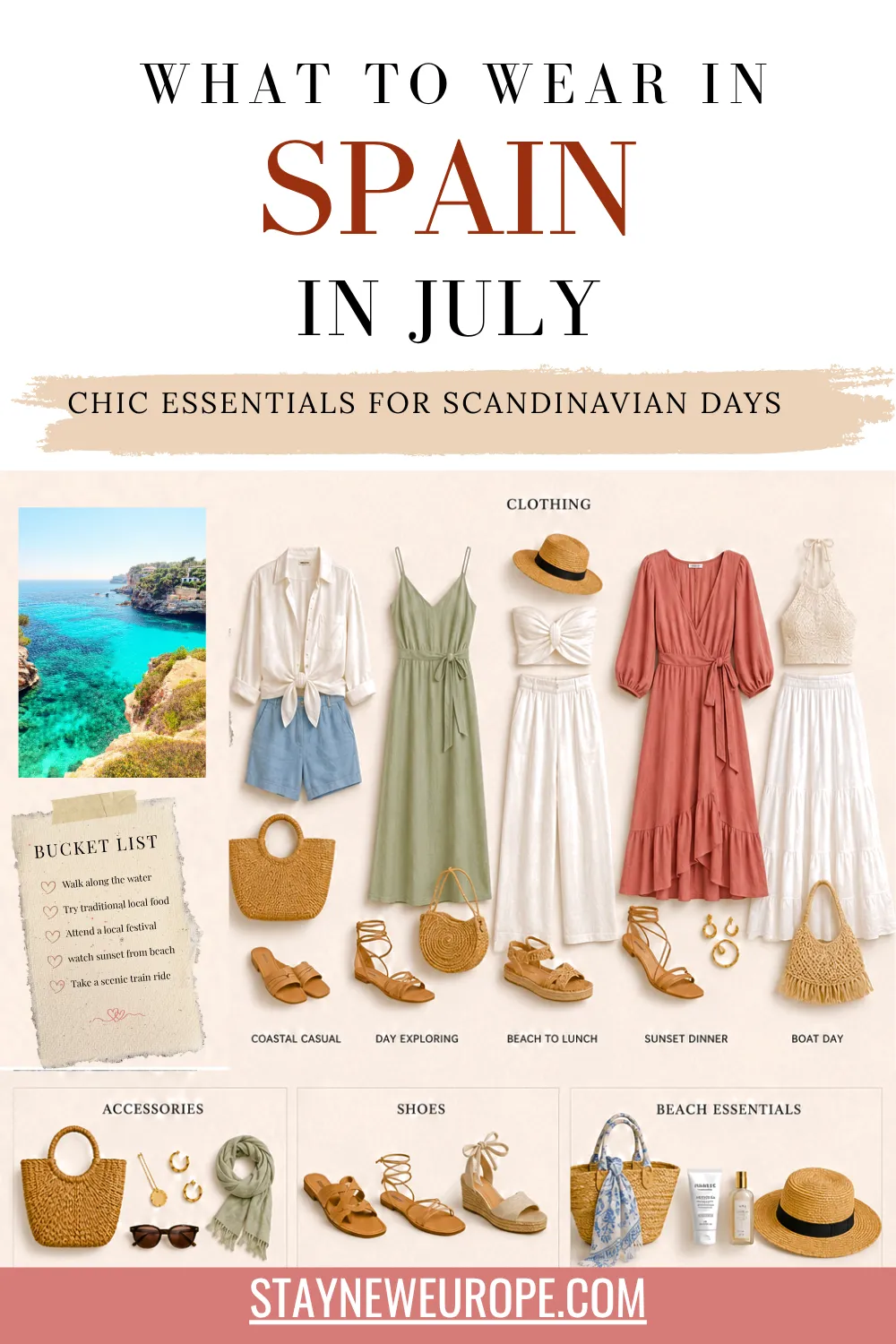
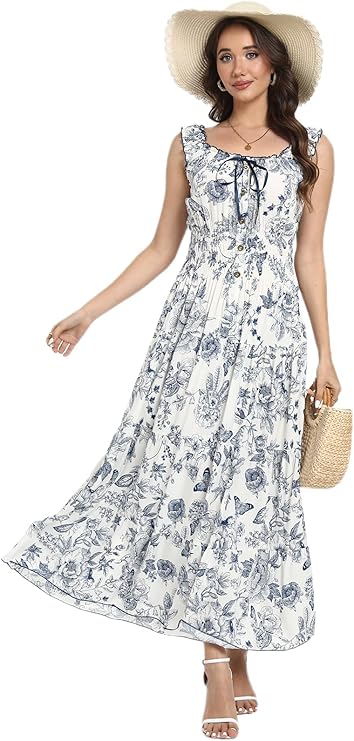
A flowy midi dress in a natural fabric moves with you, keeps you cool, covers your shoulders (useful for churches without the fuss of carrying a separate layer), and looks completely intentional whether you’re walking through the Gothic Quarter at noon or sitting down to dinner at a candlelit restaurant at 10pm. Add a pair of flat sandals or strappy espadrilles and you have a complete outfit that requires almost no thinking.

The key is fabric and silhouette. Anything fitted or synthetic will be genuinely uncomfortable. Anything loose in cotton, linen, or viscose feels like wearing a very light breeze. I’d steer towards solid colours or simple prints — busy patterns with clashing accessories can look overdone in the Spanish sunshine. A rust-orange wrap dress, a white broderie anglaise midi, or a classic navy sundress with a relaxed waist all work beautifully here.
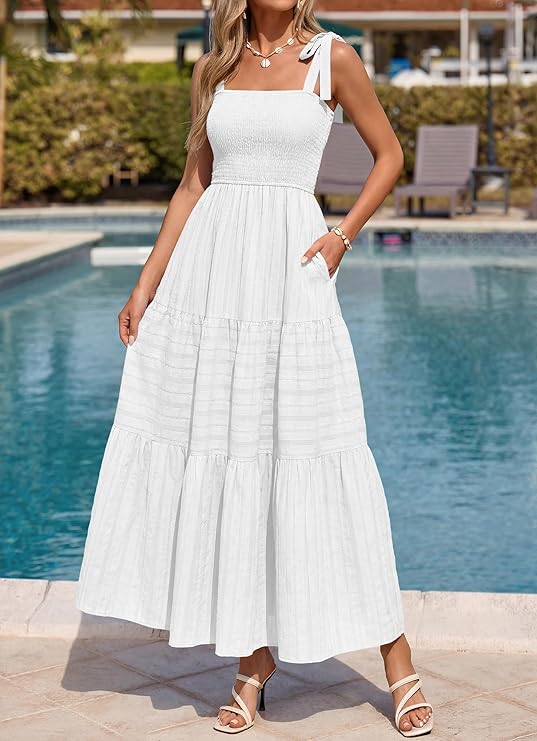
Local tip: Midi lengths are smarter than minis for July sightseeing. You’ll be sitting on church steps, climbing hills, and squeezing through narrow streets — a longer skirt is cooler (counterintuitively) and more practical than it sounds.
What to Wear Instead of Jeans
Here’s where I’ll be slightly controversial: leave the jeans at home. Or pack exactly one pair and accept that they will stay folded in your bag for most of the trip.
Jeans in 36°C heat are not a fashion statement — they’re a form of self-punishment. They trap heat, they chafe, they take forever to dry if you sweat through them, and they add significant weight to your luggage for approximately zero reward. I know there’s a comfort in jeans. I know they “go with everything.” But in July Spain, they are the one item that will make you quietly miserable.

The swap is easy: linen trousers or tailored linen shorts cover almost every scenario that jeans would, and they breathe a thousand times better. For a polished daytime look, wide-leg linen trousers in cream or tan with a simple tucked-in top and sandals is genuinely chic and won’t have you melting by 11am. For evenings, a slightly smarter pair in navy or slate works just as well as jeans ever did, without the suffering.

If you genuinely can’t pack without denim, one pair of lightweight stretch jeans is fine for cooler evenings or air-conditioned restaurants. But commit to the linen trousers for daytime — you will not regret it.

Local tip: Wide-leg linen trousers in neutral tones are practically a uniform among well-dressed locals in Madrid in summer. If you want one outfit that makes you feel immediately at home in the city, this is it.
Comfortable Shoes That Won’t Ruin Your Trip
This is the section where I tell you something you might not want to hear: your cute new sandals are a liability if you haven’t broken them in.
Spain’s streets are not smooth. Barcelona’s Gothic Quarter has uneven stone that destroys anything with a heel. Granada’s Albaicín climbs in sharp, cobbled switchbacks. Madrid’s pavements, though flatter, are still hard underfoot after six hours of walking. The average tourist covers 15,000 to 20,000 steps a day when exploring a Spanish city in summer — and every single one of those steps matters.

What actually works: a well-worn pair of leather sandals with a proper footbed (think Birkenstock-style or anything with genuine arch support), clean white trainers that can dress up slightly for dinner, or espadrilles for lower-intensity evenings. What doesn’t work: brand-new heeled mules, flip flops for anything more than a beach walk, or those woven flat sandals that look wonderful but have zero padding.

I learned this in Barcelona, walking from the Sagrada Família to El Born in sandals I’d only worn twice before. By the time I reached the waterfront, the backs of my heels had given up entirely. Now I test every shoe thoroughly before any trip, or I bring only the pairs I know.

Local tip: Pack a tiny roll of blister plasters in your bag. Not because you’ll definitely need them — but because the one time you don’t have them is the time you absolutely will.
The Evening Temperature Drop (Yes, It Really Happens)
Nobody warns you about this and it catches out more tourists than almost anything else. Spain in July feels relentlessly hot until about 8pm, and then — particularly inland, and at higher altitudes — the temperature can drop enough to make you genuinely reach for a layer.
In cities like Granada, which sits at around 700 metres above sea level, the evenings can feel noticeably cooler once the sun is fully down. Even Madrid, which holds heat like a radiator, gets more comfortable by 10pm. The coast is a different story — Málaga and Barcelona stay warm and humid into the night — but don’t assume that applies everywhere.
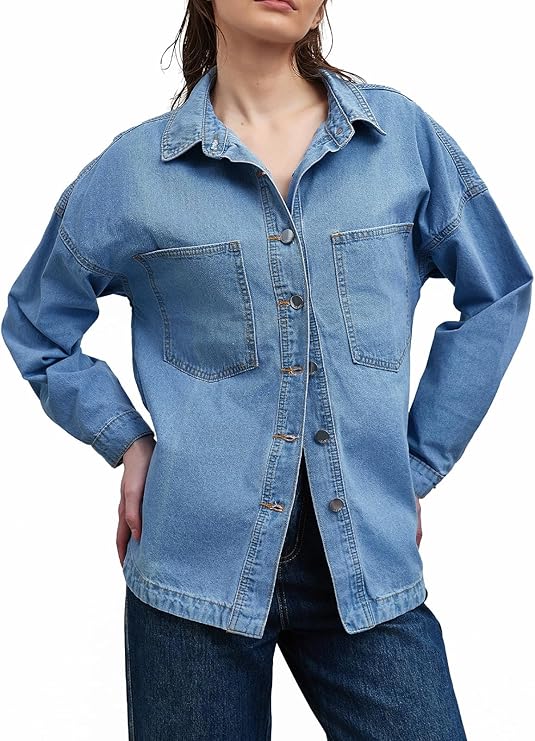
What this means for packing: bring one lightweight layer that you can carry in your bag and pull out when needed. A thin cotton cardigan, a longline shirt tied around your waist, or a very lightweight denim jacket works well. The trick is to make sure it’s genuinely lightweight — not the denim jacket I brought that took up half my luggage allowance — and small enough to fit in a crossbody or tote without drama.

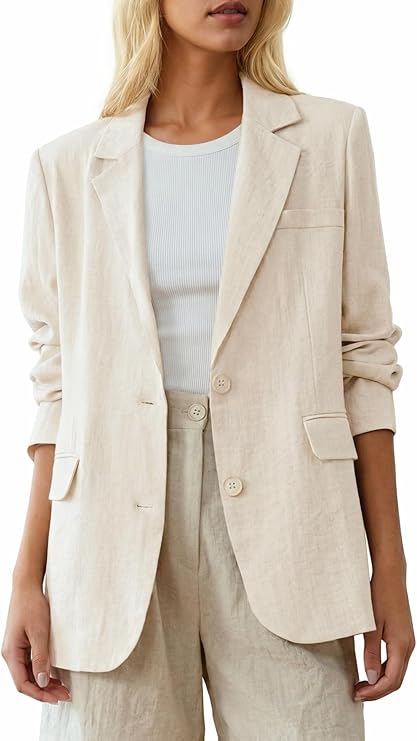
Local tip: A linen blazer is the ultimate Spain-in-July layer. It looks intentional, covers your arms for churches, adds polish for dinner, and packs down surprisingly small. It’s the one piece I’d tell you to prioritise if you’re trying to pack light but still look pulled-together.
What to Wear on the Beach and the Coast
If your Spain trip includes the coast — and in July, it really should — you’ll need to think about beach-to-town transitions, because Spaniards do this seamlessly and tourists often get it wrong.
On the beach itself: a good swimsuit or bikini, a light kaftan or oversized linen shirt as a cover-up, and a wide-brimmed hat. Simple.
What you won’t see at the beach: heavy shorts, trainers, or full outfits that seem to suggest you’ve wandered to the wrong location. Spain has a very easy relationship with beach dressing and it’s almost entirely about lightweight cover-ups and confidence.

The transition from beach to town is where most tourists stumble. Walking into a restaurant or shop in wet swimwear and flip-flops is frowned upon in most Spanish beach towns. A simple linen dress over a bikini and a swap to flat sandals takes about forty-five seconds and makes you look like you actually thought about it. That’s the only effort required.
For coastal evenings, a flowy off-shoulder top with white linen trousers and flat sandals is a classic that works everywhere from Ibiza to Cádiz to the Costa Brava.
Local tip: Pack a kikoi or thin sarong rather than a thick beach towel if you’re travelling light. It doubles as a beach towel, wrap skirt, and impromptu picnic blanket, and takes up almost no space in your bag.
What to Wear for Spanish Churches and Cathedrals
Let me be very clear about this, because it causes more tourist embarrassment than almost anything else: Spanish churches have dress codes, and they are enforced.
The rule is consistent across all of them:
- Shoulders covered.
- knees covered.
- Technically that means no sleeveless tops (or a cover-up over them) and shorts or skirts need to be at or below the knee.
This applies in the Sagrada Família, the Alhambra’s interior, Seville Cathedral (the largest Gothic cathedral in the world), and every smaller church you’ll wander into during your trip. Having someone turn you away at the door is frustrating and avoidable.

The good news is that compliance is easy if you pack strategically:
- A light scarf in your bag doubles as a shoulder wrap and a knee cover in seconds.
- A loose midi dress with straps is fine if you add a cardigan or linen jacket over it.
- Or simply dress with coverage as your baseline for church-heavy days.
- A linen shirt and lightweight trousers or a midi skirt.
and you’re in everywhere without thinking about it.
This is also why that linen blazer I mentioned earlier earns its place in your suitcase. It solves the shoulder issue immediately while looking like you dressed with intention rather than desperation.
Local tip: Keep a thin cotton scarf in your bag every single day, not just for churches. It also works as sun protection on your neck and shoulders during long outdoor walks, which matters more than you’d think after a few hours in direct July sun.
Evening Outfits: Dinner at 10pm Has a Dress Code
Spain in July means you’ll be eating dinner at 9 or 10pm, and Spanish restaurants — particularly anything mid-range and above — have a certain effortless elegance about them that makes you want to look the part.
Nobody expects you to be in formal wear. But there’s a clear difference between “I thought about this for thirty seconds” and “I just arrived from the beach.” The former is always appreciated.
For women: a silk-effect slip dress or a tailored linen dress with simple jewellery is a reliable choice for dinner.
For men: linen trousers with a plain linen or cotton shirt (untucked is fine) and clean leather sandals or loafers does the job. The key detail in both cases: freshness. In the heat, changing clothes before dinner is genuinely worth it — not for anyone else’s benefit, but for your own. There’s something about putting on something clean and slightly considered before a late Spanish dinner that lifts the whole experience.

If you’re in Barcelona and heading into the El Born area or a rooftop bar, the bar for effort goes slightly higher. People there really do dress. A simple elevated outfit — something with a print, or with an interesting detail — fits right in.
Local tip: Pack at least two outfits that you’d be happy to wear to dinner without changing from what you’ve been wearing all day. Spain’s evenings are long, spontaneous, and wonderful, and having options means you’re ready for wherever the night takes you.
Bags: Crossbody, Tote, or Backpack?
The bag question matters more in Spain than in most places, for a reason that people don’t always mention directly: pickpocketing is a real issue in busy tourist areas of Barcelona, Madrid, and Seville.
My strong preference is a crossbody bag that sits against your body, with a zip closure and ideally a bag that’s not easily slashed. Not because you should be anxious, but because wearing your bag in front of you in Las Ramblas or the Madrid Metro is just sensible, and crossbody bags make that instinctive.

For daily exploring, a small crossbody with room for your phone, cards, sunscreen, and a bottle of water is enough. Anything larger and you’re carrying unnecessary weight in the heat. For beach days or longer day trips, a lightweight canvas tote or a small packable daypack works well as a second bag — just don’t make it the bag you keep your valuables in.

The anti-tourist tip: leave the large designer handbag in the hotel safe and use something smaller. I’ve seen people carrying expensive bags look visibly stressed in crowded areas, and that tension eats into your enjoyment of the place.
Local tip: A small packable bag that folds into a zip pouch takes up almost no space in your main luggage but is incredibly useful when you need to carry a bit more — beach gear, shopping, market finds — without committing to a full-sized backpack every day.
Accessories That Elevate Everything
Accessories in July Spain are both practical and stylish, which is a rare combination that should be taken full advantage of.
A wide-brimmed hat is non-negotiable in my view. Not a baseball cap (fine, but boring), not a straw hat so fragile it collapses in your bag — a proper structured wide-brimmed straw hat or a packable sun hat that gives real facial and neck coverage. Walking through Seville in July without one is genuinely punishing. In Barcelona, the sea breeze makes it easier, but anywhere you’re spending time in the midday sun, a hat earns its pack weight in full.

Sunglasses matter too, obviously — but go for a frame you already know you love, not a new purchase for the trip. You’ll be wearing them twelve hours a day, and discovering you don’t like the way they feel is better done at home.

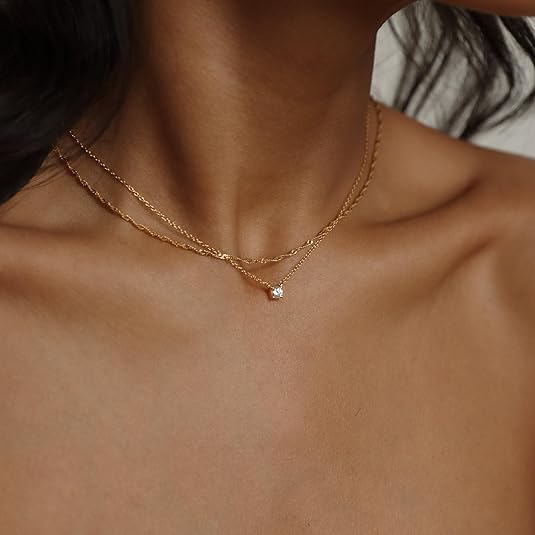
Jewellery: simple and minimal works best in the heat. Pieces that catch the light without requiring maintenance — a thin gold chain, simple earrings, a single ring — look intentional without the weight or anxiety of more elaborate choices. Your wrists get sweaty in July Spain; delicate layered bracelets become uncomfortable surprisingly fast.
Local tip: A good, wide-brimmed hat also photographs beautifully, which — let’s be honest — is half the reason most of us think about accessories before a trip in the first place.
What NOT to Wear: The Tourist Mistakes That Stand Out
Being recognisable as a tourist isn’t the end of the world, but there are a few packing decisions that make life noticeably harder in Spain in July, and I think they’re worth being direct about.
Heavy sports trainers are the most common one. I understand the appeal — comfort, support, they go with everything — but bright white or overly tech-looking trainers in a Spanish city scream tourist in a way that, combined with carrying your passport in a neck pouch, paints a bit of a target. Clean, simple trainers in a neutral colour are fine. Your neon trail running shoes from a 10K last spring are not.
Backpacks in city centres are another thing to reconsider. In Seville’s Barrio Santa Cruz or Barcelona’s Gothic Quarter, wearing a backpack is an open invitation for the kind of attention you don’t want. The contents are easily accessible and you can’t see what’s happening behind you.
Cargo shorts with multiple pockets look practical but actually make you carry more than you need. Flip-flops beyond the beach make your feet vulnerable and are visibly uncomfortable on cobblestones. And over-packing your suitcase means you’re pulling weight through 30-degree heat when you could have packed light and moved freely.
If you’re still building out your Spain wardrobe and want a fuller list, the Spain packing list with 30 clothing must-haves is one of the most thorough references I’ve come across.
Fabrics That Work (and the Ones to Avoid Entirely)
Fabric choice in July Spain makes the difference between an enjoyable trip and a sweaty, uncomfortable one — and yet it’s something most people don’t think about until they’re already there.
Work brilliantly: Linen, lightweight cotton, viscose, modal, chambray, and linen-cotton blends. These breathe, absorb sweat, and stay comfortable even in high heat. White and light colours reflect sunlight rather than absorbing it, which makes a measurable difference in how you feel.
Avoid entirely: Polyester, nylon, synthetic blends marketed as “performance” or “technical” (fine for hiking, not for city streets), thick denim, heavy cotton jersey, and anything with a tight weave that doesn’t allow air circulation.
The grey area: Silk looks and feels beautiful in the heat but wrinkles dramatically with sweat and can show moisture in unflattering ways. Wear it for evenings only, not for morning sightseeing. Rayon and viscose are lovely and light but some versions pill or lose their shape after a hot day — check the quality before you pack them.
Local tip: Hold a fabric up to the light before packing it. If you can see through it even slightly, it’s going to breathe. If it’s completely opaque and dense, think twice.
Your Spain in July Capsule Wardrobe
This is the edit I’d make for a seven to ten day trip to Spain in July, packing for a mix of city exploring, coastal days, church visits, and late dinners.
Tops: 3 lightweight linen or cotton tops (mix of relaxed and slightly smarter), 1 silk-effect top for evenings, 1 oversized linen shirt that doubles as a beach cover-up.
Bottoms: 2 pairs of wide-leg linen trousers, 1 pair of tailored linen shorts, 1 pair of lightweight jeans (if you really can’t live without them).
Dresses: 2 midi dresses in natural fabrics (one casual, one dinner-appropriate), 1 sundress for beach-to-town transitions.
Shoes: 1 pair of well-worn leather sandals with support, 1 pair of clean simple trainers, 1 pair of evening sandals or espadrilles.
Layer: 1 linen blazer, 1 thin cotton cardigan.
Accessories: 1 structured wide-brimmed hat, sunglasses, thin cotton scarf, 1 crossbody bag, 1 packable tote.
That’s it. 22 items including shoes and accessories. Everything mixes, nothing is wasted, and nothing weighs you down in the heat.
Practical Packing: How to Actually Get This Right
The most common mistake I see people make for July Spain is massively overpacking “just in case” scenarios that don’t actually materialise. You don’t need a rain jacket (it barely rains in most of Spain in July — it’s one of the driest months of the year). You don’t need three different jacket options. You don’t need formal clothes unless you’re attending an event.
The outfit-per-day calculation for summer travel should be: fewer physical items, more mixing. Five items that work together in multiple combinations beats ten items that each only work one way.
Before you pack, lay everything out on your bed and do one brutal edit: if you can’t picture wearing it at least twice in different combinations, it stays home. If it’s heavy, reserve it only for a genuinely specific occasion. If you’re bringing it “just in case,” ask what the actual worst case is — usually it’s that you’re slightly cooler than expected one evening, which a single light layer already solves.
If you’re navigating carry-on restrictions and want to know how to make this work in a small bag, the how to pack a carry-on for 10 days guide has some genuinely smart strategies for making it all fit.
Mistakes to avoid:
- Packing for worst-case weather rather than most-likely weather
- Buying new shoes specifically for the trip without breaking them in
- Bringing heavy denim when lightweight linen always performs better
- Forgetting that evenings in Spain are real social occasions worth dressing for
- Packing a bag so full you can’t move quickly through the city
What to Wear Where: A Quick Regional Cheat Sheet
Spain’s regional character means that what works perfectly in Ibiza might feel slightly off in Madrid, and vice versa.
Barcelona: The city has a cosmopolitan edge — fashion matters here and people notice it. Slightly more trend-aware dressing works well. Relaxed but put-together. The beach-to-city transition is common here.
Madrid: Sophisticated and slightly more conservative in style than the coast. Elegant linen and good shoes feel right. The heat is fiercer and more constant, so fabric quality really matters.
Seville/Andalusia: Colour is more welcome here. A bright coral or deep blue dress feels completely at home among the whitewashed walls and flower-filled patios. Siesta culture is still real — plan indoor time between 2pm and 5pm.
San Sebastián: The north is cooler (relatively) and slightly more casual. You might actually use that thin cardigan here more than anywhere else.
Islands (Mallorca, Ibiza, Canaries): Beach culture is king. The bikini-to-dress transition is practically expected. Evenings on Ibiza trend glam; Mallorca is more relaxed.
Here’s the thing about packing for Spain in July — once you’ve let go of the idea that you need to be prepared for every weather eventuality, everything becomes easier. The heat is the constant, and it’s actually wonderful once you stop fighting it. The food happens at night, the streets come alive after 9pm, and the light in July is something you simply have to stand in and appreciate. Dress for the warmth, make friends with linen, find a pair of sandals that genuinely support your feet, and leave the rest at home. You’ll move through Spain freer, more comfortable, and far more like someone who actually knows where they are — which, honestly, is the whole point of packing well in the first place.

