
November in Lisbon is a mood. One hour you’re peeling off your jumper on a sunny miradouro with a pastel de nata in hand, the next you’re sprinting under a shop awning while the Atlantic empties itself onto the cobblestones. The light is gold, the crowds are thinner, and the whole city feels like it exhaled after summer.
It’s also a city built on seven hills, paved in slippery limestone, and full of locals who look annoyingly effortless in a camel coat. Pack like it’s July and you’ll shiver. Pack like it’s Scandinavia and you’ll sweat your way up Alfama.
I’ve watched plenty of travellers get this wrong: white trainers that die by lunchtime, a flimsy “waterproof” jacket, a suitcase full of outfits that never leave the bag. Here’s what actually works.
Before We Dive In
A few quick facts so the rest makes sense.
Weather: Expect daytime highs around 16–18°C (low 60s°F) and evenings dipping to roughly 10–12°C (low 50s°F). November is one of Lisbon’s wetter months, with showers rolling in and out, often followed by bright sun twenty minutes later. Humidity is high, so cold feels colder than the number suggests. Always check the forecast a few days before you fly.
Walking conditions: Lisbon is steep. The calçada portuguesa, those gorgeous black-and-white limestone pavements, turns into a skating rink when wet. Trams, funiculars and metro help, but you’ll still walk 15,000+ steps on a normal day.
Style culture: Lisboetas dress neat, simple and a little understated. Dark denim, tailored coats, leather boots, scarves. Nobody is in activewear unless they’re actually exercising. This matters more than you’d think.
If you’re travelling elsewhere in Portugal or Europe, take a look at our other month-by-month packing guides: [INSERT INTERNAL LINK: related Portugal/Europe packing guide from the sitemap].
Layers Matter More Than Any Single Piece
Here’s the truth: there is no perfect Lisbon November jacket, only a perfect system. The day swings 6–8 degrees between a sunny square and a shaded alley, so you need to adjust on the move.
My formula is three layers: a thin base (a cotton or merino tee), a mid layer (a fine-knit jumper or overshirt), and a weatherproof outer. On a typical morning you’ll wear all three, strip to two by lunch, and re-add everything by sunset when the wind off the Tagus bites.

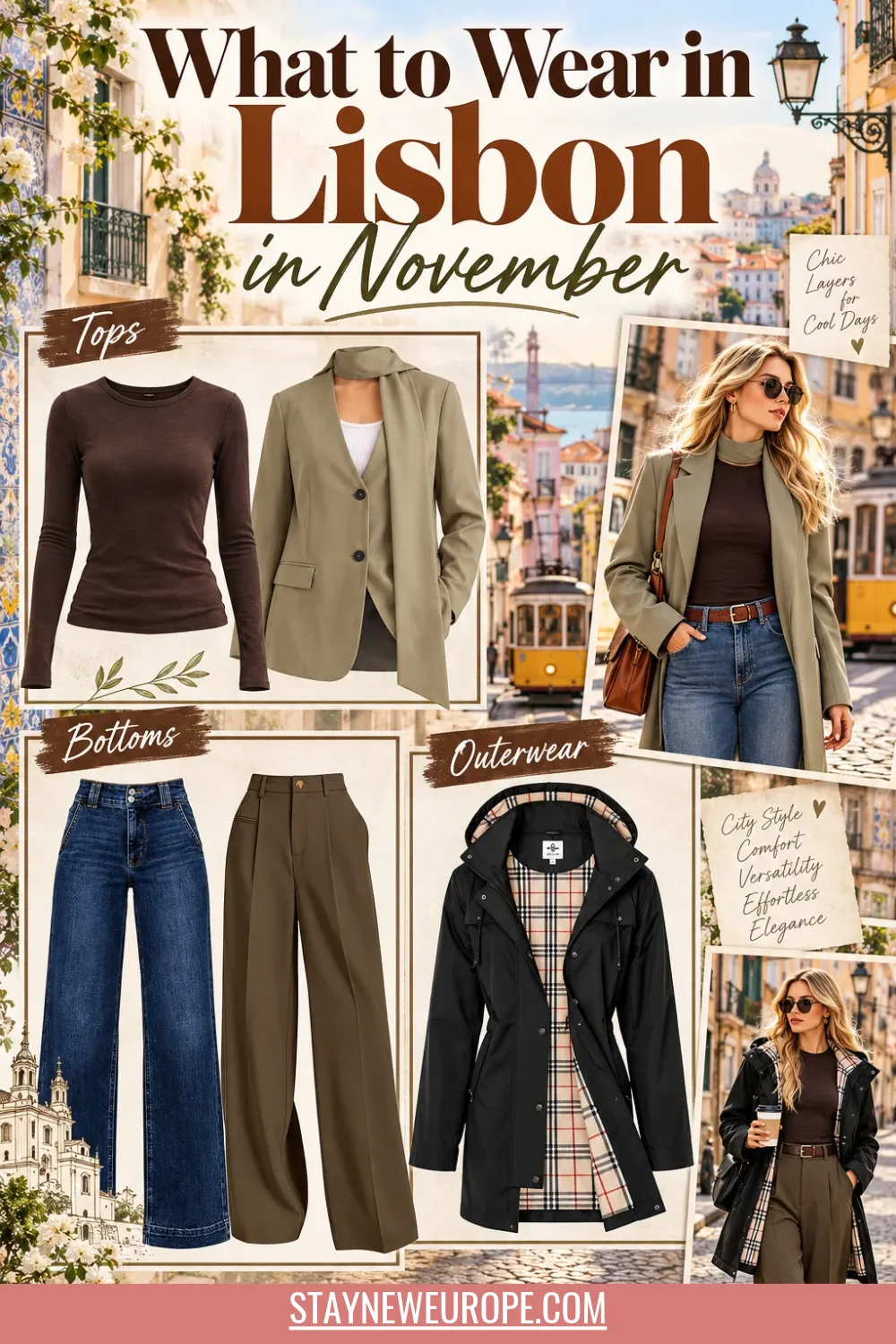
Outfit combo: long-sleeve tee, wool-blend cardigan, light trench. It looks pulled together at a café and survives the 28 tram queue.
Local tip: Choose layers you can tie or stuff into a bag. A cardigan that’s too bulky becomes a burden the moment the sun appears.
The Lisbon Dress Code (And How to Blend In)
Lisbon isn’t as formal as Milan or Paris, but it’s far more polished than a beach town. Think “casual with intention.”
What works: neutral palettes (navy, camel, olive, cream, black), clean lines, and one or two textures, like wool, suede or leather. What stands out: athletic leggings as outerwear, oversized logo tees, flip-flops, and a daypack covered in patches.
I learned this the hard way when I wandered into a lovely little tasca in a hiking jacket and felt like the one guest who missed the memo. A swap to a simple blazer fixed that for every dinner after.

Local tip: If in doubt, go darker and plainer. Lisbon rewards quiet style.
What NOT to Wear (Tourist Mistakes I See Every Week)
Let me be honest: the biggest offenders are shoes. Smooth-soled leather loafers, flat canvas sneakers and fashion boots with zero grip become genuinely dangerous on wet calçada.
Also on the no-list: shorts (too cold, and you’ll stand out), thin ponchos from a souvenir shop, heavy puffer parkas (overkill, and you’ll roast on trams), and anything that needs ironing. Lisbon trips are not wrinkle-friendly.
And please, skip the “all white” travel outfit. Between puddles and sooty tram grease, it won’t make it past day two.
Local tip: If a shoe slips on your hotel’s marble lobby, it will slip on every Lisbon hill.
Jeans, Trousers and (Sadly) No Shorts
Jeans are your best friend here. Dark, straight or relaxed-fit denim handles drizzle better than you’d expect and goes from morning wandering to dinner without a change. Avoid super-skinny styles that cling when wet.

For something smarter, wool-blend or cotton twill trousers in navy or charcoal are brilliant. I also love lightweight ankle-length trousers, which keep hems out of puddles. Linen? Save it for summer.

Outfit combo: dark jeans, fine-knit jumper, ankle boots. Repeat it three times with different tops and nobody will notice.
Local tip: Pack one pair of quick-dry trousers if you’re planning a Sintra day trip. Sintra is mistier, muddier and several degrees cooler than the city.
Walking Shoes: Grip First, Style Second (But You Can Have Both)
If you only take one piece of advice from this article, let it be this: shoes with real rubber soles. You’ll climb stairs, hills and slick stone, and your feet will thank you.
My go-to is a leather or suede ankle boot with a chunky tread, ideally water-resistant. They look sharp with jeans and skirts alike. A sleek leather sneaker with a proper grip sole is the second option, and one pair of those can cover most days.

Break everything in before you arrive. Blisters on cobbles are a special kind of misery.
Local tip: Bring a small bottle of waterproofing spray. Two minutes of spritzing in your hotel room before day one saves your suede.
Tops and Knits for Women
Think soft, simple and easily layered. Fine merino or cotton long-sleeve tees, a couple of silky or crepe blouses for dinner, and two or three jumpers in flexible colours. Striped Breton-style tops are a quiet Lisbon classic, and they photograph beautifully against all that tilework.
A turtleneck or mock-neck knit is probably the most useful single top in November. It keeps your neck warm, looks polished, and pairs with jeans, a skirt or tailored trousers.

Outfit combo: cream turtleneck, high-waisted wool trousers, leather boots and a tote bag. Done.
Local tip: Avoid fabrics that cling when humid. Slightly structured cotton blends hold their shape far better than thin synthetics.
Skirts, Dresses and Tights
Yes, you can wear them. A midi skirt or knit dress with opaque tights and boots is one of the most Lisbon outfits you can build. It’s warm, it moves well on stairs, and it feels instantly dressed up.

Choose midi or knee-length over mini: gusty hills and tram steps are not kind to short hemlines. Fleece-lined tights are worth the pack space for cool evenings by the river.

I wore a corduroy skirt, black tights and a chunky cardigan for a whole day of tile hunting and still felt fresh at fado that night.
Local tip: Pack a pair of spare tights. One snag on a rough stone wall is all it takes.
Jackets and Coats for Unpredictable Weather
Here’s where I’d spend the money. You want a water-resistant outer that isn’t a bulky parka: a lightweight trench, a quilted mid-weight jacket with a hood, or a waxed-cotton jacket. Wool coats look fabulous, but they soak up rain and take forever to dry in humid hotel rooms.
My pick for most people is a hooded, water-resistant trench in beige or navy. It’s smart enough for dinner, practical enough for downpours, and slim enough to wear over layers.

Avoid ultra-thin “packable” shells unless you’re pairing them with a warmer mid layer. On a windy evening at the Miradouro da Senhora do Monte, you’ll feel every gust.
Local tip: Get a jacket with real pockets and a zip. Lisbon’s busy trams and metro are classic pickpocket zones.
Evening Outfits That Don’t Scream “Tourist”
Dinner in Lisbon is relaxed but stylish. For restaurants in Chiado, Príncipe Real or Alfama, think dark denim or tailored trousers, a nice knit or blouse, a blazer, and polished boots. Add a scarf and you’re set.

For fado houses and cocktail bars, go a little more dressed up, but nothing black-tie. A simple dress with a leather jacket, or a silk shirt with trousers and block heels (low, stable ones, remember the cobbles) works beautifully.

The thing I noticed most? Locals don’t change drastically between day and night; they just refine. A swapped top, a swipe of lipstick, fresh accessories.
Local tip: Dinners start late (often 8 or 9 pm). Layer up for the walk home, as temperatures drop fast after sunset.
What to Wear in Churches and Monasteries
Lisbon’s big sights, like Jerónimos Monastery, the Sé Cathedral and Carmo, are places of worship first. Most expect shoulders and knees covered, especially in active areas, though enforcement varies.
November is easy mode here: your layers already cover everything. A scarf doubles as a shawl if you get caught in a sleeveless top, and midi hems or trousers keep you safe.
Local tip: Take hats off inside. It’s a small gesture that locals notice and appreciate.
Bags: Crossbody vs Backpack
Skip the big backpack. It’s a hassle on crowded trams, awkward in tiny cafés, and a pickpocket magnet. A zip-top crossbody bag in leather or sturdy nylon keeps your essentials in front of you and your hands free.

If you’re out all day, I like a compact tote with a zip, big enough for a scarf, an umbrella and a water bottle. For the flight, pick a small carry-on duffle or a soft-sided cabin suitcase. Lisbon’s cobbled streets chew up hard-shell wheels, and a soft bag is easier on staircases in older buildings.

Local tip: Keep your phone in an inside pocket on Tram 28. It’s the most targeted route in the city.
Accessories That Make Simple Outfits Look Considered
Accessories do the heavy lifting in November. A wool or cashmere-blend scarf is arguably the most important item in your bag: it warms you, dresses up a plain tee and doubles as a church cover-up.

Beyond that: a beanie for cold evenings, simple gold or silver jewellery, a leather belt, and sunglasses. Yes, sunglasses. November sun in Lisbon is low and bright, especially along the water.
A pair of thin gloves isn’t essential, but I was grateful for them one breezy night near the river.
Local tip: Buy a small hand-painted ceramic or cork accessory at a local shop. It’s a souvenir you’ll actually wear.
Rain Prep: The Boring Stuff That Saves Your Trip
Pack for rain even if the forecast looks clear. A compact, sturdy umbrella (wind-resistant, please) beats a flimsy one that flips inside out on the first gust. Water-repellent shoes, a hooded jacket and a small waterproof pouch for your phone and documents all earn their place.

I also tuck a spare pair of socks into my bag. Few things lift your mood faster than dry feet after an unexpected downpour.
Local tip: When it pours, duck into a pastelaria. Ginjinha, coffee and a warm custard tart beat an umbrella any day.
Fabrics to Choose (and Avoid)
Choose: merino wool, cotton blends, corduroy, denim, suede or leather (treated), and lightweight knits. They breathe, layer well and recover from humidity.
Avoid: pure linen (too cool and wrinkly), thin synthetics that trap sweat, heavy fleece (too hot indoors), and delicate silk that shows every raindrop.
Quick rule: if it dries slowly and wrinkles easily, leave it at home.
Local tip: Hang damp clothes by the window overnight. Lisbon’s breezes help more than a radiator.
The November Lisbon Capsule Wardrobe
You can cover nearly every situation with around 12 pieces:
- Two pairs of jeans or trousers (one dark denim, one smarter)
- One midi skirt or dress
- Three tops (a tee, a blouse, a Breton stripe)
- Two knits (one turtleneck, one cardigan)
- One water-resistant trench or jacket
- Two pairs of shoes (grip boots plus leather sneakers)
- One scarf and one small crossbody bag
Mix and match in neutral colours and every piece works with the others. That’s the secret to travelling light.
Packing Practicalities
How many outfits: For a 5–7 day trip, I pack about 5–6 outfits, repeat bottoms freely, and rotate tops and layers. Nobody remembers your jeans, but they will notice a limp, tired jumper.
Packing light vs overpacking: Light wins in Lisbon. Stairs without lifts, tiny tram steps and steep streets make big luggage a pain. If you can carry your bag up three flights without cursing, you’ve packed correctly.
Outfit planning tips: Lay everything out before you pack. If an item doesn’t work with at least three other pieces, leave it behind.
Mistakes to avoid: Overpacking shoes, assuming it’ll be warm, forgetting a rain layer, and bringing new shoes you haven’t broken in.
Non-clothing essentials: A universal adapter (Portugal uses Type C/F plugs), a power bank, a reusable water bottle, a compact umbrella, blister plasters and a small travel laundry kit.
FAQs About the Lisbon November Packing List
Is it too cold for sandals? Yes, in most cases. Closed shoes are far more comfortable and safer on wet stone.
Do I need a heavy winter coat? Rarely. A mid-weight, water-resistant jacket plus layers handles most days.
Can I wear sneakers? Absolutely, as long as they’re leather or sleek and have good grip. Avoid chunky white or flat canvas pairs.
Should I bring an umbrella? Yes, a compact, wind-resistant one.
Is Lisbon dressy for dinner? Smart casual is perfect. You don’t need formal wear.
Go Get Lost in a Good Coat
Lisbon in November is the version of the city that locals love best: softer light, quieter miradouros, tiled facades glowing after rain. You don’t need a fashion degree to enjoy it, just a few good layers, shoes that grip, and the confidence to wear your jacket like you meant to.
So pack the scarf, break in the boots, and leave a little room in your bag for the tiles, tins of sardines and wine you’ll inevitably bring home. The city will handle the rest.

