
Valencia in November is a funny, lovely in-between. One afternoon you’re sitting on a terrace in sunglasses, shirtsleeves rolled, wondering why you packed a coat. The next morning the sky turns the colour of wet slate and the city smells like warm pavement and rain.
The streets are calmer, the light turns golden by 4pm, and the whole city seems to be strolling: along the Turia Gardens, through the old town’s tangled lanes, down to the beach for a very long paella lunch. Walking is the whole point, which means what you put on your feet and your back matters more than you’d think.
Most visitors get it wrong in one of two directions. They pack for a beach holiday because “it’s Spain,” or they pack for Northern Europe because “it’s November.” Valencia sits right in the middle, and I’ve seen both mistakes shivering in the same café. Let me save you from both.
Before We Dive In
Weather: Expect daytime highs of roughly 17–20°C and evenings dropping to around 8–12°C. Rain is the wildcard, with around 55mm falling on average across the month, often in short, sharp bursts rather than all-day drizzle. You’ll still get plenty of sun, though sunset arrives early, around 5:40–6pm.
Walking conditions: Valencia is flat, which is a gift. The catch is the old town (El Carmen and around the Cathedral), where the paving is a mix of smooth stone, uneven slabs and the occasional slippery patch after rain. You’ll comfortably walk 15,000+ steps a day without noticing.
Style culture: Valencians dress smart-casual and a little more put-together than most tourists expect. Think dark denim, good knitwear, clean sneakers or boots, and a scarf worn as though it’s nothing. Nobody is in a full tracksuit at dinner. You don’t need to dress up, just dress on purpose.
Note: If you’re traveling to other cities and regions in Europe, check out our other monthly guides, like Barcelona in November – INSERT LINK and Seville in November – INSERT LINK.
1. Lightweight Layers: The Only Rule That Really Matters
Valencia in November can run a 10-degree swing between a sunny 2pm and a breezy 8pm. Layers are how you win.
I learned this the hard way on my first November trip, when I left the hotel in a thick sweater at 9am and was carrying it like a hostage by noon. Now I build outfits in three thin pieces: a base tee or fine-knit top, a mid-layer (cardigan, overshirt or merino sweater), and an outer layer I can peel off and stuff in a bag.

A typical day looks like this: tee plus cotton overshirt for the morning market, shed the overshirt at lunch, add a sweater and scarf at sunset. Three pieces, four looks, zero stress.
Local tip: Choose layers that look good on their own. If your “mid-layer” only works under a coat, you’ll be stuck wearing the coat indoors, sweating through a lovely lunch.
2. What Actually Works Dress-Code-Wise in Valencia
Valencia is relaxed, but relaxed in a stylish way, and the locals are quietly good at it.
Neutrals are the uniform: navy, black, camel, olive, cream, grey. Add one colour moment, like a rust scarf or a burgundy knit, and you’ll look like you live here. Loud logos and head-to-toe athleisure are the fastest way to get labelled a tourist, though honestly nobody will mind.
For daytime, jeans, a knit and clean sneakers are perfect. For dinner, swap the sneakers for ankle boots, add a better jacket, and you’re done. Valencians eat late (9pm is normal), so the restaurant crowd tends to be sharply dressed and well-fed.

Local tip: Take a look at what people are wearing on Calle Colón or in Ruzafa and borrow shamelessly.
3. What NOT to Wear (The Tourist Mistakes)
Let me be honest: I’ve made most of these myself.
Skip the flip-flops (too cold, and the pavements are not kind to them), brand-new unbroken-in shoes, and anything white-and-delicate if rain is forecast. Also skip the full summer wardrobe: shorts and tiny tank tops will leave you shivering by 6pm. And don’t bring that enormous puffer meant for a Scandinavian winter, because you’ll be sweating in it by lunchtime.
The sneakiest mistake is a single heavy coat. It’s either too warm for the day or too thin for the night. This is why layers beat one big jacket every single time.
Local tip: If you’re unsure about an item, ask yourself “Would this work at 3pm AND 8pm?” If not, leave it home.
4. The Jacket: Light, Smart, and a Bit Rain-Ready
This is your most important single piece.
My pick is a trench, a water-resistant bomber, or a clean utility jacket in a neutral shade. Something that cuts the wind at night and doesn’t turn you into a sauna during the day. A light unlined or lightly padded jacket is a sweet spot.

I’d rather wear a mid-weight jacket over a sweater than a heavy coat over a tee. It gives you flexibility, and the jacket pairs with both jeans and a dress.
Local tip: Check the pockets before you buy. Valencia means constant sunglasses, phone, and metro card switching, and a jacket with real pockets saves your bag.
5. Jeans, Trousers or Shorts: Pick Your Fighter
Long pants win, and it isn’t close.
Straight-leg or relaxed jeans in mid or dark wash are the backbone of almost every outfit I pack. They handle the evening chill and cobblestone wandering and look right everywhere from the central market to a nice dinner. For something dressier, a pair of tailored wool-blend or cotton trousers does the job.

Shorts? I’d leave them. Even on a 20°C day, the shade in narrow streets is cooler than you’d expect, and I’ve never seen a local in shorts in November. If you’re a “always warm” person, cropped trousers are a fair compromise.
Local tip: Pack one pair of dark, slightly stretchy trousers that you can wear to dinner AND on a day of walking. It’s the best-value item in the bag.
6. Comfortable but Stylish Walking Shoes
Your feet will carry you across the whole city, so this is where you should spend the money.
My daily shoe is a clean leather or canvas sneaker in white or cream. It matches everything, and Valencians wear them constantly. For rain or a dressier evening, a low-heeled ankle boot with a decent grip is the second pair worth packing.

Please break them in before you leave. I once wore new boots to the Cathedral and spent the afternoon performing a very elegant limp. Wear thin, breathable socks, since the sun can make shoes warmer than you expect.
Local tip: If rain is forecast, choose rubber-soled shoes. Wet polished stone in the old town can be surprisingly slippery.
7. What to Wear in Valencia in November for Women
For women, the formula is simple: pieces that mix and match.
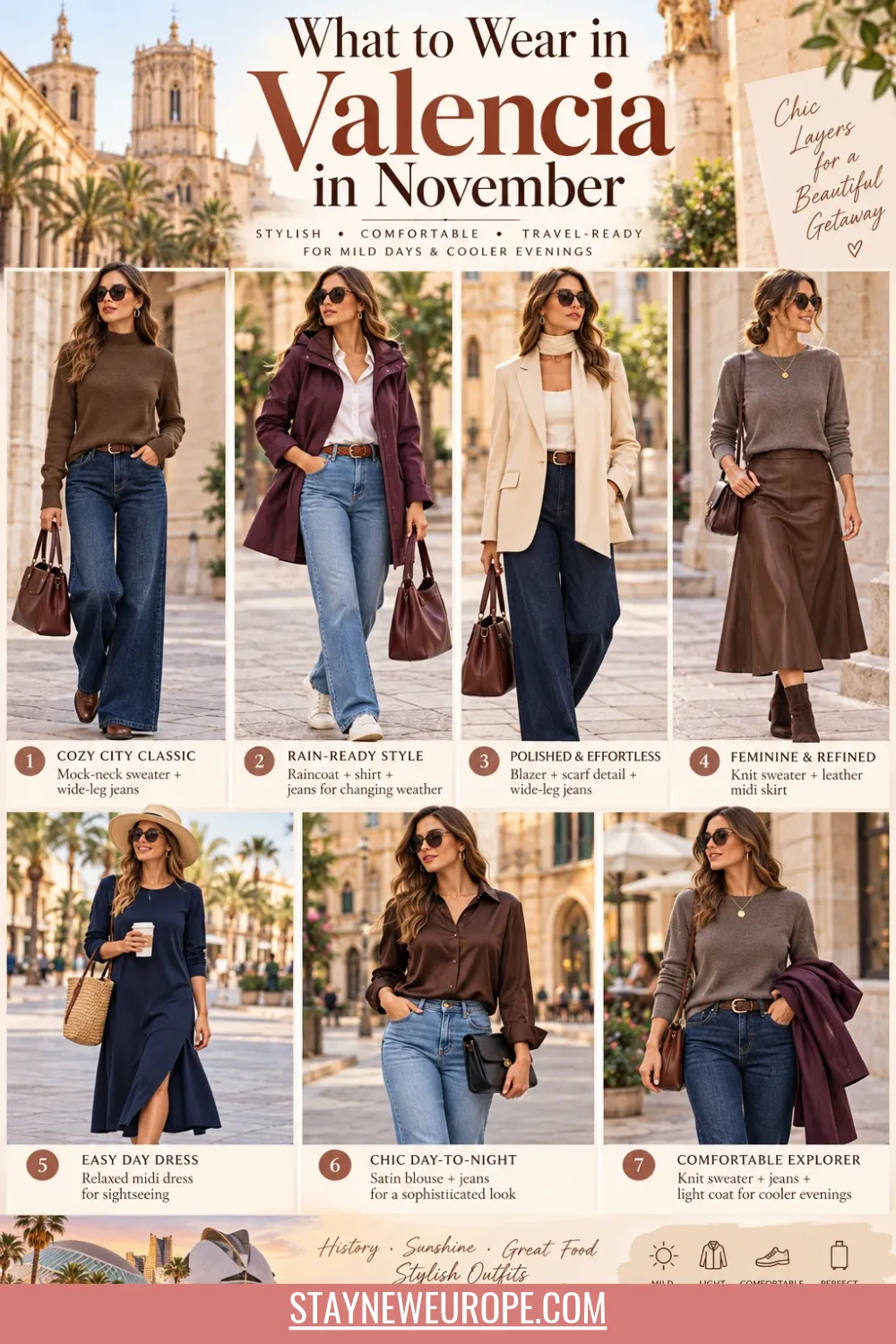
Pack two or three tops (a fitted tee, a silk-feel or cotton blouse, a fine-knit sweater), one midi skirt or dress that works with boots, and one pair of tights or thin leggings for cool evenings. A midi skirt with ankle boots and a denim jacket is probably my favourite Valencia outfit: it works for a morning walk, a long lunch and dinner too.

Dresses are absolutely still on the table. Just treat them as part of a layered outfit, with a cardigan or jacket on top and tights or a chunky sock-and-boot combo underneath.

Local tip: Choose skirts and dresses that have some weight to them. A flimsy summer dress will fly around in the sea breeze, and nobody wants that on the Malvarrosa promenade.
8. Evening Outfits That Don’t Scream “Tourist”
Dinner is where Valencia dresses up a little, and it’s a lovely excuse to wear something good.
Think of one “going out” outfit you’d wear at home to a nice restaurant. For me it’s dark jeans, a silky top, a blazer, and boots. It’s polished without being fancy. Men do well with chinos, a fine knit or a crisp shirt, and a jacket.

Evenings drop to about 8–12°C, and many terraces have heaters but not walls, so bring something warm that looks intentional, like a wool scarf or a tailored coat, not a hiking fleece.

Local tip: Bring a scarf that doubles as a shawl. It’s the single most useful dinner accessory I own.
9. What to Wear for Churches and the Cathedral
Valencia’s Cathedral and several churches expect modest dress, and it’s easy to manage.
Keep shoulders and knees covered. If you’re in a sleeveless top, a light scarf or cardigan solves it in two seconds. Shorts and very short skirts can get you turned away at the door.

Since you’re already layering in November, this is the easy part. Throw an overshirt or cardigan over your top and carry on.
Local tip: A big cotton scarf in your daybag means you’re always church-ready, and it’s your sunset layer, too.
10. Bags: Crossbody vs Backpack (and What to Pack Everything In)
Let’s talk luggage first. For a long weekend, I’m a carry-on-only convert. A 35–40 litre soft-sided duffle or weekender bag fits under most airline seats limits and forces you to edit. It’s also easier to haul up the stairs of the beautiful-but-liftless apartment you’ve booked in the old town.

For daily wandering, a crossbody bag is the winner. It keeps your phone and wallet close and your hands free for pastries. A small leather or nylon crossbody is lovely, as long as it zips shut.

A backpack works for beach days or a trip to the Albufera, but I’d skip it for crowded markets. It’s awkward in crowds and it’s easy for pickpockets to reach.
Local tip: Choose a bag that closes properly. Zips or flap closures beat open totes in busy areas like the Mercado Central.
11. Accessories That Elevate Simple Outfits
Accessories are the cheapest way to look like you tried.
A scarf is number one: it adds warmth, colour and polish. Next, sunglasses, because November sunshine in Valencia is real and low-angled, and it’s in your eyes all afternoon. Finally, a simple belt and a pair of small earrings or a watch pull a plain outfit together.

Gloves and hats aren’t needed. You’re not going to Norway.
Local tip: Pack accessories in a small pouch so they don’t get lost in the bottom of your bag.
12. Rain Preparation (Unexpected but Important)
Valencia’s rain doesn’t hang around, but when it arrives, it commits.
Pack a compact umbrella, or better still, a lightweight water-resistant jacket with a hood. Showers are often short and heavy, so shelter in a café for twenty minutes and the sun usually returns. One practical note: the region occasionally gets serious weather warnings, so check the forecast and official alerts from Spain’s national weather agency (AEMET) before heading out on day trips, and follow local guidance.

A pair of shoes that can survive a puddle is the other half. Suede and fabric sneakers will be your enemy.
Local tip: Leave a small umbrella in your daybag all week. The day you leave it behind is the day it pours.
13. Fabrics to Choose (and Avoid)
Fabric choice is the difference between comfortable and miserable.
Go for cotton, merino wool, wool blends, and lightweight denim. They breathe in the afternoon warmth and insulate in the evening chill. Merino is a particular favourite because it regulates temperature and doesn’t smell after a day of walking.

Avoid pure linen (too thin and creases like crazy), heavy polyester (sweaty when the sun comes out), and anything very thick and bulky. Humidity near the coast sits at around 65–75%, which makes synthetic fabrics feel clammy.
Local tip: Roll your knits instead of folding them. They’ll arrive crease-free, and take up less space.
14. Capsule Wardrobe for Valencia in November
This is the list I’d actually pack for a long weekend or a week.
Three tops, one fine-knit sweater, one overshirt or cardigan, one light jacket, two pairs of long trousers or jeans, one midi skirt or dress, a pair of white sneakers, a pair of ankle boots, a scarf, and sunglasses. Everything should mix with everything else, built around two or three neutrals and one accent colour.

Mix and match them and you get at least seven outfits. I’ve done a full week out of a carry-on this way and still had room for ceramics from the market.
Local tip: Lay your outfits out on the bed before packing. If an item only works in one outfit, it doesn’t go in the bag.
Packing Practicalities
How many outfits: For a week, I’d bring 5–6 tops, 2–3 bottoms and 2 pairs of shoes (plus the ones you wear on the plane). Laundry is easy to find, and everything should coordinate.
Packing light vs overpacking: Light wins, every time. You’ll be walking a lot, taking the metro, and perhaps dragging a bag up stairs. Pack for 70% of your trip and wash the rest.
Outfit planning tips: Plan one outfit per type of day: morning exploring, long lunch, evening out. Your layers do the rest.
Mistakes to avoid: Packing “just in case” outfits, bringing brand-new shoes, forgetting a rain layer, and not leaving room for souvenirs. Also, pack your essentials (meds, chargers, one change of clothes) in your carry-on if you check a bag.
Non-clothing essentials: A reusable water bottle, a portable phone charger, a universal adapter (Spain uses the two-round-pin European plug), sunscreen (yes, even in November), a small first-aid kit with blister plasters, and a lightweight tote for market shopping.
FAQs About Packing for Valencia in November
Is it warm enough to swim in Valencia in November? The sea sits at around 18°C, so only the brave will swim. Most people sunbathe in a sweater and eat paella instead.
Do I need a heavy coat? Usually not. A light or mid-weight jacket plus layers is enough for most days and evenings.
Can I wear sneakers to dinner? Yes, if they’re clean and simple. Leather or minimalist white sneakers work well in most restaurants.
Should I bring an umbrella? Yes, a compact one. A light hooded rain jacket is even better.
Is it a good idea to bring shorts? I’d skip them. Long trousers or a midi skirt will serve you better.
Go Get Dressed, Then Go Get Lost
Here’s what I love most about Valencia in November: the city lets you slow down. You’ll wander into a courtyard you didn’t plan to find, linger over a coffee because the light is perfect, and end up at a tiny bar where everyone’s eating something you can’t pronounce but must order.
Pack a few good layers, a pair of shoes you trust and a scarf that makes you feel put-together, and then forget about your suitcase entirely. The city will take care of the rest. Go on, book the flight.

