
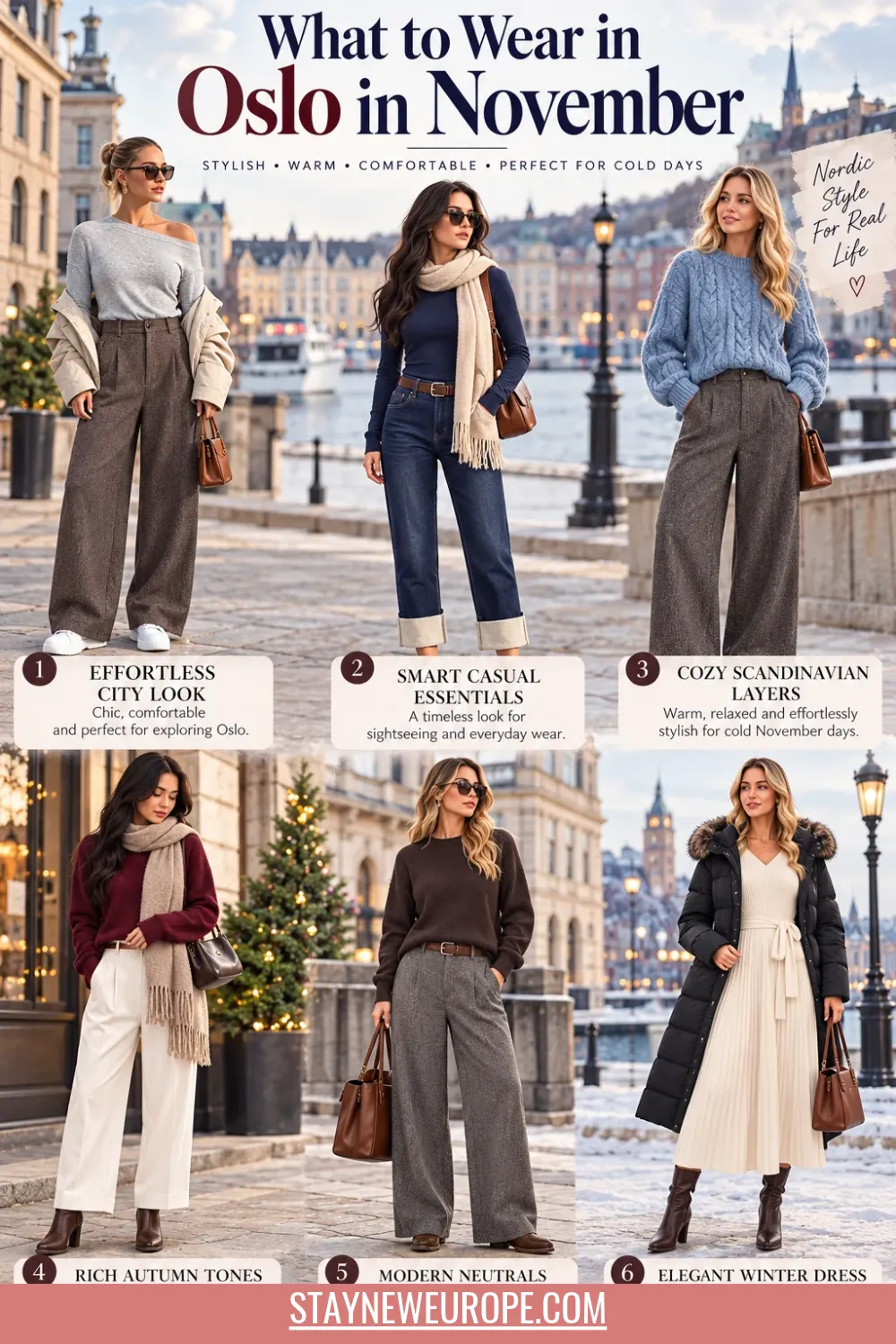
Oslo in November is a mood. The sun clocks in late, clocks out mid-afternoon, and in between it gives you soft grey light, wet leaves on the pavement and a fjord that looks like brushed steel. Then the whole city lights candles in every café window and suddenly it’s the coziest place in Europe.
It’s also damp, properly cold, occasionally icy, and the weather can’t make up its mind. I’ve watched people step off the airport train in sneakers and a denim jacket and visibly regret every decision they’ve ever made.
Here’s what I’d actually put in the bag: the layers that work, the shoes that won’t betray you on a frosty tram platform, and the mistakes I’d rather you not repeat.
Before We Dive In
A quick reality check before the outfit talk:
Weather: Expect roughly -1°C to 5°C (30–41°F) for most of the month, with the chillier end arriving as November goes on. Rain and sleet are common, and the first snow can show up. The cold is a damp, get-into-your-bones kind, so the thermometer undersells it. Daylight is short, with the sun setting somewhere around 3:30–4:30 pm.
Walking conditions: Oslo is easy to walk but not flat. There are hills, tram tracks, wet leaves and the odd icy patch, especially around the fjord and in the morning. You’ll cover a lot of ground on foot, so grip matters more than looks.
Style culture: Norwegians dress for the weather first and style second, but they do both well. Think dark, clean, minimal and quietly high-quality. You’ll see technical outerwear over beautiful knitwear, and nobody blinks at a hiking-style boot at a nice dinner.
Heading elsewhere in Europe? Check our other monthly guides: Placeholder: related packing guide 1 · Placeholder: related packing guide 2
A Carry-On Bag That Won’t Wreck Your Back
Winter clothes are bulky, so luggage becomes a real decision. I learned this the hard way when my “just a small bag” plan met two sweaters and a coat.
A 40L carry-on backpack or soft duffel is my pick. The Osprey Farpoint 40 is a favourite for a reason: it opens like a suitcase, fits most airline cabin limits and handles a tram ride and a staircase without complaint. Soft-sided beats hard-shell here because you can squish it into a small hotel room or an overhead bin.

Wear your heaviest items on the plane (boots, coat, chunkiest knit). It looks slightly ridiculous in the airport queue and saves you precious bag space.
Local tip: The Flytoget and regional trains from the airport are efficient and warm. Keep your coat on top of your bag, not buried, because the walk from platform to street is where the cold hits.
Base Layers: The Unglamorous Hero
Let me be honest: nobody is going to see this layer, and it will be the reason you enjoy your trip. A thin merino base layer is the difference between “charming cold stroll” and “counting minutes until the next café.”

Merino wool (Icebreaker, Smartwool or Norwegian-founded brands like Devold) regulates temperature, resists smells and stays warm even when slightly damp. Pack a top and a pair of leggings or long johns and wear them under jeans or trousers on the coldest days.

If merino is out of budget, Uniqlo’s Heattech range is a decent stand-in. It’s thinner and less odour-resistant, but it works for a short trip.
Local tip: Skip cotton as your base layer. Once it gets damp from sweat or sleet, it stays damp and cold.
Knitwear and Mid Layers (Your Style Moment)
This is where you get to look good. A chunky wool or wool-blend sweater is basically Oslo’s unofficial uniform, and it earns its place both for warmth and for how it looks at dinner.

Go for neutral shades such as oatmeal, charcoal, navy, forest green or deep burgundy. A quarter-zip merino sweater works over a collared shirt, and a roll-neck works with practically everything. Norwegian-style patterned sweaters from brands like Dale of Norway are a lovely souvenir and genuinely warm, though a little full-on as an everyday piece unless you lean into it.

Morning exploring outfit: base layer, roll-neck, jeans, boots, coat. Add a thin fleece or lightweight down vest underneath your coat if it’s a particularly raw day.
Local tip: Layer thin-to-thick rather than wearing one massive sweater. Museums and trams are heated, and you’ll be peeling off layers every few minutes.
The Coat: Where Not to Cheap Out
If you only spend money on one thing, spend it here. You’ll wear this coat every day, in every photo, and it decides whether you’re comfortable.
You want a waterproof or at least water-resistant, windproof coat that covers your hips, ideally with a hood. A long down or synthetic-insulated parka is the easiest choice. Norwegian brands like Helly Hansen and Bergans make excellent, locally tested options, and Fjällräven’s Expedition range is a solid alternative. A wool overcoat looks stunning but isn’t practical in sleet, so only bring one if you’re mostly doing dinner-and-café days and are prepared to bring a rain shell too.

I’ve seen people try to get away with a fashion trench in November. They lasted about forty minutes before dashing into the nearest shop for a hot chocolate and a rethink.
Local tip: Hoods matter more than you think. An umbrella is almost useless in blustery wind, but a good hood works in any weather.
Jeans, Trousers and Skirts (Yes, Skirts)
Jeans are fine, and Norwegians wear them constantly. Just choose a thicker, darker pair rather than skinny stretchy denim, which gets chilly and clingy when wet.

Better still: lined or thermal trousers, wool-blend pants or hiking-style trousers in a dark, neat cut. They shrug off drizzle and look sharp enough for dinner. If you love skirts, go for a midi or maxi in wool or corduroy, worn with fleece-lined tights and knee-high boots.

Leave the shorts and leggings-as-trousers at home. Thin leggings under a tunic are fine if they’re thermal, but alone they won’t cut it.
Local tip: Pack one pair of dark, water-resistant trousers you can wear for both daytime wandering and a nice meal. It saves space and takes the guesswork out of getting dressed.
Boots: Grip Before Glamour
Your feet will make or break the trip. Cold, wet feet turn a magical afternoon into a miserable one fast.
Choose waterproof leather or suede-treated boots with a proper rubber sole and decent tread. Blundstones are great for city days, and Ecco, Sorel or Timberland make equally good options. Hiking boots like the Salomon or Merrell models are less pretty but handle ice better, and no one in Oslo will judge you.

Break your boots in before you travel. Blisters in sub-zero temperatures are a special kind of unpleasant.
Local tip: Pack a pair of lightweight ice grips (Yaktrax or similar slip-on cleats) if you’re visiting later in November or heading up into the hills. They weigh almost nothing and you’ll be very glad of them on one icy hill.
Socks: The Quietly Important Bit
I used to ignore socks. Then I spent an afternoon walking around Oslo in cotton ones that got damp in the sleet, and I became a convert.
Merino wool socks keep your feet warm even when slightly wet and don’t smell after a day’s walking. Pack four or five pairs for a week, plus a thin liner pair if you run cold. Darn Tough and Smartwool are reliable picks.

Local tip: Bring a spare pair in your day bag. Changing damp socks mid-day is a small act of self-love.
Hat, Gloves, Scarf: The Cheap Upgrade
These three items take almost no room and change everything. The Norwegian cold gets in at the neck, ears and fingers first.
A wool or fleece-lined beanie, a large scarf you can wrap twice, and gloves with touchscreen fingertips (or a thin liner glove under a thicker mitten) will keep you comfortable. Merino or lambswool scarves feel lovely and double as a blanket on a chilly tram.

Local tip: Pick a neutral colour for all three so they match every outfit. Oslo style leans muted, and a bold orange hat will mark you out as a visitor instantly.
Rain Preparation (Unexpected but Important)
November in Oslo brings drizzle, sleet and occasional heavier showers. A big golf umbrella is a nuisance on narrow pavements and doesn’t survive fjord gusts.
Better to bring a waterproof shell or a coat with a hood, plus water-repellent boots. A compact, wind-resistant travel umbrella is handy as a backup. Bring a small dry bag or zip pouch to protect your phone, passport and camera.

Local tip: Waterproof sprays like Nikwax can revive old boots and coats. Treat them a day or two before you go.
Dressing Like You Belong (What Actually Works in Oslo)
Oslo isn’t Milan: nobody expects heels and tailoring on the pavement. What works is a clean, understated look: dark denim or trousers, a well-fitting sweater, quality boots and a sleek coat.

Colour palette-wise, black, charcoal, navy, camel, cream and forest green make everything mix and match, which is the secret of a capsule wardrobe. Add one pop, like a rust scarf or mustard beanie, and you’ve done the Scandinavian thing.
A women’s outfit that works from morning to dinner: thermal base layer, fine-knit roll-neck, wool-blend trousers (or a midi skirt with thermal tights), waterproof boots, long coat, scarf. A men’s equivalent: merino base, oxford shirt, crew-neck sweater, dark chinos or jeans, boots, parka.

Local tip: Fit and fabric quality do the heavy lifting in Oslo style. A simple outfit that fits well beats a loud one every time.
Evening Outfits That Don’t Scream “Tourist”
Dinner out in Oslo, whether it’s a cosy restaurant in Grünerløkka or a stylish spot at Aker Brygge, is smart-casual at most. You do not need cocktail wear.
Swap your daytime knit for something slightly sleeker: a fine merino or silk-blend top, a tailored pair of trousers or a knit dress with tights, and your cleanest pair of boots. Add a simple necklace or earrings and you’re done. Men can pair a dark overshirt or fine-gauge sweater with dark jeans.

Local tip: Restaurants usually have a coat check or hooks, but you’ll still want to dress warmly for the walk or tram ride there. Pack a lightweight packable dress layer you can switch into.
Museums, Churches and Other Indoor Stops
November is museum season, which is brilliant, and Oslo has plenty. Most museums and churches here have a relaxed approach to dress, but modest and neat is polite if you visit a working church or cathedral. Cover bare shoulders if you’re in a sleeveless dress, and remove your hat when you step inside.
The real challenge is that you’ll be going from freezing outdoors to very warm indoors, over and over. This is why layers matter: you want to be able to strip a sweater or open your coat without ending up carrying a mountain of fabric all day.
Local tip: Look for a day pack or tote that can hold your hat, scarf and gloves, so your hands are free while you browse. A crossbody bag with a zip is better than a loose tote for tram days.
What NOT to Wear (Mistakes I See Constantly)
Let me save you from the common ones:
Canvas sneakers and ballet flats: They soak through in minutes and have no grip. Thin, fashion-only coats: You’ll spend your trip shivering for photos. Cotton everything: Cotton hoodies and jeans stay wet and cold. Too many heavy items: If it doesn’t layer, it doesn’t go in the bag. Brand-new shoes: Untested boots are a blister risk you don’t need.
Oh, and white trainers. Slush will win.
Fabrics to Choose (and Avoid)
Choose: merino wool, lambswool, cashmere blends, fleece, down or synthetic insulation, Gore-Tex or similar waterproof membranes. Wool and merino stay warm even when damp and keep you comfortable across temperature swings.
Avoid: cotton next to the skin, thin polyester that doesn’t insulate, and anything that needs ironing. Silk and satin are lovely for evening, but only as a top layer under a warm knit.
What to Pack Besides Clothes
Lip balm and a rich moisturiser: the cold, dry air plus indoor heating is brutal on skin. A portable power bank, because cold drains phone batteries fast. A reusable water bottle, since Oslo tap water is excellent. A small thermos for coffee or tea on longer walks. Sunglasses, believe it or not: low winter sun on wet streets or snow can be dazzling.
Cards are accepted nearly everywhere, so you can carry very little cash. Add a small travel adapter (Norway uses Type C and F plugs) and you’re set.
How to Pack: Outfits, Overpacking and Planning
For a 4–5 day trip, I’d bring: 2 pairs of trousers or jeans, 3–4 tops or sweaters that mix and match, 2 base layers, 5 pairs of socks, 1 smarter outfit for dinner, 1 waterproof coat, 1 pair of boots, plus hat, scarf and gloves. That’s it.
Plan your outfits around a three-colour palette, so everything combines. Lay everything out on the bed before packing and take out one thing from each category. You’ll almost certainly not miss it.
The mistakes I see most: bringing too many “just in case” shoes, ignoring waterproofing, packing for the coldest imaginable day instead of layering, and forgetting that you’ll be walking more than you expect. Laundry is easy in Oslo if you stay longer, so pack lighter and rewear.
FAQs: Oslo in November Packing
Is Oslo very cold in November? It’s cold but manageable, usually hovering around freezing with damp air. Layers solve most of it.
Will it snow? Possibly, especially late in the month. Pack for slush and icy patches either way.
Do I need a heavy winter coat? A warm, waterproof, windproof coat is the single most useful item you can bring.
Can I wear sneakers? Only waterproof, grippy ones. Boots are safer.
What should I wear to dinner? Smart-casual: nice knit, tailored trousers or a knit dress, clean boots. No dress code to stress about.
Do I need an umbrella? A hooded coat is better. A compact umbrella is only a backup.
Go and Enjoy It
Here’s the thing about Oslo in November: once you stop fighting the weather and dress for it, the city feels completely different. The dark afternoons become an excuse for candlelit cafés, the cold turns a sauna into a joy, and a steaming cup of coffee tastes better than it has any right to.
Pack your layers, lace up decent boots and wrap that scarf twice. Then walk out the door and let the city surprise you.

