
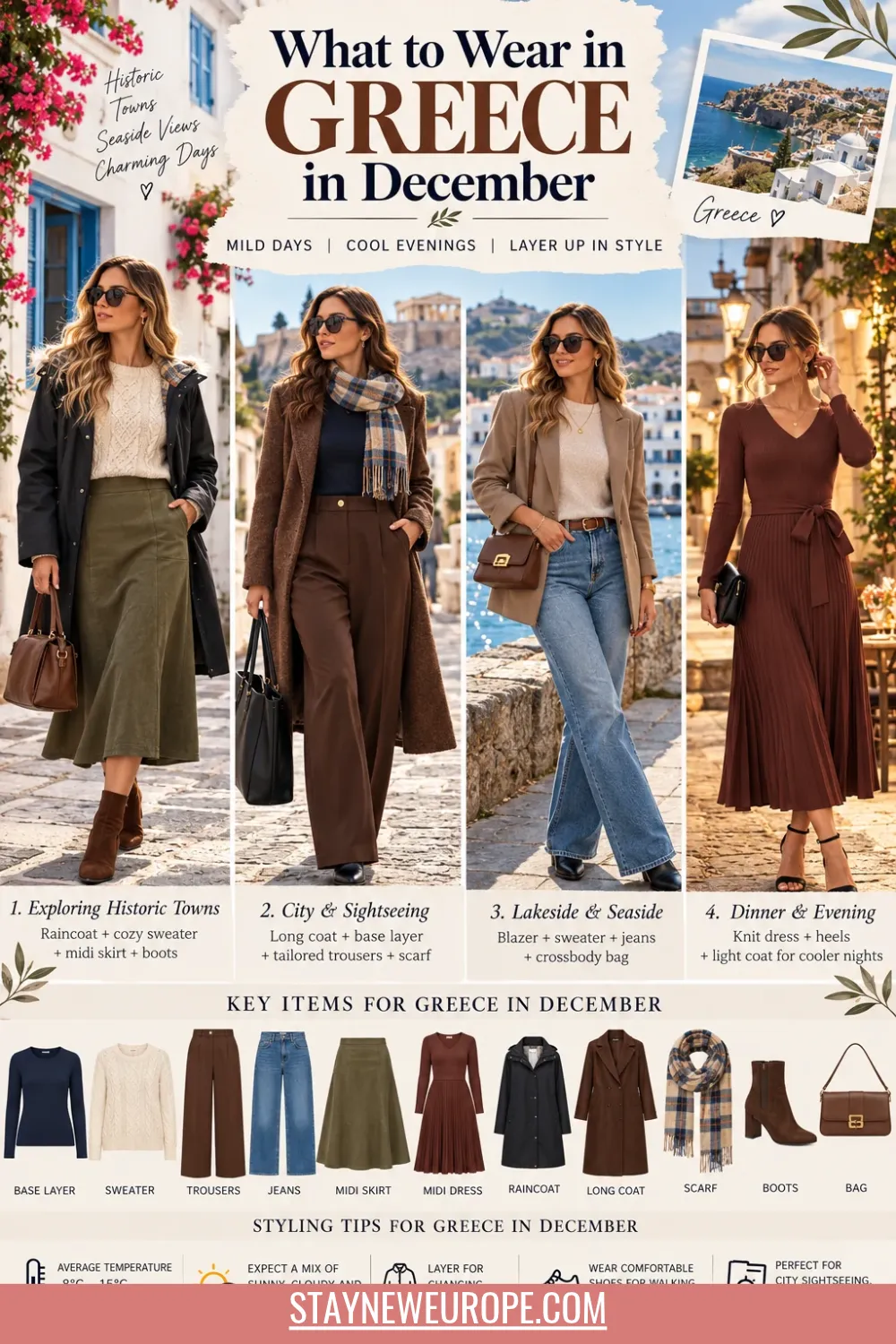
Let me be honest: I packed for Greece in December like I was heading to a beach bar. Linen shirt, sandals, one sad cardigan. Then I stood in Athens at 8 a.m. with a north wind coming off the hills, watching locals stroll past in proper coats and scarves, looking completely unbothered.
December in Greece is not the postcard summer you’ve seen online. It’s quieter, greener, moodier and so much more local. Some days are bottle-blue and mild enough for coffee outside. Others are grey, wet and properly windy. Often it’s all three before lunch.
The mistake almost everyone makes is packing for “the Mediterranean” instead of for winter. Here’s what I’d wear if I were doing it again, and what I’d happily leave at home.
Before We Dive In
A quick reality check, because December in Greece varies a lot by region.
Weather: Athens typically sits around 14–15°C by day and drops to 8–9°C at night. Rain is common, though it tends to come in showers rather than all-day drizzle. The islands feel similar but windier, and Crete is usually the mildest. Thessaloniki and the north are noticeably colder, and mountain areas like Meteora’s surroundings, Arachova and Karpenisi can see snow.
Walking conditions: Expect uneven marble, slippery stone steps and a lot of uphill. Wet marble in Athens is basically an ice rink in disguise.
Style culture: Greeks dress well in winter. Not flashy, just put-together: dark coats, neat boots, scarves worn like they mean it. You don’t need to be fashionable, but you’ll feel better if you’re not in full hiking gear at dinner.
Heading elsewhere in Europe this winter? Have a look at our other monthly packing guides: [INTERLINK: add 2–3 relevant guides from the stayneweurope.com sitemap here].
The Layering Rule That Saves Every Day
Greek December weather changes faster than my mood in a museum queue. Layers aren’t optional, they’re the whole strategy.
My formula is simple: a thin base layer, a mid layer (knit or fleece), and a proper outer layer. You’ll peel things off in the sun, add them back at dusk, and never be miserable at either extreme. One heavy sweater just doesn’t give you that flexibility.

I learned this the hard way on a sunny afternoon at the Acropolis, wearing a thick wool jumper with nothing underneath. Lovely at 9 a.m., a sweaty mess by noon.
Local tip: Wear thin layers you can stuff into a bag. Archaeological sites have almost no shade and a lot of stairs, so you’ll warm up quickly.
A Proper Coat (Not a Fashion Jacket)
If you only invest in one thing, make it the coat. The wind is what gets you, not the temperature.
A mid-weight wool coat or a lightly insulated, water-resistant jacket works for most of the mainland. I’d pick a knee-length cut if you can, because it keeps the wind off your legs on exposed spots like Cape Sounion or Hydra’s waterfront. A packable down jacket is the practical pick if you’re covering several places and don’t want to haul bulk.

Colour-wise, navy, camel, olive and black all blend in beautifully. Think about the dinner photos too, because you’ll be wearing this coat in every single one.
Local tip: Check for a hood. Greek rain often arrives sideways, and an umbrella on a windy island is a losing battle.
Jeans, Trousers and (Yes) Why Shorts Are Out
Shorts in December are a gamble that won’t pay off, unless you’re somewhere very specific and very lucky.
Mid-weight jeans or dark trousers are the sweet spot. I’d bring two or three pairs and rotate them. Straight-leg or relaxed cuts look more local than skinny jeans, and they’re easier to layer thermals under on colder days. Fleece-lined leggings or thermal tights work well too if you’re heading north.

Avoid thin white or pale linen trousers. They’re gorgeous in July and heartbreaking in a December puddle.
Local tip: Dark colours hide the dust and rain splashes from muddy paths. Your future self will thank you.
Tops and Knitwear Worth Packing
Think soft, simple and easy to combine. A few good knits will do more than a suitcase of “maybe” tops.
Merino or lightweight wool jumpers are brilliant because they warm you without bulk and don’t smell after a day of walking. Pair them with fitted long-sleeve tees or silk-blend shirts underneath. For women, a fine-knit roll neck with a skirt and boots is a go-to for sightseeing in the morning and dinner at night.

Stick to a palette: cream, grey, navy, burgundy, forest green. It makes mixing and matching a breeze, and it photographs well against whitewashed walls and grey winter skies.
Local tip: Bring one “nicer” top for dinner. Tavernas in December are cosy, candlelit and a little more dressed-up than summer’s flip-flop crowd.
Skirts, Tights and Dresses for Women
Yes, you can wear skirts in Greek winter. You just need the right tights.
A midi skirt or knit dress with warm tights and ankle boots is a really easy outfit that looks effortless in Athens or Thessaloniki. I’d pick opaque tights over sheer ones, since the wind finds every gap. A wool-blend dress under a long coat takes you from museum to meze without a change.

If you’re doing a lot of walking, a skirt with some stretch or a dress with a bit of movement keeps you comfortable on steps and hills.
Local tip: Skip bare legs, even on a sunny day. The sun is deceptive, and the evening drop in temperature is real.
Shoes: Comfortable, Grippy, Not Embarrassing
This is where trips are won or lost. You’ll walk a lot, mostly on marble and cobbles.
Leather or suede ankle boots with a decent grip sole are my top pick. They handle rain, look polished at dinner and survive the uneven stones around the Plaka. Clean minimalist trainers are a good second pair for long days. Avoid smooth-soled shoes, because polished marble gets slippery when wet and I have the bruised pride to prove it.

If you’re planning a hike (Meteora, Samaria’s surrounding trails when open, or Mount Olympus foothills), waterproof walking shoes or light hiking boots are worth the space.

Local tip: Break your shoes in before you go. Nobody wants blisters in the middle of the Acropolis.
What NOT to Wear (Tourist Giveaways)
Let’s get this out of the way, kindly but firmly.
Skip flip-flops, anything that screams “beach holiday” and heavy rain ponchos in neon colours. Also skip the head-to-toe hiking kit unless you’re actually hiking. You’ll look overdressed for a taverna and underprepared for the wind.
White trainers that aren’t clean, very short shorts and flimsy sundresses also top the “wrong season” list. Greece in December rewards practical, muted, tidy clothing.
Local tip: If in doubt, ask yourself: “Would this work in a London or Paris autumn?” If yes, it’ll work here.
Evening Outfits That Don’t Scream Tourist
Dinner is a big deal in Greece, even in winter. People dress up a little, especially in Athens.
Dark jeans or tailored trousers, a knit or blouse, a good coat and a scarf is plenty. Women might add a statement earring or a slim belt. Men can wear a casual blazer or a smart knit over a collared shirt. You don’t need to overthink it, just look like you made a small effort.

Rooftop bars and nicer restaurants may be a touch more polished, but even then, simple and well-fitted beats flashy every time.
Local tip: Tavernas can be draughty. Keep your scarf on and bring a light layer you can tuck over your shoulders.
What to Wear for Churches and Monasteries
December is festive season, and many churches and monasteries are open and busy, especially around St. Nicholas Day (6 December) and Christmas.
Cover your shoulders and knees. Women are often offered a wrap skirt at Meteora and similar sites, but don’t count on it. Bring a large scarf or pashmina that can double as a shawl, and wear trousers or a longer skirt on any day you plan to visit religious sites.

Local tip: A big wool scarf is your multitool: warm neck, church cover-up and picnic blanket if needed.
Bags: Crossbody vs Backpack vs Carry-On
You’ll want something secure, lightweight and comfortable on long walks.
For daily sightseeing, a crossbody bag with a zip is my pick. It keeps your hands free and your valuables in front of you in crowded spots like Monastiraki. A small backpack works if you’re carrying layers and water, but I’d keep it for hiking and site days.

For the trip itself, a 40-litre carry-on duffel or a compact cabin suitcase keeps you honest. Winter clothes are bulky, so a soft-sided bag with a bit of squish is more forgiving than a rigid case. Ferries and island hops are also much easier without a giant suitcase.

Local tip: Pack a foldable tote for market finds and wet shoes. You will buy olive oil. Everyone does.
Accessories That Do the Heavy Lifting
Small items make a big difference in December.
A wool scarf, soft beanie and thin gloves are non-negotiable if you’re going north or hitting the mountains. A good pair of sunglasses matters too, because winter sun in Greece is bright and low.

Add a simple watch, small hoops or a belt, and a basic outfit starts to look intentional. Accessories also take up almost no suitcase space, which is the best kind of upgrade.
Local tip: A neutral scarf goes with everything and instantly lifts a coat-and-jeans combo.
Rain Prep and Fabrics: What Works, What Doesn’t
Rain is a regular visitor, so plan for it without letting it take over your luggage.
A compact, wind-resistant umbrella is useful in cities. For islands and coastal areas, a hooded waterproof layer is far better. Choose wool, merino, cotton blends and quick-dry synthetics. Avoid heavy denim jackets as your main outer layer, since they soak up water and take forever to dry.

Thin linen and cheap polyester are also poor choices. One gets cold, the other gets clammy.
Local tip: Bring a few zip-lock bags or a small dry bag for your phone and passport during rainy sightseeing days.
Non-Clothing Essentials for Greece in December
A few small items I wouldn’t travel without: a universal adapter (Greece uses type C and F plugs), a refillable water bottle, lip balm and moisturiser (the wind dries everything out), and a portable charger for long days.
Winter days are short, so a small torch or phone light can be handy for evening walks. Add a few blister plasters and basic pain relief to your pouch, and you’re covered.
Local tip: Download offline maps. Mountain villages and some islands can have patchy signal.
A Simple Capsule Wardrobe for Greece in December
Here’s a tried-and-tested formula for a week:
Two pairs of jeans or trousers, one skirt or dress (for women), four tops or knits, two long-sleeve base layers, one heavy coat, one light packable jacket, one pair of boots, one pair of comfortable trainers, one scarf, and a hat. Underwear and socks for the week, plus thermal socks if you’re heading north.
Everything should mix with everything else. If a piece only works with one outfit, it stays home.
How Many Outfits to Bring (and the Mistakes to Avoid)
Plan for five or six outfits maximum, even for a longer trip. Wear your bulkiest items on the plane and re-wear knits and trousers. Nobody is counting.

The classic mistakes I see: overpacking “just in case” clothes, forgetting a waterproof layer, bringing only fashion shoes, and assuming island weather matches mainland weather. Choose a colour palette first, then build outfits around it. And leave some suitcase space, because you will not leave without a few Greek souvenirs.
Local tip: Laundry is easy and cheap in most cities. Pack light and wash once mid-trip.
FAQs About Packing for Greece in December
Is it warm enough to swim in Greece in December? Only for the very brave. The sea sits around 17–18°C, so most visitors stick to walking and sightseeing.
Do I need a heavy winter coat? For Athens and the islands, a mid-weight coat is usually enough. For northern Greece and mountain villages, go heavier.

Can I wear sandals? I wouldn’t. Closed shoes are more comfortable, warmer and more in keeping with local style.
Should I bring an umbrella? A compact one is useful in cities, but a hooded waterproof jacket is better on islands and windy coasts.

What colours should I pack? Neutrals and deep tones like navy, olive, camel, burgundy and black. They mix easily and look polished.
One Last Thing Before You Zip That Suitcase
Greece in December isn’t about perfect beach days. It’s about fires crackling in tavernas, empty ruins in soft winter light, hot chocolate in a mountain village and a Christmas tree lit up in Syntagma Square.
Pack warm, pack simple and pack something that makes you feel good when you catch your reflection in a shop window. The rest takes care of itself. Go, get a little windswept and enjoy every minute.

