
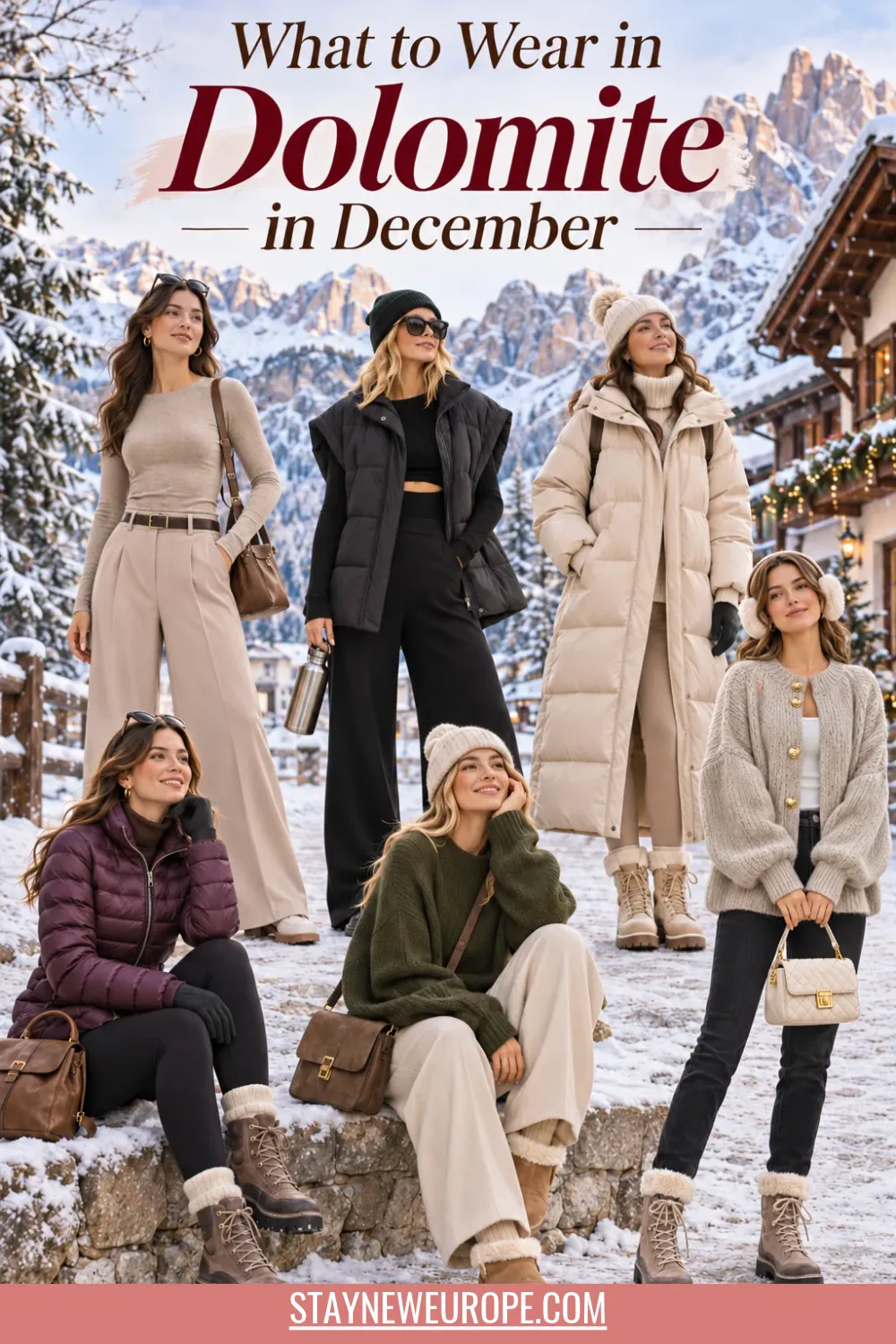
Picture this: you step out of a warm Bolzano café, the air hits your face like a cold slap, and above the rooftops the Dolomites are glowing pink. Mulled wine in one hand, camera in the other. It’s the most beautiful moment of your trip, and you’re shivering in a fashion sneaker and a “water-resistant” jacket that is, let’s be honest, resistant to nothing.
December in the Dolomites is Christmas markets in the valleys, powder on the peaks, and temperatures that swing from “pleasant in the sun” to “why can’t I feel my toes” in about ten minutes. I’ve done it the right way and the wrong way, and the wrong way involved a cotton hoodie and a lot of regret.
The most common packing mistakes? Dressing for a city break, dressing for an Arctic expedition, or packing one enormous coat instead of smart layers. Let me save you from all three.
Before We Dive In
Here’s the quick picture of what you’re dressing for:
Weather: Valley towns like Bolzano, Brunico and Ortisei usually hover around -5°C to 4°C in December, while higher up (Alpe di Siusi, Seceda, Cortina’s slopes) it easily drops to -10°C or colder. Snow is likely, and so is brilliant sunshine. Weather in the mountains changes fast, so check a local forecast right before you go.
Walking conditions: Think packed snow, icy patches on village lanes, cobbled market squares, and the occasional steep path to your guesthouse. Grip matters more than looks here.
Style culture: South Tyrol and the Veneto side of the Dolomites are polished in the evenings. Locals look cosy but put-together: wool, knitwear, good boots. Nobody wears a ski suit to dinner. Well, almost nobody.
Indoors vs outdoors: Mountain huts, restaurants and hotels are properly heated, sometimes aggressively so. You’ll be peeling layers on and off all day, which is exactly why layering is the whole game.
Travelling elsewhere in Italy? Our other guides will help: [INTERNAL LINK: Venice in May packing guide], [INTERNAL LINK: another monthly Italy outfit guide], [INTERNAL LINK: South Tyrol / Christmas markets article].
1. Start with Merino Base Layers
Cotton is the enemy up here, and merino is your best friend. I learned this the hard way on a sunny hike where I sweated, stopped for lunch, and turned into an ice sculpture.
A thin merino long-sleeve top and leggings (or thermal bottoms) wick moisture, stay warm when damp, and, small miracle, don’t smell after three days. Pack two sets and rotate. Wear one under jeans or trousers for market days, and the same set under snow pants on the slopes.

Outfit combo: Merino base, chunky knit, wool trousers for a day in Bressanone. Same base, softshell and ski trousers for the mountain.
Local tip: Buy merino before you leave. Mountain-sport shops in Italy are lovely but pricey, and the good stuff isn’t cheap anywhere.
2. The Mid-Layer That Does the Heavy Lifting
A fleece or light insulated mid-layer is the unsung hero of the trip. It’s the thing you’ll wear every single day.
Go for a half-zip fleece or a thin down vest. I like a vest because it keeps your core toasty without bunching under a jacket. Neutral colours (cream, navy, forest green) look good in photos and match everything.

Outfit combo: Merino top, fleece half-zip, shell jacket for hiking; swap the fleece for a cashmere jumper when dinner calls.
Local tip: Rifugi (mountain huts) are cosy, so you’ll want to strip the outer layer fast. Make sure what’s underneath is something you’re happy to be seen in.
3. The Big Jacket: Warm, Not Ridiculous
You do need a proper winter coat in December, but “proper” doesn’t mean a sleeping bag with sleeves.
A down or synthetic-insulated jacket that reaches at least hip length is perfect. Look for a hood, deep pockets and a rating that works down to about -10°C. A longer parka is beautiful for town days, but a bit awkward if you’re hiking or skiing.

If you can only bring one coat, choose a mid-thigh insulated jacket in a dark, classic colour. It works at the Christmas market, on a cable car, and at dinner.

Local tip: Skip white or light colours unless you enjoy wearing your lunch. Dark navy, olive or black hides everything.
4. A Waterproof Shell for Snow Days
Snow, sleet and wet slush are all possible, and an insulated jacket alone won’t save you in a wet storm.
A lightweight waterproof shell with a hood sits over your mid-layer and blocks wind and wet. It folds into a daypack, so you’re not committed to wearing it. On days when the forecast says “maybe,” it’s the sensible choice.

Local tip: Check the seams and zips before you buy. “Water-resistant” and “waterproof” are very different things, and mountain weather will find the difference immediately.
5. Boots: Where You Should Spend the Money
If I could only tell you one thing, it would be this: your boots decide your trip. Cold, wet feet will ruin the most scenic day.
Pack insulated, waterproof boots with a proper grip sole, ideally with a Vibram-style tread. Winter hiking boots or warm snow boots both work, but they should be broken in before you land. Fashion boots with smooth soles are a hazard on icy village lanes.

Outfit combo: Winter boots with wool socks and trousers tucked in for walks; clean leather boots with a good sole for evenings.
Local tip: Bring slim removable insoles or a warm pair of slippers for hotels. Taking off wet boots at a guesthouse door is a ritual, and you’ll be glad of dry feet.
6. Socks That Actually Keep You Warm
Two pairs of cheap socks is not the same as one pair of good ones. Thick cotton socks just trap damp.
Pack three or four pairs of mid-weight merino socks, and don’t wear them too tight, because circulation equals warmth. Bring an extra pair in your daypack in case you get snow in your boots.

Local tip: Skip the temptation to double up on socks inside tight boots. It restricts blood flow and makes your feet colder.
7. Trousers and Jeans: What Works (and What Doesn’t)
Jeans are a trap in the mountains. Once they’re wet with snow, they stay wet, stiff and freezing.
For walking around towns, wool-blend trousers or thicker lined trousers are far better. For anything on the snow, pack waterproof or softshell trousers. If you love jeans, wear them only for indoor evenings, and put thermal leggings underneath.

Outfit combo: Lined trousers, thermal base, boots and a knit for the Christmas market in Brunico.
Local tip: Snow pants can be rented in many resorts if you only need them for a day or two, so you don’t need to carry them.
8. Knitwear: Your Cosy and Stylish Secret
This is where you get to look good. Italians do winter knitwear beautifully, and the Dolomites bring out the best of it.
A chunky wool or cashmere-blend jumper in cream, oatmeal or deep green looks great with boots and a scarf. Fair Isle or Nordic patterns are a proper local favourite and work especially well in South Tyrol. Wool is warm, breathable and forgiving if you’ve eaten too many canederli.

Local tip: Pack knits in a compression bag. They take up space, but they’re the thing you’ll wear most in photos.
9. Hats, Gloves and Scarves
Most heat is lost where you forget to cover. Gloves are the item people lose, so bring two pairs.
A warm beanie, a neck gaiter or wool scarf, and insulated waterproof gloves are non-negotiable. I carry thin liner gloves too, so I can use my phone and camera without exposing bare fingers to -8°C.

Outfit combo: Beanie, scarf and gloves in coordinating colours instantly make a basic coat look intentional.
Local tip: Hand warmers cost a couple of euros and are lifesavers on cable cars and in long market queues.
10. Sunglasses and Sun Protection (Yes, Really)
Snow reflects sunlight like a mirror. I once got a sunburn on my chin in December, which felt both ridiculous and deserved.
Pack proper sunglasses (polarised or with high UV protection) and a SPF lip balm and face sunscreen. At altitude, the sun is stronger than you’d expect.

Local tip: Bring a cheap pair of sunglasses as a backup. They get lost or dropped in snow more than you’d think.
11. Evening Outfits (Without Looking Like a Tourist)
After a day outdoors, locals change. Not into a ball gown, but into something neat and warm.
For dinner in Ortisei or Cortina, think dark jeans or tailored trousers, a nice knit, and your good boots. Add a scarf and a simple coat, and you’re set. Skip the full hiking gear if possible. Fancier places appreciate a little effort, though mountain restaurants are relaxed.

Outfit combo: Wool trousers, turtleneck, leather boots and a long scarf for an elegant but cosy dinner.
Local tip: Many restaurants have coat racks near the entrance. A smaller bag makes it easier to tuck your belongings away.
12. Bags: Daypack, Crossbody and Luggage
Your luggage choice matters, especially with trains, buses and snowy streets.
For checked luggage, a soft duffle is easier than a hard suitcase on icy ground and fits in tight cable car and bus compartments. For daily use, a 20 to 25 litre daypack handles spare layers, water and snacks. A small crossbody bag is perfect for market evenings.

Local tip: Cobbles and snow don’t mix with small wheels. A rolling suitcase can turn into a very annoying drag by the second day.
13. What to Wear to a Church or Chapel
You’ll likely pass through lovely alpine churches, especially around Christmas. Dress codes are gentle, but respect still counts.
Cover shoulders and knees where possible. Easy: a knit and trousers, which are already your default in December anyway.

Local tip: Remove your hat when you step inside, and keep conversation quiet. Christmas services can be in progress.
14. What Not to Wear (The Tourist Mistakes)
Let me be blunt about these:
- Smooth-soled fashion sneakers on icy ground
- A single heavy coat with nothing underneath to adjust
- Cotton hoodies and cotton leggings as base layers
- Jeans on the snow
- Forgetting gloves, a hat or sunglasses
I’ve seen all of them, and I’ve worn a couple. The fix is layers, grip and fabrics that behave when wet.
Local tip: If you’re unsure, look at what locals wear on the street: boots, wool and smart outerwear. Copy them.
Practical Packing: How Much to Bring
For a week, I’d bring:
- 2 merino base layers (tops) and 2 bottoms
- 2 to 3 knitwear or mid-layers
- 2 pairs of trousers plus 1 pair of snow or softshell trousers
- 1 insulated jacket and 1 waterproof shell
- 3 to 4 pairs of socks
- Winter boots, plus indoor shoes
- Hat, gloves, scarf, sunglasses
- 1 nicer evening outfit
Packing light vs overpacking: You’ll repeat outfits, and nobody notices. Neutral colours make everything mix and match. Layers do the work.
Outfit planning tip: Lay out each day: base, mid-layer, outer, and accessories. If something doesn’t work with at least two other items, leave it behind.
Mistakes to avoid: Packing too many “just in case” items, forgetting power adapters and chargers, and underestimating the cold on cable cars. Also, bring a small thermos or reusable bottle. Cold mountain air dehydrates you quickly.
Packing List: The Non-Clothing Essentials
A power bank (cold drains batteries fast), a small first-aid kit with blister plasters, lip balm, hand cream, reusable water bottle, and a small microfibre towel. A compact umbrella is useful in valley towns.

If you’re planning to hike icy trails, lightweight ice cleats that fit over your boots are well worth the weight.

FAQs About Dolomites December Packing
Do I need ski gear? Only if you’re skiing. Many shops rent equipment, so you can pack lighter.
Is it too cold for sightseeing? Not with layers. The sunny days are gorgeous.
Can I wear jeans? For evenings and indoor days, yes. For snow, no.
What shoes are best? Insulated, waterproof boots with a grippy sole.
Do I need formal clothes? No. Smart casual is plenty almost everywhere.
Go and Enjoy It
Here’s what I want you to picture instead: you, warm and comfortable, standing in a snowy square as the market lights flicker on, a steaming cup in your gloved hand, peaks glowing behind you. You’re not thinking about your feet or your fingers. You’re just there.
Pack the layers, trust the boots, and bring a scarf you love. The Dolomites will do the rest.

