

Paris in July is one of those experiences that sounds effortlessly glamorous until you are standing in 34°C heat on the Pont de l’Alma with sweaty feet, a tote bag cutting into your shoulder, and trainers that are slowly destroying your aesthetic. Nobody warns you properly. The blogs all say “light layers and a trench coat!” and then you arrive and the trench coat never leaves your suitcase.
Let me be honest with you: July in Paris is hot. Not Mediterranean-beach hot, but proper city hot — close and humid with bursts of sun that make the limestone buildings glow beautifully while quietly roasting you alive. The good news is that Paris in this month is also incredibly stylish, and dressing well here is genuinely one of the pleasures of being there. You just need to pack correctly.
The most common mistakes I see? Too many jeans, shoes with zero grip on cobblestones, and an obsession with the “classic Parisian trench” that has no place in the heat of July. This guide will sort all of that out.
Before We Dive In: What July in Paris Is Actually Like
July temperatures in Paris typically sit between 19°C and 30°C, with occasional heatwaves that can push it past 35°C. The city hit 42°C during the infamous 2019 heatwave, and while that was extreme, summers in Paris have been running hotter in recent years. Mornings are usually pleasant — maybe even a touch cool before 9am — but by early afternoon, the heat radiates off the pavement and the stone walls of the Marais in a way that catches you off guard.
Rain does happen in July. It is not a monsoon, but quick afternoon thunderstorms are entirely possible — the kind that come from nowhere, dump a lot of water in twenty minutes, and then disappear, leaving the streets steaming. Humidity sits at a moderate level most of the time, not as oppressive as Rome in August, but enough that synthetic fabrics will feel unbearable by noon. UV levels are high, so sun protection matters more than most visitors expect from a northern European city.
In terms of terrain, Paris is a walking city, full stop. You will walk more than you plan to. The pavements are mostly flat but the cobblestones around Montmartre, the Île de la Cité, and parts of Le Marais are relentless — beautiful but merciless on the wrong footwear. As for local style, Parisians in July dress with a kind of studied ease that looks effortless and is absolutely not: linen trousers, loose silk blouses, quality sandals, minimal jewellery, and a face that says they have never broken a sweat in their life. This is the standard to aim for. Not a packing list — a vibe.
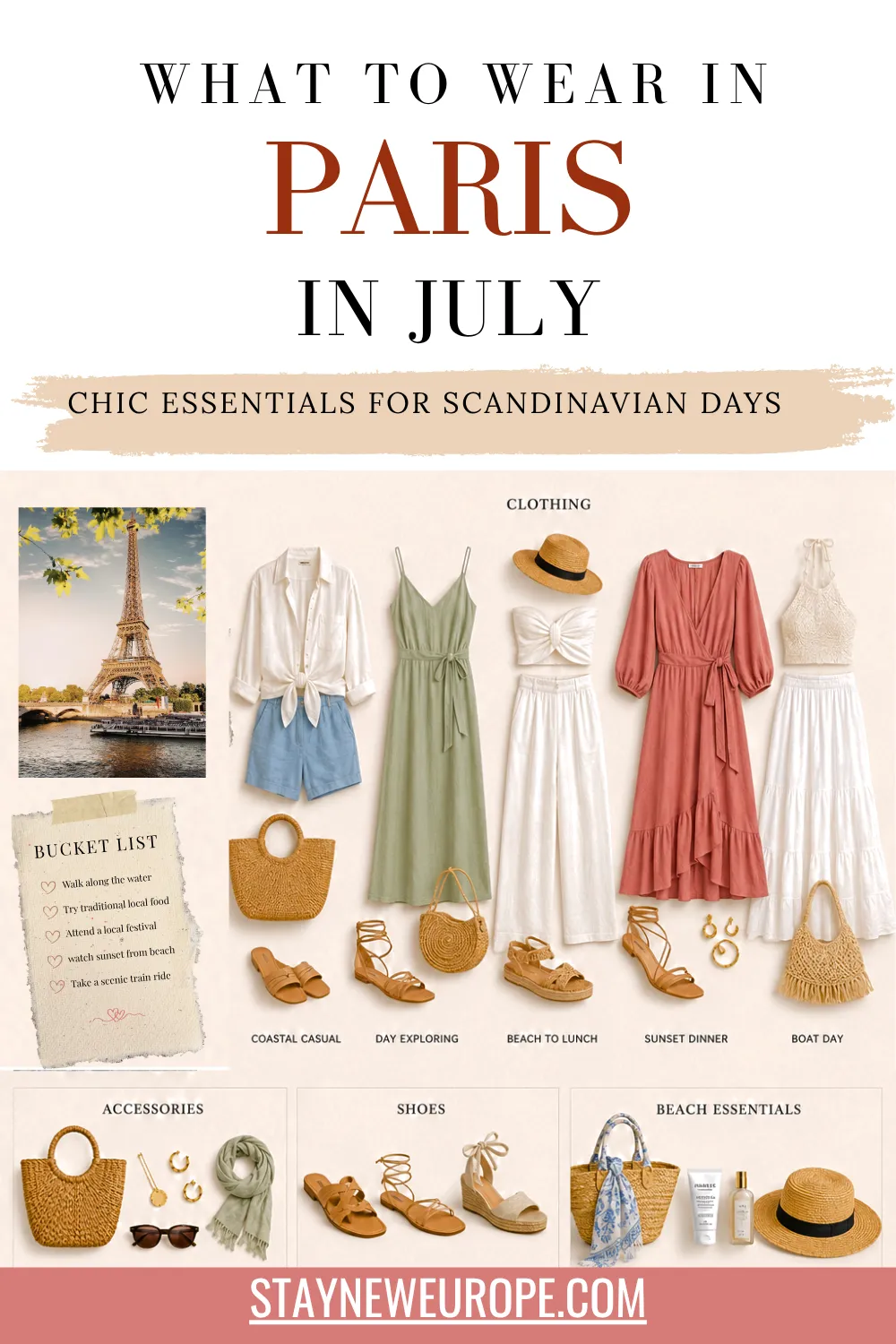
Linen: The Fabric That Will Save Your Trip
If you pack one thing based on this article, make it linen. I am not being dramatic. Linen is what separates the people who glide through July in Paris looking relaxed from the people who look like they are melting into the Metro seat.
Linen breathes in a way that cotton and certainly synthetic fabrics simply cannot match. When you are walking from the Louvre to Saint-Germain-des-Prés in the afternoon heat — which sounds like a nice 20-minute stroll until you remember it is 31°C — a linen shirt or linen dress is the difference between arriving refreshed and arriving desperate. It wicks moisture, dries fast, and somehow looks better slightly wrinkled, which is convenient because it will be slightly wrinkled.
Linen trousers in a neutral — stone, cream, pale blue, olive — are the most Paris-appropriate item you can pack for July. They work for daytime sightseeing, they work for a long lunch at a pavement café, and they elevate to a dinner outfit with the right sandal and a silk top. Women who pack one good pair of linen wide-legs essentially have the lower half of every outfit sorted.

For men: linen trousers paired with a linen or lightweight cotton shirt (untucked, sleeves rolled once) is the Parisian formula. It looks like you tried just the right amount. That is all Paris asks of you.

Linen can feel a little stiff at first wear, but it softens quickly. If you are buying specifically for this trip, wash it once before you go — it will be more comfortable from day one and will feel like a second skin by the end of the week.
Local tip: French linen tends to run with a relaxed, slightly oversized cut. If you want to blend in rather than stick out as an anglophone tourist in head-to-toe tight athleisure, lean into that looser silhouette. It is the right call in the heat anyway.
Dresses and Skirts: The Easiest Outfit You Will Ever Pack
A good summer dress might be the single most efficient packing decision a woman can make for Paris in July. One piece, no coordination required, instant elegance — and in the heat, the freedom of airflow around your legs is genuinely not something you should underestimate.
Midi dresses work beautifully here. They read as polished, they cover your legs for any church or museum visits without you having to pack a separate item, and Parisians wear them constantly in summer. Think muted florals, stripes, solid terracotta or dusty rose — not neon, not overtly tropical prints. The colour palette of the city tends toward the earthy and the classic.

A slip dress in silk or satin is also an excellent choice for the evening — thrown over a plain white or nude bodysuit for daytime modesty, then worn alone with sandals and simple gold earrings at night. I cannot count how many times I have done this in Paris and felt appropriately dressed for wherever the evening took me.

Linen skirts deserve a specific mention. A midi linen skirt in a neutral or stripe, paired with a fitted cotton tank or camisole, is arguably the most Parisian outfit in existence for a July day. It is cool, stylish, practical, and takes about four seconds to assemble. Pack one or two.

Avoid maxi dresses with long dragging hems for heavy sightseeing days — they pick up Paris pavement in an unlovely way. A hem that sits just below the knee or at mid-calf is the sweet spot.
Local tip: Parisian women rarely wear strapless dresses for daytime. A thin strap or cap sleeve reads as more intentional and put-together. Save the strapless for evening.
The Shoe Question (This Is the Important One)
Let me be very clear about something: your cute block-heeled sandals will destroy you on the cobblestones of Montmartre. Your trainers will look perfectly comfortable and entirely wrong at dinner. And your flip-flops will have you exhausted by noon. Shoes are the most consequential decision you will make for Paris in July.
The answer — the genuine, tested, walked-seven-miles-in-them answer — is a leather flat sandal with a proper footbed. Not a fashion sandal with a thin sole and no support. Not a rubber flip-flop. A real sandal with a contoured sole, ideally with a toe loop or ankle strap to keep it secure on uneven ground. Birkenstock, Ecco, Camper, and similar brands have options that look genuinely chic with the right outfit. This is not a compromise. This is the move.

Wear them in before you go. I learned this the hard way in the Marais one Tuesday when I wore new sandals and spent the last three hours of the day walking with that particular grim determination that comes from a blister forming in real time. Do not be me.
A pair of white or beige low-profile trainers — think classic Veja, New Balance 327, or equivalent — is a good second pair for heavier sightseeing days. They are genuinely acceptable in Paris now in a way they were not a decade ago, especially for a younger crowd. Wear them with linen trousers or a midi skirt, not with shorts, and you will look fine.

If you plan evening dinners at better restaurants or any event that requires a bit of polish, one pair of a strappy flat sandal or a very low block heel is worth the bag space. Just one. Keep it simple.

Local tip: Parisians walk in proper shoes. You almost never see Parisian women of any age in athletic sandals or sport slides on a regular city day. The “comfortable but stylish” bar here is higher than you think — meet it with good leather sandals and your whole outfit will look more intentional.
What NOT to Wear in Paris in July
Oh, let us have this conversation. Because honestly, tourists in Paris in July sometimes look like they have packed for a different continent and a different decade simultaneously.
First: shorts. This is nuanced. Board shorts or cargo shorts read as very American/tourist in central Paris, particularly in the fancier arrondissements. Tailored shorts — chino-length, well-fitted, in a solid neutral — are genuinely fine and increasingly common. But the standard-issue tourist in long baggy shorts and a branded T-shirt is a look that will make every interaction with a Parisian server slightly cooler than you would like.
Sports bras as tops. I know. I know it is hot. But a sports bra on its own, worn as a top through the Louvre or along the Seine, reads as not quite reading the room. A breathable linen or cotton tank, even a thin one, takes about zero additional effort and keeps you looking considered.
Heavy denim. No. July in Paris and thick jeans are a combination that produces misery by 11am. If you love jeans, pack one pair of lightweight or stretch denim for cooler evenings. Leave your thick dark-wash jeans entirely at home.
Novelty Paris-themed items — the Eiffel Tower print scarves, the “Paris Je t’aime” sweatshirts. You will see them everywhere in tourist shops near Notre-Dame. Actual Parisians wear none of them. I am not saying this to be snobby, but genuinely: they will not make you feel more connected to the city, and they will absolutely mark you as an easy target for the many people in Paris who prefer their targets obviously identifiable.
Local tip: Toplessness is not the norm in Paris city parks the way it might be in some beach towns. Even in the heat, a casual outfit with a loose top is standard. Sacré-Cœur and Notre-Dame both require covered shoulders and sometimes knees — pack accordingly.
Lightweight Cotton Tops: Your Daily Workhorse
Cotton gets a bad reputation in travel circles — “it holds moisture,” people say. This is true. But in Paris in July, a quality lightweight cotton tank or fitted T-shirt is still an excellent foundation for your daily outfits, particularly when the alternative is a sweaty synthetic.
The key word is lightweight. We are not talking about your regular house T-shirt. We are talking about fine-gauge cotton, a slightly longer length, a fitted but not skin-tight cut. Something that looks intentional. A pack of thin ribbed cotton tanks in white, cream, and one colour is probably the most versatile thing in your suitcase.

Layer a tank with a loose linen overshirt for morning sightseeing. Remove the overshirt by noon when it gets too warm. Add a silk scarf or a simple necklace for dinner. This is the Parisian July formula and it costs almost no brain power to execute.
Striped marinière tops — the Breton stripe — are very genuinely worn in Paris, not ironically. A classic navy-and-white stripe in a lightweight cotton or linen blend is both authentically local and extremely practical. Pack one. Wear it constantly.

For men: a well-fitted plain cotton or linen-cotton blend T-shirt in a neutral or muted tone is perfectly appropriate for almost every daytime situation in Paris. Avoid branded T-shirts (logos age poorly and scream tourist). A plain tee, tailored trousers or chinos, and a good sandal or low trainer will see you through 80% of your days.
Local tip: Tucking a shirt or tank into high-waisted trousers or a skirt is the easiest way to instantly look more Parisian. It works. Try it before you dismiss it.
The Silk Scarf Situation
Yes, really. A silk scarf in July in Paris is not a quirky vintage choice. It is almost compulsory. And before you write it off as too fussy, let me explain why it earns its weight in your bag.
A silk scarf serves six functions in Paris in July. It is an outfit accessory (tied at the neck, in the hair, looped through a bag handle). It is a light layer for the aggressively air-conditioned restaurants and museums that will make you genuinely shiver in July despite the heat outside. It is a cover-up for churches and religious sites when you have bare shoulders. It is a surface to sit on if you end up at one of the parks. It is a beach-style towel in a genuine pinch. And it looks absolutely extraordinary.

You do not need the real Hermès, though if you have one, obviously pack it. Good quality scarves from Zara, &Other Stories, or any of the many Paris markets are just as chic when worn well. The print matters more than the provenance.

Tying a scarf loosely around your neck with a short loop — not a neckerchief bow, more of a casual drape — is the move. If that feels too much, tie it to your bag strap. Either way, you will feel smarter for having it within reach the moment you walk into the Musée d’Orsay and the air conditioning hits you like a cold wave.
Local tip: At any Parisian flea market, particularly the Marché aux Puces de Saint-Ouen on the edge of the city, you can find beautiful vintage silk scarves for a fraction of boutique prices. Buying one there and wearing it for the rest of your trip is one of the most satisfying Paris moves you can make.
Evening Outfits: Getting Dinner in Paris Right
Parisians dress for dinner. Not formally, not in the way that requires advance planning — but they do make a subtle effort that most tourists miss. You will notice it the moment you sit down at a mid-range restaurant in the 6th arrondissement and look around.
The bar is not haute couture. The bar is: something that looks chosen. A silk or satin slip top instead of your daytime tank. Linen trousers swapped for a simple midi skirt. Good sandals instead of trainers. A little jewellery. Basically, whatever you wore during the day, elevated by swapping one or two pieces.

For women, the slip dress I mentioned earlier really does earn its place here. Midnight blue or deep burgundy look particularly good in Parisian candlelit restaurant lighting — useful information, you are welcome. Paired with simple gold hoops and a leather or woven shoulder bag, this is a dinner outfit that requires approximately no thought and looks like it required significant thought.

For men, July evenings call for clean chinos or well-fitted linen trousers, a relaxed button-down shirt in a muted colour, and leather shoes or dressy sandals. Not trainers for dinner at a restaurant with tablecloths. Not your shorts. The effort is minimal but the impact is real.

Nightlife in Paris — bars in the Oberkampf area, late-night spots around Pigalle — skews slightly more casual and more creative. Dark jeans (the lightweight pair you packed for cooler evenings) with a good top, interesting earrings, and a structured bag work perfectly here. The Parisian nightlife crowd does not dress up in the way London or Milan might, but they do dress with personality.
Local tip: Many Paris restaurants, particularly the old-guard bistros, are smaller and more intimate than you might expect. You will be sitting close to other tables. Fragrance matters — keep it light. And leave the large backpack at the hotel; it does not fit comfortably beside a table for two.
Sun Protection: The Part Nobody Talks About Enough
Paris is not Greece. It is not Santorini or the Amalfi Coast. It does not announce itself as a sun destination. And precisely because of this, tourists consistently underestimate how much UV exposure they get while walking its streets, sitting in its parks, and cruising the Seine.
You will spend a lot of time outside in July. The city encourages it — the gardens of the Palais Royal, the Luxembourg, the quays along the river where people sit with a picnic and a bottle of rosé. UV index in Paris in July regularly sits at 7 or 8, which is classed as high. Factor 30 minimum, applied properly, is not optional.
A sun hat is worth the packing annoyance. A wide-brim straw hat looks genuinely chic in Paris and doubles as a fashion accessory — pair it with a linen dress and you are basically in a French film. Yes, it is slightly awkward to pack. Crush it into your bag, reshape it when you arrive, it will be fine.

A lightweight SPF mist is something I now take everywhere in July. It refreshes your face, it protects bare arms and the back of your neck (where you will absolutely forget to apply cream), and it takes up the space of a small perfume bottle. Worth it.

Sunglasses are obvious, but quality matters more in Paris than you might think. Parisians wear them well — classic shapes, neutral tones, real lenses. A good pair of sunglasses elevates every outdoor outfit and protects your eyes from the glare off all that beautiful pale limestone.

Local tip: The Seine quays and the parks like the Champ de Mars are fully exposed. If you are planning a long afternoon picnic, dress your base layers in SPF-protective fabric or plan to reapply regularly. Sunburn on day one of a Paris trip is a miserable and entirely avoidable way to spend the rest of your week.
Dealing with Heatwaves: When It Gets Seriously Hot
Paris has had some brutal heatwaves in recent summers, and July is prime heatwave season. If temperatures climb past 36°C — which can happen with very little warning — your packing choices need to adapt fast.
On truly extreme heat days, every single item on your body should be either linen or a performance fabric designed to wick moisture and dry quickly. This is not the day for your cute fitted linen blazer or your ankle-length maxi. This is the day for the most minimal outfit you can put together that still reads as dressed.
Loose linen wide-leg trousers and a sleeveless linen or cotton top is about as minimal as you can go while still looking like a person who planned their outfit. A lightweight slip dress, sandals, sunhat, sunglasses, and a small bag. Done. This is what you wear when Paris turns into an oven.
Carry water constantly. Every café will refill your bottle if you ask — and they will, because Parisians understand heat now in a way they did not twenty years ago. Most museums are air-conditioned and planning a major museum visit for the hottest part of the afternoon (1pm to 4pm) is a genuinely smart strategy, not a concession.

A small personal fan — the compact handheld type — is not embarrassing. It is practical. The Metro in Paris has essentially no air conditioning and in a heatwave it becomes one of the more hostile environments you will encounter in a major European city.

Local tip: On extreme heat days, the Canal Saint-Martin neighbourhood, with its shaded trees lining the water, is markedly cooler than the open boulevards around the Champs-Élysées. A morning walk there will remind you that Paris is beautiful and that you made the right choice not to spend the hottest hour outside.
Bags: What Actually Works in Paris
A crossbody bag is the correct bag for Paris in July. This is not a suggestion. It is based on the twin realities of pickpocket risk and the complete impossibility of comfortably carrying a tote in 30°C heat while navigating the Metro.
Pickpockets in Paris are real. They concentrate in the predictable places — the Eiffel Tower, the Metro line 1, the queues outside the Louvre, Sacré-Cœur. A bag that sits against your body, closes securely, and gives you both hands free is genuinely the safer choice. Zip closures are better than magnetic snaps.
Leather or high-quality canvas crossbody bags look elegant and are more durable than they seem. A medium-sized bag — not tiny, you need space for water, sunscreen, and your camera — in a neutral tan, black, or burgundy will go with everything you have packed and will look appropriate everywhere from the Musée d’Orsay to a casual picnic by the Seine.

A separate small fabric tote is worth packing folded in your luggage. You will almost certainly pick up things — a baguette, a book from a bouquiniste on the riverbank, a bottle of wine from the market. Having a tote available means your crossbody is not strained and you are not carrying your hotel plastic bag through Le Marais. Practical, sustainable, and it takes up zero space.
Backpacks are not forbidden in Paris, but a standard hiking backpack is the wrong bag for dinner, for galleries, and for anywhere with close crowds. If you want a backpack, make it a compact anti-theft model with hidden zips that sits flat against your back. Even then, swap it for a crossbody on busy tourist days.

Local tip: Many Parisian museums and attractions now require security checks on bags and some have banned large backpacks entirely. Check the policy of each attraction before you go and pack your museum day bag accordingly.
Accessories That Do the Heavy Lifting
Paris is a city where one good accessory can elevate a simple outfit into something that looks deliberate and European. The right earrings, the right watch, the right bag strap — these small things matter more here than in almost any other city.
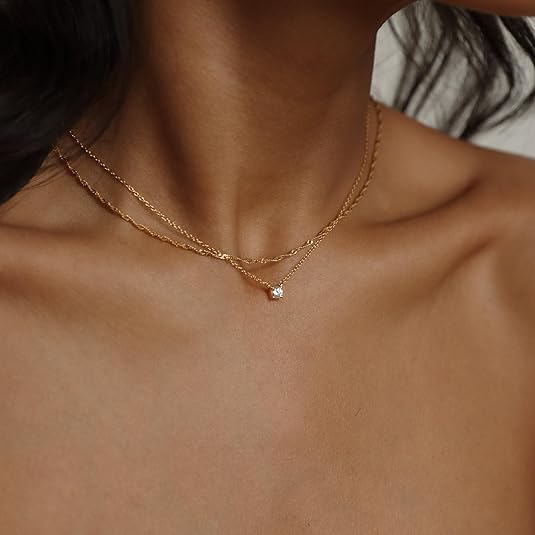
Simple gold jewellery is the default Parisian move in summer. Thin gold hoops, a delicate chain, a small ring or two. Nothing chunky, nothing flashy, nothing that jingles when you walk. The aesthetic is understated confidence, not maximalist decoration. Pack two or three pieces you genuinely love and leave the rest at home.
A quality watch is worth wearing every day. Parisians wear watches — not as status symbols particularly, but as part of a considered outfit. If you have a watch you love, this is its trip.
A lightweight linen or cotton blazer is worth one spot in your suitcase, but understand its purpose: it is not a daytime layer (it is too hot for that in July), it is an evening piece for cooler nights and smarter dinners. July evenings can drop to around 17°C after a storm or later in the night, and a blazer makes the transition from restaurant to walk along the river comfortable and stylish.

Do not pack heavy statement jewellery for a Paris July trip unless you have a specific occasion. It will feel out of place in the heat, it weighs more than it should, and the Parisian aesthetic it is most compatible with is somewhere between minimal and quietly interesting.
Local tip: The hardware on your accessories matters in Paris. Cheap gold that turns green, loose clasps, peeling metal — these details are noticed. One or two quality pieces beats five cheap ones every time.
Packing for Religious Sites and Museums
Notre-Dame is under ongoing restoration but increasingly welcoming visitors. Sacré-Cœur requires covered shoulders. The Sainte-Chapelle, the Panthéon, Saint-Sulpice, and many other churches that you might wander into spontaneously also expect a degree of modesty. This does not mean you need to carry a full cover-up everywhere, but you do need to be able to create one quickly.
The silk scarf I mentioned earlier solves this for shoulders. For legs, a midi skirt or midi dress means you are automatically covered. If you are wearing shorts or a short dress, draping a scarf over your lap is the standard solution — which works provided your scarf is large enough. Keep this in mind when buying.
Museums in Paris are kept at a temperature that can feel genuinely cold in July when you come in from the street. The Louvre, the Musée d’Orsay, and the Pompidou Centre are all aggressively air-conditioned. Keep that light layer — linen overshirt, blazer, or large scarf — in your bag for the first twenty minutes inside any major museum, because you will want it.
If you are visiting the Musée Rodin, note that much of the experience is outdoors in the sculpture garden. Comfortable shoes, a hat, and sunscreen are the relevant accessories here, not a blazer.
Local tip: The Sainte-Chapelle dress code is taken seriously by the staff. A couple I met on my last trip was denied entry in shorts despite having a pre-booked timed ticket. Carry your scarf or pack a lightweight sarong that works as a wrap — and actually put it on before you reach the door.
The Paris July Capsule Wardrobe for One Week
This is the part where I tell you that you do not need to pack as much as you think. One week in Paris in July can be done comfortably with a carry-on, provided you pack with purpose rather than anxiety.
For women:
1.two pairs of linen or lightweight trousers (one neutral, one with a little colour or pattern)
2. two midi skirts (one linen, one in a slightly dressier fabric).
3.three or four lightweight tops or tanks
4.two summer dresses (one casual, one that can dress up for evening)
5. one pair of flat leather sandals for walking.
6.one pair of dressier flat sandals for evenings.
7. one pair of white or neutral low-top trainers for heavy walking days
8.one silk scarf, minimal jewellery.
9. A crossbody bag, and a compact blazer for cool evenings.
For men:
- two pairs of linen or lightweight chino trousers.
- two pairs of well-fitted casual shorts.
- five to six lightweight T-shirts or linen shirts.
- one slightly smarter button-down for evenings.
- one pair of leather walking sandals.
- one pair of clean low-profile trainers.
- and one light jacket or overshirt for evenings.
The key to making this work is outfit repeating. The Parisians do it. Europeans generally do it. You are not being photographed by a fashion magazine every day — you are experiencing one of the most beautiful cities in the world. Wear the linen trousers again. Re-wear the silk scarf. Nobody cares, and the freedom of a light bag is worth more than the comfort of excessive options.
The one item people consistently forget for Paris in July: a portable battery charger. You will use your phone for maps, translation, photography, and restaurant reservations all day every day, and there are fewer public charging stations in Paris than in comparable cities. Pack a slim power bank and thank me later.

Practical Packing Advice for This Trip
Packing light for Paris is not a punishment — it is a genuine improvement to your trip. Dragging a large suitcase up the stairs in a Haussmann-era apartment building with no lift, or checking a bag for a quick Eurostar connection, or paying hold luggage fees that now rival the cost of a decent lunch in the 7th arrondissement — these are things to avoid.
Pack outfits, not items. Before anything goes in the bag, check that it works with at least two other things you are bringing. If it only pairs with one other piece, it is probably not earning its weight. The linen trousers should work with three tops. The sandals should work with every outfit.
Outfit repeating is genuinely the Parisian way. Parisians famously have fewer things that they wear more often, and they look extraordinary. Building a small wardrobe of pieces that work together and wearing combinations of them repeatedly is both sustainable and stylish. Nobody in Paris is tracking your outfits. They are too busy eating good cheese.
Avoid the temptation to pack a “just in case” dressy outfit for a night out you haven’t planned yet. If a genuinely special occasion arises, Paris has excellent shopping. The city’s second-hand and vintage market scene — particularly in the Marais and around rue de la Roquette — means you can find something beautiful quickly and cheaply if you need it.
If you are heading to the south of France after Paris — Nice, Marseille, or anywhere along the Côte d’Azur — check out a separate packing guide for those destinations, because the clothes that work beautifully in Paris need a slight adjustment for beach towns and villages, where swimwear becomes a central piece and the heat climbs significantly higher.
Wrapping It All Up
There is a particular feeling you get when you land at Charles de Gaulle or step off the Eurostar at Gare du Nord and know, genuinely know, that you are dressed right for where you are going. It is a quiet confidence. You are not going to be too hot. You are not going to feel out of place at dinner. You are not going to ruin your feet on day two.
Paris in July rewards people who pack with intention. The city is beautiful enough that you do not need to think about your clothes all week — but when they are sorted, when the linen is breathable and the sandals are comfortable and the scarf is doing its six jobs, Paris has a way of making you feel like you belong there.
Go well. Walk slowly. Eat outdoors when you can. And resist the urge to overpack. The best version of your Paris trip is the one where your bag is light enough to carry easily and your outfit is good enough that you never once wished you had brought something else.

