
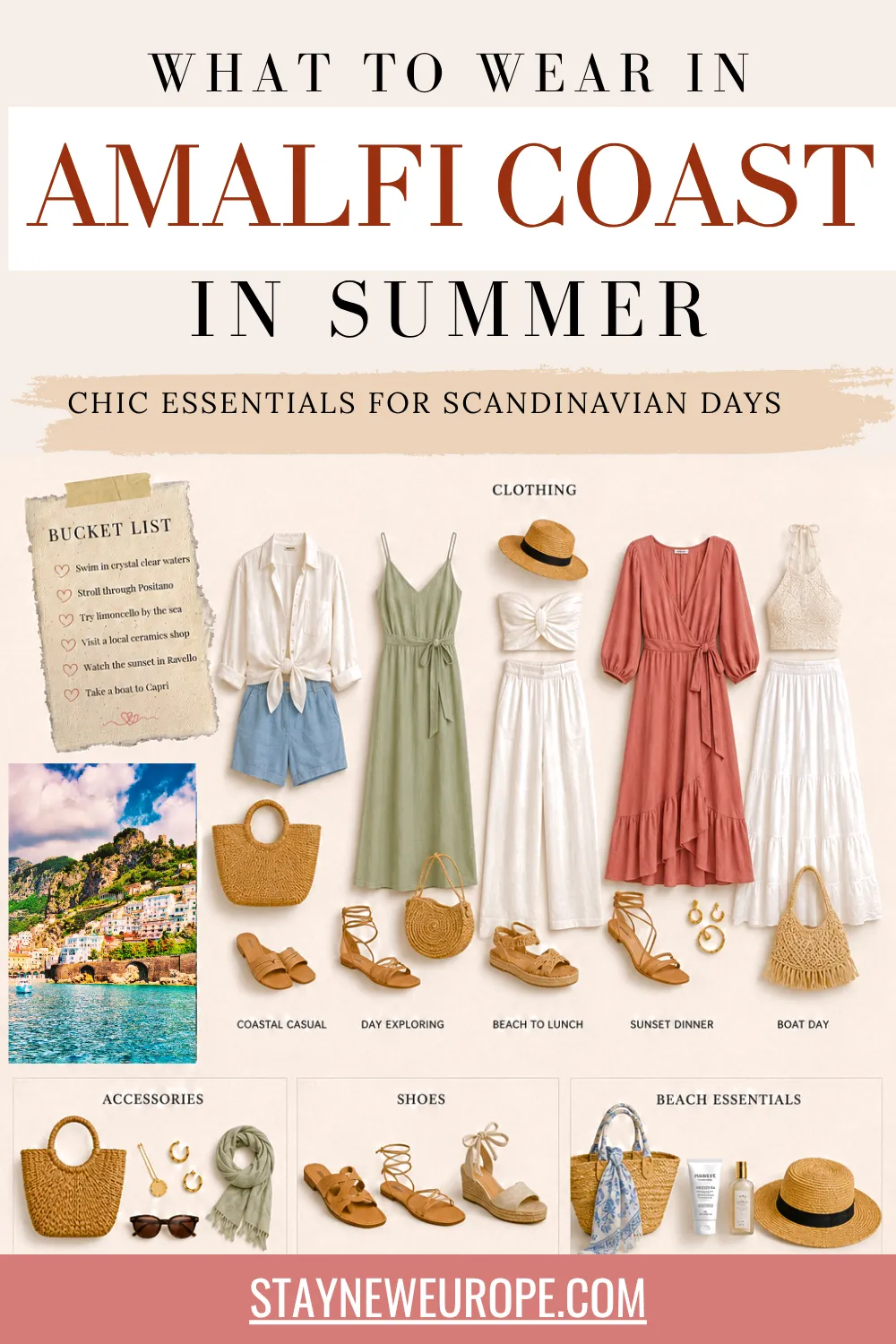
Let me be upfront about something: the Amalfi Coast is not a place you can dress casually for and get away with it. I don’t mean that in an uptight way — I mean the terrain, the heat, the culture, and honestly the sheer visual spectacle of the place all conspire to demand that you think a little harder about your wardrobe before you arrive. I’ve seen women teeter off the ferry in stilettos, wrinkle their noses at the stairs, and spend the rest of the day miserable. I’ve also seen women rock up in heavy jeans when it’s 35°C in August and spend the afternoon looking vaguely like they might faint into the lemon trees.
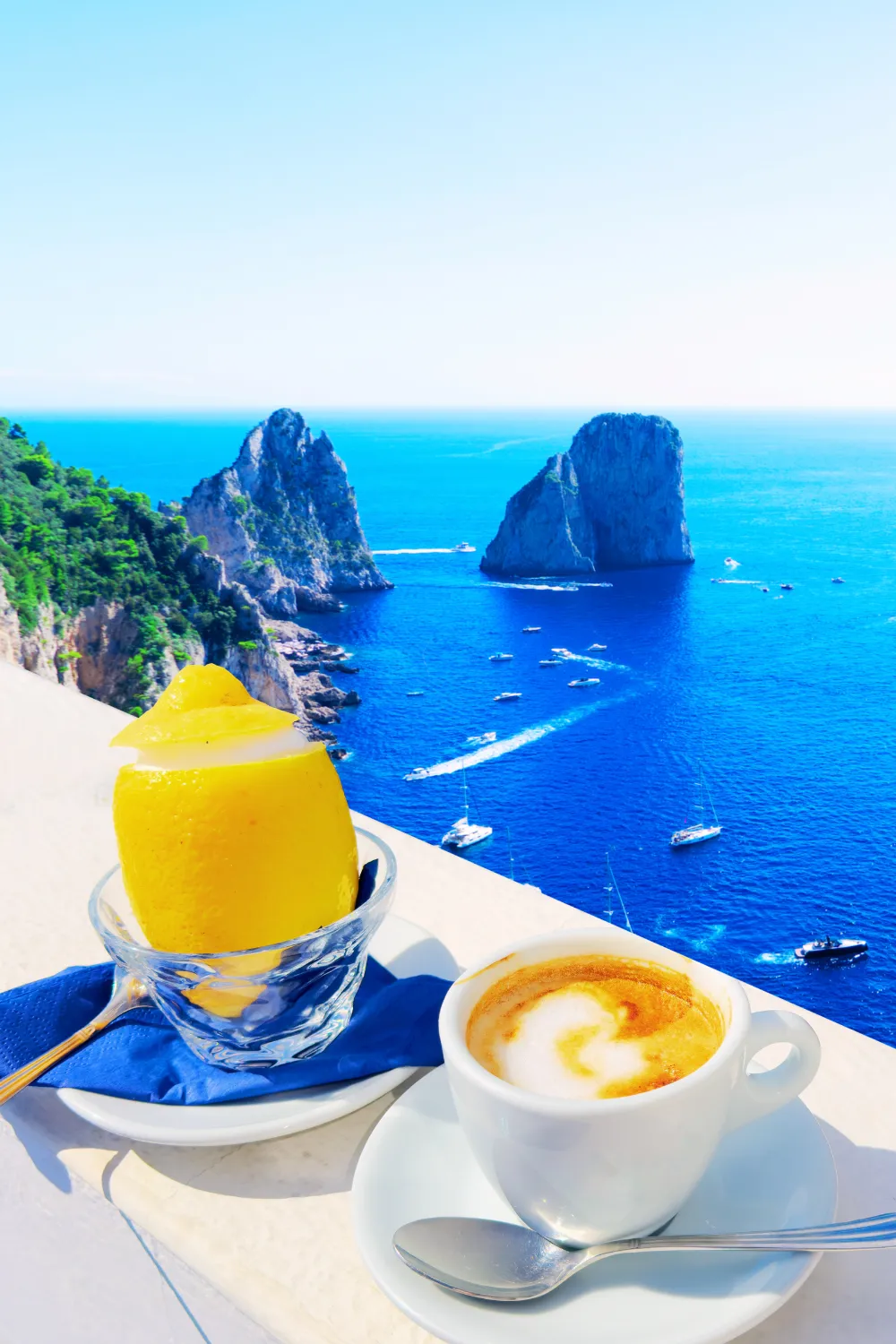
The Amalfi Coast in summer — July and August especially, but June and September too — is hot, dramatic, steep, and impossibly beautiful. The villages cling to cliffs. The paths are narrow and often stepped. The sun bounces off white walls and turquoise water at a heat intensity that’s different from what you get in Rome or Florence. You need clothes that work hard: that look lovely for lunch at a cliffside restaurant, keep you cool when you’re sweating up a flight of 200 stone steps, and still read as “stylish visitor” rather than “unprepared tourist.”
This guide covers exactly what to wear on the Amalfi Coast for women in summer — what genuinely works, what to leave at home, and the small decisions that make a big difference.
Before We Dive In: What the Amalfi Coast Actually Requires of Your Wardrobe
Summer on the Amalfi Coast runs hot and bright from June through September, with July and August being the most intense. Temperatures regularly sit between 28°C and 36°C, with very little shade in the peak afternoon hours. Humidity can creep up, especially near the water, making the heat feel thicker than it looks on paper.
The terrain is non-negotiable. Positano, Ravello, Amalfi town, Praiano — almost every village involves significant climbing. You’ll be navigating stepped alleys, sloping cobbled streets, and boat landings that involve a small leap of faith. Flat paths are the exception, not the rule.
CLOTHING CULTURE:
Style culture here is Italian, which means people pay attention to how they’re dressed. Locals and Italian tourists tend to look effortlessly put-together even in the heat — not overdressed, but definitely not sloppy. Nobody is going to turn you away from a restaurant for wearing shorts, but you’ll feel more at ease (and get better service, if we’re being honest) when you look like you made an effort. If you’re also planning to explore further afield across southern Italy, it’s worth reading up on what to wear in Italy in June for broader context on how to pack for the country’s summer heat.
Linen: The One Fabric That Actually Belongs Here
I know everyone says linen, but let me explain why it’s genuinely non-optional on the Amalfi Coast rather than just trendy. In 34°C coastal heat, synthetic fabrics — even “breathable” ones — trap sweat against your skin in a way that becomes actively unpleasant within about twenty minutes. Cotton is better but can feel heavy when damp. Linen, by contrast, wicks moisture away from your body and dries almost immediately. It’s also lightweight enough to pack generously without filling your entire bag.
The practical magic of linen is that it does two things at once: it’s relaxed enough for a morning walk to the market but elevated enough for lunch somewhere with an actual wine list.
A loose linen shirt in cream, terracotta, or dusty sage looks like you’ve got taste, not like you’ve given up.
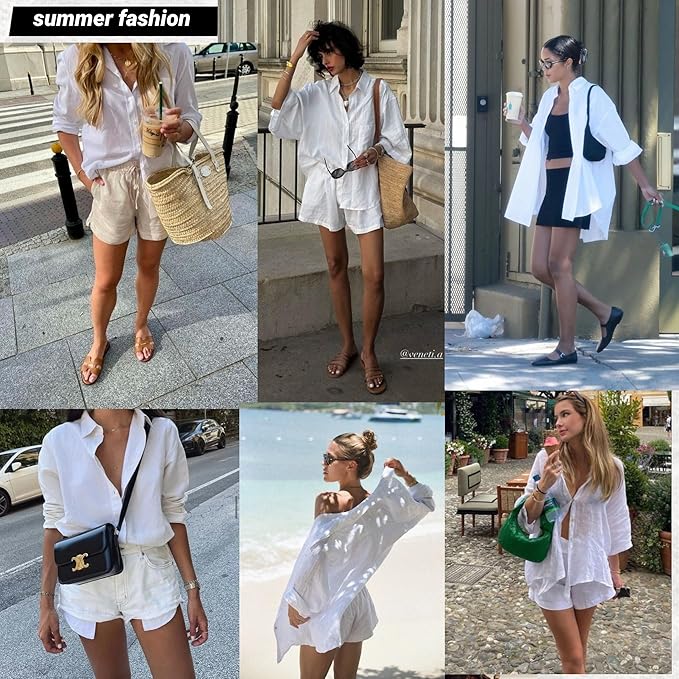
Pack linen in multiple forms — a button-down shirt, wide-leg trousers, a shirt dress, maybe a co-ord set.
The wrinkles are part of the aesthetic on the Amalfi Coast, and anybody who tells you otherwise has never seen an Italian grandmother wear one with complete authority. Avoid linen in very pale colours if you’re prone to visible sweat patches — a medium terracotta or olive reads much more forgiving than white.
Local tip: Italian linen from local shops in Amalfi town and Positano is genuinely beautiful and reasonably priced compared to designer versions back home. Budget a little space in your bag for a linen piece you buy there — it’ll have a story attached.
Maxi Dresses: The Amalfi Coast’s Unofficial Uniform
If there’s one item that’s been worn on the Amalfi Coast by approximately every woman who’s ever been there and loved it, it’s a floaty maxi dress. And this isn’t a coincidence — it’s because they actually solve every problem the coast throws at you simultaneously.
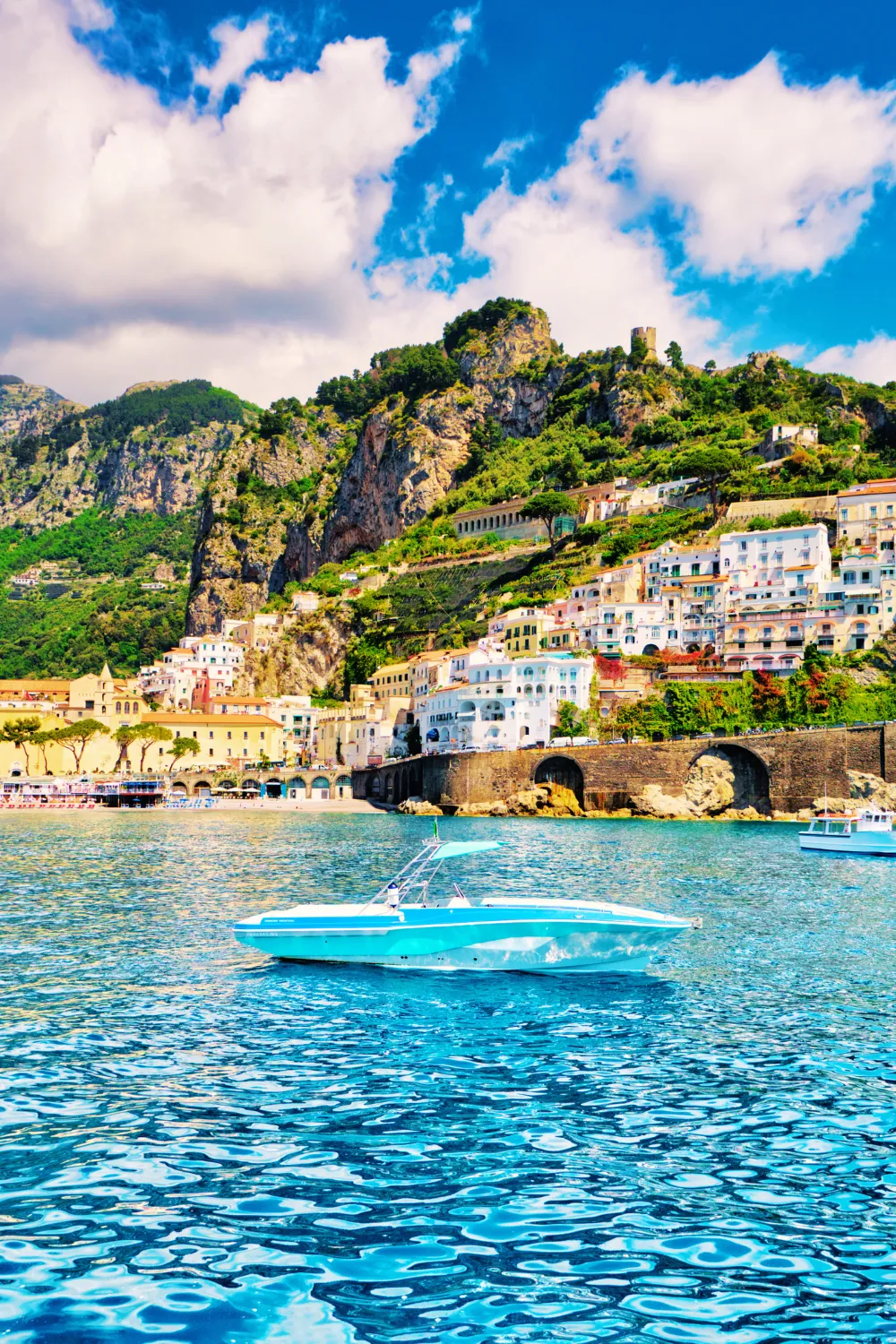
A well-chosen maxi keeps your legs covered from the sun (important when you’re on a sun-drenched boat or terrace for hours). It circulates air freely around your body, making it far cooler than it looks. It’s appropriate for churches, which you’ll want to enter, and it photographs beautifully against the dramatic scenery. It also covers the fact that by hour three of walking, your legs might be looking a little worse for wear.

Choose maxi dresses in lightweight viscose, cotton voile, or — again — linen. Go for styles with a wrap element or a defined waist if you want to avoid looking shapeless; the “pillow case with armholes” silhouette doesn’t do anyone any favours. Florals and bold prints are completely at home here, and a brightly patterned maxi against a blue sea is the kind of photo you’ll actually print out.

What to wear it with: flat sandals, a crossbody bag, and a pair of sunglasses you actually care about.
For the evening: swap the sandals for block heels or wedges and add some gold jewellery. Instant transformation, zero extra luggage.
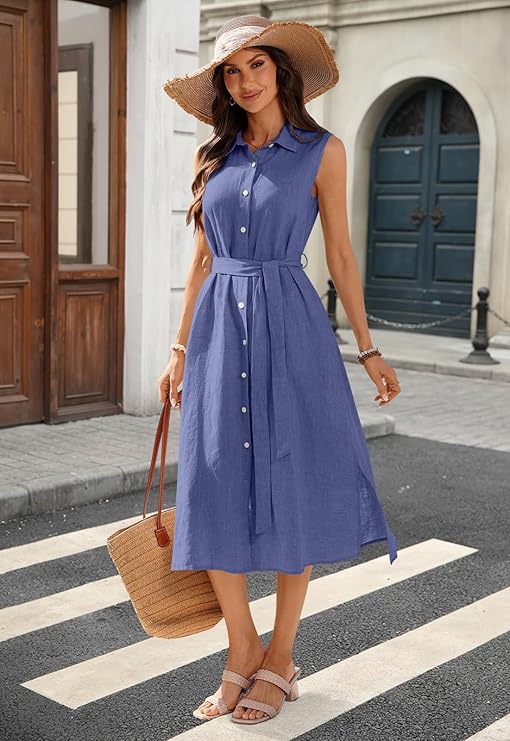
Local tip: Positano has several little boutiques selling handmade sundresses and cover-ups in local prints. They’re not cheap but they’re beautiful, and the craft is genuine. Worth it as a holiday piece you’ll actually wear again.
What to Wear in Amalfi Coast for Women in Summer: The Shorts Question
Let me be honest — shorts work here, but not all shorts. There’s a type of tourist short that looks immediately wrong on the Amalfi Coast, and it’s the baggy, cargo, or athletic variety. Shorts like this read as “I wandered away from the beach and forgot to change,” which isn’t quite the vibe the coast calls for.
What works beautifully: tailored linen shorts or cotton shorts that hit mid-thigh or just above the knee. Pleated-front shorts in a neutral colour have an elegant quality that reads more “deliberately casual” than “couldn’t be bothered.” Pair them with a tucked-in silk camisole or a fitted linen top and you’ve got an outfit that works from the morning ferry to an afternoon aperitivo.

One consideration: if you’re visiting churches (and you’ll want to — Sant’Andrea Cathedral in Amalfi is stunning), shorts won’t get you in without a scarf or sarong to cover your legs. This is worth factoring in. I keep a lightweight sarong in my bag at all times for exactly this reason — it weighs nothing and solves the problem in five seconds.
If you’re spending a day primarily on a boat or beach, shorts over a swimsuit is perfect. Just have something more considered for when you arrive back in town.

Local tip: White or cream shorts photograph incredibly well against the blue water and colourful buildings, but they do show everything. Pack a spare pair if white is your go-to — a splash of limoncello or boat grease is a real possibility.
Walking Shoes That Won’t Ruin Your Day (Or Your Feet)
This is the section where I am absolutely not going to be diplomatic: you cannot wear flip flops for exploring Amalfi Coast villages. I see people try it every single time, and every single time they are miserable by 11am. The steps are uneven, sometimes slippery, often steep. Flip flops offer zero support, zero grip, and will have your knees aching within an hour.
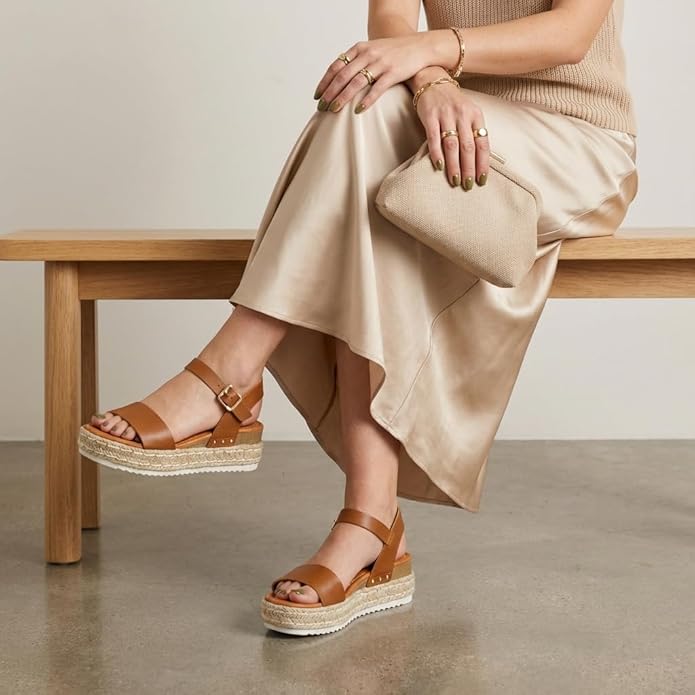
What you need is a proper walking sandal — specifically one with a supportive sole, ankle strap, and enough grip to handle wet stone steps. Birkenstock Arizonas have become iconic for a reason: they’re ugly (let’s be honest), but they genuinely work, and Italian women have incorporated them into chic outfits with such confidence that they’ve become a look in themselves.

Alternatively, look for leather sandals with a moulded footbed — the kind of thing you’ll find sold in Capri or Positano for a significant amount of money, because they earn it.
If you’re planning to hike the Path of the Gods (Sentiero degli Dei) — which you absolutely should, it’s breathtaking — you need actual trainers or trail shoes. Non-negotiable. The path involves loose gravel, exposed cliff sections, and a long descent into Nocelle that will destroy your feet in anything less supportive.

Save your beautiful flat leather mules or block-heel sandals for the evening, when you’re on a terrace and not navigating stairs.
Local tip: The leather sandal workshops in Positano and Capri will make you a pair of custom sandals in your exact size within a day. It costs more than buying something off-the-shelf, but the fit is perfect and they last for years. A genuinely worthwhile splurge.
Swimwear That Does Double Duty
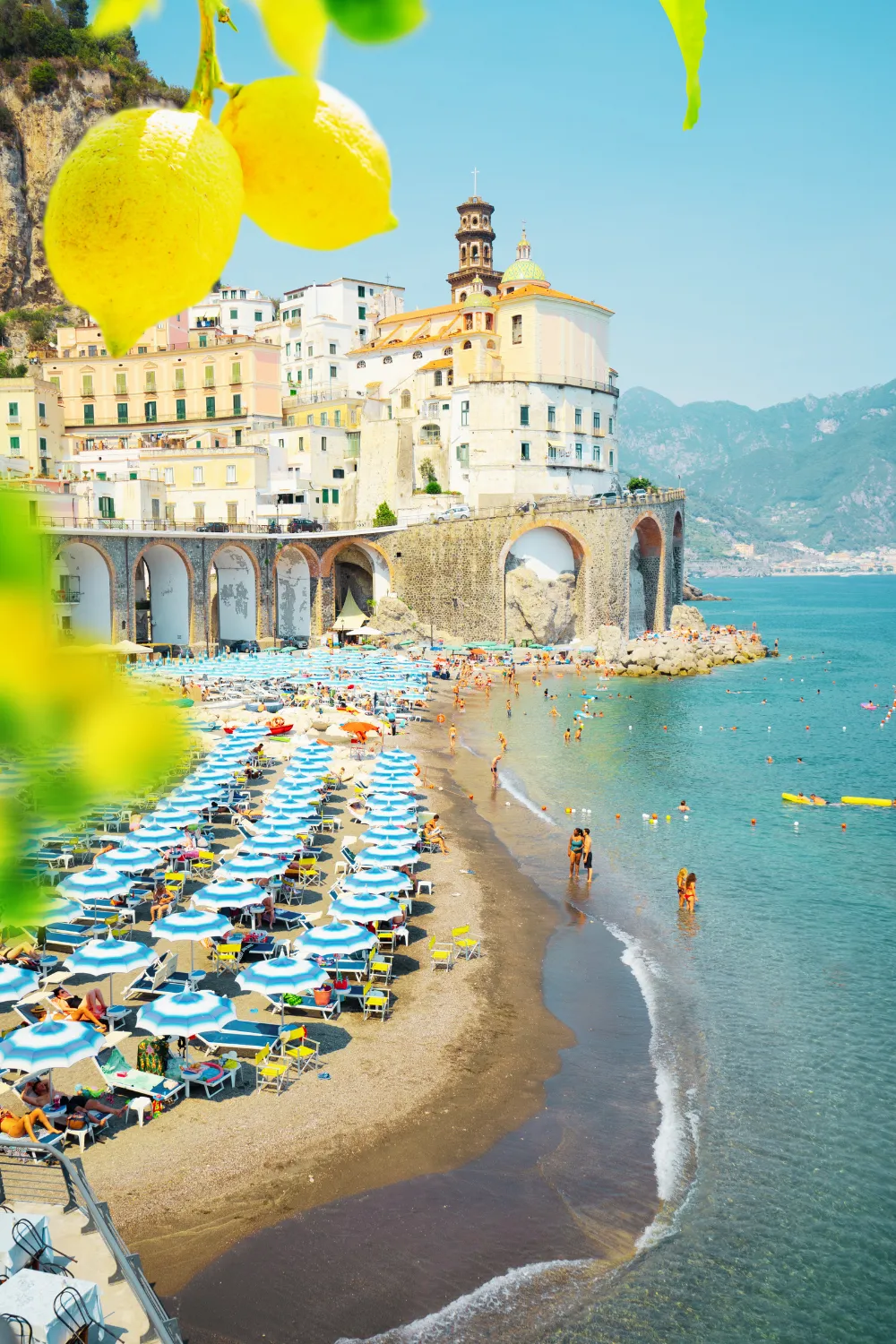
The sea on the Amalfi Coast is the kind of blue that makes you want to immediately get into it, so packing the right swimwear matters. But here’s the thing people underestimate: getting from your accommodation to the beach — and back — involves walking through town, often quite a bit of it. Walking around in a bikini alone in Italian villages is considered poor form and will genuinely make you feel out of place.

A beautiful swimsuit or bikini paired immediately with a cover-up is the answer. The cover-up here doesn’t mean a sad towel sarong — it means a lightweight kaftan, a broderie anglaise shirt dress, or a tie-front linen shirt you’ve already packed for other purposes. The double-duty principle is your best friend when packing for the Amalfi Coast.

Pack two swimsuits minimum if you’re staying more than a few days.

Things don’t dry as fast as you’d think in a humid environment, and wearing a damp swimsuit is nobody’s idea of a good morning. A one-piece is equally appropriate as a bikini and is often more comfortable for scrambling onto rocks or getting in and out of small boats.
Local tip: Many of the beaches on the Amalfi Coast are pebbly rather than sandy, so water shoes are a genuinely useful addition — not glamorous, but they make getting in and out of the water significantly less painful.
Evening Outfits: Dressing for Dinner on the Cliff
Dinner on the Amalfi Coast is an event. People change for it. Not into formal wear — this isn’t the kind of place where you need a cocktail dress — but they shift from daytime casual to something that feels intentional. A sundress gets a scarf. A linen shirt gets tucked in properly. Jewellery comes out.
My favourite evening formula here: a satin or silk-blend slip dress in a solid colour (dusty rose, cobalt blue, ivory), flat leather sandals, a wicker clutch or small evening bag, and simple gold hoops or a chain. It takes thirty seconds to put together, looks effortless, and is completely comfortable for a three-hour dinner with many glasses of local wine.

An alternative that I reach for constantly: wide-leg tailored trousers in cream or white, paired with a fitted silk camisole and a light knit cardigan for the sea breeze that comes in around 9pm. Add block heel sandals and you’re dinner-ready without having packed a single dedicated “evening” item.

The key distinction is that the Amalfi Coast evenings have a soft, warm, golden quality — they’re romantic and relaxed. You want to look lovely, not formal. Leave any structured blazers, heavy fabrics, or stiff silhouettes in the suitcase.

Local tip: Restaurants on the coast often have terraces where the evening breeze can be surprisingly cool once the sun drops. A lightweight knit layer — a cashmere-blend cardigan, a fine cotton wrap — will get used every single evening.
What to Wear for Churches and Sacred Spaces
Every major village on the Amalfi Coast has at least one church worth visiting, and Italian churches enforce a dress code without apology.
Shoulders must be covered, knees must be covered, and many churches will turn you away or hand you a paper cover-up if you’re not compliant.

The easiest solution is to simply dress with this in mind rather than treat it as an inconvenience. A maxi dress covers everything automatically. A linen shirt over a sundress sorts the shoulders.
A sarong or a lightweight scarf folded over your bag can cover bare legs in about ten seconds — I always have one.

The Duomo di Amalfi (Sant’Andrea Cathedral) is the most dramatic and most visited — the striped facade, the Arab-Norman architecture, the long staircase up to the entrance. It would be a genuine shame to miss it because of a dress code that’s very easy to work around.
Local tip: Keep your shoulder cover-up accessible — not stuffed at the bottom of your bag. The spontaneous decision to step into a beautiful church is something you want to be able to act on immediately.
Bags: Crossbody or Bust
Let me be clear about bags on the Amalfi Coast: nothing with wheels, nothing large enough to require a second thought when you’re squeezing through a narrow alley, and nothing that sits on your shoulder and slides off every time you step onto a boat. The crossbody bag is the correct answer.
A medium-sized leather or canvas crossbody — something that holds your phone, a small wallet, sunscreen, a scarf, and your sunglasses case — is the ideal companion here. It stays on your body when you’re navigating steep stairs, frees up both hands, and looks put-together without effort.

A small wicker or rattan bag works beautifully for evening use and photographs wonderfully against the coastal backdrop. Many shops in Positano sell locally made versions that are a much better deal than the designer equivalents.

What to avoid: large tote bags (they slide off your shoulder on every staircase), backpacks for evenings (too casual for restaurant settings), and overfilled bags of any kind (they put your centre of gravity in the wrong place on steep paths). If you’re hiking, a small rucksack is fine — but leave it at the hotel for dinner.
Local tip: Keep your bag minimal in crowded peak season. The ferries and bus routes between villages can be genuinely packed in July and August, and a compact crossbody is much easier to navigate than anything larger.
Accessories That Earn Their Place in Your Bag
The Amalfi Coast is one of those places where accessories genuinely elevate a simple outfit in a way that matters. The scenery is so extraordinary that you want to look in proportion with it — a beautiful hat, a good pair of sunglasses, and some gold jewellery and you’re there.
A wide-brim hat is almost essential here. Not a floppy beach hat that blows off in the sea breeze, but something with a structured brim that stays put — a raffia or straw hat with a chin tie, or a structured panama style. The sun is intense and direct, especially on boat trips and cliff-top terraces. A hat also photographs beautifully, if that matters to you (it definitely matters to me).

Sunglasses of a quality where you genuinely like them. This sounds obvious but I can’t count the number of times I’ve been somewhere spectacular and spent the day squinting because my sunglasses were uncomfortable or kept sliding down. Invest in a pair you’ll actually wear, and keep them accessible.

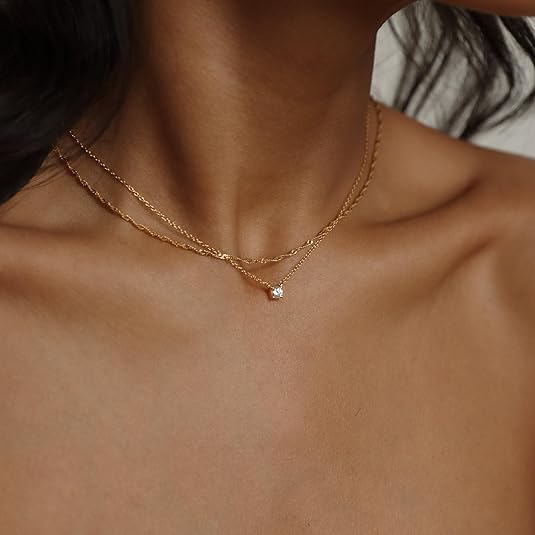
Gold jewellery works better than silver in southern Italian sun — it has a warmth that suits the light. Simple layered chains, small hoops, a stack of thin bracelets. Nothing fussy or delicate enough to catch on anything.
Local tip: Coral and ceramic jewellery made locally is genuinely lovely and reasonably priced. The ceramics of the Amalfi Coast are a tradition worth supporting, and a pair of hand-painted ceramic earrings from a small shop in Ravello is a much better souvenir than a fridge magnet.
What NOT to Wear: Tourist Mistakes to Sidestep
Let me be the friend who tells you the slightly uncomfortable truth before you pack.
Heels on cobblestones. Even kitten heels. The streets are ancient, uneven, and occasionally wet from the sea spray. You will twist something. Block heels on a smooth restaurant terrace are fine; stilettos navigating Positano’s main street are a hospital visit waiting to happen.
Heavy denim in July or August. Jeans on the Amalfi Coast in peak summer are genuinely uncomfortable. The heat is intense, and denim doesn’t breathe. If you love jeans, reserve them for a cooler evening and bring something lighter for the daytime.
Matching tracksuits, athletic leggings, or anything with a sportswear aesthetic. This isn’t a judgment on athleisure as a concept — it’s just that it doesn’t fit the cultural context here. Italian leisure has its own look, and it isn’t gym-adjacent.
All-white everything for a boat day. Boats have ropes, rusty bits, salt spray, and the occasional unfortunate spill. White is gorgeous for lunch; it’s a risk for a day at sea.
Too many shoes. Every pair you pack needs to earn its place. The coast involves a lot of carrying things up stairs — literal carrying, because many hotels don’t have lifts and your luggage comes with you. Two pairs of walking sandals plus one evening pair is generous; four pairs is optimistic.
Local tip: The ferries between villages are how most people get around, and queuing for them in peak season involves standing in direct sun for 20–30 minutes. Dress with that in mind when planning your day.
Sun Protection Outfits for Boat Days and Beach Days
A day on a boat or on the pebble beaches of the Amalfi Coast means hours of direct, reflected sun with very little escape from it. This is not the moment to worry about whether your cover-up is photogenic — this is the moment to prioritise not getting burnt.
A long-sleeved linen shirt as a cover-up is my absolute first choice for boat days. It sounds counterintuitive but loose, long-sleeved linen is genuinely cooler than bare skin in direct sun because it blocks the UV without trapping heat.
A pair of swim shorts or a sarong tied at the waist, your wide-brim hat, and that linen shirt is a practical and still-stylish combination.
SPF should be high — 50 minimum on the Amalfi Coast in summer. The combination of sea reflection and direct overhead sun is much more intense than a day in the city. Reapplication every two hours is not a suggestion; it’s a requirement if you want to avoid spending your holiday red and regretful.
Local tip: Italian pharmacies (farmacie) are excellent and well-stocked with high-quality sunscreens. If you forget yours or run out, you won’t struggle to find a good one.
Fabrics to Choose (and a Few to Avoid)
You already know about linen. Here’s the broader fabric picture for a summer trip to the Amalfi Coast.
Love: Linen, cotton voile, lightweight viscose (especially in flowing cuts), TENCEL/lyocell (soft, moisture-wicking, wrinkle-resistant), cotton poplin. These breathe, move well, and don’t betray you when the heat kicks in.
Tolerate with strategy: Silk and satin blends for evening only, when temperatures drop and you’re not exerting yourself. Beautiful, but high-maintenance in the heat.
Avoid: Polyester in any form for daywear, heavy cotton (denim, canvas), anything with significant stretch that clings. Nylon is fine for swimwear, not for anything you’ll wear on land.
One specific note: viscose is a dream fabric in theory but an absolute liability in rain. It stains easily, clings when wet, and doesn’t recover its shape after a thorough soaking. The Amalfi Coast in summer is reliably dry, so this usually isn’t an issue — but if you’re there in June or September, factor in the possibility.
Local tip: TENCEL/lyocell is a genuinely underrated travel fabric — it has the drape of silk, the breathability of cotton, and it packs into almost nothing. If you haven’t experimented with it yet, an Amalfi trip is a great excuse to start.
The Capsule Wardrobe: Everything You Actually Need
If you’re packing smart — which, given that you may be lugging your bag up seventy-two steps to your hotel room, you should be — here’s a realistic capsule for five to seven days on the Amalfi Coast in summer. For more packing strategies that work for Italy, have a look at the ultimate printable Italy travel checklist which covers the practical side in detail, or if you want to see how the Amalfi wardrobe fits into a broader southern Italy trip, the what to wear in Italy in June guide is a useful companion.
Tops: Two linen or cotton shirts (one white, one colour), two silk or cotton camisoles, one fitted long-sleeved linen shirt for sun protection.
Bottoms: One pair of tailored linen shorts, one pair of wide-leg linen trousers, one lightweight midi skirt.
Dresses: Two maxi or midi dresses (one casual-day, one slightly elevated), one slip dress for evenings.
Swimwear: Two swimsuits or bikinis.
Cover-ups: One kaftan or oversized shirt, one lightweight sarong.
Shoes: One pair of supportive walking sandals, one pair of flat leather sandals or mules (evening/restaurant), one pair of water shoes or trainers if hiking.
Accessories: One wide-brim hat, one quality pair of sunglasses, one crossbody bag, one small evening bag, gold jewellery, one lightweight cardigan or knit layer.
That’s genuinely everything. Resist the urge to add “just in case” items — they become the things you carry up the stairs and never wear.
Practical Packing Tips: Getting It Right Before You Go
The instinct to overpack for a holiday you’ve been excited about for months is completely understandable, and it will make your Amalfi Coast experience significantly harder than it needs to be. Here’s how to think about it clearly.
Choose a colour palette before you pack and stick to it. Neutrals — sand, cream, terracotta, olive — with one accent colour (cobalt, coral, deep red) means everything works together and you can mix and match freely without having packed “outfit by outfit.” If you’re unsure how to build a travel wardrobe that genuinely mixes and matches, the how to pack a carry-on for 10 days guide from Stay New Europe breaks down the method very clearly.
Plan for the actual days you’ll have. Three beach days, two village-hopping days, one hike, two nice dinners — now you can pack backwards from those activities rather than forward from an anxiety spiral. Each item should appear in at least two planned outfits.
Wear your heaviest items on travel days. If you’ve packed trainers and a linen jacket, they go on your body for the journey, not in the bag.
Avoid the “I might need this” trap. You will not need your full-length evening gown, your silk blouse that needs dry cleaning, or the fourth pair of shoes. The Amalfi Coast is not formal. It is, however, genuinely steep, and every extra kilo is something you’re carrying uphill.
Packing mistakes to avoid: forgetting a cardigan for evenings (the sea breeze is real), packing too many “nice” items at the expense of comfortable walking clothes (you’ll spend more time walking than looking nice, and these aren’t mutually exclusive anyway), and underestimating how much you’ll sweat (pack more tops than you think you need, fewer bottoms).
A Final Word Before You Go
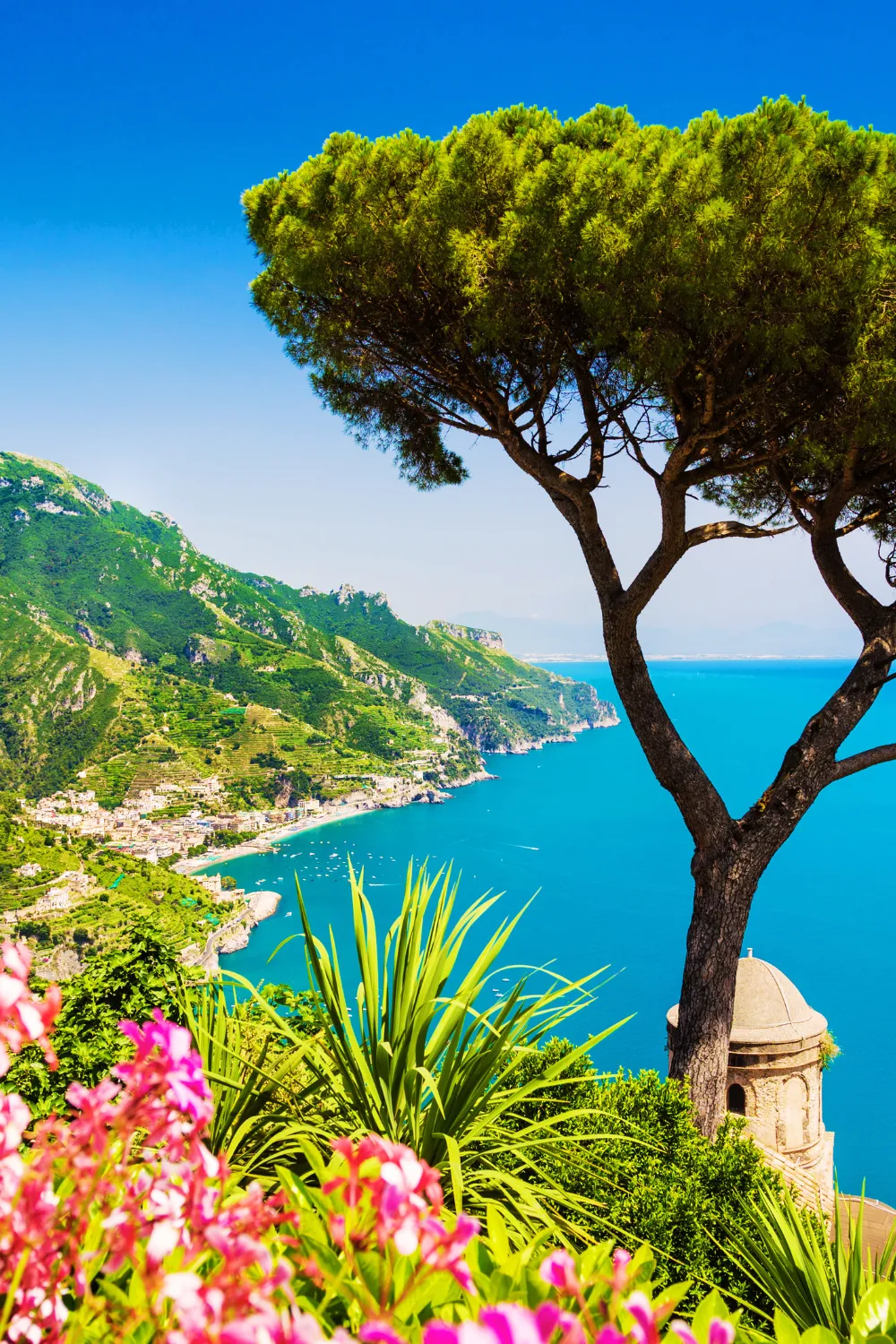
There’s a moment that happens on the Amalfi Coast — maybe on a terrace above Positano with a glass of local white in your hand, or from the bow of a small boat as the villages slide past — when the scenery gets so beautiful it almost feels unreal. The colours are more saturated than seems reasonable. The water is a shade of blue that doesn’t have a good name in English. The lemon trees are laden and fragrant, and the light has that particular southern Italian quality of being warm and golden even at midday.
You want to be comfortable in that moment. You want to not be thinking about the wrong shoes or the outfit that’s sticking to you in the heat. The whole point of getting the packing right is that it disappears — you stop thinking about your clothes and start thinking about where you are.
Pack well, pack light, and leave room in your bag for the linen shirt you’ll inevitably buy in a tiny shop because it’s too beautiful to leave behind. The Amalfi Coast has a way of demanding at least one impulse purchase, and you might as well make it a good one.

