
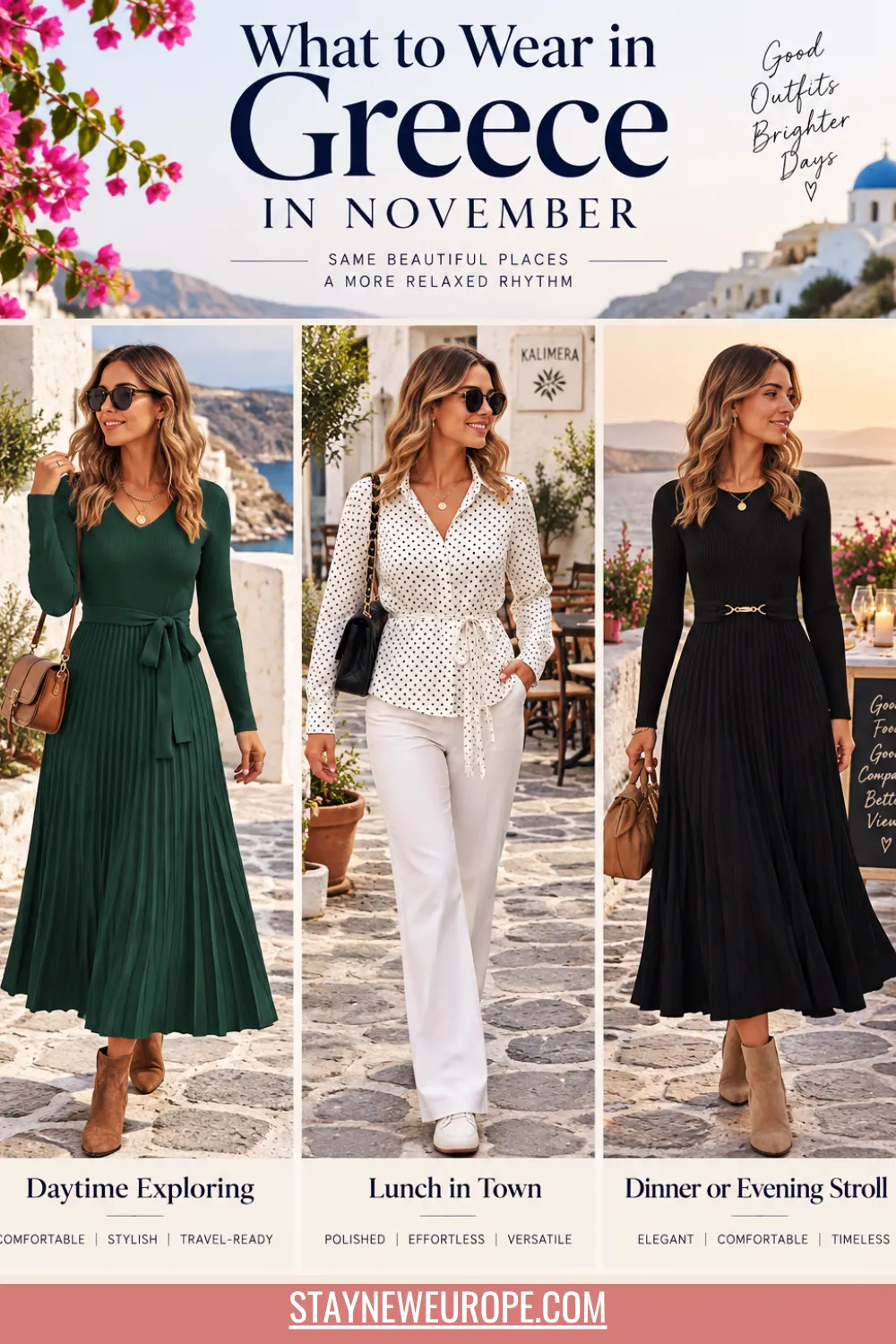
Let me be honest with you — I went to Greece in November expecting a softer, quieter version of summer. What I got instead was wind whipping off the Aegean strong enough to steal my scarf, grey skies over the Acropolis, and a taverna owner in Nafplio laughing kindly at my “packing for the Mediterranean” logic.
This is the trip nobody prepares you for. The postcards are all July — white walls, blue domes, bare shoulders. November Greece is a different country entirely: quieter streets, golden late-autumn light, olive harvests happening in the background, and a chill that catches you off guard the second the sun dips behind a hill.
The mistake almost everyone makes? Packing like it’s still shoulder season, or overcorrecting and packing like they’re headed to the Alps. Neither is right. I learned this the hard way, layer by uncomfortable layer, so you don’t have to.
Before We Dive In
Weather: Greece in November sits somewhere between “bring a coat” and “don’t panic, it’s not freezing.” Athens and the mainland typically hover between 12–18°C (54–64°F) in the day, dropping into single digits Celsius at night. The islands run a touch milder thanks to the sea, but they also catch more wind — and rain becomes a real possibility, not just a footnote. This is the Mediterranean’s actual autumn, not a marketing version of it.
Walking conditions: Athens’ Plaka district and most historic centres are marble and cobblestone, and November rain makes them genuinely slippery — I nearly went down outside the Acropolis Museum on a wet Tuesday. Island towns like those on Naxos or Rhodes add uneven old-town stone into the mix. Your shoes matter more this month than almost any other packing decision.
Style culture: Greeks — especially in Athens — dress with quiet intention. Think tailored coats, good boots, scarves knotted just so. Nobody is in beachwear anymore by November, and showing up in flip-flops and a rash guard will mark you as a tourist faster than a map in your hand. Smart-casual is the baseline here, even for a coffee run.
A Bag That Can Actually Handle November
Before we get to clothes, let’s talk logistics, because the wrong bag makes everything harder.
November Greece means you’re not just carrying sunscreen and a swimsuit anymore — you’re managing a packable rain jacket, a scarf, maybe gloves for the evenings, and layers that come on and off constantly as you move between sun-warmed courtyards and shaded, windy streets. A soft-structured duffle or a wheeled carry-on with real compression straps earns its keep here.
I switched to a mid-sized duffle with a separate shoe compartment for this exact trip, and it saved me from unpacking my whole bag just to find dry socks after a rain shower in Chania. If you’re island-hopping by ferry, prioritise something you can actually lift over your head onto a luggage rack — this is not the month for an oversized hard-shell case you have to drag over uneven docks.

Local tip: if your itinerary includes ferries between islands, pack a foldable tote inside your main bag. You’ll want a dry, separate spot for a wet umbrella or damp shoes at some point in the trip — trust me on this one.
Lightweight Layers (Why They Matter More Than You Think)
Here’s the thing about November in Greece — the temperature swing across a single day can be 8–10 degrees, and that changes what “dressed for the weather” even means.
You’ll start the morning needing a coat, peel down to a light sweater by early afternoon when the sun’s properly up, then be reaching for that coat again the second it sets. This isn’t a “pack one warm jacket and be done” kind of trip — it’s a layering trip, full stop. Think a breathable base layer, a mid-weight knit, and an outer layer you can shed and stuff in a bag without it looking crumpled three hours later.

My go-to combination became a fine merino long-sleeve under a cotton sweater, with a trench or wool-blend coat over the top. It sounds like a lot until you realise you’re constantly removing one piece as the day heats up, then putting it back on for the evening chill.
Local tip: merino wool doesn’t hold odour the way cotton does, which matters when you’re re-wearing the same base layer three days in a row to keep your case light.
Dresses That Actually Work for a Greek November
A flowy summer dress on its own is a hard no this month — but a dress as the base of an outfit, worn with layers, is one of the smartest pieces you can pack.
A midi dress in a heavier cotton or a wool-blend knit, worn under a coat with tights and boots, gives you that effortless, “I live here” look without freezing.

I wore the same forest-green knit dress four times on one trip — once with a denim jacket and sneakers for daytime wandering, once with a wool coat and boots for dinner in Athens — and nobody clocked the repeat because the styling changed so much.

Avoid anything strapless or in thin linen; it’ll just sit in your case unworn. What you want is fabric with actual weight to it — ribbed knits, brushed cotton, a bit of wool blend — that can layer under a coat and still look intentional, not bulky.
Local tip: a slip dress under a chunky knit sweater, worn as a longer top, is a combination I saw on half the women in Athens’ Kolonaki neighbourhood — steal it.
Jeans, Trousers, or Shorts — What Actually Works
Shorts are, unfortunately, off the table for most of November unless you’re specifically heading to a warmer southern island on a rare sunny stretch — and even then, you’ll want them for maybe one afternoon, not the whole trip.
Good denim or a structured trouser is your real workhorse this month. I lived in a pair of dark, slightly cropped jeans that worked equally well tucked into boots for sightseeing and dressed up with a blazer for dinner.

Wide-leg trousers in a heavier fabric are having a real moment too, and they’re forgiving after a long lunch of moussaka and wine, which — let’s be honest — you will have more than once.

Corduroy deserves a mention here as well. It photographs beautifully against Greece’s stone and marble backdrops, and it’s genuinely warm without looking like winter gear.
Local tip: skip anything too fitted at the ankle if you’re doing a lot of hill walking — Athens has more inclines than people expect, and you’ll want ease of movement.
Comfortable but Stylish Walking Shoes
I said it above and I’ll say it again: your shoes are the single most important packing decision for Greece in November.
Wet marble, uneven cobblestones, and archaeological sites with loose gravel are not the place for anything without real grip. A pair of leather ankle boots with a low, sturdy heel became my daily uniform — they worked for the Acropolis, for wandering Nafplio’s old town, and for dinner without needing a shoe change.

White trainers are fine too, but bring a pair that’s already broken in; this is not the trip to test new shoes.

I made the mistake once of packing suede boots for a “just in case it rains” scenario and then, of course, it rained the entire second day. Suede and Greek November rain do not mix — the marks never fully came out.
Local tip: pack a small tube of shoe protectant spray, or apply it before you leave home. It’s a two-minute step that saves your favourite boots.
What NOT to Wear (Tourist Mistakes I’ve Made or Watched Happen)
- Flip-flops past October, for one — I watched someone genuinely shivering in them outside the Temple of Poseidon and it looked miserable.
- Anything sleeveless without a layer to go over it is another one; the wind off the water is sharper than the daytime temperature suggests.
- Also skip the head-to-toe technical hiking gear unless you’re specifically doing a mountain trek — Greeks dress well even for casual outings,
- and a full waterproof shell with cargo pockets reads as camping gear, not city style.
- And please, leave the giant printed beach kaftan at home. It had its moment in July; November calls for something with more structure.
Local tip: if in doubt, look at what local women in their 30s and 40s are wearing on a weekday morning coffee run — that’s your style benchmark for the whole trip, honestly.
Jackets for Unpredictable Weather
This is the piece worth spending real money on, because you’ll wear it every single day.
A structured wool or wool-blend coat does double duty — warm enough for cool evenings, smart enough for dinner, and it photographs beautifully against Greece’s stone architecture. Alongside it, pack something waterproof and packable for the actual rain days, because a wool coat and a downpour are not friends.

I carry a slim packable rain shell that folds into its own pocket, tucked into my day bag at all times from late October onward.
A denim or leather jacket is a good middle layer for the milder days when a full coat feels like overkill but a sweater alone isn’t enough.

Local tip: a coat in camel, navy, or forest green will match literally everything else you packed — resist the urge to bring a statement colour coat as your only option.
Evening Outfits in Greece
Dinner in Greece, even in November, still has a bit of theatre to it — long, slow meals, candlelit tavernas, the kind of evening where you want to look like you made an effort without looking overdressed.

A knit dress with boots and a good coat is my default. For a dressier night in Athens, I’ll swap to trousers, a silk or satin top, and heeled boots instead of a flat — the extra height feels appropriate against the marble floors of a nicer restaurant.

Men fare well in dark trousers, a crewneck or button-down, and a decent jacket; Greek men dress up for dinner more than you’d expect.

What you don’t need: anything sequinned, anything beach-adjacent, or heels you can’t actually walk in on cobblestones — I’ve watched more than one woman take her shoes off entirely halfway through a walk to a restaurant.
Local tip: a single gold or silver statement earring elevates a simple sweater-and-trouser combo instantly — pack one pair, wear it constantly.
What to Wear for Churches (Dress Codes That Actually Matter)
Greek Orthodox churches and monasteries take dress codes seriously, and November’s cooler weather actually makes this easier to follow than summer does.
Shoulders and knees covered is the standard rule, and in November you’re likely already in trousers or a longer dress with a coat, so you’re mostly there without trying. The one thing to double-check: sleeveless tops under an open coat won’t cut it once the coat comes off inside — bring a light cardigan or scarf specifically for this.

If you’re visiting Meteora’s monasteries, note that some still require women to wear a wrap skirt over trousers — they’re usually provided at the entrance, but having your own lightweight sarong in your day bag means you’re not waiting on a shared communal one.

Local tip: a large square scarf earns its spot in your bag purely for this — shoulder cover, hair protection from wind, and an instant skirt-wrap if needed.
Bags: Crossbody vs Backpack
For daily sightseeing, a crossbody bag wins for me every time in November — it sits close to the body, keeps your hands free for holding a coat or umbrella, and doesn’t strain your shoulders the way a backpack can over a full day of walking.

That said, if you’re doing anything hike-adjacent — Meteora, parts of Delphi, or a countryside day trip — a small daypack with a rain cover is worth the extra bulk.

I use a structured leather crossbody for city days and switch to a canvas backpack for excursion days, and having both meant I was never caught out either way.
Local tip: a bag with a zip top, not a magnetic clasp, matters more in busy areas like Monastiraki — November’s smaller crowds don’t fully erase pickpocket risk.
Accessories That Elevate Simple Outfits
November is when accessories genuinely do the most work, because you’re often repeating the same three or four base pieces across a week-long trip.
A patterned scarf can transform the same wool coat from Tuesday’s museum look into Thursday’s dinner look.

A structured leather belt cinches an oversized sweater into something more considered.

And a pair of leather gloves — which felt almost comically formal when I packed them — turned out to be genuinely necessary on a windy ferry crossing to one of the Cyclades.

Jewellery-wise, I’d keep it simple: a couple of good rings, one statement earring style, and skip anything too delicate that you’ll be fussing with under layers all day.
Local tip: a beret or structured wool cap does more for a photo than you’d expect, and it solves the “my hair is a disaster in this wind” problem in one move.
Rain Preparation (The Unexpected but Important Bit)
Nobody plans their Greece trip around rain gear, and that’s exactly why it catches people out in November.
A proper packable rain jacket is non-negotiable — not a flimsy poncho from a tourist shop, which I resorted to once in Athens and regretted within the hour.

A small travel umbrella that actually fits in a daybag matters too, especially for island destinations where wind makes rain come in sideways rather than politely from above. Waterproof or at least water-resistant footwear rounds this out; suede and canvas both struggle here.

I’d also suggest packing one full backup outfit in a way that’s protected from the rest of your case, in case you get properly soaked on a travel day and need dry clothes immediately on arrival.
Local tip: check the forecast for Meltemi-adjacent wind warnings if you’re island-hopping — ferries do get cancelled, and dressing for a possible extra unplanned day matters more than people realise.
Fabrics to Choose (and Avoid)
Wool, wool blends, brushed cotton, corduroy, and merino are your friends this month — they hold warmth, resist wrinkling in a packed case, and layer well without adding bulk.
Linen, which is the fabric everyone associates with Greece, is genuinely the wrong choice for November — it doesn’t insulate at all and looks visibly out of season. Pure cotton on its own runs cold too; it’s fine as a base layer but not as your only defence against the evening chill. Silk works beautifully as a lightweight layering piece under a sweater, adding warmth without bulk.
Local tip: a fine-gauge merino base layer takes up almost no case space and does more temperature regulation than a bulky fleece — pack two, not one.
A Capsule Wardrobe for Greece in November
Here’s roughly what earned its place in my case for a nine-day trip covering Athens and one island: two pairs of trousers (one dark denim, one wool-blend), one midi knit dress, three tops in varying warmth levels, one chunky sweater, a merino base layer, a wool coat, a packable rain shell, one pair of leather boots, one pair of trainers, and a small rotation of scarves and jewellery to change up the look daily.
Everything shares a colour palette — navy, camel, forest green, cream — so any top pairs with any bottom, and the accessories do the heavy lifting of making it look like more outfits than it actually is. It’s genuinely freeing to stop overthinking outfit combinations once everything is designed to mix and match from day one.
Local tip: lay everything out on your bed before you pack and remove one item — you almost always overestimate what you’ll actually wear.
How Many Outfits to Bring (and the Overpacking Trap)
For a week to ten days, five to six full outfit combinations is genuinely plenty when you’re working from a capsule wardrobe — you’re not packing one outfit per day, you’re packing pieces that recombine.
The overpacking trap in November specifically comes from packing for every possible weather scenario as if you need a dedicated outfit for each one. You don’t. One good coat handles cold and mild days differently depending on what’s under it; one pair of boots handles rain and dry days differently depending on how you accessorise. Plan outfits around layering flexibility, not around covering every temperature separately.
The most common mistake I see — and made myself, early on — is packing a “just in case” outfit for a scenario that never happens, while wearing the same three reliable combinations the entire trip anyway.
Before You Go
I won’t pretend November Greece is the version most people picture when they book the trip — it’s not sun loungers and gelato at 10pm. It’s something better, honestly: quieter ruins, warmer welcomes from locals who have their city back, golden light that summer’s harsh glare never gives you, and dinners that stretch on because nobody’s rushing you out for the next seating.
Pack like you mean it — layered, warm, a little bit dressed up — and you’ll spend your trip actually present in it, instead of cold, damp, and wishing you’d brought a real coat. Greece in November rewards the traveller who shows up prepared for its real weather, not its Instagram weather. Go be that traveller.

