
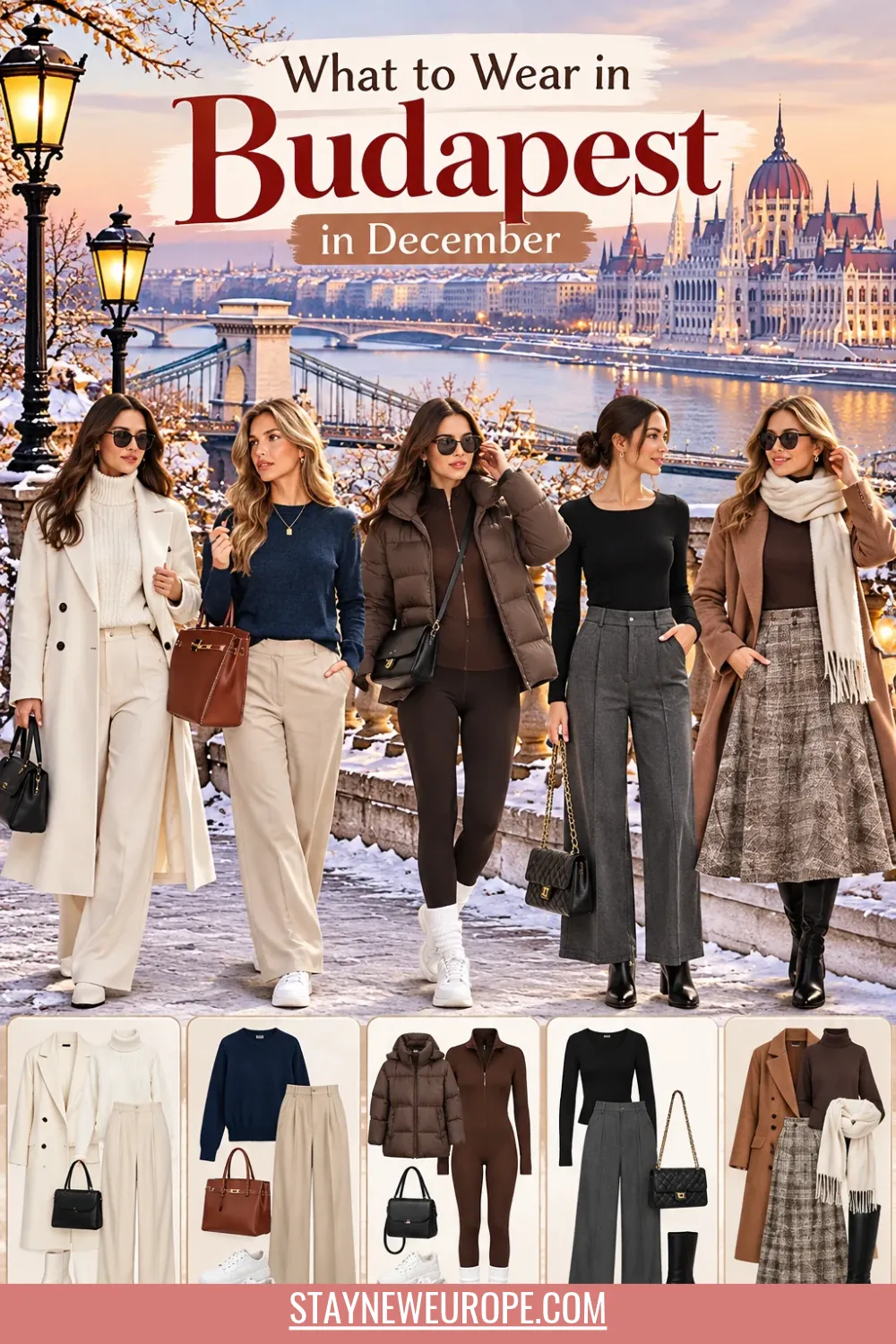
Budapest in December smells like chimney cake, mulled wine and cold river air. The Christmas markets glow by 4pm, the Danube turns the colour of pewter, and everyone on the tram is wearing black wool and an expression of quiet competence.
It’s also properly cold, often damp, and built on hills and cobblestones that do not care about your cute boots. I arrived once in sneakers and a “warm-ish” jacket, and within two hours I was bargaining with a market stall for a hat I did not love.
So here’s what I’d actually pack: layers that work for markets, thermal baths and dinner, shoes with real grip, and a few small things that make a big difference. Let me save you the shivering.
Before We Dive In
Weather: Expect roughly -2°C to 4°C (28–39°F). Some years bring snow, but grey, drizzly, foggy days are more common than a postcard winter. The wind along the Danube is the real troublemaker. Daylight is short, with sunset around 4pm.
Walking conditions: Cobblestones, tram tracks, steep paths up Castle Hill and Gellért Hill, and frosty pavements first thing in the morning. You will walk a lot, and slippery surfaces are the main thing to plan for.
Style culture: Budapest dresses dark, polished and practical. Think long coats, good boots, scarves tied with intent. You won’t be judged for a puffer, but you’ll feel better in something that looks put-together.
Heading elsewhere? Check our other monthly guides, like What to Wear in Prague in December and What to Wear in Vienna in December.
Start With the Right Bag
Your bag decides how comfortable the whole trip is, so let’s start there.
I’m a carry-on person, even in winter. A 40–45L carry-on backpack or a soft-sided carry-on with wheels fits a winter wardrobe if you wear your bulkiest items on the plane. Wearing your coat and boots on the flight is a rule I follow without shame.

For daily wandering, bring a small crossbody bag with a zip. It keeps your hands free for mulled wine and your phone out of reach of the pickpockets who like busy trams and markets.

Local tip: Leave space in your suitcase. Hungarian paprika, handmade wool socks and Tokaji wine are all coming home with you.
Layers Matter More Than One Big Coat
The mistake is thinking one thick coat will do everything. It doesn’t, because you’ll be moving between outdoor chill and overheated trams, cafés and baths.
Build in three layers: a thin base, a warm mid-layer, and a windproof outer layer. This lets you add or remove pieces as you go. I once stood in the Great Market Hall in a giant parka, sweating gently next to a pile of salami, and learned my lesson.
Morning outfit example: thermal base layer, fine-knit jumper, wool coat. By lunch, when the sun briefly shows up, the coat can come off.

Local tip: Old yellow Metro Line 1 and many trams run warm. Dress so you can peel off a layer in seconds.
The Base Layer Nobody Photographs
This is the unglamorous hero of winter travel. A thin merino or thermal long-sleeve top underneath your clothes adds serious warmth without bulk.

Merino is my favourite because it stays warm even if you get a little damp and doesn’t smell after a day of walking. If you prefer a budget option, Uniqlo’s Heattech range does the job well.
Pair it with thermal leggings under jeans or trousers on the coldest days. Nobody can tell, and your legs will thank you at the Fisherman’s Bastion.

Local tip: Keep a spare base layer in your daypack. If you get caught in sleet, changing into a dry one is a small miracle.
The Coat: Your One Big Decision
Pick a coat that covers your hips, blocks wind and looks decent at dinner. A long wool coat over layers is the most “Budapest” look, but a down coat in black, navy or olive works beautifully too and blends in.

Skip anything bright and overly technical unless you’re hiking. Budapest is more city than mountain, and a sleek puffer or wool blend fits right in.
For the colder or wetter days, a water-resistant coat with a hood beats an umbrella, which will fight you on windy bridges.

Local tip: Check the coat has inside pockets. Your phone battery dies faster in the cold, and keeping it close to your body helps.
Jeans, Trousers or Skirts?
Jeans are fine, but thin ones in cold wind are miserable. Go for thicker denim, wool-blend trousers or lined trousers. Dark colours hide slush and look sharper in the evening.

For women, a midi skirt can work beautifully with thermal tights and tall boots, especially for dinner or the opera. For a market day, I’d choose trousers every time.

An outfit that worked for me: dark straight-leg jeans, a chunky knit, a long coat and ankle boots with proper tread. Add a scarf and you’re ready for anything from the Christmas market to a wine bar.

Local tip: Skip shorts and thin leggings as outerwear. Even on a sunny day, the wind off the river will cut straight through.
Boots With Grip (Not Just Style)
If I could only give one piece of advice, it would be this: bring waterproof boots with a real rubber sole. Cobblestones in winter get slick, and I watched more than one stylish traveller do an involuntary dance near the Chain Bridge.

Leather or waterproof-treated ankle boots with a chunky sole are ideal. Brands like Sorel, Timberland or Blundstone get a lot of praise for winter city walking, and plenty of travellers swear by Dr. Martens with thick socks.
Break them in before you leave. Blisters at the start of a trip are a very bad idea.
Local tip: Check the tread before you buy. Smooth, fashionable soles are for dry cities, not frosty hills.
Socks, Tights and Other Small Warm Things
Cold feet ruin a trip faster than almost anything. Wool or merino socks are non-negotiable, and a second pair in your daypack is smart.

For skirts and dresses, fleece-lined or thick opaque tights add warmth without looking bulky. Pack more pairs than you think, because they get wet and dry slowly in a hotel room.

Local tip: Hungarian markets sell lovely handmade wool socks. Buy a pair on day one and wear them straight away.
Accessories That Do the Heavy Lifting
A hat, scarf and gloves are the cheapest way to feel dramatically warmer. Wool or cashmere-blend beanies look clean and stylish, and a large scarf doubles as a wrap on cold trams.
Gloves with touchscreen fingertips let you take photos without freezing your hands. I used to roll my eyes at them until I tried to take a picture of the Parliament building at dusk.

A scarf in a rich colour, like burgundy, mustard or forest green, lifts a plain black outfit and makes you look like you planned it.
Local tip: Pack a spare pair of gloves. Dropping one in a crowded market is oddly common.
What to Wear for Evenings Out
Budapest nightlife ranges from candlelit wine bars to ruin pubs to opera evenings. The trick is to look put-together without carrying a separate wardrobe.
For dinner, I’d go with dark trousers or a midi skirt with thermal tights, a fine knit or silk-blend blouse, and the same boots (cleaned up). Add a statement earring or scarf, and you look like you live there. For the Opera House or a concert, step it up slightly with a dress, tights and dressy boots.

Ruin bars like Szimpla Kert are relaxed, so nothing fancy is needed, but you’ll be inside a crowded warm building, so layers are your friend.
Local tip: Most places have a cloakroom. Use it, and you’ll feel far more comfortable at your table.
What to Wear to the Thermal Baths
This one surprises first-timers. In December, the outdoor pools at places like Széchenyi are steamy and wonderful, but the walk from the changing room to the water is cold.
Pack a swimsuit, flip-flops or slides for the wet floors, and a quick-dry towel (or plan to rent one). A warm robe is a luxury, but a big hoodie or sweater to pull on immediately afterwards is essential. Wet hair in freezing air is not a vibe.

Local tip: Bring a plastic bag for your wet swimsuit, and wear a hat on the way home. Your head will be hot, and the cold air will find it.
What to Wear to Churches and Synagogues
St. Stephen’s Basilica, Matthias Church and the Great Synagogue all expect modest dress. Shoulders and knees should be covered, and winter makes this easy.
A scarf or shawl in your bag covers you in seconds, and long coats do half the work already. Remove hats inside churches as a courtesy.
Local tip: Check opening hours before you go. Some sites close for services or special events, particularly around Christmas.
What NOT to Wear (Tourist Mistakes)
Let me be honest about the usual traps. Thin sneakers, a fashion-only coat, no hat, and cotton hoodies as your main warmth layer are the classic ones.
Avoid white sneakers unless you enjoy cleaning them nightly, and skip high heels on cobblestones unless you’re going straight to a taxi. Cotton jeans and cotton socks get damp and stay damp.
Also skip the bulky “ski jacket” look unless you’re heading to the mountains. You’ll feel overdressed and sweaty indoors.
Local tip: If you’re not sure, pick the dark, simple version of the item. It rarely looks out of place.
What to Pack Besides Clothes
A few non-clothing items make a trip smoother. Pack a reusable water bottle, a power bank (cold drains phone batteries quickly), lip balm and a rich hand cream.
A small foldable umbrella is useful for drizzly days when a hood isn’t enough. Pocket hand warmers cost little and feel amazing at an outdoor market. A universal EU plug adapter is also a must if your devices don’t use European plugs.
Local tip: Bring a small zip bag for wet gloves or a damp scarf, so your daypack stays dry.
How Many Outfits Should You Bring?
Here’s the rule I use for a 4–5 day trip: three bottoms, four tops, two sweaters, one coat, one pair of boots and one spare pair of shoes if you have room. Mix and match everything in a dark palette with one or two accent colours.
A mini capsule wardrobe might look like this: black trousers, dark jeans, a midi skirt, two knits, two long-sleeve tops, one blouse for dinner, a scarf, a hat and your thermal layers. It all coordinates, which means you can repeat pieces without anyone caring.
Mistakes to avoid: packing “just in case” outfits, bringing three pairs of shoes you won’t wear, and forgetting that winter clothes are bulky. Wear your heaviest items on the plane, and use packing cubes if you like order.
Local tip: Laundry in Budapest is easy and affordable, so don’t overpack for a long weekend.
FAQs About the Budapest December Packing List
Do I need a winter coat in Budapest in December? Yes. A warm, windproof coat is essential, especially near the river.
Is it likely to snow? Sometimes, but not guaranteed. Rain, sleet and fog are common, so waterproof boots are the safer bet.
Can I wear jeans? Yes, ideally thick ones, with thermal layers underneath on colder days.
What should I wear to the Christmas markets? Layers, waterproof boots, a hat, gloves and a scarf. You’ll be standing outside for a while.
Is there a dress code for dinner or the opera? Smart-casual is fine for most places. For the opera, dress up a little with polished boots and a dressier top or dress.
Do I need an umbrella? A compact one helps, but a hooded coat usually works better in windy conditions.
Go Pack, Then Go Wander
Budapest in December is one of those cities that rewards the prepared traveller. When you’re warm, comfortable and a little bit well-dressed, you stop thinking about the cold and start noticing the good stuff: steam rising off a bath, lamps reflecting in the Danube, the sweet smell of cinnamon at a market stall.
So pack the boots, take the extra layer, and tuck a scarf in your bag. Then walk across the Chain Bridge at dusk with a cup of mulled wine in your gloved hand, and let the city do the rest.

