
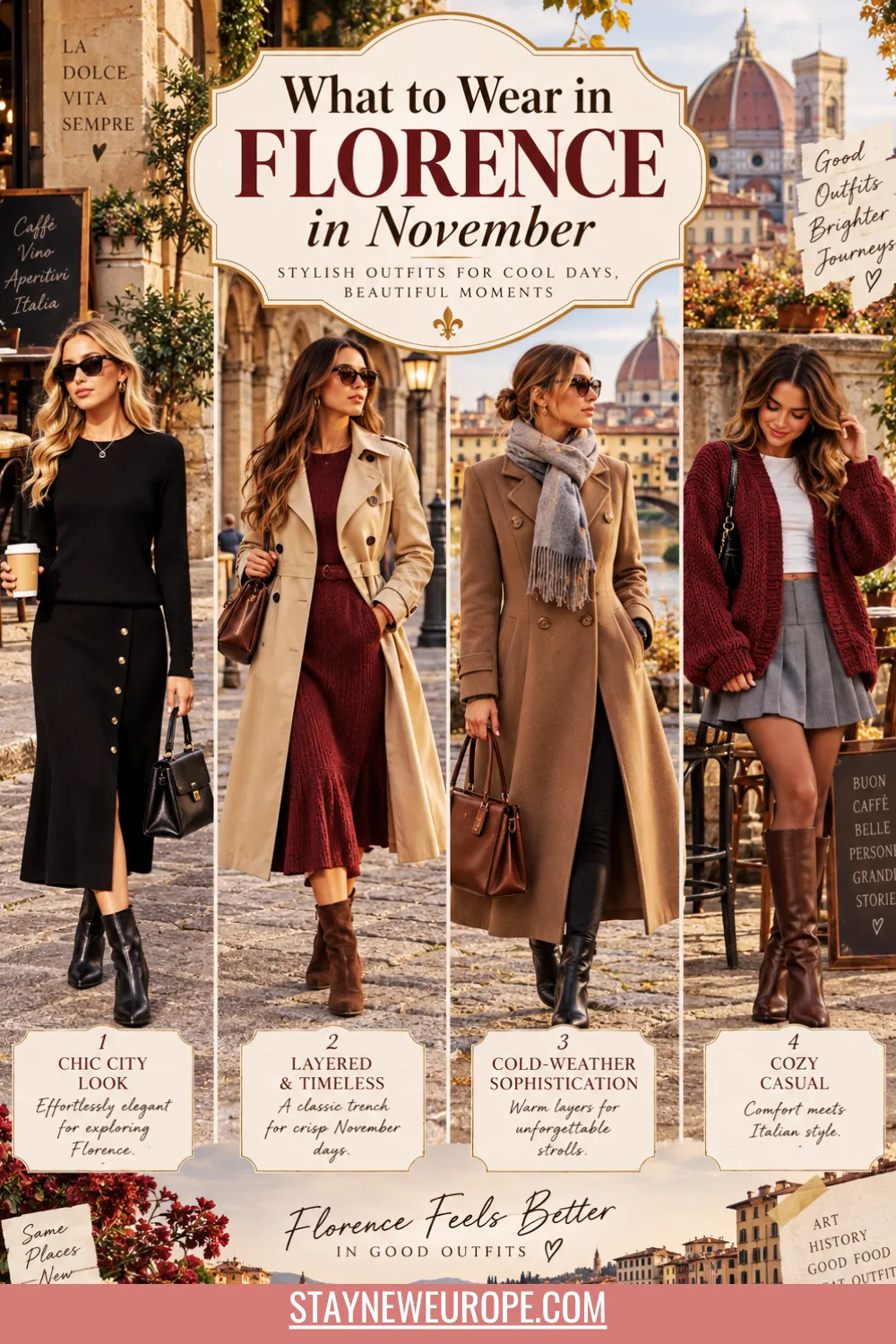
Florence in November is quiet in a way that almost feels illicit. The queues at the Uffizi shrink to something human-sized, the light goes gold and low by 4pm, and the Arno turns this moody, silvery colour that no filter can quite fake. It’s one of my favourite times to be in the city — but it is not the Florence of the postcards, and it definitely isn’t the Florence people packed for in June.
Let me be honest: I underestimated this trip the first time. I showed up with a light trench, one scarf, and a vague idea that “Italy is warm-ish, right?” I was wrong within about four hours, standing on the Ponte Vecchio at dusk with my hands jammed into my armpits, watching actual Florentines glide past in wool coats looking completely unbothered.
The mistake almost everyone makes in November is packing like it’s a milder version of October, or worse, layering with the wrong fabrics and ending up damp and cold by lunchtime. Florence in November rewards a very specific kind of packing — warm, structured, a little bit stylish, and ready for rain that shows up without much warning.
BEFORE WE DIVE IN
Weather: November in Florence sits somewhere between 6°C and 14°C (43–57°F), and the gap between those two numbers is doing a lot of work. Mornings can be properly cold, especially near the river, while a sunny early afternoon might trick you into unzipping your coat. Rain is common — not constant, but the kind that arrives in short, sharp bursts without a lot of warning.
Walking conditions: the historic centre is almost entirely on foot, and much of it is uneven stone paving that gets genuinely slick when wet. Add in a few proper hills if you’re heading up to Piazzale Michelangelo, and you’ve got a city that punishes cute-but-impractical shoes fairly quickly.
Style culture: Italians dress well, and this matters more in a smaller, culturally proud city like Florence than almost anywhere else in the country. Bella figura — the art of presenting yourself with a bit of care — doesn’t take a break for cold weather. Locals in November aren’t wearing puffer jackets and leggings; they’re in wool coats, good scarves, and leather boots that look like they were chosen on purpose. You don’t need to match that exactly, but showing up looking deliberately put-together (rather than purely functional) will change how you experience the city, church visits included.
Lightweight Layers (Why They Matter More Than You Think)
Here’s the thing nobody tells you: one thick coat is far less useful in Florence in November than three thinner layers stacked on top of each other.
The temperature swing between an 8am espresso and a 2pm walk through the Boboli Gardens can be ten degrees, easily. If your only strategy is “one big coat,” you’ll spend half the day sweating in a church and the other half freezing on the Ponte Santa Trinita.
Layers let you adjust in real time — a thin merino base, a mid-weight knit, and something structured on top gives you far more control than a single heavy piece ever will.

I learned this the hard way on my first proper Florence trip, hauling around a single oversized parka that I either wore fully zipped or not at all. The travellers who look effortless in November photos almost always have a base layer, a knit, and a coat working together, not one item doing all the work alone.
Outfit idea: a fine merino long-sleeve top, a chunky knit cardigan over it, and a wool coat on top — you can peel back to just the cardigan indoors and still look finished.

Local tip: buy one good merino base layer before the trip rather than after. It’s the single piece that makes every other layer work better, and it packs down to almost nothing.
The Coat That Actually Earns Its Suitcase Space
Your coat is doing more work in Florence in November than any other single item you pack, so this isn’t the place to compromise.
A structured wool or wool-blend coat, ideally knee-length or just past it, is the workhorse here. It needs to survive both a chilly morning at the Duomo and a slightly smarter dinner later that night, which is a lot to ask of a puffer jacket. Puffers keep you warm, sure, but they read as very casual against Florence’s more polished daily aesthetic, and they don’t layer especially well under a scarf.

If you only bring one “investment” piece for this trip, make it the coat. Camel, black, charcoal, or deep green all work beautifully against the city’s warm stone and terracotta backdrop, and all of them photograph better than a technical shell.
Outfit idea: wool coat, dark jeans, ankle boots, and one good scarf — this is basically the Florence November uniform, and for good reason.
Local tip: a belted wool coat does the work of a coat and a blazer in one, which matters if you’re trying to pack light. Our Italy in August packing guide covers the opposite extreme of this same city’s weather, if your trip happens to bridge both seasons.
Jeans, Trousers, or a Skirt — What Actually Works
Denim is not the enemy in Florence in November, but it needs backup.
A good pair of dark, structured jeans works for almost every daytime scenario — walking, museums, casual lunches — but pair them with tights or thermal leggings underneath if you’re prone to getting cold, because denim alone isn’t much of an insulator once the temperature drops into single digits Celsius.

Tailored wool trousers are the smarter alternative for dinners or gallery days where you want to look a notch more polished without sacrificing warmth.

Skirts are absolutely still an option, just not bare-legged ones. A midi skirt in wool or a heavier knit, worn with opaque tights and boots, reads as properly Florentine and photographs beautifully against the city’s cobbled streets and warm-toned buildings.

Outfit idea: dark straight-leg jeans, a fine-knit jumper, ankle boots, and a wool coat for daytime; swap the jeans for a wool midi skirt and tights for an evening version of the same outfit.
Local tip: skip shorts entirely, even on an unseasonably sunny afternoon. Locals will notice, and church entry requirements (more on that below) rule them out anyway.
Comfortable but Stylish Walking Shoes
This is the section where I get slightly evangelical, because bad shoe choices ruin more Florence trips than bad weather ever does.
The historic centre is cobblestone, uneven, and occasionally slick with rain, and you’ll be covering a genuinely surprising amount of ground each day without necessarily realising it.
Leather ankle boots with a low block heel or a flat sole are the sweet spot — supportive enough for hours of walking, smart enough for dinner, and weatherproof enough to survive an unexpected drizzle.

Trainers are fine for a purely casual day, but choose a clean, minimal pair rather than anything bulky or overtly athletic — Italians wear trainers too, just quieter ones.

What you want to avoid entirely is anything with a smooth, thin sole; the wet stone paving will make short work of it.
Outfit idea: leather ankle boots with jeans and a knit for daytime, the same boots with a skirt and tights for dinner. One good pair genuinely covers both.
Local tip: break in any new boots before you leave home. Florence’s cobblestones are not the place to discover a blister on day one.
What NOT to Wear (Tourist Mistakes)
A few things I see constantly, and gently beg people to reconsider.
- Athletic wear — leggings-as-pants,
- branded hoodies, running shoes with reflective panels — reads immediately as tourist and, more practically, won’t get you into most churches.
- Flip-flops or open sandals are a hard no in November regardless of style; they offer zero protection from cold stone and sudden rain. And oversized rain ponchos,
while genuinely useful in a downpour, are best kept folded in your bag rather than worn while you’re strolling past the Duomo unless the rain is truly torrential.
The other quiet mistake is under-layering because you’re worried about looking bulky. A well-chosen coat and one good knit will keep you warmer and look sleeker than three mismatched cardigans thrown on in a panic at 7am.
Local tip: if in doubt, dress slightly smarter than you think the occasion calls for. Florence rewards it more than most cities.
Rain Preparation (More Important Than You’d Guess)
November rain in Florence tends to arrive fast, fall hard for twenty minutes, and then vanish like nothing happened — which is exactly the kind of weather that catches unprepared travellers off guard.
A compact umbrella that actually fits in your day bag is worth more than you’d think; buying an overpriced one from a street vendor mid-downpour is a rite of passage I’d rather you skip.

Beyond that, a water-resistant coat (not just warm — actually treated for rain) saves you from that miserable damp-wool smell that lingers for the rest of the day. Leather boots with a proper sole will also outperform suede in wet conditions, so save the suede for drier trips.

Outfit idea: a water-resistant wool-blend coat, a packable umbrella in your bag, and leather (not suede) boots — that’s your entire rain strategy sorted.
Local tip: check the forecast the night before, not the morning of. Florentine weather in November can shift overnight more than you’d expect.
Evening Outfits in Florence
Dinner in Florence is an event, even on a Tuesday, and the way locals dress for it reflects that.
You don’t need anything formal, but you do want something a step up from your daytime layers — a silk or satin top under your coat, a pair of tailored trousers or a knit dress, and shoes with slightly more polish than your walking boots.

Statement earrings or a good scarf can elevate a simple daytime outfit into an evening one without requiring a full suitcase of separates.

I’ve had some of my favourite Florence evenings in a black knit dress with tights, boots, and a wool coat over the top — warm enough for the walk there, smart enough for the restaurant, and completely unremarkable to actually cook and eat pasta in, which matters more than people admit.
Outfit idea: knit midi dress, opaque tights, ankle boots, wool coat, and gold jewellery — dressy without trying too hard.
Local tip: most Florentine trattorias are more casual-smart than you’d expect from the outside. You’ll rarely be underdressed in a good knit and boots.
What to Wear for Churches (Dress Codes, and They’re Enforced)
Florence has an enormous number of churches worth visiting — the Duomo, Santa Croce, Santa Maria Novella — and nearly all of them enforce a dress code that catches visitors off guard.
Shoulders and knees need to be covered, for everyone, regardless of gender. That means no sleeveless tops, no shorts, no short skirts — and this is actually checked, not a suggestion. In November this is barely an inconvenience since you’re already layered up against the cold, but it’s worth knowing before you plan a day around a specific basilica.

A long cardigan or scarf in your bag is a smart backup even if your outfit already technically qualifies, since interpretations of “covered enough” can vary slightly by church and by the person checking.
Local tip: keep a lightweight scarf specifically for this purpose. It doubles as a shawl over bare shoulders and takes up almost no space in your bag.
Bags: Crossbody vs. Backpack
Florence’s centro storico gets genuinely crowded around the major sights even in November, and your bag choice matters more than you’d think.
A structured crossbody bag with a zip closure is my strong recommendation — it sits close to your body, keeps your hands free for holding a coffee or a map, and is significantly harder to pickpocket than an open tote.

A small backpack works too, particularly if you’re carrying a camera or extra layers, but wear it on your front in genuinely crowded areas like the Ponte Vecchio or the Uffizi queue.
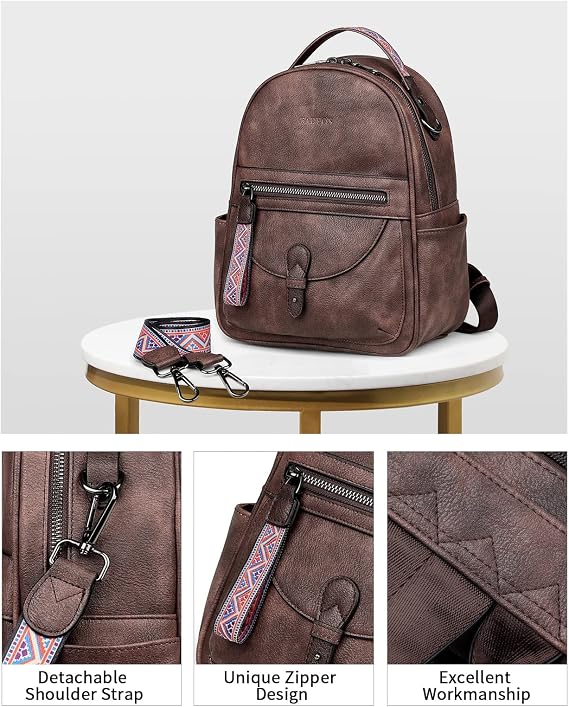
Whatever you choose, leave the oversized weekend tote at the hotel for day trips. It’s one more thing to manage while you’re navigating narrow streets and stone steps, and it rarely earns its bulk.
Local tip: a crossbody in leather or a leather-look material photographs better against Florence’s warm-toned streets than anything neon or logo-heavy, if that sort of thing matters to you.
Accessories That Elevate a Simple Outfit
This is where Florence in November actually works in your favour — cold weather accessories do a lot of visual heavy lifting.
A good wool or cashmere scarf is the single highest-impact item you can pack; it adds warmth, colour, and texture to an otherwise simple jeans-and-coat outfit.

Leather gloves are a small luxury that make a genuine difference on a cold morning, and a structured hat (think a soft beret or a wool fedora, not a beanie) reads as considered rather than purely functional.

Jewellery-wise, keep it simple during the day — a single pair of earrings or a delicate necklace — and save anything bolder for evenings when you’re not bundled up to your chin anyway.
Local tip: buy your scarf in Florence itself if you can. The leather and textile markets near San Lorenzo have genuinely beautiful options, and it becomes a souvenir that actually earns its suitcase space.
Fabrics to Choose (and Avoid)
Fabric choice quietly determines whether you’re comfortable or miserable by day three.
Wool, cashmere, and merino are your best friends in November — they regulate temperature well, resist wrinkling in transit, and layer without adding bulk. Cotton is fine for base layers but offers little warmth on its own, and anything heavily synthetic (think cheap polyester blends) tends to trap moisture rather than wick it, which is exactly what you don’t want on a rainy day of walking.
Leather, for coats, boots, and bags, is both weather-appropriate and squarely in line with the local aesthetic — it’s genuinely everywhere in Florence for good reason.
Local tip: if you’re buying anything wool while you’re here, check the label. Tuscany has a strong textile tradition, and locally made wool pieces are often better value than you’d expect.
Dresses That Actually Work for the Season
Dresses aren’t off the table in November, they just need reinforcements.
A knit midi dress in a heavier fabric, worn with opaque tights and boots, works beautifully for both daytime sightseeing and evening dinners — it’s one piece doing the job of a full outfit, which is exactly what you want when you’re trying to pack efficiently.

Avoid anything in a light, floaty fabric that was clearly designed for summer; it’ll look and feel out of place against the season, no matter how much you love it.
Layer a cardigan or blazer over the dress for daytime, then swap it for your wool coat when you head out, and you’ve built two distinct looks from one core piece.

Outfit idea: charcoal knit midi dress, black tights, ankle boots, wool coat, statement scarf — dressed for the Duomo in the morning, dinner in Oltrarno at night.
Local tip: one versatile dress genuinely earns its space over two “just in case” outfits you’ll never actually wear.
The Right Carry-On or Duffle for This Trip
Florence’s centro storico has cobbled streets and very few lifts in older buildings, which makes your luggage choice more important than it sounds.
A hardshell carry-on with sturdy wheels handles the cobblestones far better than a soft duffle you have to drag or carry. If you’re doing a multi-city Italy trip, a structured duffle with a shoulder strap is a solid backup for shorter legs of the journey, but for Florence specifically, wheels that can handle uneven stone will save your arms and your patience.

Whatever you bring, pack it half-full on the way in. November trips tend to come home heavier thanks to leather goods and wool finds, and Florence is not the city to test how much your suitcase can physically hold.
Local tip: a spinner-wheel carry-on turns easily on narrow Florentine pavements in a way that two-wheel luggage simply can’t manage.
Building a Capsule Wardrobe for Florence in November
The real secret to packing well for this trip isn’t more clothes, it’s fewer, better-connected ones.
Aim for a core palette — charcoal, camel, black, cream — where nearly every top pairs with nearly every bottom, and one coat ties the whole thing together. Two knits, two bottoms, one dress, and a coat can realistically produce close to a week of distinct outfits without repeating a single look twice in the same combination.
If you want the fuller breakdown of how to build this kind of interchangeable system from scratch, our travel capsule wardrobe guide walks through the exact logic, and it applies just as well to a cold Florence week as it does to a mild Paris one.
Local tip: lay everything out on the bed before you pack and count how many outfits each piece can realistically contribute to. Anything under two gets left behind.
How Many Outfits to Actually Pack
For a five-to-seven day Florence trip in November, you genuinely don’t need more than this: two coats or jackets (one heavier, one lighter for milder days), three to four jumpers or knits, two pairs of trousers or jeans, one skirt, one dress, and a rotating set of scarves and accessories to keep things visually fresh.
The biggest packing mistake I see is bringing a full “just in case” outfit for an event that probably won’t happen — a fancier dress for a dinner you haven’t booked, a second pair of boots for a hike you’re not taking. If you can’t picture at least two specific outfits using a piece before you leave home, it doesn’t need to come.
Plan your outfits loosely before the trip rather than figuring it out each morning. Even a rough mental list — “day two: jeans, the grey knit, boots” — saves real decision fatigue on a trip where you’d rather be looking at the Duomo than your suitcase.
Florence in November has this quiet, golden-hour magic that the summer crowds never really get to see, and dressing for it properly only makes that experience better. Pack the good coat, break in the boots, bring one scarf you actually love, and go enjoy a version of this city that most visitors never bother to plan for. You’ll be warm, you’ll look like you meant to be there, and honestly — that’s most of the battle.
