
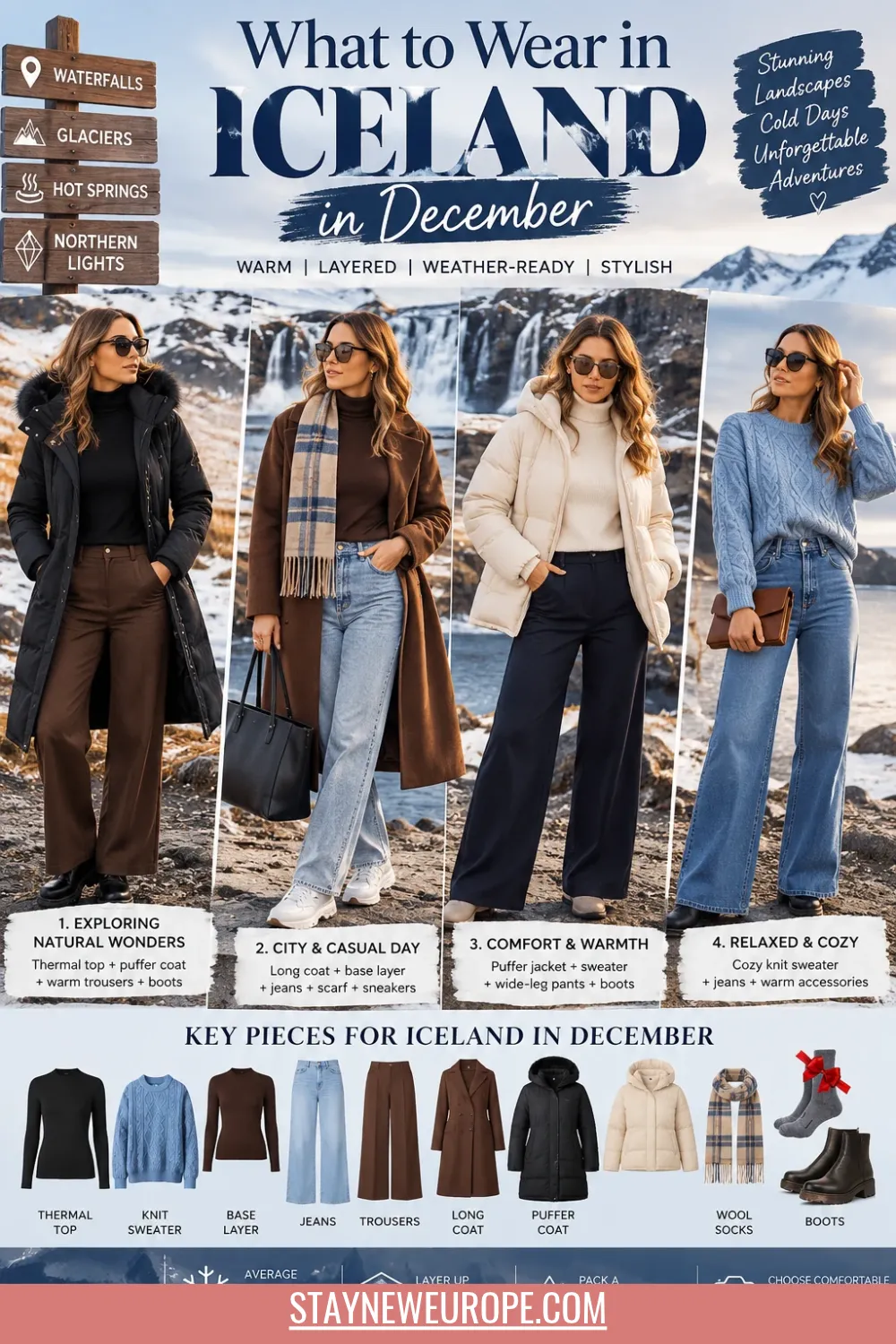
Let me paint you a picture. It’s 11:15 a.m., the sun is just thinking about rising, the sky is a soft pink-grey, and a gust of wind off the North Atlantic has just stolen your hat. You’re standing in front of a waterfall that’s half frozen, half roaring, and you’ve never been so happy or so cold.
That’s Iceland in December. Short days, long shadows, sleet that arrives sideways, and the occasional green ribbon of northern lights if the sky cooperates. It’s wildly beautiful, and it will absolutely punish a bad packing list.
I’ve watched travellers shiver in fashion puffer jackets, slip around in sneakers, and carry umbrellas that lasted roughly nine seconds. Here’s what actually works, so you can spend your trip looking at the scenery and not at your numb toes.
Before We Dive In
A quick reality check on what you’re dressing for:
Weather: Reykjavik hovers around -3°C to 3°C (27–37°F) in December. It’s less brutally cold than people expect, but the wind is the real villain. Rain, sleet, snow and sun can all show up in one afternoon. Inland and up north, temperatures drop a lot further.
Daylight: Roughly 4–5 hours. Sunrise is around 11:00, sunset around 15:30. Plan your outfits for dawn-to-dusk adventures and cosy evenings.
Walking conditions: Icy pavements in town, slippery boardwalks at waterfalls, wet volcanic gravel, and snowy trails. Grip matters more than anything.
Style culture: Icelanders dress for the weather first, then layer personality on top. Think wool sweaters, dark technical jackets, good boots, and a beanie that’s seen things. Nobody is judging your hiking pants at a restaurant.
Planning more than one trip? Check out our other monthly and destination guides across Europe, like [INTERNAL LINK: Scandinavia/Nordic winter guide from stayneweurope.com] and [INTERNAL LINK: another winter destination guide].
The Base Layer: Where Your Whole Trip Is Won or Lost
Cotton is out. Merino wool or a good synthetic is in, and I’m not negotiable on this.
I learned this the hard way on a glacier walk. I wore a cotton long-sleeve underneath, sweated on the uphill, and then got chilled to the bone the second we stopped. Merino wicks moisture, stays warm when damp, and barely smells after three days, which is useful when you’re repacking a rental car at 7 a.m.

Pack two or three tops and two pairs of leggings or long johns. Wear one set, wash one set in the sink, and rotate. They dry overnight, even in Iceland’s dry indoor heating.

Local tip: Icelandic guesthouses often have drying racks or heated bathroom floors. Hang your base layers there, not on the radiator, which can shrink merino.
The Mid Layer: Your Cosy Engine Room
Fleece or wool, medium thickness, easy to peel off. This is the layer that does the real warming.
A classic Icelandic wool sweater (a lopapeysa) is the obvious souvenir, and honestly it’s also a genuinely excellent mid layer. If you’d rather not buy one before you go, a lightweight fleece or a thin down vest does the same job for less bulk.

On a typical sightseeing day, I wear a base layer, a mid layer, and my outer shell. When I walk into a café, the shell comes off and I’m comfortable. Layers beat one giant coat every single time.
Local tip: Buy your wool sweater in Iceland if you want the real thing, but check the label. Genuine ones will say handknitted or made in Iceland, and they aren’t cheap. Budget accordingly.
The Outer Shell: Windproof and Waterproof, Please
If you only spend serious money on one thing, make it this.
December in Iceland means wind that finds every gap in a jacket. A waterproof, windproof shell with a proper hood is non-negotiable, and I’d choose that over a heavy puffer. Puffers keep you warm, but they soak through in sleet and sit useless against a gale.

Go for a hooded Gore-Tex style shell that fits over your mid layer, plus a lightweight down or synthetic insulated jacket for really cold days or night-time aurora hunting. Stacked together, they give you three jackets worth of flexibility from two pieces.

Local tip: Check the hood actually cinches. I once stood on a black-sand beach holding my hood on with one hand for twenty minutes. Don’t be me.
Waterproof Trousers: The Thing Nobody Packs (Everyone Needs)
Jeans in Iceland in December are a mistake, and I say that as someone who loves jeans.
Once denim gets wet, it stays wet and heavy and freezing. For anything outdoors (waterfalls, glacier lagoons, snowy trails), I wear waterproof shell trousers over thermal leggings. They’re not glamorous, but they also mean I stayed out an extra hour at Seljalandsfoss while others retreated to the car.

Pair them with flexible hiking trousers or fleece-lined leggings on drier days. For town and restaurants, dark stretchy trousers or thick tights under a wool skirt work perfectly well.

Local tip: Rental shops in Reykjavik sell and hire waterproofs if you’d rather not carry them. Handy if you’re packing carry-on only.
Boots: The Make-or-Break Decision
Waterproof, ankle-high, with proper tread. If it looks cute but has a smooth sole, leave it at home.
I’d recommend a sturdy waterproof hiking boot, broken in before you travel. Brand-new boots and three days of walking make a grim combination. Ice and slush are everywhere, and good grip is what stops you from face-planting in front of a tour group.

Bring a second pair of comfortable, slip-on shoes for indoors, rental accommodation, and hot-spring changing rooms. Your feet will thank you after a long day in stiff boots.

Local tip: Slip-on ice cleats (microspikes) cost very little and are a gift on frozen paths and glacier tours. Pack them if you’re hiking at all.
Socks: Small Item, Big Drama
Two pairs of wool socks is a rookie number. Bring four or five.
Thick merino hiking socks are the heroes here. One day of damp feet in cold temperatures will make you miserable, and you can’t buy dry socks at a waterfall. I keep one fresh pair in the car just for emergencies, and they’ve saved me more than once.

Avoid layering two cotton pairs thinking it’ll help. It won’t. One good wool pair beats two bad ones every time, and make sure your boots still have room for toes to wiggle, because tight boots make cold feet worse.
Local tip: Wear thin liner socks under thick wool if you’re prone to blisters. It’s a tiny change that makes long walking days far kinder.
Hats, Gloves and Scarves: The Extremities Rule
Your head, hands and neck will decide whether you’re having a good time.
Pack a warm beanie that covers your ears (ear coverage matters when it’s windy), a buff or neck gaiter, and two pairs of gloves: a thin liner pair for taking photos, and a waterproof insulated pair or mittens for serious cold. Mittens are warmer than gloves, even if they look a bit chunky.

I lost feeling in my fingers on a windy afternoon because I only brought one thin pair. Never again. Phone photos are a lot easier with touchscreen liner gloves under mittens, which is a very nerdy and very effective combo.
Local tip: A neck gaiter doubles as a face cover on windy days and stays put better than a scarf, which has a habit of flying off your neck.
What to Wear for Hot Springs and the Blue Lagoon
Yes, you’ll be in a swimsuit in December. Yes, it’s wonderful.
Bring a swimsuit you’re comfortable in, flip-flops for walking around the pool area, and a quick-dry towel (many places rent one, but not all). The dash from the changing room to the water is short but bracing, and the steaming, milky-blue water on a freezing evening is one of my favourite Iceland moments.

A heads-up on pool etiquette: Icelanders require a thorough soap shower, without a swimsuit, before entering any public pool. It’s perfectly normal and everyone follows it, so just do it quickly and move on.
Local tip: Condition your hair before the lagoon, or pack a leave-in conditioner. The silica water can leave hair feeling like straw, and a hat for the walk back keeps wet hair from freezing.
What to Wear for Northern Lights Hunting
Double what you think you need. Then add a hat.
Aurora watching means standing still in the dark for long stretches, often well below freezing with a wind chill on top. Base layer, fleece, insulated jacket, waterproof trousers, thick socks, mittens, and a balaclava or neck gaiter is the combination I’d wear. You’ll look like a small, well-insulated bear. You’ll also be warm enough to enjoy it.

Chemical hand warmers are a cheap, brilliant addition. Tuck them into gloves or boots and the difference is dramatic. Bring a small thermos of something hot too, because cocoa under the northern lights is hard to beat.
Local tip: Take a tour if the forecast looks good, but keep your warm layers in the van or car. Guides sometimes lend thermal suits, which are surprisingly cosy.
What to Wear in Reykjavik for Dinner (Without Overthinking It)
Good news: no one expects dressy. Smart, warm, and a little stylish will do.
Dark jeans or tailored trousers, a nice knit or wool sweater, and a good pair of boots will take you through most restaurants and bars. Add a scarf and a decent coat, and you blend in perfectly. Women often wear tights or thermals under skirts and dresses, with a wool sweater on top.

I tend to bring one slightly nicer top and a statement necklace or earrings to elevate the same trousers and boots. It means one outfit stretches across several dinners without feeling repetitive.
Local tip: Restaurants usually have coat racks, so wear your layers freely. Many places are warm inside, and you’ll be glad you can strip down.
What NOT to Wear (Tourist Mistakes I’ve Seen)
Let me be honest: some of these I’ve made myself.
Cotton hoodies and jeans as your only outerwear, fashion sneakers with zero grip, umbrellas (the wind will destroy them), thin gloves, and brand-new boots you haven’t walked in. Skip all of them. Also skip heavy cotton scarves and big bulky coats you can’t layer.
The other big one: dressing only for the temperature on your weather app. In Iceland, the “feels like” number is the one that counts, and it can be ten degrees lower than the thermometer once wind joins the party.
Local tip: Check the Icelandic weather and road conditions sites daily during your trip. Plans change fast, and so should your layers.
Bags: What to Carry and What to Carry It In
A small daypack, a duffel or soft-sided suitcase, and a dry bag. That’s the trio.
For your main luggage, a duffel or soft-shell suitcase squeezes into rental car boots far better than a hard shell. A 30–35 litre daypack is great for waterproof layers, water, snacks, and a spare pair of gloves. Pack a roll-top dry bag too, for your electronics and camera, because sleet and sea spray don’t care about your gadgets.

Crossbody bags are fine for city strolling in Reykjavik, but for any outdoor excursion a backpack with a rain cover wins. Keep your hands free for balance on icy paths.

Local tip: Flying with carry-on only? Wear your bulkiest items (boots, jacket) on the plane and pack the lighter layers.
Non-Clothing Items You’ll Be Glad You Brought
These are the small things that turn good trips into smooth ones.
A reusable water bottle (Icelandic tap water is excellent, and free), sunglasses (low winter sun is blinding off snow), lip balm and heavy moisturiser, a head torch for the dark mornings and aurora nights, a portable phone charger (cold drains batteries fast), and a universal adaptor for European sockets.
Add a few resealable plastic bags to keep wet gloves and socks separate from dry items. It sounds silly until you reach for dry gloves and find them soaked.
Local tip: Keep your phone in an inside pocket. Cold kills batteries quickly, and your body heat keeps it running much longer.
Fabrics to Choose (and Avoid)
Wool, merino, fleece, down, and technical synthetics are your friends. Cotton and denim are not.
Cotton holds moisture and loses all its insulation when it gets wet. Synthetics and merino keep working even when damp. For insulation, down is warmest for its weight but struggles when soaked, so pair it with a waterproof shell. Synthetic insulation is a better bet if you expect a lot of rain.
If wool makes you itch, wear a thin merino or silk layer underneath. You’ll get all the warmth with none of the scratch.
A Simple Capsule Wardrobe for Iceland in December
Think mix-and-match, not “outfit of the day.”
For a week, bring: 3 base layer tops, 2 base layer bottoms, 2 mid layer sweaters or fleeces, 1 insulated jacket, 1 waterproof shell, 1 pair waterproof trousers, 1–2 pairs of everyday trousers or leggings, 4–5 pairs of wool socks, a hat, gloves and mittens, a neck gaiter, waterproof boots, slip-on indoor shoes, a swimsuit, and some underwear and sleepwear. Stick to a neutral palette (black, grey, navy, forest green) so everything works together and photographs beautifully against snow.
How to Pack: Outfits, Overpacking and Mistakes
How many outfits? Fewer than you think. In Iceland, you’ll repeat the same base layers and outer pieces daily. Aim for roughly three to four “looks” built from mix-and-match pieces.
Packing light vs overpacking: Pack light, but don’t skimp on technical gear. I’d happily carry an extra pair of socks over a “just in case” outfit. Bulk comes from jackets, so wear them in transit.
Outfit planning tips: Think in layers, not outfits. Lay out base, mid, and shell for each type of day (sightseeing, hot springs, northern lights, dinner) and see what overlaps.
Mistakes to avoid: Packing cotton, forgetting waterproof trousers, bringing only one pair of gloves, wearing new boots, and trusting the app temperature without checking wind.
FAQs About Packing for Iceland in December
Is it very cold in Iceland in December? Colder than a typical city break, but milder than many expect. Reykjavik is usually near freezing, with wind making it feel much colder.
Do I need a heavy winter coat? Not necessarily. A good layering system (base, mid, waterproof shell, insulated jacket) is more versatile than one heavy coat.
Can I wear jeans in Iceland in December? For restaurants and town, fine. For anything outdoors, choose waterproof or technical trousers instead.
What shoes are best? Waterproof, insulated hiking boots with good grip. Add ice cleats for icy trails.
Should I bring a swimsuit? Yes. Geothermal pools and hot springs are one of the best parts of a winter visit.
Go Get Cold (In the Best Possible Way)
Picture it: you’re stepping out of a warm café into a crisp, blue-hour afternoon, boots gripping the frosted pavement, wool sweater snug under your shell, steam rising off a mug in your gloved hands. A pale light is stretching over the harbour, and the whole country smells like snow and sea.
That’s the version of Iceland you want, and it’s completely within reach with the right layers. Pack smart, wear the ridiculous-looking waterproof trousers with pride, and leave room in your bag for a wool sweater you’ll wear for years. The northern lights don’t care what you look like, but you’ll feel a lot better watching them while warm.

