
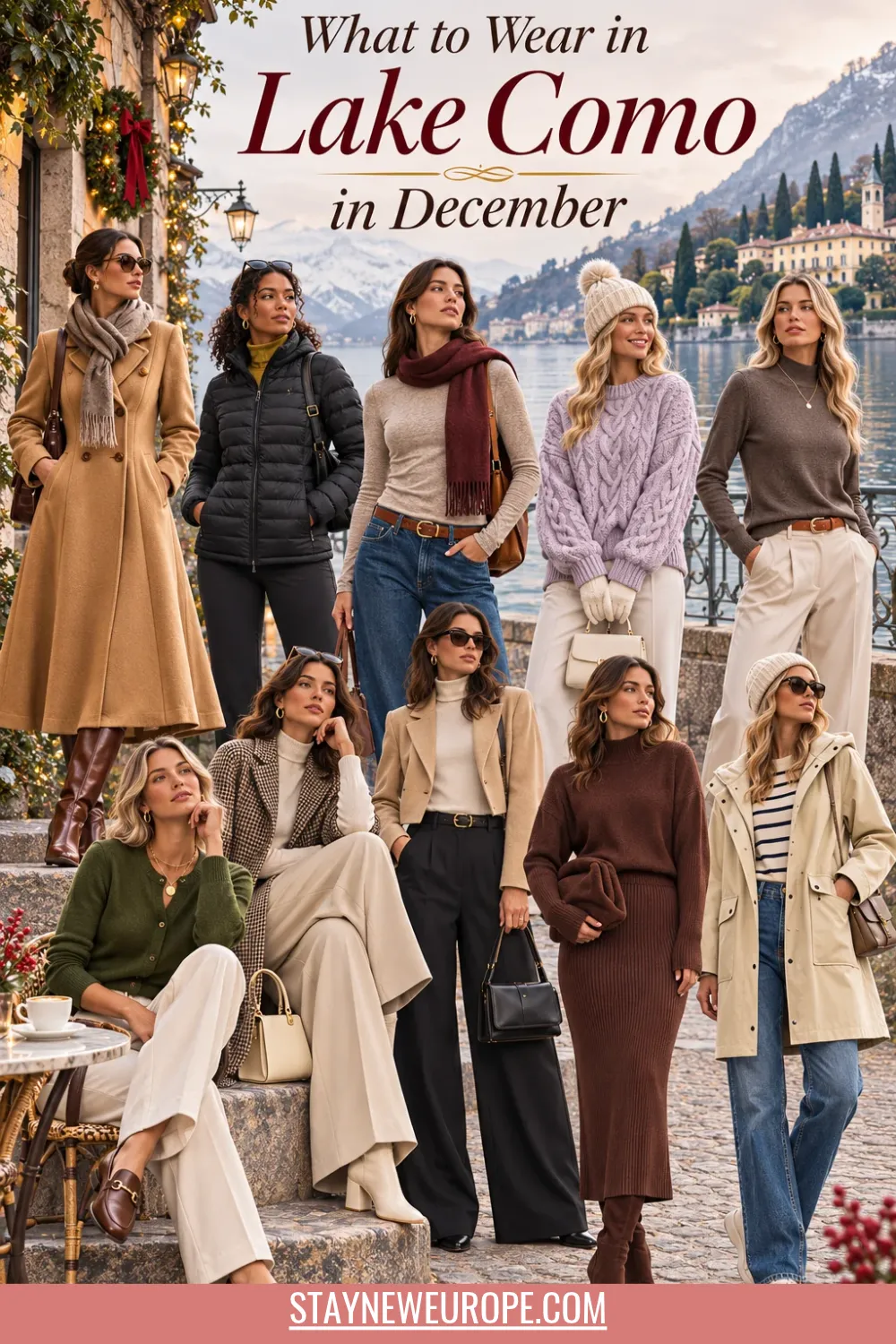
Picture this: you step off the ferry in Bellagio, the lake is the colour of pewter, the mountains have vanished into cloud, and a man in a perfectly cut camel coat walks past with an espresso like it’s the most natural thing in the world. You, meanwhile, are in a rain poncho from a 2019 theme park trip. Yes. I’ve been both of these people.
November on Lake Como is moody, quiet and honestly gorgeous. The crowds are gone, the villages feel like they belong to the locals again, and the light does this soft, silvery thing that makes every photo look like a film still. But it’s also damp, chilly, and weirdly unpredictable. One hour it’s crisp and bright, the next you’re inside a cloud.
Most people pack for “Italy” and forget this is a lake wedged between Alpine foothills. The classic mistakes? Too many summer dresses, flimsy ballet flats, and no real coat. Let me save you from all three.
Before We Dive In
Let me set the scene so the outfit advice makes sense.
Weather: Expect roughly 4–12°C (about 40–54°F) over the day, colder by the water at night. November is one of the wetter months here, so rain, mist and grey mornings are normal. Humidity makes it feel colder than the number on your phone. Check the forecast the week before you fly, because it can swing.
Walking conditions: Lake Como villages are all steep lanes, stone steps and cobbles. Wet stone is slippery. You’ll climb more than you expect, especially in Varenna, Bellagio and Brunate.
Style culture: Italians dress well, even for a Tuesday coffee. In the cooler months that means good coats, scarves, neat boots and muted colours. You don’t need to be fancy, you just need to look put-together.
Heading to other parts of Italy? Check out our other monthly guides: [INTERNAL LINK: Venice monthly guide], [INTERNAL LINK: Rome monthly guide], [INTERNAL LINK: Florence monthly guide].
A Proper Coat Is Your Best Friend
Here’s the thing I learned the hard way: a “light jacket” and a coat are not the same animal. On the lake, in November, you want the second one.
Wool or a wool blend looks right in Italy and keeps the damp wind out. A knee-length coat in camel, charcoal, navy or olive is the sort of piece you’ll see on every terrace. If you’re a puffer person, a slim, packable down jacket works brilliantly too. Italians wear them constantly, and they squash down into a suitcase.

Pair a camel coat with dark jeans and boots for a lakefront stroll, or throw a black puffer over a knit dress for ferry days.

Local tip: Ferries are breezy even when the village is calm. Keep your coat on and zipped for the crossing, then unbutton once you’re in the lanes.
Layers: The Real Secret of November
Let me be honest, I used to roll my eyes at “pack layers.” Then I spent a morning shivering at the Como funicular station and sweating five minutes later on a hill. Now I’m a convert.
Think in three levels: a thin base layer (merino or fine cotton), a mid layer (sweater, cardigan or knit), and the coat. Temperatures change fast between shade, sun, ferry deck and a warm restaurant, and layers let you adapt without a full wardrobe change.

Try a fitted long-sleeve tee, a chunky roll-neck and a coat for exploring, then swap the tee for a silk blouse under the same knit for dinner.

Local tip: Skip bulky layers. Thin and warm beats thick and shapeless, especially when you’re packing carry-on only.
Knitwear That Does Double Duty
If I could only bring one item, it would be a good sweater. Lake Como in November is basically knitwear season.
Merino and wool blends are lovely because they stay warm when slightly damp and don’t smell after a day of walking. Cashmere is a worthwhile splurge if you travel often. Choose earthy shades like cream, forest green, burgundy or navy, which look right with the lakeside palette.

One roll-neck and one crew neck, plus a cardigan, give you plenty of combinations. A cardigan under a coat is brilliant for church visits and chilly restaurants.

Local tip: Cotton-heavy sweaters hold dampness. If it rains, wool dries and warms you far better.
Trousers and Jeans: What Actually Works
Shorts are out, obviously. But what about the trousers question? It matters more than you’d think when everything is wet and uphill.
Dark, straight or slim jeans are the safest bet, and I’d skip anything distressed since Italians tend to go neat even with denim. Wool-blend or ponte trousers are a revelation because they’re comfortable, they hold their shape for several days, and they look smart enough for dinner. Avoid thin leggings as outerwear, they get cold fast.

Wear dark jeans with a knit and ankle boots by day, then switch to tailored trousers and a silk top at night.

Local tip: Light-coloured jeans show every splash from puddles. Go dark.
Boots You Can Walk In All Day
This one decides whether your trip is joyful or miserable. Cobbles, steps and wet pavement are not kind to bad shoes.
Leather ankle boots with a grippy rubber sole are my top pick. Look for a low, chunky heel or flat sole, a bit of waterproofing, and enough room for thick socks. Clean white or leather sneakers also work in Italy and look right with most outfits, but make sure they’re water-resistant. Skip ballet flats, they have almost no support and soak through instantly.

Wear boots on the plane, so they don’t take up suitcase space.
Local tip: Break your boots in before you travel. Blisters in Bellagio are not a good look.
Dress Code Matching: What Locals Actually Wear
Lake Como has a quietly glamorous reputation, so “tourist casual” stands out a bit.
You’ll see muted tones, good textures and a touch of polish. Think neutral coats, tailored trousers, knit dresses, scarves tied loosely, leather bags. Activewear, beachwear and loud logos tend to look out of place. You don’t need designer labels, just clean, neat clothes in a coordinated palette of black, navy, camel, cream and olive.
Build your suitcase around three or four colours so everything mixes. It makes mornings easy and photos look better.
Local tip: Take a cue from the locals at the aperitivo hour, around 6pm. That’s the dress level you’re aiming for.
What NOT to Wear (Tourist Mistakes)
Okay, gently, with love. These are the mistakes I see every year.
Number one: cute shoes without grip. Number two: a thin denim jacket as your only outerwear. Number three: transparent plastic ponchos, which flap in the wind and look like you’ve given up. Number four: heavy jewellery that clunks against the ferry railing. And number five, which got me once, a huge luggage-style backpack for a day trip.
If you stick to a neat jacket, walkable boots and a compact bag, you’re already ahead of most visitors.
Local tip: If your outfit would look at home on a hiking trail, leave it there. Save the technical gear for the actual hikes.
Rain Preparation (Unexpected but Important)
November rain on the lake can arrive suddenly and hang around. I once spent an afternoon watching the mountains disappear in about four minutes.
A compact, sturdy umbrella is good for the village lanes, though wind can flip a cheap one. A hooded, water-resistant coat or a lightweight rain shell over your layers is more reliable, and a waterproof pair of boots keeps your day on track. Bring a small dry bag or plastic pouch for your phone and camera.

On wet days, wear a water-resistant coat, dark trousers and boots, and let a bright scarf do the style work.
Local tip: Many cafés and little shops have narrow doorways. A small umbrella is far easier to manage than a giant golf one.
Fabrics to Choose (and Avoid)
Fabric decides how you feel at 3pm, much more than the outfit itself.
Go for wool, merino, cashmere, denim, thick cotton and fleece-lined layers. These handle chill and mild damp well. Be careful with thin polyester, flimsy cotton and satin, which feel cold and clammy in humid weather. Silk can work as a base layer or dressy blouse, but not as your main warmth.
A merino base layer under a silk blouse is a great trick. It keeps you warm without bulk.

Local tip: Check labels before you buy anything new for the trip. Look for at least 50% wool for real warmth.
Evening Outfits That Don’t Scream Tourist
Dinner in November is cosy. Candlelit restaurants, wood-fire smells, the lake dark beyond the windows. You want to look polished without freezing.
For women, a knit midi dress with tights and boots, or tailored trousers with a silk blouse and blazer, strike the right note. For men, dark chinos, a fine-knit sweater over a collared shirt and leather boots are perfect. A scarf adds instant style.

You don’t need to dress up like a gala guest. Simply swap your daytime sneakers for polished boots and add one nice piece, such as a statement earring, a neat belt or a good scarf.
Local tip: Many lakeside restaurants are cool by the door and warm at the back. Keep a thin layer handy.
What to Wear for Churches and Villas
Lake Como has beautiful churches, and some villas and gardens have their own rules.
Many religious sites ask you to cover shoulders and knees, so a long-sleeve top, scarf or a cardigan sorts it out. In November that’s easy, since you’ll already be dressed for the cold. Do check opening times and seasonal closures for villas and gardens before you go, because some wind down for the winter.
A large wool scarf or shawl is the perfect multitasker: warm on the ferry, modest in a church, stylish at dinner.

Local tip: Keep a scarf in your day bag. You’ll use it more than you think.
Bags: Crossbody vs Backpack
Your bag affects comfort more than you’d expect, especially with a wet umbrella and a camera in hand.
A leather crossbody or small shoulder bag with a zip is my daily pick. It keeps your hands free for railings and steps, and it’s safer in crowds. A compact backpack makes sense if you’re hiking or bringing lots of gear, but a slim, neat one fits the style better than a big trekking pack.

For luggage, I recommend a carry-on-sized soft suitcase or a structured duffle, both easy to lift onto trains, ferries and into cramped hotel rooms. Lake Como involves a lot of stairs and no lifts in older buildings, so travel light.
Local tip: Water-resistant leather or coated canvas is worth the extra. Rain can ruin suede in minutes.
Accessories That Elevate Simple Outfits
This is where cheap outfits start looking expensive. It’s the best part of November dressing, honestly.
A good scarf is first, in wool or cashmere. Then gloves, a beanie or a wool hat for windy ferry rides, plus sunglasses because the light on the water can be dazzling even on grey days. A simple belt, small earrings, a watch or a leather bag complete a polished look without effort.
Wear a charcoal coat, cream scarf and burgundy gloves for a quick Italian-style palette.

Local tip: Touchscreen-friendly gloves are a small luxury. You’ll be checking ferry timetables all day.
What to Pack for Lake Como in November (Non-Clothing)
Clothes are only half the story. Here’s the small stuff I’d never leave behind.
A power bank, because cold drains phone batteries fast. A universal plug adapter (Italy uses Type C and F sockets). A reusable water bottle. Blister plasters and a basic first-aid kit. Lip balm and hand cream, since the damp cold dries out your skin. A small foldable tote for shopping, and a light scarf or travel pillow for trains and ferries.
If you plan to hike, add a headlamp or small torch. Dusk comes early and the paths get dark.
Local tip: Download offline maps and ferry timetables. Signal in the mountains can drop out.
How Many Outfits to Pack (and the Capsule Wardrobe Trick)
Here’s my rule: if you can’t make at least three outfits with each item, it stays home.
For a 5–7 day trip, I’d pack one proper coat, one rain layer, 3 sweaters, 2 long-sleeve tops, 2 pairs of trousers, 1 pair of dark jeans, 1 dress or a smart dinner outfit, boots, one pair of sneakers, 3–4 pairs of warm socks, and 2 scarves. All in a tight palette of black, navy, camel and cream, so everything mixes.
Plan your outfits at home, take photos, and pack only what you actually plan to wear. Wear the bulkiest items, like your coat and boots, on the travel day.
Mistakes to avoid: packing “just in case” outfits, bringing three pairs of shoes you don’t love, forgetting warm socks, and leaving your rain layer at home because the forecast looked fine. It will not be fine.
Local tip: Most hotels and apartments have a drying rack or radiator. Pack fewer items and re-wear sweaters.
FAQs About Lake Como November Packing
Is it too cold for the lake in November? It’s cool and damp, but very manageable with a good coat, layers and boots.
Do I need a heavy winter coat? Not an Arctic parka. A warm wool coat or packable puffer plus layers is plenty for most days.
Can I wear sneakers? Yes, clean leather or water-resistant sneakers are fine. Choose grippy soles.

Should I bring an umbrella or a rain jacket? A hooded, water-resistant coat is more reliable, with a compact umbrella as backup.
What about formal dinners? Smart casual is enough. A knit dress or tailored trousers with a blazer and boots works nearly everywhere.
Here’s what I’d love for you to take away from all of this: November on Lake Como is a gift. Empty lanes, steaming cappuccinos, mist curling over the water, and that rare feeling that you’ve found the place before everyone else did.
Pack your good coat, lace up the boots that love hills, and let a scarf do the talking. Then go sit by a window with something warm in your hands and watch the clouds roll over the mountains. You’re going to look great doing it, and, more importantly, you’re going to feel like you belong there.
Buon viaggio.

