
There’s a particular kind of embarrassment that hits you somewhere around the Marais — you’re sweating through a synthetic shirt, your trainers are squeaking on the cobblestones, and a Parisian woman glides past in a linen midi dress and block heels, looking like she just stepped off the pages of a magazine she probably doesn’t read because she’s too busy actually living. June in Paris is stunning. The light is golden until almost 10pm, the terrasses are full, the Seine sparkles, and the city hums with a specific kind of energy that makes you want to drink rosé at 2pm and not apologise for it.
But here’s the thing nobody really warns you about: Paris in June is warmer than most people expect, breezier than the temperatures suggest, and wildly unpredictable in the evenings. One afternoon I was roasting outside Shakespeare & Company. That same night, I was genuinely cold walking back across Pont Neuf. If you’ve packed entirely for summer, you’ll regret it. If you’ve packed for autumn, you’ll melt.
I’ve made both mistakes. This is me saving you from the same fate.
Before We Dive In: What June in Paris Actually Feels Like
Let me give you the real picture — not the postcard version.
Temperatures: June averages hover between 15°C (59°F) in the mornings and 24°C (75°F) in the afternoon, though it regularly creeps into the high 20s during heat spikes. Paris has been hit with early summer heatwaves more frequently in recent years, so don’t be surprised if you get a few days that push 30°C. Then again, don’t be surprised if you wake up to 14°C and overcast skies and wonder if you accidentally arrived in April.
Rain: June is Paris’s third wettest month. Not drenching monsoon rain — more like sudden, dramatic, 20-minute downpours that come out of nowhere and drench you completely before the sun comes back out like nothing happened. I’ve been caught in one outside the Louvre wearing a white linen top. I won’t elaborate.
Walking: You will walk so much more than you think. Paris is a city you feel through your feet — from Montmartre’s steep climbing streets to the long flat stretches of the Canal Saint-Martin to the uneven stones around Saint-Germain. If your shoes aren’t genuinely comfortable, you will be miserable by noon, regardless of how good they look.
Style culture: This matters more than you think, and I say this not to intimidate you but to inspire you. Parisians dress with intention. They’re not wearing more — they’re wearing better. A well-cut trouser, a simple top, a considered bag. They don’t try hard. They just look… right. There’s a lesson in there.
Lightweight Layers: The Absolute Non-Negotiable
I cannot stress this enough, and I will not apologise for how emphatic I’m being about it: layers are the entire game in Paris in June.
The mornings can be 15°C with a wind that cuts through you. By 2pm you’re stripping off everything you can legally remove. By 8pm, sitting outside at a restaurant as the sun dips, you’ll be wishing you’d brought something to wrap around your shoulders. This happens nearly every single day in June, in some variation. It’s not unusual — it’s just Paris.
The key is not to pack bulky layers. Nobody wants to schlep a jumper around the Musée d’Orsay. Think thin cardigans, lightweight button-down shirts you can tie around your waist, or a fine-knit longline that packs down to almost nothing. A light denim jacket is a June essential — not because it’s particularly warm, but because it works at every point of the day and looks good with almost everything.
I found my best Paris layer strategy entirely by accident. I’d packed a loose oversized linen shirt thinking it was just for the beach later in the trip. It became the thing I wore every single morning and every single evening. Over a tank, under nothing, knotted at the waist, draped on my shoulders — it did everything.
Local tip: Parisians are masters of the “one statement piece, everything else simple” approach. Make your layer the thing that elevates the outfit. A beautiful woven cardigan or a perfectly cut blazer in a neutral tone does infinitely more work than a stiff tourist hoodie.
Dresses: Yes, Absolutely, Bring Them
If you’ve been debating whether to pack that midi dress, pack it. Pack two.
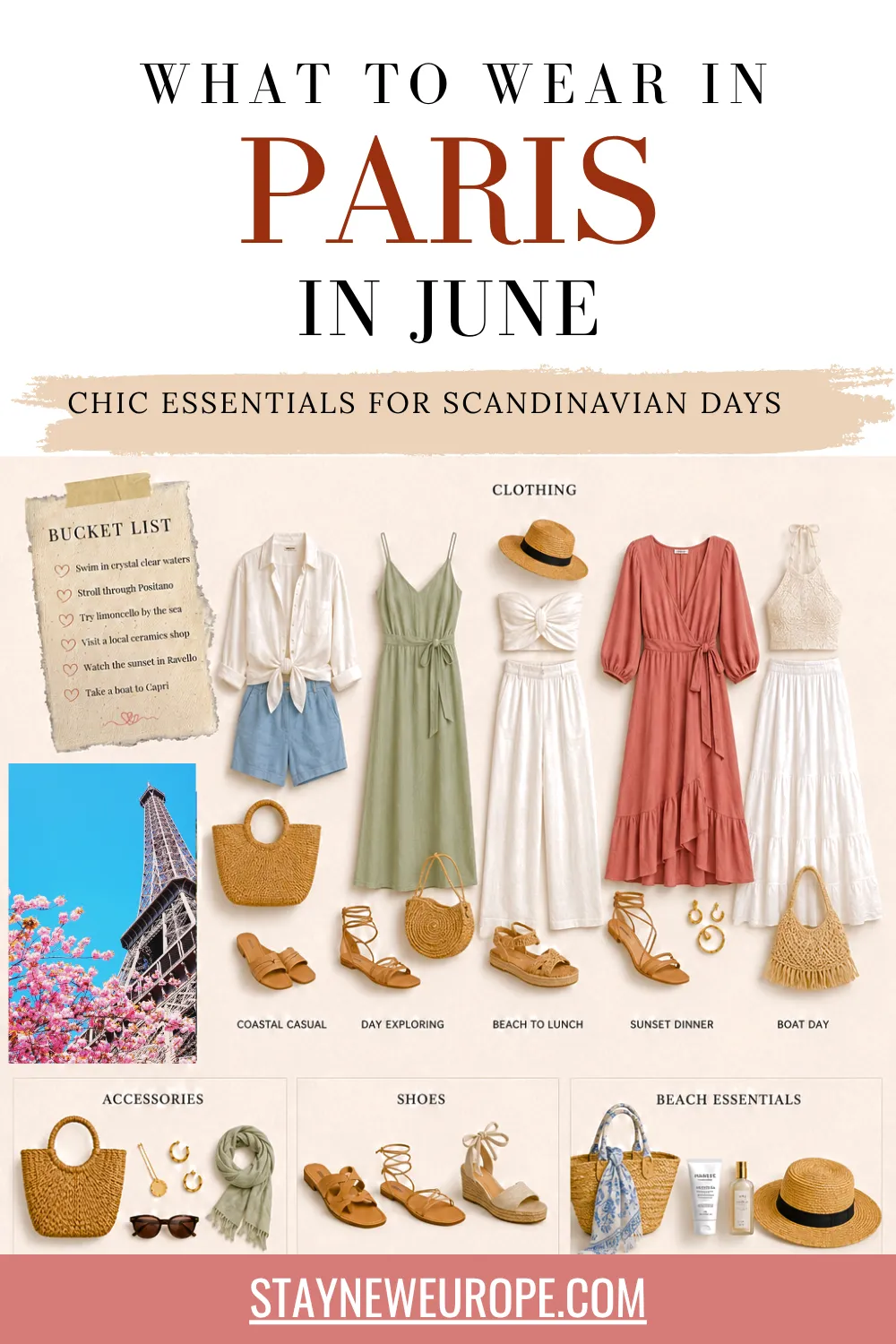
June is genuinely dress weather in Paris — but there’s a specific kind of dress that works, and it’s probably not the bodycon mini you wore to a rooftop bar in Barcelona. The Paris vibe leans towards easy, floaty, and feminine without being fussy. Think wrap dresses, shirt dresses, smock dresses in natural fabrics. Something that moves when you walk and doesn’t stick to you when you sweat.

I wore a rust-coloured wrap dress to a Sunday morning market in the 11th and genuinely felt like I’d nailed it — comfortable enough to walk for three hours, pretty enough that I didn’t feel underdressed when we ended up at a proper lunch. That’s the Paris dress sweet spot.

For churches and museums: just be aware that very short hemlines can feel slightly out of place, though nothing is officially banned in most Paris venues (unlike Rome or Venice where it’s more enforced). Still — a dress that hits the knee or below gives you total flexibility and honestly looks chicer anyway.
Local tip: French women often wear a dress with a very flat, barely-there sandal rather than heeled shoes. It looks more intentional, not less. Save your energy for the actual walking and let the dress do the heavy lifting.
Jeans in Paris: The Complicated Truth
Let me be honest with you: jeans in Paris in June are a risk.
On a cool, cloudy day? They’re great. On a hot afternoon when you’ve been walking since 9am and the sun is full and unforgiving? You will be baking inside your own legs. Dark jeans especially trap heat in a way that becomes genuinely unpleasant.
That said, a well-fitted pair of straight-leg jeans remains one of the most Paris-appropriate things you can pack. Nobody does jeans like the French — specifically, the kind of straight, slightly high-waisted, no-stretch jean that looks completely effortless with a tucked-in cotton top and a loafer. It’s practically a uniform.
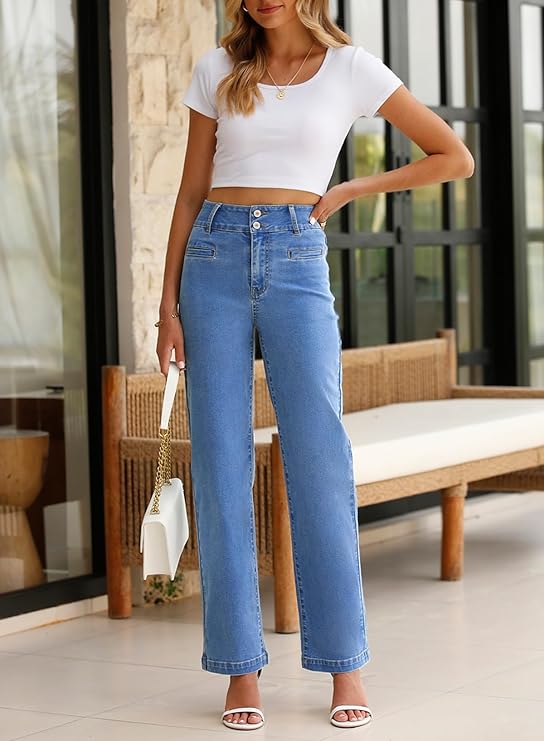
My rule: pack one or maximum two pairs, make sure they’re lighter weight denim rather than thick structured denim, and save them for mornings, evenings, and cooler days. Don’t rely on them as your daily outfit through the hot afternoon hours.
What works better for warm days: wide-leg linen trousers. They look just as put-together as jeans, they’re 10 times more comfortable in heat, and somehow they photograph beautifully everywhere in Paris, which is its own kind of bonus.
Local tip: If you must wear jeans in a heatwave, light wash or mid-wash straight-leg styles in lighter denim are genuinely cooler than dark rigid denim. Small detail, big difference.
Shoes: The Decision That Will Make or Break You
I learned this the hard way, specifically on a Tuesday in June when I wore brand new espadrilles to walk from the 6th arrondissement to Sacré-Cœur. I won’t tell you what state my feet were in by the time I reached the top of Montmartre. Just — don’t.
Paris is a walking city and June is a walking month. You will easily clock 15,000 to 20,000 steps on a normal tourist day. Your shoes need to be genuinely comfortable from the first step, not “broken in by the third day.” There are no comfortable blisters.
The good news: “comfortable” and “stylish” are not mutually exclusive in 2025, and the Paris footwear landscape is actually perfect for this. The shoes that work:
White leather sneakers — the classic choice, and honestly the best. A clean, minimal sneaker in leather (not canvas — they scuff too easily) works with dresses, trousers, and jeans. Minimal branding, neutral colour. Looks Parisian, feels like walking on cushions.

Block-heeled sandals — for evening or slower days. A small block heel is manageable on cobblestones in a way that stilettos absolutely are not. Choose leather over plastic for the insoles.

Leather loafers — slightly more effort than sneakers but iconic for the Paris aesthetic. A classic penny loafer or a simple mule style works brilliantly with straight-leg jeans or wide trousers.
What to avoid: Flip flops (you’ll stub your toes on cobblestones, and Parisians will side-eye you), wedge espadrilles (wobbly on uneven ground), and anything with zero ankle support.
Local tip: Break in any new shoes at home for at least two weeks before the trip. Non-negotiable.
What NOT to Wear in Paris in June
Nobody’s going to arrest you. But I will silently be judging you, and so will every Parisian you pass. Let me be the friend who tells you the truth.
The matching tracksuit: I know this is technically fashionable right now in certain cities. In Paris, it reads as “I packed wrong.” Save it for the airport.
Shorts and a logo t-shirt: The combination screams tourist in a way that’s almost poetic. Individual pieces are fine. Together, with white trainers and a bum bag, it’s a full uniform that puts a target on your back — both for pickpockets and for withering French glances.
Heavy backpacks in restaurants: Parisians eat with intention. A massive hiking backpack crammed under a bistro table is awkward for everyone, including you.
Overly casual activewear: Gym leggings and sports bras are fine for your morning run. They’re not Paris café attire. I know this is an unfair rule. I didn’t make it.
Platform shoes with cobblestones: The image is funny. The reality is one rolled ankle before you’ve seen the Eiffel Tower.
The common thread in all these mistakes is trying to optimise entirely for comfort while ignoring context. You can have both — you just need to be a little more intentional about it.
Local tip: When in doubt, ask yourself: “Would someone in Saint-Germain look twice at this?” If yes, reconsider.
Jackets: You Need One More Than You Think
A jacket is not optional for Paris in June. I know it feels like it should be — it’s summer, it’s warm, you’ve packed for sunny days. But the jacket earns its place in your bag every single time.
The evenings drop faster than you’d expect, especially near the Seine where the air comes off the water with a definite chill. And Paris’s outdoor terrace culture means you’re often sitting outside for long dinners as the temperature slides. Nothing kills the romance of a candlelit Parisian dinner like shivering and pretending you’re fine.
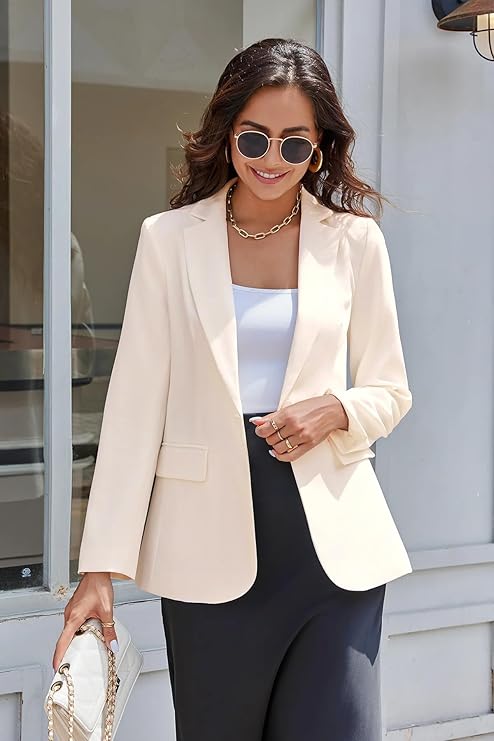
The best jacket for June is a light, unlined blazer. Not a heavy wool coat, not a full parka — something in cotton, light linen blend, or unstructured suiting fabric that packs relatively flat and looks genuinely smart. A camel, cream, or soft navy blazer is one of the most versatile things you’ll bring.
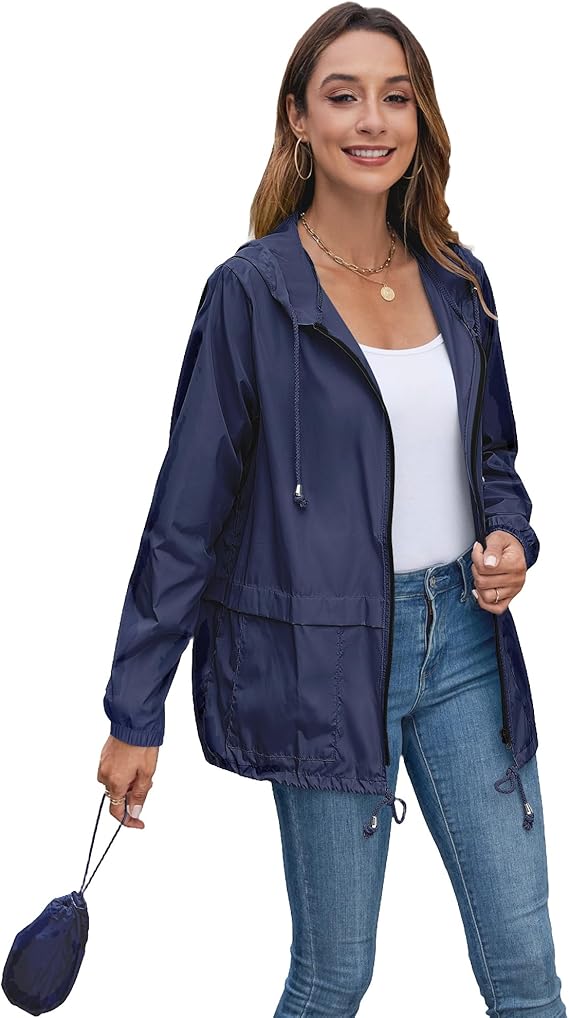
A light rain jacket in a packable style is also worth considering — not because you’ll wear it every day, but for those sudden downpours that don’t announce themselves. Something that folds into its own pocket and lives in your bag is perfect. Bonus: it doubles as a windbreaker on unexpectedly cool evenings.
Local tip: A good blazer can dress up almost any casual outfit. Jeans and a simple top look completely different with and without a blazer. It’s the easiest upgrade in your wardrobe.
Evening Outfits: Paris After Dark Deserves the Effort
Paris evenings in June are genuinely magical — long golden light until nearly 10pm, terrasses full of people, the city at its most beautiful and most itself. Give the evenings some effort. They deserve it.
That doesn’t mean formal. It means intentional. A dress you love. Trousers that fit properly. A top that isn’t wrinkled from the bottom of your bag. Shoes you’ve thought about.
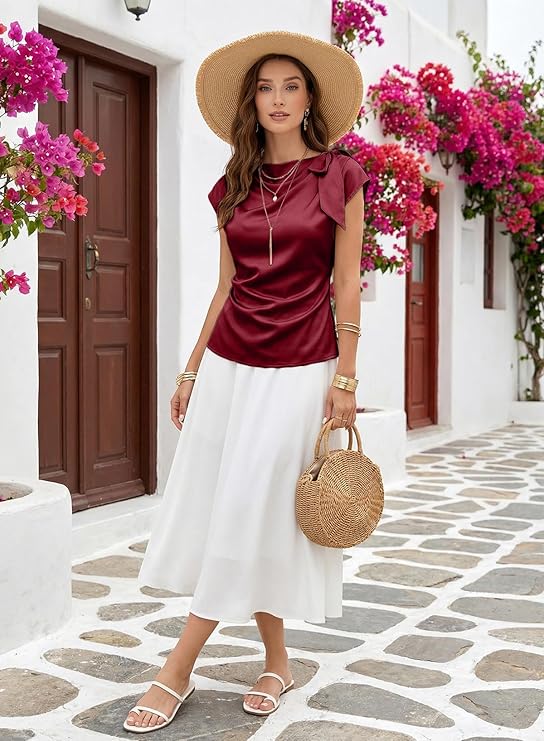
For women: a silk or satin slip dress over a thin t-shirt is a perfect June evening outfit — the t-shirt adds warmth and a slightly deconstructed cool-girl nonchalance that is very Paris. Or wide-leg trousers with a tucked-in camisole and a blazer thrown over. Minimal jewellery. A good bag. That’s it.
For men: a clean linen shirt in a soft colour, well-fitted chinos or dark jeans, leather shoes or clean leather trainers. The key word is “clean.” Ironing is optional; looking like you care slightly is not.

Most Paris restaurants are smart casual at most — you won’t need anything formal unless you’re going somewhere genuinely special. But the city has a way of making you want to try a little harder, and I mean that as a compliment.
Local tip: The French concept of being “bien habillé” (well-dressed) is less about price and more about fit, cleanliness, and intention. A €30 dress that fits perfectly will always look better than a €200 one that doesn’t.
What to Wear in Churches and Museums
Paris has some of the world’s most extraordinary religious buildings — Notre-Dame (yes, it reopened, and yes, it’s breathtaking), Sainte-Chapelle, the Sacré-Cœur. Most have dress codes, and in June, this requires a bit of planning because it’s warm and you’re likely wearing less.
The practical rule: shoulders and knees covered. Not because French churches are stricter than others — they often aren’t — but because it’s genuinely respectful and prevents any awkwardness at the door. A lightweight scarf is the simplest solution. Tie it around your shoulders going in, unwrap it the second you step back into the sunshine.

Museums are simpler — there’s no dress code at the Louvre or d’Orsay beyond basic standards of decency. But they’re often air-conditioned to an almost aggressive degree, which means a layer you were grateful to peel off outside becomes suddenly very welcome inside.
This is another vote for the cardigan or light jacket that lives in your bag. Church in the morning, museum in the afternoon — you need something you can throw on and take off without thinking.
Local tip: The Sacré-Cœur is genuinely worth the Montmartre climb, but they’re strict about shoulders and will turn you away at the door. Keep a scarf in your bag from day one.
Bags: The Paris Bag Question Is More Important Than It Sounds
What you carry matters, both practically and stylistically. Let me break this down honestly.
A crossbody bag is the definitive Paris choice and I will defend this opinion aggressively. It keeps your hands free, sits close to your body (important in busy metro stations and crowded attractions), and looks infinitely more intentional than a backpack. A simple leather crossbody in a neutral colour — black, tan, dark brown — works with everything and doesn’t scream “tourist with valuables inside.”

A tote bag works well for market days, museum visits, and days when you know you’ll be collecting things. But carry it in the crook of your arm or on one shoulder, not hanging off your back where pockets are easily accessed.
Backpacks are practical and sometimes genuinely necessary — especially if you’re doing museum-heavy days with water bottles, cameras, and layers to carry. Just be aware that large backpacks in crowded areas are prime targets for pickpockets, and you’re far less aware of what’s happening behind you. If you do bring one, keep it at your front in crowds.

What to avoid: the obvious tourist bum bag worn as intended, the huge branded shopping bag as a daily bag, and anything with an unlockable zip right at the top.
Local tip: A basket bag — the woven kind, structured, with a simple clasp — is peak Paris summer energy and genuinely useful. Light, stylish, and surprisingly roomy. You’ll see them everywhere in June.
Accessories That Make the Whole Outfit
This is where the French approach to dressing becomes most instructive. The Parisian outfit is rarely about the individual pieces — it’s about the total effect, and accessories are a huge part of that.
A silk scarf is genuinely the most Paris-appropriate accessory you can bring, and it earns its keep in June specifically. In your hair, around your neck, tied to your bag, wrapped around your shoulders in a museum — it’s one piece with five jobs. A small vintage one costs almost nothing and packs flat.

Simple gold jewellery — a thin chain necklace, small hoop earrings, a delicate ring — elevates a plain outfit without trying too hard. Chunky, statement jewellery is a different look that can work, but it’s more about the overall outfit balance.
Sunglasses: Not just practical but genuinely important to the aesthetic. A good pair of sunglasses is one of the first things a French person notices. Classic frames in tortoiseshell or simple black are never wrong.

A nice belt: If you’re wearing trousers or jeans regularly, a good leather belt in a simple style makes everything look more intentional. It’s the kind of detail you wouldn’t think about and then you do it once and wonder why you never did it before.
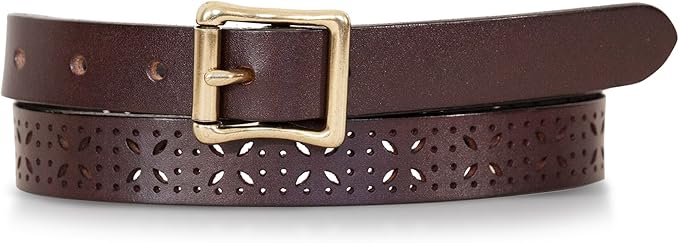
Local tip: Don’t over-accessorise. The French rule is generally to put on what you want, then take one thing off. It almost always improves the outfit.
Rain in Paris in June: Prepare Without Packing a Full Raincoat
I mentioned this briefly but it deserves its own section because it catches people out every time.
Paris in June has an average of eight to ten rainy days. That doesn’t mean full grey miserable English drizzle (usually) — it means sudden afternoon thunderstorms that appear out of nowhere, drop an enormous amount of rain in 20 to 30 minutes, and then stop completely. The sun comes back. The pavements steam slightly. Life continues.
The mistake people make is either to fully ignore this (and get soaked) or to pack a massive waterproof parka that takes up half their bag and makes them look like they’re prepping for a hike in the Lake District.
What actually works: a packable waterproof jacket that folds down to the size of a paperback. It lives at the bottom of your bag every day. You only know it’s there when you need it. This is the low-drama solution to a high-drama problem.
A compact travel umbrella is also worth it — the small ones that actually fit in a bag, not a full-sized golf umbrella. Paris streets are narrow and umbrella etiquette in crowds is already chaotic enough.

Local tip: If you get caught in a downpour, the Parisian response is to find the nearest café, order something, and wait it out. It’s honestly the best approach and one of the more enjoyable accidents that can happen to you in this city.
Fabrics to Choose (and the Ones to Ditch)
The fabric conversation matters more in June than any other month because you’re dealing with heat, potential rain, and the need to look presentable from morning to evening.
Reach for: Linen (breathable, beautiful, wrinkles in a way that looks intentional), cotton (easy, packable, works in almost every context), lightweight silk or satin (evening gold), jersey knit (doesn’t crease, comfortable all day).
Be careful with: Light-coloured cotton in a downpour (see: me and that white linen top), very sheer fabrics that show everything when the wind picks up on the Seine, and heavy jersey that looks casual and not in a chic way.
Avoid entirely: Synthetic fabrics that trap heat and don’t breathe — polyester blends, stiff nylon, anything that feels remotely plasticky against your skin. You will sweat in it, it will not recover, and you’ll feel it all day. Also avoid anything that needs ironing every single day unless you’re staying somewhere with an iron you trust.
The linen question comes up a lot because linen wrinkles so dramatically. Here’s my honest take: wear it anyway. A linen shirt that’s slightly lived-in looks different from a shirt that’s been crumpled in a ball at the bottom of a bag. Give it a shake, hang it in the bathroom overnight, and wear it with confidence. The French do.
Local tip: Merino wool, despite sounding like it belongs in winter, is a miraculous travel fabric even in June. A thin merino top regulates temperature brilliantly and doesn’t smell after a long day. Sounds counterintuitive. Works every time.
A Capsule Wardrobe for a Week in Paris in June
Let me actually build this for you, practically, because sometimes you need someone to just say the words.
Tops: 2 fitted cotton t-shirts in neutral colours, 1 slightly nicer top for evenings (silk camisole or lightweight blouse), 1 linen or cotton overshirt that works as a layer.
Bottoms: 1 pair of straight-leg jeans, 1 pair of wide-leg linen trousers, 1 lightweight shorts option for hot days (well-cut, not gym shorts).
Dresses: 2 dresses — one casual (day exploring, market mornings), one slightly elevated (evening dinners, slightly nicer lunches).
Outer layers: 1 light blazer (unlined, cotton or linen blend), 1 packable rain jacket.
Shoes: 1 pair of leather sneakers, 1 pair of flat sandals, 1 pair of block-heeled sandals or loafers for evenings.
Accessories: 1 silk scarf, 1 crossbody bag, sunglasses, simple jewellery you can mix.
That’s it. That covers every situation Paris will throw at you in June. I promise you don’t need more.
The Practical Packing Bit You Probably Need to Read
Overpacking for Paris is a real and specific problem, because the instinct is to “have options” — but options mean weight, and weight means struggling onto the metro, paying for checked luggage, and hating yourself on the stairs of your Airbnb.
The rule I now follow: Lay out everything you think you want to bring. Remove a third of it. That’s your actual packing list.
Outfit planning vs freestyle packing: Actually think through the rough shape of your week. Dinner reservation Tuesday? Plan an outfit. Museum day Wednesday? You need comfortable shoes and layers for the AC. Markets Sunday? Your casual dress and sneakers. Planning three or four actual outfits mentally means you pack what you’ll wear, not what you might wear.
Mistakes to avoid: Packing “just in case” shoes that never come out of the bag. Bringing seven pairs of earrings when you’ll wear two. Packing “comfortable shoes for the journey” that you then also don’t want to leave behind and end up carrying around Paris as dead weight.
The Paris laundry reality check: If you’re staying for more than five days, plan to do one wash, either at a laundrette (easy to find, weirdly enjoyable) or using the machine at your accommodation. Pack for five days, wash once, done.
Local tip: Paris has beautiful shops. Leave a little room in your bag for something you find there. A French linen top bought at a market in the 11th is infinitely better than anything you’ll find at home, and it becomes a proper souvenir.
One Last Thing Before You Go
Pack clothes you actually feel good in — not clothes you think you should bring, not clothes you bought specifically for the trip and haven’t worn before, not the outfit you’ve been saving for a special occasion that never comes.
Paris in June is one of those rare places that genuinely rewards being present. The long evenings, the warm light on pale stone buildings, the cafés spilling onto narrow streets, the feeling that the city is slightly showing off for you. You don’t need to look like a fashion editor. You just need to feel like yourself — comfortable, prepared, and with enough room in your bag for a baguette.
Go. Wear the linen. Bring a scarf. Walk until your feet ache and then sit somewhere beautiful with a glass of something cold.
Paris will meet you there.

