
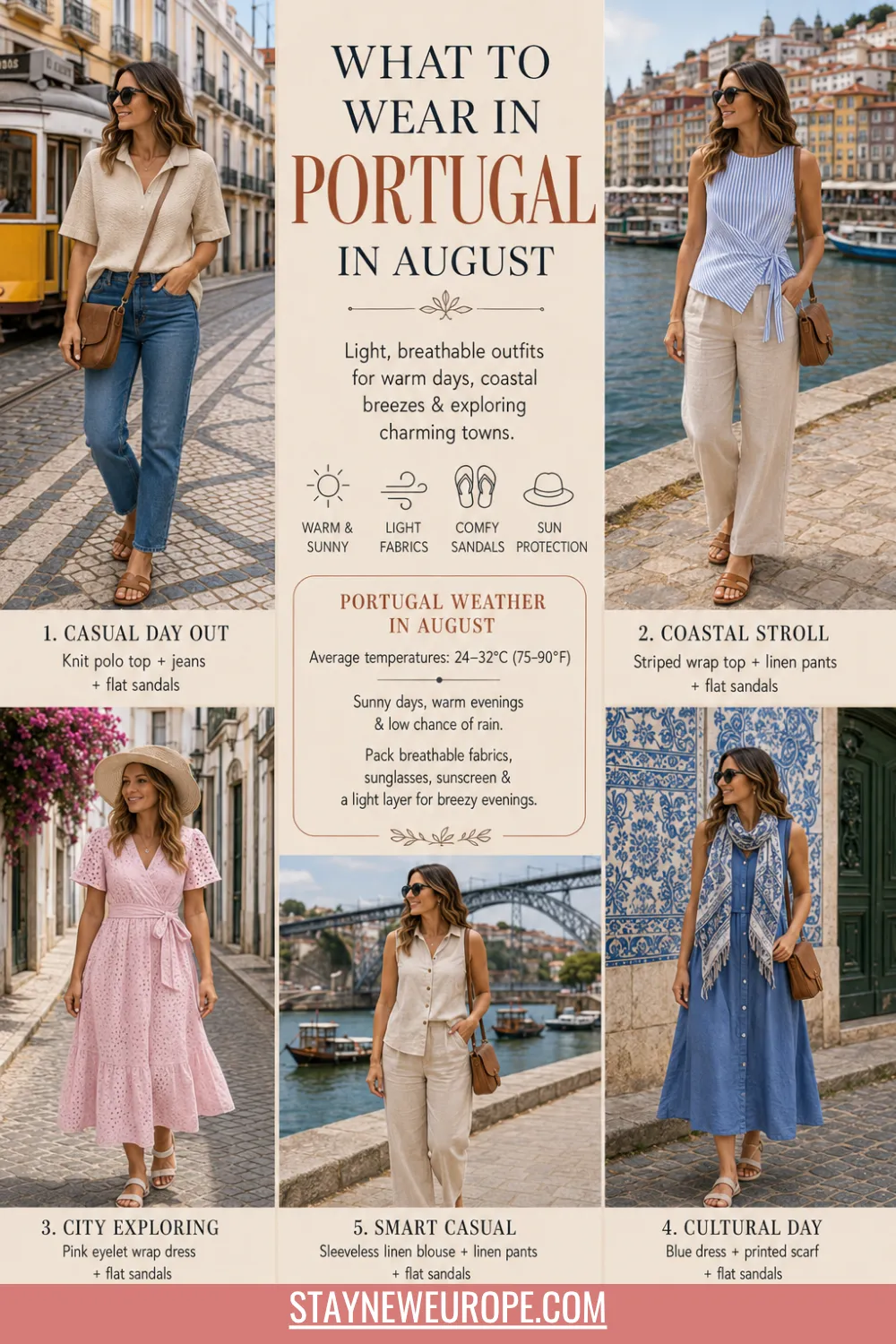
Portugal in August is a lot of things: golden, loud, gloriously sun-drenched, and — let me be honest — relentlessly hot. Lisbon’s cobblestone hills will humble you. The Algarve beaches will bake you. Porto’s riverside will charm you, and the evening Atlantic breeze will save you. It’s one of Europe’s most beautiful months in one of Europe’s most beautiful countries.
But I’ve watched enough tourists wilting in black jeans outside Belém Tower to know that packing wrong for Portugal in August is a very easy mistake to make. You don’t need to suffer for it. A little thought now, and you’ll spend the whole trip looking put-together and actually feeling comfortable — which, at 35°C, is its own kind of luxury.
Here’s everything I wish someone had told me before my first August in Lisbon.
Before We Dive In: Portugal in August — What You’re Actually Dealing With
The weather: August is peak summer, and Portugal leans into it hard. Lisbon regularly hits 33–37°C, sometimes nudging higher. The Algarve can feel even more intense. Porto is slightly cooler (28–32°C), and if you’re heading inland to Évora or the Douro Valley, brace yourself — it can crack 40°C. Evenings cool down noticeably in coastal areas, which is a lifesaver, but don’t count on that until after 8pm.
The terrain: Portugal is not flat. Lisbon’s seven hills are not a metaphor — they are actual steep, cobblestoned climbs that will destroy the wrong shoes and punish the wrong outfit. Even the Algarve requires more walking than people expect. Your footwear choices matter enormously here.
The style culture: Portuguese people dress well. Not flashy — understated, put-together, and appropriate for the heat without looking sloppy. Lisbon in particular has a quietly stylish café and restaurant culture, and you’ll feel the difference between looking like you thought about your outfit and looking like you grabbed whatever was on top of the suitcase.
Linen: The Non-Negotiable Starting Point
Let me save us both some time: if you pack nothing else of strategic value, pack linen. I resisted linen for years because I thought it looked rumpled and casual. Then I wore a linen shirt through a 36°C afternoon in Alfama and understood, on a cellular level, what it means to be dressed correctly for the heat.
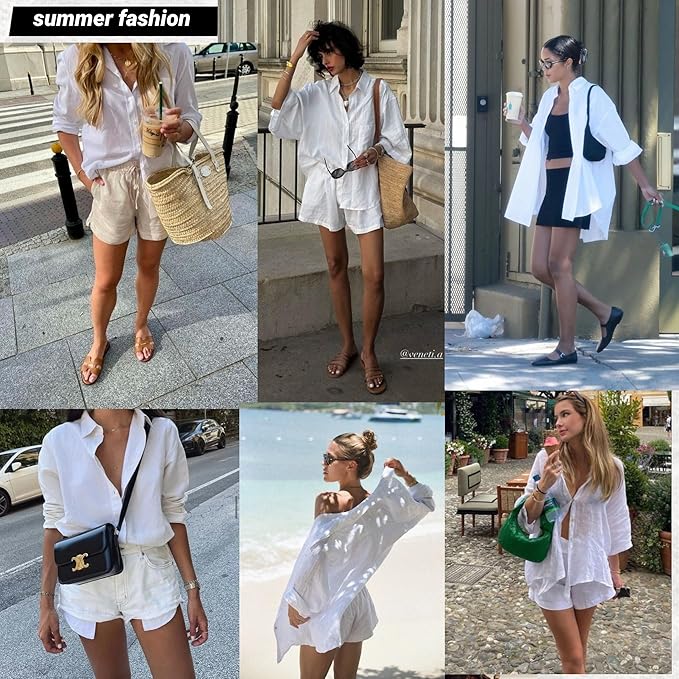
Linen breathes in a way that cotton cannot match at these temperatures. It wicks, it dries fast, and it has this effortless Mediterranean quality where the wrinkles actually look intentional rather than careless. In Portugal’s heat, any synthetic fabric — anything marketed as “stretch travel fabric,” anything with nylon or polyester in the label — will trap heat against your skin and make your afternoon genuinely unpleasant.
Local tip: Portuguese women in their 40s and 50s have cracked the linen code completely. Watch them. A loose linen shirt, wide-leg linen trousers, decent sandals, and a tote bag. That is the formula. It is devastatingly simple and it works in every situation from morning pastéis de nata to evening dinner reservations.
Dresses: Your Best Friend in the August Heat
A dress is one piece of clothing. One decision. Instantly an outfit. In 35-degree heat, that simplicity is not laziness — it’s survival strategy.
For Portugal in August, linen midi dresses are the single most versatile item you can pack. They work for morning sightseeing, afternoon café-sitting, church visits (critical — more on that below), and evening dinners with just a sandal swap.

A wrap dress in lightweight cotton or viscose also travels beautifully — adjustable at the waist, cool, and polished enough for anywhere you’re likely to go.

Avoid tight bodycon styles. They look great in photos and they will make you miserable within twenty minutes of walking uphill in Lisbon. Loose, floaty, and breathable is the dress philosophy that actually works here. Floral prints photograph beautifully against Portugal’s blue azulejo tiles — if you were looking for permission to pack that sundress, this is it.
Outfit idea: Linen midi dress in cream or terracotta + leather flat sandals + straw crossbody bag + gold hoop earrings. Wear it to Sintra, wear it to dinner, wear it everywhere.
Local tip: If you’re visiting Portugal’s many churches (and you absolutely should — the interiors are extraordinary), a midi or maxi dress means you walk straight in without hunting for a wrap. Knees and shoulders should be covered; a dress that hits the knee solves both problems in one.
Lightweight Trousers and Shorts: The Real Debate
Here’s where people go wrong: they pack jeans. I understand the impulse — jeans are familiar, they go with everything, they feel like a safe choice. In Portugal in August, they are a slow punishment. Dark denim absorbs heat, doesn’t breathe, and turns a pleasant afternoon walk into something you want to be over.

Wide-leg linen trousers are the upgrade you want. They’re cooler than jeans, look significantly more intentional, and work across a wide range of situations. Beige, white, olive, or cream all photograph beautifully against Portugal’s terracotta and blue-tiled architecture.

For women: a pair of these with a simple tucked-in linen top is an effortless look that works from morning to evening.
Shorts are absolutely appropriate for August in Portugal — especially for beach days, Algarve exploration, and morning sightseeing. Opt for linen or cotton shorts in a length that hits mid-thigh or slightly above the knee.

Avoid very short denim cutoffs if you’re planning any church visits or fancier dinners — they’re fine for daytime, but you’ll want something that adapts to more situations.
Local tip: Portuguese men wear tailored chinos or smart shorts with loafers and a well-fitted shirt in a way that looks entirely effortless. If you’ve been hesitant about shorts in Europe, Portugal in August is the moment.
Comfortable Walking Shoes (The Lisbon Hills Will Test Every Pair You Own)
I am going to be extremely direct about this: Lisbon has the most punishing terrain of any European capital for anyone who is not wearing the right shoes. The calçada portuguesa — those beautiful black-and-white mosaic cobblestones — are gorgeous to look at and genuinely treacherous in heels or thin-soled sandals, particularly when they’re worn smooth. And they are always worn smooth.

What actually works:
- leather sandals with a proper contoured footbed (Birkenstock, a good Spanish brand, or any sandal with genuine arch support),
- clean leather or canvas trainers with real cushioning.
- and low-heeled leather mules for evenings.
The sweet spot is stylish AND supportive — Portugal genuinely rewards looking like you’ve thought about your shoes, and modern comfort-forward brands have made this requirement much easier to meet.

I have made the mistake of breaking in new sandals in Lisbon. I limped back to my accommodation, located a pharmacy, bought blister plasters, and wore flatter shoes for the rest of the trip. Learn from this.

What to avoid: Flip-flops on the hills (zero ankle support on wet cobblestones is an injury waiting to happen), wedge heels (beautiful, dangerous), and anything that hasn’t been properly broken in before the trip.
Local tip: If your trip includes the Algarve, pack a pair of proper water shoes or reef-safe sandals — many of the most beautiful beaches have rocky entries and sharp sea edges.
Tops That Actually Work in the Heat
The key word is breathe. Linen, cotton, and light cotton-linen blends are your allies. A simple linen top tucked into trousers or worn loose over shorts is the Portuguese afternoon uniform for a reason — it’s light, it doesn’t cling, and it looks like you put thought into it without actually requiring much thought.

White, cream, and earth tones — terracotta, sand, olive — all look beautiful in Portugal. They work with the light, they photograph against the architecture, and they feel distinctly appropriate in a way that neon or heavy patterns don’t quite manage.

Avoid anything fitted and synthetic. A polyester blouse might photograph well but it will feel like a personal sauna within minutes. Sleeveless or short-sleeved is fine for most of the day; just carry something with sleeves for churches and for the evening Atlantic breeze, which can be surprisingly cool.
Local tip: A simple linen button-down shirt, worn open over a camisole, is perhaps the most flexible piece you can pack. Day: wear it open with shorts. Evening: button it up, tuck into trousers. Church: it covers your shoulders. Three outfits, one shirt.
Swimwear: The Algarve Requires Its Own Planning
If your Portugal trip includes any time in the Algarve — and if it doesn’t, reconsider — your swimwear situation deserves some thought. The beaches are extraordinary (Praia da Marinha, Lagos, Albufeira) and the water in August is warm enough to actually enjoy rather than merely endure.

A good swimsuit or bikini is table stakes. But what you wear over it matters as much as what you wear under it. A light linen or cotton cover-up is essential for moving from beach to restaurant or bar without the “swimwear in a café” awkwardness.

A maxi sarong, a loose shirt dress, or a lightweight button-down worn as a coverup all work. The rule of thumb: swimwear on the beach and in the water; proper cover-up for anywhere else.

Pack at least two swimsuits if beach time is a significant part of the trip — August heat and salt water mean they don’t always dry as fast as you’d like, and rotating them keeps them lasting longer.
Local tip: Many Algarve beach restaurants have a relaxed smart-casual dress code in the evening. Your cover-up plus sandals plus earrings can often take you straight from beach afternoon to sunset dinner, which is an extremely good use of minimal luggage.
Evening Outfits: Portugal After Dark Has Its Own Dress Code
Portugal’s evenings are genuinely special — the light goes golden, the temperature drops to something actually pleasant, the fado music starts in Alfama, and the terraces fill up. You want to feel like you belong in that scene rather than like someone who just wandered in from the beach.
The good news is that “elevated casual” covers almost everything. A midi dress with block-heeled sandals and a simple gold necklace is dinner-appropriate anywhere in Lisbon.

For men: a well-fitted shirt (not a polo, not a graphic tee — a proper shirt) with clean chinos and leather shoes works for everywhere from a neighbourhood tasca to a rooftop restaurant.

The Atlantic breeze I mentioned arrives in force on Lisbon evenings, so bring a light layer — a cotton cardigan, a linen blazer, or a light denim jacket if you can justify the weight. You won’t always need it, but you’ll be relieved it’s there.
Outfit idea for evenings: Wrap midi dress + leather block-heeled sandals + denim jacket + gold jewellery. Sophisticated without trying too hard, warm enough for the breeze, and completely appropriate for fado bars and fine dining alike.
Local tip: Lisbon has a brilliant rooftop bar scene (the miradouros, the rooftop terraces in Bairro Alto and Príncipe Real). Smart casual is the minimum. The effort is worth it for the view.
Church Outfits: Dress Codes Are Real and Enforced
Portugal’s churches, monasteries, and convents are among the most beautiful interiors in Europe — the Jerónimos Monastery in Belém, the Convento de Cristo in Tomar, the Igreja de São Francisco in Porto. They’re absolutely worth visiting, and dress codes are real, enforced, and non-negotiable.
Covered knees and covered shoulders are required for entry at most religious sites. Guards at the door will turn you away or hand you a slightly sad-looking paper wrap if you don’t comply. Neither of these is an experience you want.
The simplest solution is to pack outfits that are inherently modest — a linen midi dress covers knees and can be worn with a linen shirt over it for shoulders.
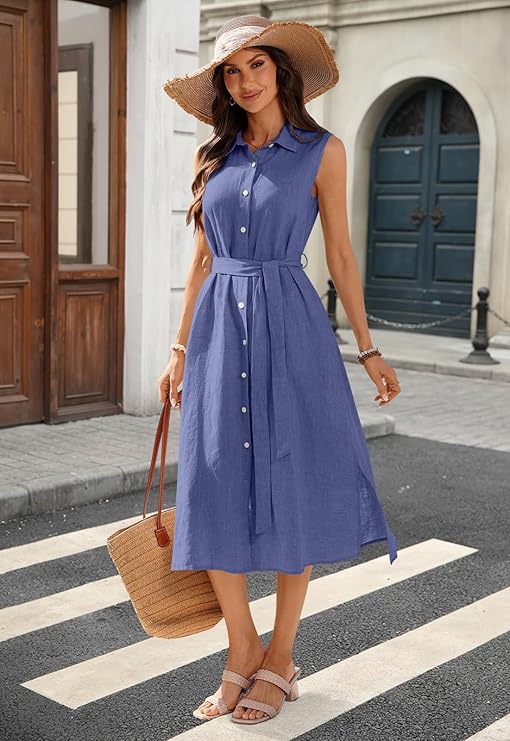
Alternatively, a lightweight scarf worn around your shoulders when entering and removed immediately after is the classic travel move. Keep one in your bag permanently in August; you’ll use it more than you expect.

Local tip: If you check out the best museums in Portugal on your trip, many of the most extraordinary ones are in former religious buildings — the same dress code logic applies, so you’re never sorry for being slightly more covered than you needed to be.
Bags: The Crossbody Always Wins
I’ve tried every bag configuration in every European city, and the crossbody bag wins in Portugal every time. Here’s why: you’re going to be walking steep hills with both hands occasionally useful for balance. You’re going to be in crowded tram 28 in Lisbon where pickpockets have a well-documented interest in tourist bags. You want your hands free, your valuables secure, and your outfit unencumbered.
A small leather or canvas crossbody in a neutral colour — tan, black, cream — works for everything from sightseeing to dinner. A straw or woven basket bag is extremely on-trend and perfectly appropriate for daytime in Portugal’s warm, coastal aesthetic, but pair it with a compact crossbody for evenings or more urban situations where security is a consideration.

Backpacks are fine for full days of hiking or day trips, but a large rucksack on Lisbon’s packed trams is socially awkward and a practical target. If you need the capacity, go for a sleek, zipped backpack rather than an open-top canvas tote.

Local tip: Keep your main valuables — phone, card, passport photocopy — in your crossbody and leave the large bag at the hotel for evening outings. You’ll move faster, feel lighter, and worry less.
What NOT to Wear in Portugal in August
Let me be the friend who tells you the honest things.
Jeans: Unless they’re ultra-lightweight and you genuinely have no other option. Dark denim in 35°C heat is a choice that will follow you with regret all day.
Heels on cobblestones: I’ve said this already and I’ll say it again. Even sensible-looking block heels can catch on mosaic cobblestones in a way that is both undignified and genuinely risky.
Heavy fabrics: Thick cotton, denim, anything with wool, anything that doesn’t breathe. August Portugal is not the time.
Logo-heavy athleisure: Portugal is not unfriendly about it, but you will feel out of place in a city where locals dress with effortless, quiet intention. Leave the airport-to-hotel athleisure look at home.
White linen on Lisbon’s dusty hills: Gorgeous in theory, requiring constant mental energy in practice. Cream or off-white is more forgiving.
Swimwear in the city: Lisbon and Porto are not beach towns. Swimwear is for the beach and the pool. Cover up before you get anywhere near a café, restaurant, or shop.
Accessories That Do the Heavy Lifting
Accessories are where you can add personality without adding weight — which, in August, is the whole game.
Sunglasses: Non-negotiable. Good ones with UV protection, not just decorative. Portugal in August is genuinely intense, and squinting through every outdoor moment gets old fast.

Sun hat or wide-brimmed hat: Underused by tourists, essential for comfort. A packable straw hat is the Portuguese summer essential — it folds into your bag, provides real shade, and looks appropriately Mediterranean.

Lightweight scarf: Church visits, cool evening breezes, sudden air-conditioned restaurant blasts — a cotton or linen scarf earns its weight several times over.

Gold jewellery: Portugal responds well to warm metals. Simple gold hoops, a delicate necklace, a stack of thin rings — these elevate a plain linen outfit from “dressed for the heat” to “actually intentional.” Keep it simple and the effect is significant.
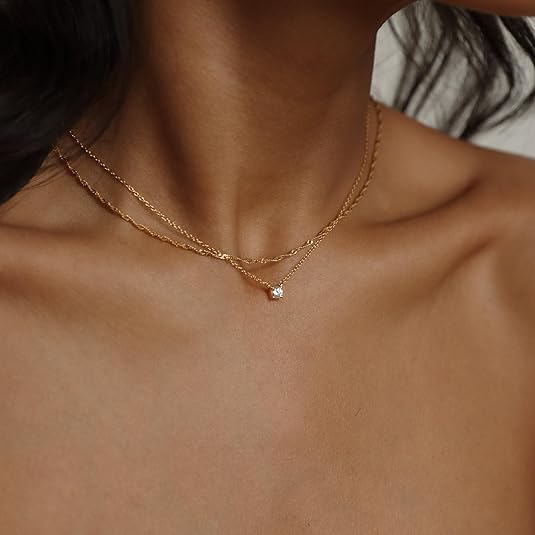
Local tip: You can find beautiful hand-painted ceramic jewellery, cork accessories, and handmade tile-inspired pieces throughout Portugal — buying accessories on the trip is both a souvenir strategy and a way to dress appropriately for where you actually are.
Fabrics to Choose (and Definitely Avoid)
Pack these:
- Linen (the absolute star of August in Portugal)
- Lightweight cotton and cotton-linen blends
- Viscose/Rayon (light, drapey, breathable — just check it doesn’t wrinkle catastrophically)
- Chambray (a lightweight alternative to denim that actually breathes)
Leave these at home:
- Polyester (even “breathable” polyester is not breathable enough at 35°C)
- Thick cotton (better than polyester, but heavy cotton shirts and thick denim aren’t your friends)
- Nylon (traps heat, feels plasticky in summer)
- Anything marketed as “four-way stretch travel fabric” — it’s designed for comfort on planes, not comfort on cobblestones in August
The test I use: hold the fabric up to a light source and see if light comes through easily. If it does, it breathes. If it’s opaque and dense, it will cook you.
Your Portugal August Capsule Wardrobe
For a 7-10 day trip, this is the formula that works:
Women: 3 linen or lightweight cotton dresses (1 casual, 1 versatile mid-length, 1 that works for evening), 2 pairs of wide-leg linen trousers, 3-4 light tops in coordinating neutrals, 1 pair of denim or linen shorts, 1 lightweight cardigan or linen blazer, 1 swimsuit + cover-up, flat leather sandals, comfortable leather trainers, one slightly elevated sandal for evenings.
Men: 3-4 linen or lightweight cotton shirts, 2 pairs of chinos or linen trousers, 1-2 pairs of shorts, swim trunks, 1 lightweight layer for evenings, leather sandals, clean white trainers, one slightly smarter shoe for dinner.
Neutrals — cream, white, sand, olive, terracotta — mix effortlessly and photograph beautifully in Portugal. One bright colour or statement print makes everything feel less monochrome without requiring complicated outfit planning.
If you’re also travelling through Spain or another southern European country, check out the what to wear in Spain in June guide — the packing logic overlaps significantly, and you can build one capsule wardrobe that covers both destinations.
Practical Packing Tips for Portugal in August
Pack light. Portugal is hot, and more luggage means more decisions. The capsule approach — neutral colours, pieces that mix and match, one outfit per day with minimal accessories — means you look effortlessly put-together without hauling a checked bag everywhere.
Bring a day bag you can live out of. A compact crossbody for essentials, a lightweight tote or packable daypack if you’re beach-bound. Don’t carry more than you need for the day.
Plan for outfit repetition. Nobody in Lisbon is tracking your Instagram content for repeated outfits. Two linen trousers and three tops create a surprising number of variations. Embrace it.
Leave the “what if” items at home. That formal dress for a fancy dinner you might not end up booking, the extra shoes for the nightclub you might end up at — they add weight and you’re unlikely to use them. Portugal’s dress code for almost every situation is “relaxed but clearly thought about it.”
Laundry is easy and often necessary. August heat means you sweat more. Pack fewer items and plan on doing a mid-trip wash — either at a laundromat (widely available) or with travel detergent sachets in your hotel sink.
Pack Right, Enjoy More
Portugal in August is one of those trips that stays with you — the light off the Tagus at sunset, the cold Sagres beer at a beach bar, the impossible beauty of an azulejo-covered church interior at midday. The heat is real and the hills will test you, but none of that has to be your enemy if you’ve packed thoughtfully.
Linen, flat sandals, a crossbody bag, a straw hat, and a little flexibility in your outfit planning — that’s genuinely all you need to navigate Lisbon’s hills, the Algarve’s beaches, and Porto’s riverside in total comfort. The rest is just showing up and letting Portugal do what it does best.
Go. You’re ready.


One Response