
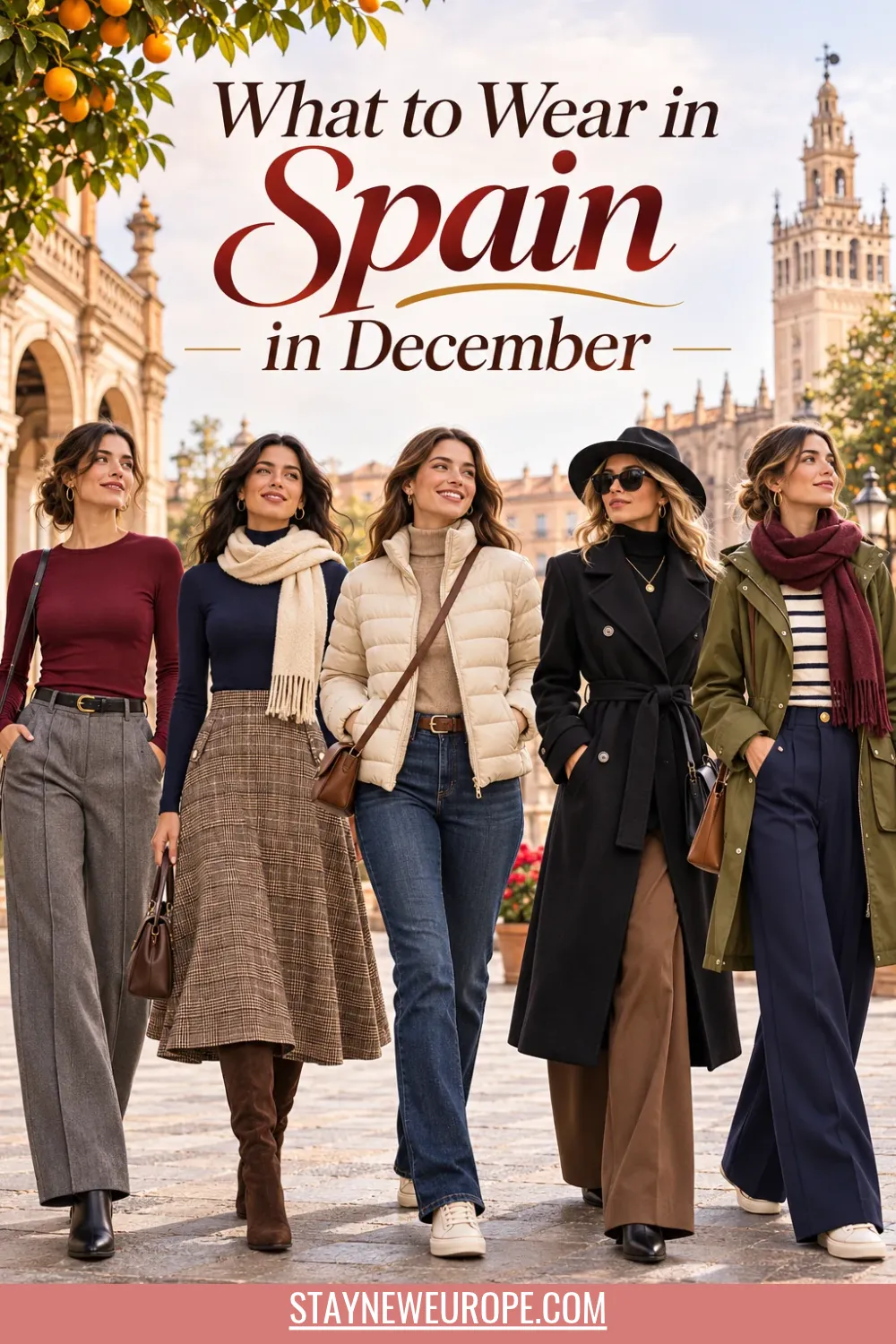
Let me set the scene. It’s 6pm in Madrid, the Christmas lights have just flicked on over Calle de Preciados, and the air has that dry, sharp bite that makes your nose go pink. Someone is selling roasted chestnuts. Someone else is walking past in a camel coat and a scarf the size of a small blanket, looking effortlessly cool. And you? You’re in a hoodie and white trainers, wondering why you believed “it’s Spain, it’ll be warm.”
I’ve made that exact mistake. December in Spain is not one climate, it’s about five. Madrid can be near freezing at night, Seville is crisp and sunny, Barcelona is damp and breezy, the north is properly wet, and the Canary Islands are basically still on holiday. Pack for the wrong one and you’ll either shiver or sweat, and either way you’ll look like a tourist.
Here’s what actually works, learned the hard way, on cobbles, in churches and at dinners that start at 10pm.
Before We Dive In
A quick reality check on what you’re packing for.
Weather: It depends on where you land. Roughly, Madrid and the central plateau sit around 3–11°C, with cold mornings and strong sun at midday. Barcelona is milder, around 8–15°C, but damp and windy by the sea. Seville, Córdoba and Granada are sunny by day and chilly after dark (Granada is colder thanks to the Sierra Nevada). Málaga and the Costa del Sol hover around 9–17°C. The north (Bilbao, San Sebastián, Santiago) is the rainy one, around 6–13°C. The Canary Islands sit comfortably in the low 20s. Always check a forecast the week you travel, because December can surprise you.
Walking conditions: Spanish old towns are a joy and a punishment. Expect polished stone, cobbles, steep hills (hello, Toledo and Granada) and plenty of steps. You’ll walk 15,000 steps without noticing.
Style culture: Spaniards dress well in winter, and they dress warm. Think dark coats, scarves, tailored trousers, leather boots. Nobody is in activewear unless they’re actually exercising. You don’t need to be fashionable, you just need to look like you tried.
Heading to other parts of Europe too? Check out our other monthly and destination guides: [INTERLINK: add 2–3 related guides from the stayneweurope.com sitemap here, e.g. a Spain in November guide, a Portugal in winter guide, an Italy in December guide]
The Bag: Carry-On or Duffle?
Hook: Winter clothes are bulky, and bulky clothes are how people end up paying for checked bags.
I’m a carry-on convert. Spain has excellent trains and plenty of budget flights, and dragging a giant suitcase over cobbles is misery. A soft-sided carry-on or a structured 35–40L duffle is far easier to lift onto a train rack or up the stairs of a boutique hotel with no lift (this happens more than you’d think).

If you’re moving between cities, go with a duffle that has backpack straps. If you’re staying in one or two places, a small wheeled carry-on is fine, as long as the wheels are chunky enough for uneven pavement.
Wear your heaviest items on the plane: the coat, the boots, the scarf. It saves a surprising amount of space and you’ll be glad of the warmth in an over-air-conditioned cabin.
Local tip: Budget airlines weigh your carry-on strictly. Wear the coat, stuff your pockets and nobody blinks.
Lightweight Layers (Why They Matter More Than You Think)
Hook: A 4°C morning and a 14°C afternoon can happen on the same day, so one thick jumper just won’t cut it.
Layering is the whole game. Start with a thin base layer (a fitted long-sleeve tee or a merino top), add a mid layer such as a knit or fine wool jumper, then a proper coat on top. When the sun comes out at noon, you peel one off and tie it around your bag.

Merino deserves its own mention. It stays warm, doesn’t smell after three wears, and is thin enough to sit under a blazer. I wore the same black merino top four times in Seville and nobody was any the wiser.
Picture a morning in Toledo: tee, grey knit, wool coat, scarf. By lunch on a sunny terrace, the scarf is in your bag and the coat is over the chair. Perfect.
Local tip: Indoors in Spain is often warmer than you expect (restaurants, shops, trains). Layers you can remove quickly beat one heavy piece every time.
What Locals Actually Wear (The Dress Code That Matters)
Hook: Spain doesn’t have a strict dress code, but it does have a strong visual language, and it’s dark, tailored and polished.
Neutral and dark tones dominate: black, navy, camel, grey, olive, burgundy. Add one texture (wool, suede, leather) and one good accessory and you’re done. I noticed that even casual outfits looked deliberate. Jeans were dark and well-fitting, trainers were clean, coats were structured.
Sportswear is for the gym. Flip-flops are for the beach. Oversized logos tend to stand out in the wrong way. You don’t need designer pieces, you just need things that fit and look cared for.
An easy formula: dark jeans or tailored trousers, a fine knit, a long coat, ankle boots. It works in Madrid, Barcelona, Valencia and Bilbao without modification.

Local tip: If you’re wondering whether your outfit is “too much” for a casual tapas bar, it isn’t. Spain rewards effort.
What NOT to Wear (The Tourist Giveaways)
Hook: Here’s my honest list of things that made me spot a tourist from fifty metres away. Including me.
Shorts in December in Madrid. I saw it. They were not warm. Also: brand-new white trainers that have clearly never met a puddle, big technical hiking jackets in a city centre, fanny packs worn at the front, and anything with “I ♥ España” on it.
The bigger mistake is dressing for the beach in a country that has real winters. Spain’s postcard image is sunshine, but December in the interior is properly cold, and it feels colder when the wind comes down off the mountains.
The final one is a thin raincoat and nothing else. Wind plus damp (looking at you, Barcelona and the north) needs a coat that actually insulates.
Local tip: If you want to look less touristy instantly, swap the baseball cap for a beanie and the backpack for a crossbody.
Trousers, Jeans or Shorts?
Hook: Short answer: trousers. Long answer: trousers, but choose wisely.
Dark, mid-weight jeans are the workhorse. They handle walking, tapas and an unexpected drizzle, and they pair with everything. Pack two pairs at most. Tailored wool or cotton trousers are your dressier option and work beautifully for dinners.

Leave the thin leggings-as-trousers at home for sightseeing days. They get cold quickly and don’t look right with a coat. If you love leggings, wear fleece-lined or thick ones under a long knit dress or skirt.
Shorts only make sense on the Canary Islands, and even then, not after sunset.
Local tip: Skip heavy, stiff new jeans. Break them in before the trip or your calves will complain after a day on cobbles.
Walking Shoes That Don’t Wreck Your Style
Hook: Your shoes will decide whether you love or hate day three of your trip.
I’d pick one pair of leather ankle boots with a rubber sole and a low block heel or flat, and one pair of clean, low-profile trainers. Boots keep your feet dry and look sharp at dinner. Trainers are for long walking days when the weather is dry.

Avoid brand-new shoes, slippery soles (polished stone is treacherous when wet), and anything with a heel higher than a few centimetres. I watched a woman try to navigate the Albaicín in Granada in stilettos. It did not end gracefully.
Bring a pair of warm, thick socks as well. Wool blends are best, and pack more than you think you need.
Local tip: Waterproof your leather boots before you leave. A cheap spray takes five minutes and saves a soggy-toe disaster in Bilbao or Santiago.
What to Wear in Spain in December for Women: Tops, Knits, Skirts and Tights
Hook: This is where it gets fun, because winter outfits in Spain are really good.
For tops, I like fitted knits, silk or satin blouses under a blazer, and fine ribbed turtlenecks. A turtleneck is the single most useful top you can pack: warm, polished and works with trousers, jeans or a skirt.

Skirts work if you pair them with thick tights or knee-high boots. A midi skirt in wool or corduroy with boots and a chunky knit is an outfit I wore on repeat. Opaque black tights are a smart move, and they add genuine warmth.

A sample day: turtleneck, wool trousers, ankle boots and a long coat for exploring. For dinner, swap the trousers for a midi skirt, add tights, a statement earring and keep the same coat.

Local tip: Pack one “going out” top that looks great but still works under a coat. Satin or a nice knit is perfect.
The Right Jacket for Unpredictable Weather
Hook: If you only get one thing right, get the coat right.
For Madrid, Toledo, Segovia and the interior, you want a proper warm coat: wool, a wool blend or a well-insulated puffer. For Barcelona, Valencia and Seville, a mid-weight wool coat or a stylish trench with a liner is enough. For the north, add a waterproof layer.

I’m a big fan of a packable lightweight down jacket as a second layer. It squashes into your bag, adds a lot of warmth under a wool coat, and works alone on milder days in the south. A long wool coat in black, camel or navy is the most “Spanish” thing you can wear, and it goes over absolutely everything.

Local tip: Choose a coat with real pockets and a collar you can pop up. Spanish wind has opinions.
Evening Outfits (Dinner Like a Local)
Hook: Dinner in Spain starts late, around 9 or 10pm, and the dress-up level is higher than you expect.
By night, temperatures drop fast, so evening outfits need to be warm and polished. I like dark trousers or a midi skirt, a fine knit or blouse, boots with a bit of polish, and a good scarf. Add jewellery, a bold lip or a nice belt and you’re set.

For men, dark jeans or chinos, a crisp shirt or fine knit, and clean leather shoes or minimal trainers do the trick. A navy overcoat finishes it.

Christmas-time venues in cities like Madrid and Barcelona can be dressier, especially around holiday events. Add a bit of sparkle if you’re feeling festive, but keep the base neutral.
Local tip: Restaurants fill up late. You’ll be sitting a long time, often in a cosy, warm room, so wear a layer you can remove.
What to Wear in Churches and Cathedrals
Hook: Spain’s cathedrals are unmissable, and some are strict about what you wear.
Most major churches (Seville Cathedral, Toledo, the Sagrada Família’s interior) expect covered shoulders and, in some, knees. In December that’s easy, because you’ll already be in sleeves and trousers, but it’s worth knowing for warmer regions. Skip crop tops, very short skirts and deeply cut tops.
A large scarf is your secret weapon. It’s warm outside, and indoors it can cover your shoulders instantly if you’ve got a sleeveless top on under your coat.

Local tip: Cathedrals are cold inside, often colder than the street. Keep your coat on.
Bags: Crossbody vs Backpack
Hook: In busy Spanish cities, how you carry your stuff matters as much as what’s in it.
A zip-up crossbody bag worn in front of your body is my go-to. It keeps your hands free, looks sleek and is much harder for pickpockets (an issue in Barcelona and Madrid, particularly around crowded sights and metros). A small leather or sturdy canvas one is ideal.

A backpack is fine for day trips and hikes, but on crowded metros wear it on your front. For full sightseeing days, a small packable daypack tucked in your luggage gives you flexibility.
Local tip: Keep your phone and wallet in inside pockets, not your back pocket. This is common sense, but it saves holidays.
Accessories That Elevate Simple Outfits
Hook: Accessories are the cheapest way to look like you’ve got your life together.
A good scarf is non-negotiable in December. Go wool or cashmere blend in a neutral colour, large enough to wrap twice. Add a beanie or a soft hat for the coldest mornings, and thin gloves for Madrid and the north.

Sunglasses matter more than you’d think, because the winter sun in Spain is bright and low, especially in the south. A simple belt, a pair of earrings or a watch will lift a plain outfit instantly.
Local tip: Buy your scarf in Spain. It’s a lovely souvenir and you’ll wear it again at home.
Non-Clothing Packing Essentials
Hook: The small stuff makes or breaks a trip.
A compact umbrella (a real one, not a flimsy one) is a good idea in the north. Lip balm and moisturiser are essential because the central plateau is dry and the cold air will crack your skin. Pack sunscreen too: winter sun at midday in Andalusia is still strong.
A power adapter for European two-pin plugs, a portable charger (maps drain batteries fast in the cold) and a reusable water bottle round things out. Bring a small foldable tote for market finds, because you will buy things.
Local tip: Bring a spare pair of dry socks in your daybag. Wet feet turn a lovely day into a long one.
Rain Preparation
Hook: Not every Spanish December is sunny. If you’re heading north, it’s the opposite.
Galicia, Asturias and the Basque Country get proper rain in winter. A waterproof jacket with a hood is better than an umbrella in the wind. Water-resistant boots are a game changer, and quick-dry trousers help if you’re caught out.

In the south and east, rain is less frequent but can arrive in dramatic bursts. A foldable umbrella and a coat with a bit of water resistance will cover you.
Local tip: Check the forecast day by day. Spanish weather can flip quickly, and having a plan B for a rainy day (museums, cafés, markets) makes it much less annoying.
Fabrics to Choose (and Avoid)
Hook: The right fabric is the difference between cosy and clammy.
Go for wool, merino, cashmere blends, thick cotton, corduroy and denim. These breathe, insulate and look good. Down or synthetic insulation is excellent for outer layers.
Avoid thin polyester blouses (they trap sweat and offer little warmth), cheap acrylic knits that pill and don’t insulate well, and anything that wrinkles badly in a bag. Stiff, heavy fabrics that take forever to dry are also annoying if you’re packing light.
Local tip: Natural fibres handle the temperature swings between cold streets and heated interiors much better than synthetics.
The Capsule Wardrobe for Spain in December
Hook: You can look put together all week with surprisingly little.
Here’s what I’d pack: two pairs of trousers (one dark jeans, one tailored), one skirt or dress, three or four tops (including a turtleneck and one dressier piece), two knits, one blazer or smart jacket, one long coat, one packable jacket, a scarf, ankle boots and trainers. Add tights, socks and underwear for the number of days you’ll be away.
Everything should mix and match. If it only goes with one other item, it stays home. Stick to a palette of black, navy, camel and grey, with one accent colour if you like.
Local tip: Lay everything out on the bed and make three complete outfits. If you can’t, you’ve got too many odd pieces.
Practical Packing: How Much Do You Really Need?
How many outfits: For a week, I’d bring five to six outfits’ worth of mix-and-match pieces. Re-wear trousers and knits (nobody is checking), and change tops and accessories.
Packing light vs overpacking: Light wins every time in Spain. You’ll be walking, climbing stairs, hopping on trains. Winter pieces are bulky, so be strict. Almost everywhere has laundry options or a self-service launderette if you need a refresh.
Outfit planning tips: Plan by day type: exploring (layers, boots), city dinner (polished knit, good coat), day trip (comfortable trousers, waterproof layer). Check the forecast for each stop on your route, since a trip from Barcelona to Seville might swing 8°C.
Mistakes to avoid: Packing for the postcard rather than the forecast, bringing brand-new shoes, ignoring evenings, and forgetting a proper coat. Also, don’t pack five “just in case” outfits. You won’t wear them.
FAQs About Packing for Spain in December
Is it cold in Spain in December? It depends on the region. Madrid and the interior can be quite cold, the north is cool and wet, and the south and the islands are milder.
Do I need a heavy winter coat? For Madrid, Toledo, Segovia and the north, yes, or at least a warm wool coat. For Seville, Málaga and the Canaries, a mid-weight coat or jacket is enough.
Can I wear shorts in Spain in December? Realistically only in the Canary Islands. Elsewhere you’ll be cold, and you’ll stand out.
What shoes should I bring? Leather ankle boots with a grippy sole and a pair of clean trainers. Both should be broken in.
Is there a dress code for dinner? No strict rules, but locals dress smartly. Smart-casual is safe almost everywhere.
Do I need an umbrella? Pack a compact one, especially for the north. A hooded waterproof jacket is even better.
Go and Enjoy It
Here’s what I keep coming back to: December might be my favourite month to see Spain. The crowds are thinner, the light is golden, the streets glow with Christmas lights, and there’s a hot chocolate with churros waiting on nearly every corner.
You don’t need a perfect wardrobe. You need a good coat, shoes that carry you through the cobbles, and a scarf you love. Get those right and the rest falls into place.
So pack your boots, tuck in that scarf, and go. Spain in winter is waiting, and you’re going to look great doing it.

