
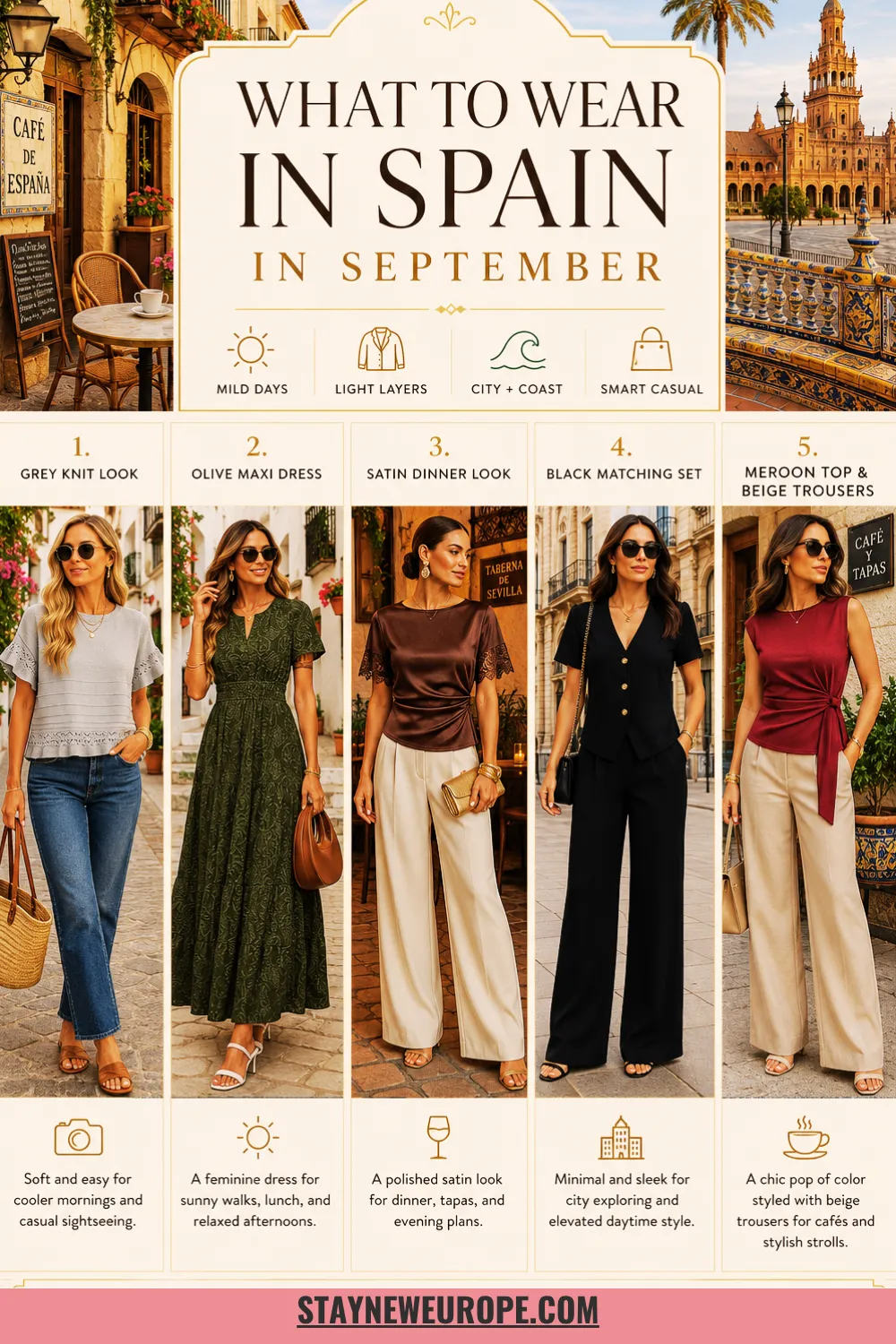
Let me be honest: September in Spain is the trickiest month I’ve ever packed for, and I’ve packed for Spain more times than I can count on both hands.
Everyone tells you it’s “shoulder season,” which sounds gentle and breezy, like you can just throw a light cardigan over a sundress and call it done. That’s not quite the truth. Madrid can still hit 30°C in the early afternoon and drop ten degrees the second the sun goes down. The coast is still basically summer. The north — Basque Country, Galicia — has already started flirting with rain. You’re not packing for one season, you’re packing for three, and they all happen on the same trip.
I learned this the hard way on a Seville-to-San Sebastián route a few Septembers back, where I sweated through a linen shirt at 1pm and then stood shivering on a Basque terrace at 9pm in the same outfit, wishing I’d packed literally anything with sleeves. This guide exists so you don’t have to relearn that lesson.
Before We Dive In
Weather: September in Spain isn’t one climate, it’s a spectrum. In the south — Seville, Málaga, Córdoba — you’re still looking at daytime highs in the high 20s to low 30s, especially in the first half of the month. Central Spain (Madrid, Toledo) cools off noticeably by evening, sometimes by 12-15 degrees. The north and the coasts get genuinely mild, with the first proper autumn rain showing up in Galicia and the Basque Country by mid-month. Humidity is generally lower than August, which honestly makes the heat far more bearable.
Walking conditions:— matter just as much as temperature. Spanish cities are made for wandering — cobblestones in old towns, uneven stone in places like Toledo or Ronda, long flat stretches in Barcelona’s Eixample. Your shoes need to survive all of it, ideally without looking like hiking gear.
Style and culture: And then there’s the style factor. Spaniards dress with intention, even on a casual Tuesday. You’ll notice it immediately — fitted trousers instead of baggy shorts, a proper leather sandal instead of a flip-flop, sunglasses that actually match the outfit. Nobody expects you to dress like a local, but leaning even slightly toward “put together” changes how you’re treated in restaurants, at hotel check-in, basically everywhere. This is one of the biggest things I cover in my broader Spain packing list, and it holds just as true in September as it does in peak summer.
Lightweight Layers Matter More Than You’d Think
Here’s the thing nobody tells you about September in Spain: it’s a layering month disguised as a summer month.
You’ll start the day in a light long-sleeve or a thin cardigan because mornings can have a genuine chill to them, especially inland. By noon you’ll want that layer completely off.

By evening, when the temperature drops and the wind picks up near the coast, you’ll want it back on. A single lightweight piece — cotton, linen blend, fine knit — earns its place in your bag by doing this dance three times a day.

The mistake I see constantly is people packing either full summer (tank tops, shorts, nothing else) or full autumn (jumpers, jackets, closed shoes only). September wants both, in small doses.

A fine merino or cotton long-sleeve under a short-sleeve top, topped with a light jacket, gets you from a 12°C morning to a 22°C afternoon without a full outfit change.
Outfit idea: A sleeveless linen dress with a thin cotton cardigan tied loosely over your shoulders — on, off, on again, all day without a second thought.
Local tip: Keep your layer in your bag rather than wearing it. The temperature swing between shaded streets and open plazas is bigger than you’d expect, and you’ll be constantly adjusting.
The Maxi Dress Still Earns Its Spot in Your Bag
I will defend the maxi dress until the day I die, and September doesn’t change that.
It works for a museum morning, it works for a long lunch, it works for an evening out with sandals swapped for something slightly dressier.

One dress, several outfits, minimal thinking required. In September specifically, a maxi dress also solves the temperature problem — it covers your legs without trapping heat the way trousers sometimes do, and it layers beautifully under a light jacket once the sun goes down.

Go for a breathable fabric — viscose, linen blend, lightweight cotton — and avoid anything fully synthetic, which will cling and feel sticky the moment humidity ticks up on the coast.
Outfit idea: A neutral-toned maxi dress + flat leather sandals for the day, swapped for a strappy sandal and a gold cuff for dinner.
Local tip: One maxi dress in a solid, versatile colour will outperform three “cute” printed ones. You’ll actually wear it every other day.
Jeans, Trousers, or Shorts — What Actually Works
Shorts are fine on the beach and honestly nowhere else, unless you’re deliberately going for a beach-town look in a coastal spot like Tarifa or Nerja. In cities, they read as distinctly tourist, and they won’t get you into most churches.

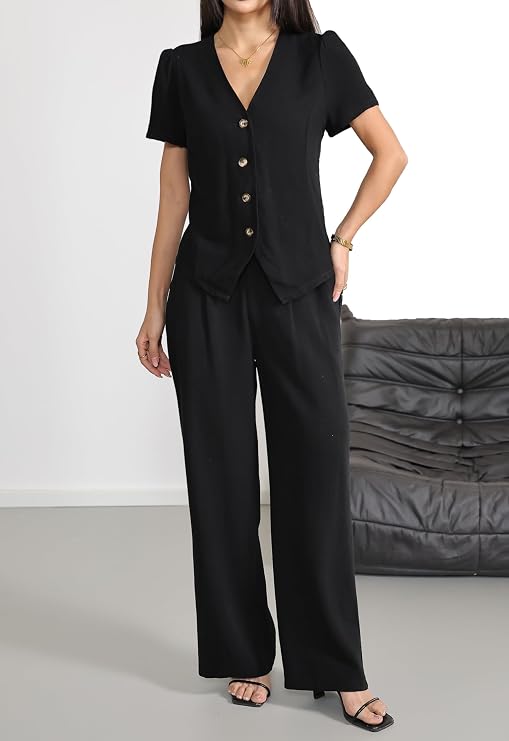
Trousers are your better everyday option in September — lightweight cotton or linen-blend trousers in a straight or slightly wide leg breathe well and photograph better than shorts ever will.

Jeans work too, but stick to a lighter wash and a breathable denim blend; heavy dark denim in Seville at 2pm in early September is a genuinely bad decision I’ve made more than once.

Outfit idea: Wide-leg linen trousers + a fitted white tank + leather sandals + a light button-down tied at the waist for later.
Local tip: If you’re only bringing one pair of trousers, make them a neutral colour that pairs with everything else you packed — beige or olive works harder than black in the heat.
Comfortable but Stylish Walking Shoes
You will walk more in a week in Spain than you walk in a month at home, and your shoe choice will either make or break the trip.
Skip the brand-new white trainers you haven’t broken in — cobblestones in Toledo or Ronda will find every weak spot.
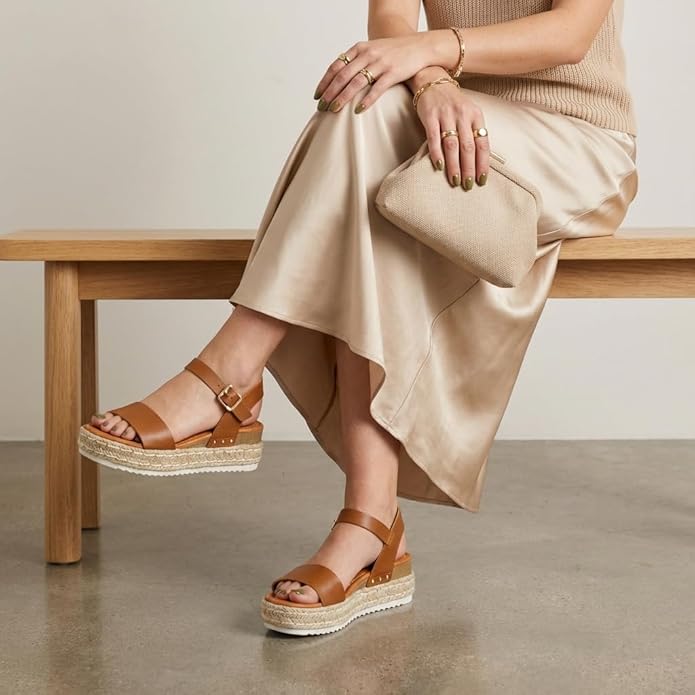
A well-worn leather trainer, a supportive flat sandal with some structure, or a low block-heel mule for evenings are all better bets.

Avoid anything with a completely flat, unsupportive sole; a full day on stone streets will punish your arches by hour three.

Outfit idea: Neutral leather trainers for daytime sightseeing, swapped for a block-heel sandal once you’re heading to dinner.
Local tip: Bring one pair of shoes that can go from museum to dinner without a change. It saves suitcase space and decision fatigue.
What NOT to Wear in Spain in September (Tourist Mistakes)
A few things I’d genuinely leave at home.
Flip-flops anywhere outside the beach — they mark you as a tourist instantly and offer zero support on cobblestones.
Athletic wear as daywear — leggings and a hoodie might be comfortable, but they stand out sharply against how locals dress, even casually.
Anything sleeveless or too short if churches or cathedrals are on your itinerary, since most enforce shoulder and knee coverage strictly at the door.
And heavy, dark-wash denim — it’s simply too hot for most of the month, particularly in the south.
Local tip: If in doubt, ask yourself whether you’d wear it running errands at home. If the answer is no, it probably doesn’t belong in Spain either.
A Jacket for the Evening You Didn’t Expect to Need One
Even in the warmer south, September evenings can surprise you, particularly near water or once the wind picks up after sunset. A light jacket — denim, a thin bomber, or a cotton overshirt — is worth the space it takes in your bag.

If your route includes the north (San Sebastián, Bilbao, Santander) or Galicia, upgrade this to a packable rain jacket, because September is genuinely when the weather there starts to turn.

Local tip: A denim jacket does double duty — casual enough for daytime, sturdy enough to survive a light drizzle without looking like rainwear.
Evening Outfits for Tapas, Terraces, and Late Dinners
Spanish dinners start late — 9pm is early by local standards — and the evening dress code leans slightly more polished than daytime. Nobody expects cocktail attire, but a slight elevation from your sightseeing outfit goes a long way.

A simple swap works wonders: change your flat sandals for something with a small heel, add a gold earring or two, swap your daytime tote for a small crossbody or clutch. That’s genuinely the whole formula.

Outfit idea: The same linen trousers from your day outfit, now paired with a silky camisole, a gold hoop, and a low block heel.
Local tip: Bring one “elevate” piece — a blazer, a nice top, a statement earring — that can transform any daytime outfit into an evening one without packing separate looks for each.
What to Wear for Churches (Dress Codes)
Spain’s cathedrals and basilicas are strict about this, and they enforce it at the entrance, not as a polite suggestion. Shoulders and knees need to be covered — no exceptions for heat, no exceptions for “just this once.”
The easiest fix is a lightweight scarf that lives in your daypack at all times. Drape it over bare shoulders or tie it as a makeshift wrap skirt over shorts, and you’re in without a fuss.

Local tip: Keep the scarf accessible, not buried at the bottom of your bag — you’ll want it fast when you’re standing at the door of the Sagrada Família or Seville Cathedral with a queue behind you.
Bags: Crossbody vs Backpack
For city days, a crossbody bag is the better call. Worn across your body and positioned in front of you, it’s genuinely difficult for anyone to access without you noticing — a real consideration in tourist-dense spots like Barcelona’s Gothic Quarter or Madrid’s Puerta del Sol. A structured leather or waxed-canvas crossbody in a neutral tone also looks considerably more put-together than a bulky backpack.

If you’re covering serious ground — day trips, hiking near Ronda or the Alpujarras — a small daypack makes more sense for the extra capacity and back support.

Local tip: Whichever bag you choose, make sure it has a zip. An open-top tote is an easy target in crowded plazas.
Accessories That Elevate Simple Outfits
A handful of well-chosen accessories will do more for your outfits than any extra clothing item. Sunglasses that you actually like, because you’ll wear them constantly.

A wide-brimmed hat if you’re spending real time outdoors in the south, where the sun is still intense through most of September.

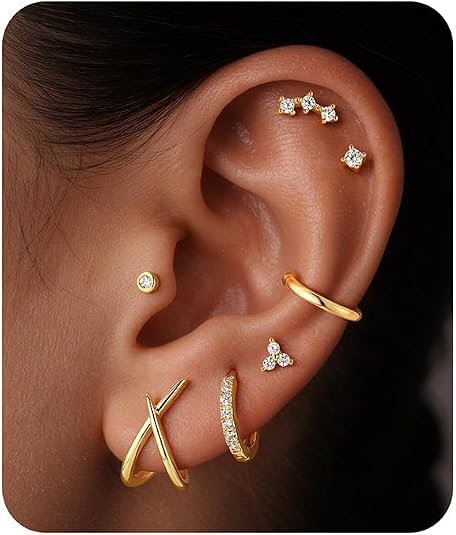
Simple gold jewellery — a chain, hoops, a ring — which reads as effortless against Spain’s warm-toned architecture and light.
Local tip: One good pair of sunglasses beats three mediocre ones. Spend a little more here; you’ll notice the difference every single day.
Rain Prep (Unexpected, But Important)
September is when Spain’s weather genuinely starts to shift, particularly outside the south. Galicia and the Basque Country can see real rain by mid-month, and even Madrid occasionally gets a passing shower. Packing one compact umbrella and a light water-resistant layer costs you almost no space and saves an entire day if the forecast turns.

Local tip: A packable umbrella that fits in a daypack side pocket is worth more than a rain jacket if you’re only expecting the odd shower rather than a full washout.
Fabrics to Choose (and Avoid)
Linen, lightweight cotton, and breathable viscose blends are your best friends — they handle heat, they pack small, and they still look intentional rather than rumpled if you choose a slightly heavier weave. Avoid anything fully synthetic or heavily polyester-based; it traps heat, clings uncomfortably, and doesn’t recover well after a day of walking and sweating.
Local tip: A slightly heavier linen (rather than the flimsiest, cheapest kind) actually wrinkles less and photographs better — worth the small upgrade.
A Capsule Wardrobe for Spain in September
If you want to travel properly light, this is roughly what covers a 7–10 day trip:
two maxi dresses, one pair of lightweight trousers, one pair of jeans in a lighter wash, three tops that mix and match with everything, one cardigan or light jacket, one denim or bomber jacket for evenings, and two pairs of shoes — one for walking, one slightly dressier for dinners. Add a scarf, sunglasses, and a small set of gold jewellery, and you’ve genuinely covered every scenario the month throws at you.
Carry-On or Duffle? Choosing the Right Bag for Spain
For a Spain trip in September, I’d lean toward a structured carry-on if you’re moving between cities by train, since Spain’s rail network is excellent and a rolling case is far easier to manage through stations than a duffle slung over your shoulder.

If your trip is more coastal and car-based, a soft duffle packs more efficiently into a trunk and compresses down for the return flight. Either way, resist the urge to check a bag if you can help it — September’s shoulder-season crowds are gentler than August’s, but lost luggage is still lost luggage.

How Many Outfits to Actually Pack
For a week to ten days, five to six full outfits is plenty when you’re building around a small capsule of mix-and-match pieces. The instinct to pack “just in case” outfits is almost always a mistake — you’ll wear your favourite three pieces on repeat and barely touch the rest. Plan a rough outfit for each day before you pack, factoring in at least one dressier evening and one more casual, comfort-first day, and you’ll avoid both overpacking and the 6am “I have nothing to wear” moment.
Mistakes to avoid: packing for the hottest day only and ignoring evenings; bringing shoes you haven’t broken in; over-relying on one fabric that doesn’t breathe; skipping the scarf and regretting it at every church door.
Ready to Pack
September in Spain rewards travellers who pack with a little intention rather than a lot of volume. You don’t need a suitcase full of options — you need a handful of pieces that layer well, breathe in the heat, and can go from a sun-drenched morning at the best museums in Spain to a late tapas dinner without a full outfit change in between. Pack light, pack smart, and leave room in your bag for whatever you inevitably buy in a Madrid boutique on day three. You’ll thank yourself the moment you’re walking comfortably through a plaza at golden hour, dressed for exactly the day you’re actually having.

