
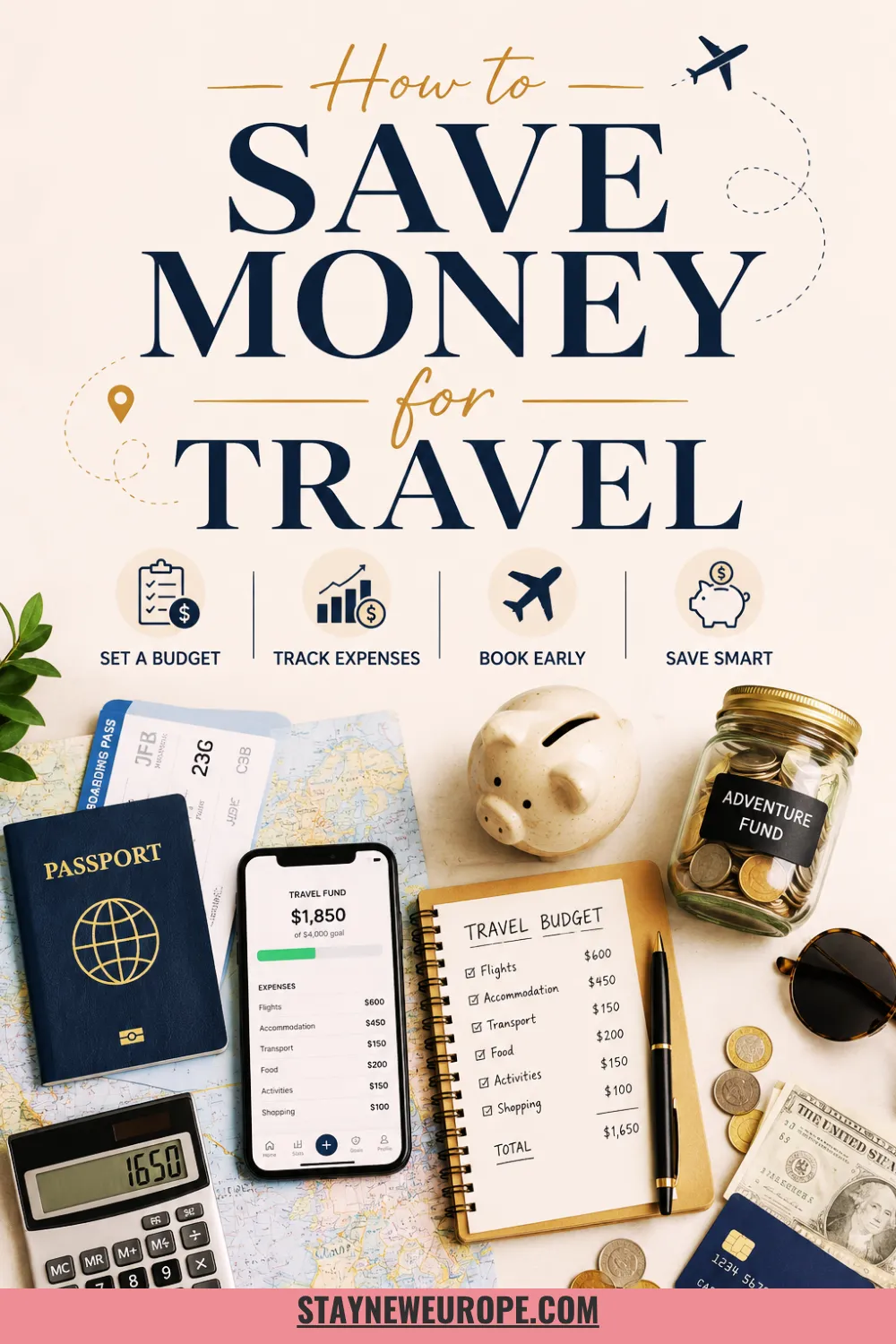
I used to think the people who traveled “all the time” had some secret trust fund I wasn’t told about. Then I actually started asking them how they did it, and it turned out to be embarrassingly unglamorous: spreadsheets, a separate bank account, and a lot of saying “not this month” to things that didn’t actually matter to them. That was the moment my own travel life changed. I went from “someday I’ll go to Europe” to booking a flight roughly every eight months, and I did it on a normal income, not a windfall.
So if you’re sitting there with fifteen browser tabs open — flights to Lisbon, flights to Florence, a hostel in Reykjavik you’re 70% sure is a scam — and no real plan for how to pay for any of it, this one’s for you. Here’s exactly how I save for travel, the mistakes that cost me money early on, and the small habits that add up to a real trip fund without making your day-to-day life miserable.
Start With the Number, Not the Vibe
Here’s the first mistake almost everyone makes, myself included: they decide they want to “save for travel” without deciding what that actually costs. Vague goals get vague results. “I want to go to Europe” is a dream. “I need €1,800 by next June for eight days in Portugal” is a plan.
Before you save a single euro, do this:
- Pick a rough destination and season. Prices swing wildly depending on when you go — my June trip to Spain cost noticeably more than the exact same itinerary would have in early May.
- Price out flights, accommodation, and a daily spending estimate using real search engines, not guesses. Skyscanner or Google Flights for airfare, Booking.com or Hostelworld for a realistic nightly rate, and a quick search for “average daily budget in [city]” for spending money.
- Add 15% on top. Something always costs more than you planned. Every single time.
Money tip: Write the number down somewhere you’ll actually see it — the lock screen on your phone, a sticky note on your laptop, the notes app you open forty times a day. A savings goal you never look at is just a wish.
Open a Separate Account (Seriously, Do This One)
This sounds almost too simple to matter, but it might be the single most effective thing on this list. If your travel money lives in the same account as your rent, groceries, and impulse Target runs, it will get spent. Not because you’re bad with money — because that’s what money does when it’s not earmarked for anything.
Open a separate savings account specifically for travel. Give it a name that means something to you — mine is embarrassingly just called “PORTUGAL” in all caps — and set up an automatic transfer the day after payday. Even €50 a month adds up to €600 a year without you ever having to think about it again.
Money tip: Pick a bank or account that’s slightly annoying to transfer money out of quickly. A little friction between you and your travel fund is a feature, not a bug.
Track Where Your Money Actually Goes (You Will Be Shocked)
I resisted doing this for years because it sounded tedious, and honestly, it kind of is — for about two weeks. Then it becomes automatic and genuinely eye-opening. Use a free app, a notes file, whatever works, and track every single purchase for one month. Not to judge yourself. Just to see it.
The point isn’t to cut everything out. It’s to find the leaks you didn’t know were there. For me it was a food delivery habit that was quietly costing me almost €200 a month — more than my flight to Milan ended up costing. I didn’t even like the food that much. I just liked not thinking about dinner.
Once you can see the leaks, you get to choose which ones to plug. That’s the difference between budgeting and deprivation — you’re not cutting joy, you’re redirecting money from things you don’t actually care about toward the thing you do.
The Subscriptions Audit Nobody Wants to Do
Go into your bank statement right now and list every recurring subscription. Streaming services you forgot you had, an app you downloaded once for a free trial three years ago, a gym membership you use twice a year out of guilt. The average person has more of these than they think, and most of them are set up to be forgotten.
Cancel the ones that aren’t earning their keep and route that exact amount straight into your travel account. If Netflix, Spotify, and that meditation app you never open are quietly draining €35 a month, that’s €420 a year — practically a whole flight to somewhere gorgeous.
Cook More, But Make It Feel Like a Reward, Not a Punishment
Nobody sticks to “stop eating out” as a rule because it feels like punishment. What works better: pick two or three meals you genuinely love cooking, buy the ingredients in bulk, and lean into them. I got weirdly into a really good shakshuka recipe during my saving-for-Sardinia phase, and it didn’t feel like sacrifice — it felt like a nice ten-minute ritual that happened to save me money.
Money tip: Meal prep on the same day you do your weekly grocery shop. The version of you at 7pm on a Tuesday, tired and hungry, is not going to cook. Do the favor for future-you in advance.
Use the “Cost Per Wear/Use” Trick on Everything
This is a mental trick I picked up from thinking about clothes and started applying to basically every purchase. Instead of asking “can I afford this,” ask “how many times will I actually use this, and what does that work out to per use?” A €120 jacket you’ll wear fifty times is a better deal than a €25 top you’ll wear twice.
This is also exactly the mindset behind building a smart travel wardrobe instead of buying a bunch of trip-specific outfits you’ll never wear again — my Spain packing list is built entirely around pieces that pull double or triple duty, which saves money on the packing side just as much as the flight side.
Sell What You’re Not Using
Before your next trip, do a genuine sweep of your closet, garage, and that drawer full of cables you don’t recognize anymore. Facebook Marketplace, Vinted, Depop, or a good old-fashioned local swap group can turn clutter into real cash surprisingly fast. I funded almost a third of a trip to Iceland by selling clothes I hadn’t worn in over a year. It felt less like “selling my stuff” and more like my closet quietly paying for my flight.
Set Up Fare Alerts and Be Flexible on Dates
This is less about cutting spending and more about spending smarter. Set fare alerts on Google Flights or Skyscanner for your destination and just let them sit in the background of your life. Flight prices fluctuate constantly, and the difference between a good fare and a bad one on the exact same route can be hundreds of dollars.
Money tip: If your dates are flexible even by two or three days, use the “cheapest month” or flexible date search view. I once saved almost €200 on a flight to Barcelona simply by leaving on a Tuesday instead of a Friday.
Travel Off-Season (Or At Least Off-Peak)
This one genuinely changes the math on a trip. Peak summer in places like the Amalfi Coast or Santorini isn’t just crowded — it’s expensive across the board: flights, hotels, even restaurant prices creep up when demand is high. Shoulder season (think April–May or September–October in most of Europe) tends to mean lower prices, thinner crowds, and honestly, often nicer weather for walking around all day.
If you’ve got your heart set on somewhere like the Spanish coast, consider whether you actually need to go in July, or whether late spring gets you 90% of the beach experience for 60% of the price.
Use Windfalls on Purpose, Not by Accident
Tax refund, work bonus, a birthday check from your grandmother — these are the easiest wins in your entire savings journey, and also the easiest to accidentally absorb into everyday spending without noticing. The second unexpected money hits your account, move a set percentage of it straight into your travel fund before your brain has time to talk you into “just this once.”
Money tip: Decide the percentage before the windfall happens. Deciding in the moment is how it becomes zero.
Round-Up Apps and “Invisible” Saving
If manual saving feels like too much friction, automate it. A lot of banking apps now offer round-up features that take every purchase, round it to the nearest dollar or euro, and drop the difference into savings. It sounds small, but over a year of daily coffees, groceries, and gas station stops, it adds up to real money without you consciously doing anything.
Don’t Forget: Saving Smart Also Means Packing Smart
Here’s something that doesn’t get talked about enough in “how to save for travel” posts: overpacking costs money. Checked bag fees, overweight luggage charges, buying things at your destination because you forgot them, or — my personal cautionary tale — panic-buying a whole new outfit in Florence because everything I brought was wrong for the weather. Building a proper capsule-style wardrobe before you go, like the approach I use in my Sardinia summer style guide, genuinely saves money on both the front and back end of a trip.
Money tip: Lay out everything you plan to pack a full week before you leave, not the night before. You’ll spot the gaps (and the excess) with a clear head instead of scrambling at 11pm.
Give Yourself a “No Guilt” Spending Category
This might be the most important tip on the entire list, and it’s the one people skip because it feels counterintuitive: build a small, guilt-free spending category into your budget on purpose. If you cut out literally everything fun in the name of saving, you will burn out on the whole system in six weeks and abandon it entirely.
Keep one thing — coffee out on Fridays, a monthly dinner with friends, whatever actually brings you joy — completely untouched. Sustainable saving beats aggressive saving that collapses after a month, every single time.
Putting It All Together
None of these tips are individually life-changing. A cancelled subscription here, a round-up app there, a flight booked on the cheap Tuesday instead of the expensive Friday — none of it feels dramatic in the moment. But stack them up over six months or a year, and you’ll look up one day and realize you have enough sitting in that separate account to actually book the trip you’ve had bookmarked for two years.
That’s genuinely how I got from “someday” to a real, dated flight to Spain as a first-time traveler — not a windfall, not a lucky break, just small, boring, consistent decisions that added up. If I could do it on a normal salary while still eating out sometimes and buying the occasional impulse dress, you can absolutely do it too.
Now go open that separate savings account. Future-you, standing somewhere gorgeous with a plane ticket already paid for, is going to be very grateful.

