
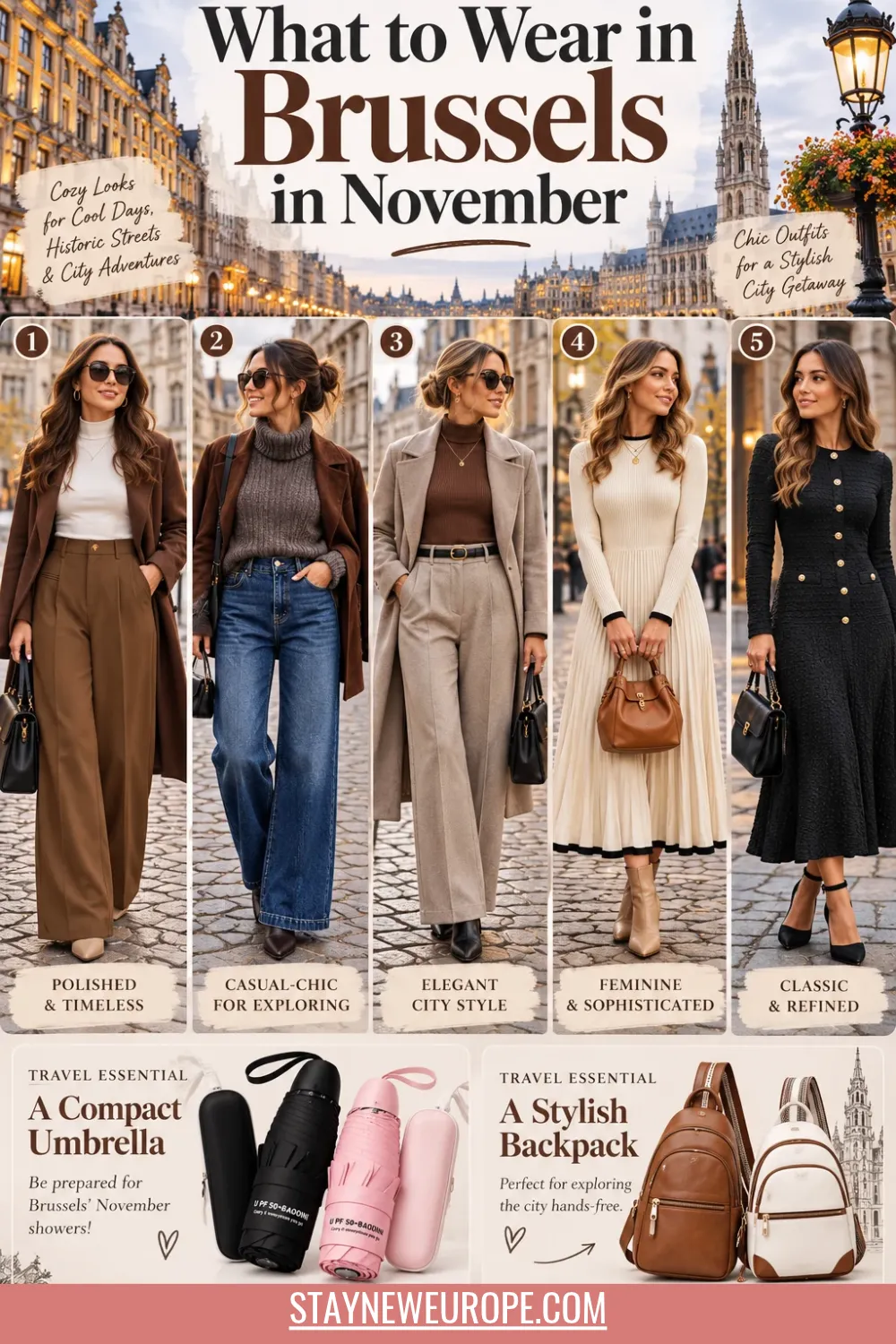
Brussels in November is a mood. The sky is the colour of wet slate, the Grand Place glows gold the second the lights come on at 4:30 pm, and somewhere around the corner a waffle stand is fogging up the whole street. It’s cosy, it’s moody, and it’s far prettier than its reputation suggests.
It’s also damp, windy and built on cobblestones that hate your cute shoes. You’ll climb from the Lower Town to the Upper Town more than you expect, duck into a chocolate shop every twenty minutes, and get rained on at least once, usually when you’ve just left a café.
Most visitors pack for “Europe in autumn” and end up cold, soggy or limping. Let me save you from that, because I’ve been all three.
Before We Dive In
Here’s the quick context so every outfit idea below makes sense.
Weather: Expect highs of roughly 8–11°C (46–52°F) and lows around 3–5°C (37–41°F). It rains on a lot of days, usually as drizzle rather than drama, and the humidity makes 9°C feel colder than it looks on your phone. Skies are grey more often than not, and it’s dark by about 4:30 pm.
Walking conditions: Cobblestones around the Grand Place and the Sablon, uneven pavements, and steady slopes between the Lower and Upper Town. You’ll easily rack up 15,000+ steps a day without noticing.
Style culture: Belgians dress in a quiet, practical, slightly arty way. Think dark knits, good coats, clean boots and very little logo. Nobody is dressed up, yet nobody looks sloppy. Brussels also sits near Antwerp’s fashion scene, so even the “casual” locals look put together. Dress like you made a small effort and you’ll blend right in.
Heading elsewhere in Europe this month? Check out our other November guides: What to Wear in Germany in November, What to Wear in Copenhagen in November, What to Wear in Prague in November and What to Wear in Italy in November.
1. Start With the Right Bag (Carry-On Wins)
Brussels is a small, walkable, tram-and-metro city, and hauling a giant suitcase over cobblestones is a rookie mistake you only make once.
A carry-on spinner with big, smooth wheels is the one I’d pick for a city break here. Cobbles chew up tiny hard wheels, so look for softer, oversized ones, and you’ll thank me when you’re rolling from Central Station to your hotel.

If you’re only staying a long weekend, a soft-sided weekender or duffle is even easier. It squashes into overhead bins, ignores tram steps, and forgives the extra pastry box you’ll inevitably carry home.

Local tip: Eurostar and Thalys-style trains from Paris, Amsterdam and London have limited luggage racks. A bag you can lift easily beats a bag with fancy features. For more on packing smart, see our guide to carry-on packing for Europe.
2. Lightweight Layers (And the Fabrics That Make Them Work)
Brussels November is about temperature swings of three kinds: freezing outside, steamy on the tram, roasting in a crowded café. One thick sweater can’t handle that.
I build every outfit from three layers: a thin base, a warm middle and a proper outer. A merino or fine-knit long-sleeve tee as a base is a game-changer because it stays warm when damp and doesn’t smell after a long day.

For the middle layer, a fine merino or lambswool sweater beats a chunky one every time. Chunky knits look cute and then trap sweat in the Metro. Wool, merino, and good cotton-blend knits are your friends. Skip thin polyester (clammy) and anything that soaks up rain like a sponge.

Local tip: Belgians layer in neutral tones such as navy, charcoal, camel and olive. Pick a palette of three colours and everything you pack will mix and match.
3. The Dress Code That Actually Works in Brussels
Let me be honest: Brussels isn’t Paris or Milan. Nobody is judging you, but there’s a certain understated polish here that rewards a little effort.
The formula I use is simple: dark straight trousers or jeans, a fine knit, a coat that fits properly, and clean leather boots. Add a scarf and you’ve basically got the local uniform. It works for museums, bars, chocolate crawls and casual dinners.
What stands out is anything loud, sporty or overly “vacation.” Hiking jackets at dinner and neon trainers are the giveaway. Keep the outfit calm and let the city be the colourful part.
Local tip: If you’re unsure, add one good piece, like a nice coat or a leather boot. It lifts the entire look.
4. What NOT to Wear (Tourist Mistakes I See Constantly)
I watch outfits like it’s a sport, and the same errors keep coming up.
White sneakers look amazing for about ten minutes and then meet a puddle. Heels or thin-soled ballet flats lose to the cobbles within an hour. A thin trench with no layers underneath is pretty and freezing. And shorts or a mini with bare legs in November are a hard no, even if you’ve got a strong constitution.
Another classic is the cheap umbrella. Brussels wind turns them inside out, and you’ll see broken ones in bins on every corner. Also skip heavy cotton hoodies as your only warm layer, because once they get damp they stay damp.
Local tip: If you can’t walk five kilometres in it, leave it at home. Save the statement shoes for the taxi-to-dinner outfit.
5. Jeans, Trousers & Why Shorts Stay Home
This is where comfort and style need to cooperate.
Dark, straight or slightly tapered jeans are the hero. They’re sturdy, they hide splashes, and they look right in every setting from the Sablon antiques to a frites stand. Avoid very light washes because wet hems show up fast.

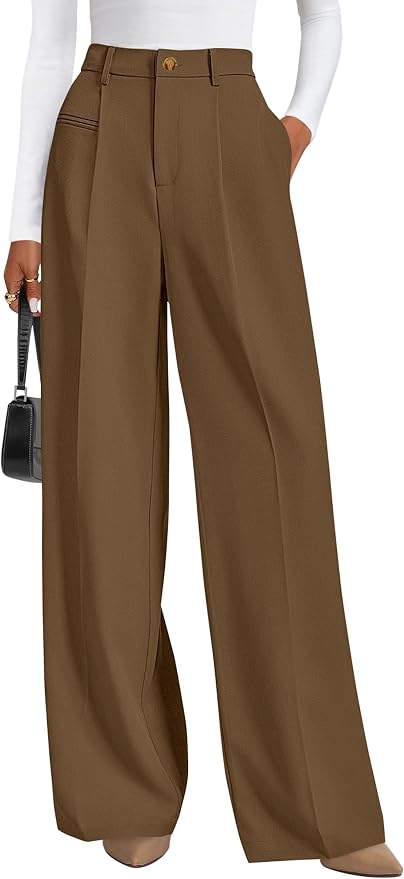
Wool-blend or smart trousers are my pick for dinners and a rainy day when I want to feel less “tourist.” If you’re a skirt person, pair it with warm tights and boots, which I’ll cover below. Leave the shorts at home, and skip anything that’s not at least a bit water-resistant on the hem.

Local tip: Jeans take forever to dry in a hotel room, so bring two pairs max and rotate them.
6. Comfortable but Stylish Walking Shoes
Shoes can make or break a Brussels trip, and I learned this the hard way on day one when I wore the wrong pair.
Waterproof leather or leather-look ankle boots with a grippy rubber sole are the single best thing you can pack. Wet cobbles are slippery, and a good sole makes you feel steady. Chelsea boots and lace-up leather boots both look right here.

Clean minimalist leather sneakers in dark or neutral colours are a good second option, as long as they’re water-resistant. Treat them with a waterproofing spray before you go. Whatever you choose, break them in at home first. Blisters on day one are no fun.

Local tip: Wool socks are your secret. Cold, wet feet are what actually ruin a trip, not the weather.
7. What to Wear in Brussels in November for Women: Tops, Knits, Skirts & Tights
Here’s the practical breakdown, because I know this is what you’re really searching for.
Tops: Mix a few long-sleeve fitted tees, a silk-feel or satin blouse for evenings, and two fine knit sweaters. A turtleneck or mock neck is perfect because it works alone or under a blazer.
Skirts and dresses: A midi skirt or knit dress with opaque thermal tights and boots looks effortless. Fleece-lined tights are a bit of a miracle on those 4°C evenings. Keep the hemline around the knee or longer, because the wind is real.

A sample day outfit: Dark jeans, a merino turtleneck, a wool coat, ankle boots and a scarf. It goes from museum to bar to dinner without a change.

Local tip: If you wear a skirt, put a thin pair of leggings or thermals under your tights. It sounds like too much until you’re standing in a queue for waffles.
8. The Coat: Your Most Important Piece
If you only spend money on one thing, make it this. The coat does most of the work.
A knee-length wool or wool-blend coat in black, navy, camel or grey is the Brussels classic, and it looks good in every photo. If you expect lots of rain, a water-resistant coat with a hood or a lightweight padded jacket works well, especially in the last week of November when it gets properly cold.

Don’t rely on a thin trench or a denim jacket. I did once, and I spent the whole afternoon trying to hide behind other people. If you pick a down jacket, go for a slim, dark one, not a puffy ski version.
Local tip: Hoods matter more than you’d think. Umbrellas and wind aren’t a good pair, so a coat with a hood saves you in a sudden downpour.
9. Evening Outfits That Don’t Scream “Tourist”
Brussels evenings are cosy, not fancy. Think beer cafés, small bistros, jazz bars and long dinners.
My go-to is black trousers or dark jeans, a silky blouse or fine knit, and a blazer or good coat with polished boots. Add a small earring or a scarf with some texture and you’re done. If you want something dressier, a simple midi dress with tights and boots is perfect.

The trick is to look relaxed. Brussels dinners are rarely black-tie, so over-the-top glam stands out. A mix of neutral tones with one interesting piece is the sweet spot.
Local tip: Many bars and restaurants are warm inside, so make sure your layers come off easily. You don’t want to melt into your soup.
10. What to Wear for Churches
Brussels has some beautiful churches and the dress code is relaxed, but a bit of respect goes a long way.
At the Cathedral of St. Michael and St. Gudula, Notre-Dame du Sablon and similar places, cover your shoulders and avoid anything very short or revealing. In November this is easy, because you’ll be wearing sleeves anyway.
A large scarf doubles as a shoulder cover and a warm layer. Take your hat off when you go in, which is a small gesture that people notice.

Local tip: Churches can be properly chilly inside. Keep your coat on and your scarf handy.
11. Everyday Bag: Crossbody vs. Backpack
A good bag keeps your hands free for chocolates, which is the true priority in Brussels.
A zip-top crossbody bag is my favourite for city days. It’s secure on crowded trams and around the Grand Place, where pickpockets do operate, and it’s neat enough to wear to dinner. Pick one in leather or a water-resistant fabric.

A small, slim backpack is fine for long museum days when you’re carrying water, a camera or a spare layer, but wear it in front on crowded trams. A tote bag with a zip works too, as long as it closes properly.
Local tip: Keep your phone and wallet in an inner pocket, not at the top of your bag. It takes five seconds to organise and saves a lot of stress.
12. Accessories That Make Simple Outfits Look Intentional
This is where a plain outfit becomes a stylish one, and it costs almost nothing.
A big wool or cashmere-blend scarf is the best accessory in Brussels. It adds warmth, colour and a touch of polish. I pick one in a deep tone like burgundy, forest green or mustard to lift my neutral clothes.

A beanie or a soft knit hat keeps your ears happy when the wind picks up, and thin touchscreen gloves let you take photos without freezing your fingers. A simple belt, small hoop earrings or a classic watch finish the look nicely.

Local tip: Pack the scarf in your day bag, not your suitcase. Temperatures drop quickly when the sun goes down at 4:30.
13. Rain Preparation (Unexpected but Important)
Rain in Brussels isn’t a surprise; it’s the plan. Prepare for it and it stops being a problem.
A sturdy compact umbrella with a vented or wind-resistant frame is worth the extra money. The cheap ones fold in the first gust. A coat with a hood and waterproof boots make an umbrella almost optional, and I like having both.

Also bring a small plastic bag or dry bag for wet shoes or a soggy umbrella, and a waterproofing spray for your boots and bag before you leave. It takes two minutes and saves your whole wardrobe.

Local tip: Drizzle usually passes quickly. When it hits, duck into a café, order a hot chocolate and wait it out. It’s the Belgian way.
14. What to Pack for Brussels in November (Non-Clothing)
A few non-clothing items make a bigger difference than an extra sweater.
A portable phone charger is a must, because cold weather drains batteries fast and you’ll be using maps and photos constantly. Hand cream and lip balm save you from dry, windy-weather skin. A reusable water bottle is handy for long walking days.
Also bring a European plug adapter (Belgium uses Type E/C sockets), a small travel umbrella if you didn’t pack one already, and blister plasters just in case. A small tote bag is great for chocolate shopping and carrying back extra goodies.
Local tip: Leave some space in your luggage. Belgian chocolate has a way of multiplying.
15. Capsule Wardrobe & How to Pack It
Here’s the practical part, and my honest advice is to pack less than you think.
For a 3–4 day trip, bring about five tops, two bottoms, one coat and two pairs of shoes. Stick to a colour palette of two neutrals and one accent, and every piece will go with every other piece. That’s the whole trick.
A sample capsule: dark jeans, black trousers, two fine knit sweaters, one turtleneck, one silky blouse, one midi skirt or dress, tights, a wool coat, ankle boots, a scarf and a crossbody bag. Wear your bulkiest items on the plane, roll the rest and you’re done. For more ideas, see our travel capsule wardrobe guide.
Mistakes to avoid: Packing “just in case” outfits, bringing three pairs of shoes you’ll never wear, forgetting a waterproof layer, and leaving no room for souvenirs. Plan each outfit with a top, a bottom and a layer, and you’ll be set. Laundry is easy to find, so you don’t need an outfit for every day.
Local tip: Lay everything out on your bed before packing. If it doesn’t go with at least two other things, it stays home.
16. FAQs About Brussels in November Packing
Is it very cold in Brussels in November? Cold and damp rather than freezing. Expect 3–11°C, so a warm coat, layers and a scarf will keep you comfortable.
Do I need a heavy winter coat? Not usually, but a solid wool or padded coat is wise, especially late in the month. Layers underneath give you flexibility.
Should I bring an umbrella or a raincoat? Both if you can. A hooded coat handles wind better than an umbrella, and an umbrella is handy for light drizzle.
Can I wear sneakers? Yes, if they’re water-resistant and have good grip. Waterproof boots are still the best choice.
Is Brussels a dressy city? Not really. It’s smart-casual and understated. Neat, dark and simple works everywhere.
Will I need anything for the Christmas markets? Winter Wonders typically opens in the last week or so of November. If you’ll be outdoors in the evening, bring gloves, a hat and thermal layers.
Here’s what I want you to take away: Brussels in November rewards the traveller who’s a little prepared and a lot curious. Pack a good coat, comfy boots and a scarf you love, and you’ll be warm, dry and looking effortlessly local while you wander between chocolate shops, glowing squares and steamy beer cafés.
So go on, zip up the bag and head out. The city is gloriously moody this time of year, and you’re about to look great in it. Go get lost in those cobbled streets, and let the drizzle be part of the story.

