
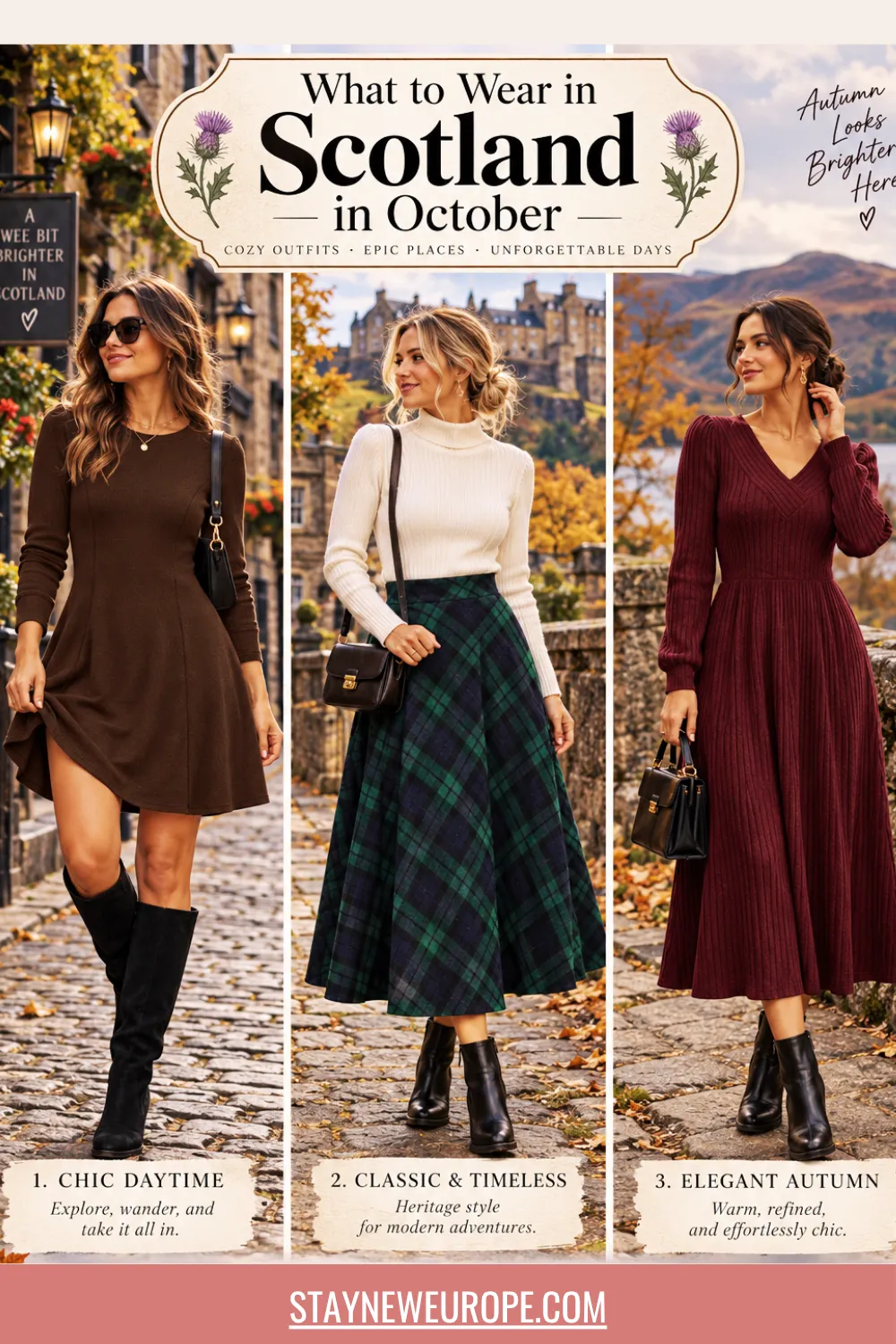
Let me be honest with you before you even open a suitcase: Scotland in October does not care about your outfit plans. I found this out on my second morning in Edinburgh, dressed for the crisp, golden autumn photo I had in my head, and instead got sideways rain, a gust off the North Sea that nearly took my scarf with it, and a sky that changed its mind four times before lunch.
And yet — this is one of my favourite months to be here. The tourist crowds have thinned out, the light turns everything gold by 4pm, and there’s something about walking cobbled streets in a big coat with a coffee in hand that just feels right. October in Scotland has a mood, and dressing for it is less about looking “autumnal” and more about surviving four seasons before dinner.
The mistake almost everyone makes? Packing like it’s a photogenic European autumn — trench coats, ankle boots, one umbrella “just in case.” I did exactly that the first time. I came home with a ruined suede jacket and a new, slightly obsessive relationship with proper waterproof layers.
Before We Dive In
Weather: October in Scotland sits somewhere between “crisp and lovely” and “actively hostile,” often within the same afternoon. Average highs hover around 11–13°C (52–55°F), lows can dip close to 5°C (41°F), and you should assume rain on most days — not constant rain, but the kind that arrives in short, committed bursts with no warning. Wind is the real variable most people underestimate, especially in Edinburgh’s Old Town and anywhere near the coast or the Highlands, where it can make 12°C feel a lot colder.
Walking and standing conditions: Walking-wise, this is not a flat-shoe-and-hope-for-the-best country. Edinburgh’s Royal Mile and the streets around it are cobbled and often slick with rain, Glasgow has long flat stretches that eat up more steps than you’d expect, and if you’re heading anywhere near the Highlands or Isle of Skye, footing gets uneven fast.
Style culture: Style-wise, Scots dress well but practically — think good coats, good boots, muted colours, and almost nobody caught out without a proper layer. It’s less about looking put-together and more about looking like you’ve done this before.
A Bag That Can Actually Handle Scottish Weather
Your bag is doing more work here than in almost any other European destination, and this surprised me the first time.
In cities that get occasional rain, a nice tote or a soft-structured bag is fine. In Scotland in October, you need something that closes properly, doesn’t soak through, and has enough room for a packable rain jacket you’ll be pulling in and out all day.
I switched to a mid-size crossbody with a zip top and a water-resistant base after a Edinburgh downpour left the bottom of my canvas bag damp for two days. For the suitcase itself, a hardshell carry-on genuinely holds up better against Scottish luggage-cart puddles than the soft-sided version I used to swear by.

If you’re doing any countryside time — Highlands day trips, Skye, the Trossachs — add a small daypack you can sling over a coat without it looking bulky. You want easy access to gloves and a hat without unpacking your whole bag on a windy hillside.

Local tip: leather bags look lovely in photos but suffer badly in sustained rain. Go for treated canvas, nylon, or a coated fabric instead — your Instagram grid will survive, and so will your bag.
Layers Are Not Optional Here — They’re the Whole Strategy
If you take one thing from this article, let it be this: Scotland in October is a layering country, full stop.
The temperature swing between an 8am start and a 2pm peak can be 6–7 degrees, and that’s before you factor in wind chill or stepping into a heated pub or museum. A single heavy coat leaves you sweating indoors and cold the moment you step back out.
What actually works is a base layer (merino if you can — it doesn’t hold odour and dries fast), a mid layer like a fine-knit jumper, and an outer shell that blocks wind and rain. I learned this the hard way after wearing one thick wool coat all day and spending half my time either overheating on a bus or freezing waiting for one.

A good outfit formula: thermal or long-sleeve base, chunky knit jumper, waterproof shell jacket, scarf you can loosen or tighten as needed.
This same three-layer logic is what I’d recommend for a similarly moody, changeable city — I go into more depth on building a flexible layering system in what to wear in Stockholm, which deals with almost identical shoulder-season unpredictability.
Local tip: buy or bring a proper Scottish wool jumper — not the tourist-shop acrylic version. A genuine lambswool or merino jumper from an Edinburgh or Inverness knitwear shop is worth the extra cost and will outlast three trips.
Waterproof Jackets: Your Actual MVP
I used to think a stylish trench was a reasonable substitute for a proper rain jacket. It is not, and Scotland will prove this to you within 48 hours.
What you actually need is a genuinely waterproof (not just water-resistant) jacket with a hood that stays up in wind — this matters more than it sounds, because a hood that blows off in a gust is worse than no hood at all. Look for taped seams and a fit roomy enough to layer a jumper underneath.

I now travel with a longline waterproof shell in a neutral colour that works over jeans during the day and over a nicer top for dinner, so I’m not packing a separate “smart” coat just for evenings.
For a day exploring Edinburgh: waterproof shell over a knit, jeans, waterproof boots.
For a Highlands day trip: same jacket, but with a thermal base layer underneath and the hood cinched tight — you’ll thank yourself on any exposed viewpoint.
Local tip: ditch the umbrella. Scottish wind turns them inside out within minutes, and I’ve watched more than one tourist chase theirs down the Royal Mile. A good hood beats an umbrella every single time here.
Jeans, Trousers, and What Actually Survives the Day
Denim gets a bad reputation for cold-weather travel, and in Scotland in October, some of that reputation is earned.Once jeans get properly wet, they stay wet and cold for hours — genuinely miserable on a long walking day. That said, jeans are fine for city days with lower rain risk, especially a slightly heavier denim rather than a thin summer-weight pair.

What I reach for more often here are water-resistant trousers or heavier cotton-blend chinos that shed light rain and dry faster if you do get caught out.

For Highland or countryside days specifically, I pack one pair of proper hiking-friendly trousers — not glamorous, but my jeans-clad travel companion spent an entire ferry crossing in soaked denim while I stayed comfortable.

A good rotation: dark jeans for city evenings and low-rain days, water-resistant trousers for anything outdoorsy, and one pair of leggings as a base layer under either when it’s especially cold.
Local tip: darker washes and colours hide splash-back from puddles and cobblestone spray far better than light denim — a small detail that saves you from looking like you’ve been dragged through a puddle by 11am.
Dresses and Skirts — Yes, They Can Still Work
I’ll admit I nearly left dresses out of my Scotland packing entirely, and that would have been a mistake.
A dress absolutely still works in October Scotland, provided you build it for the climate rather than fighting it. Think midi-length in a heavier knit or ponte fabric, worn over thick tights, with a substantial jumper or cardigan layered on top and a waterproof coat over everything.

It reads as intentional rather than under-dressed, and it’s genuinely comfortable once you get the layering right. I wore a chocolate-brown knit midi dress with black 100-denier tights and ankle boots to dinner in Glasgow and felt properly put-together without freezing on the walk there.

Skip anything in lightweight cotton or a floaty summer fabric — it simply won’t hold up to the wind, let alone the rain. Save those for a different, warmer trip.

Local tip: a wrap-style dress or one with an adjustable waist tie gives you flexibility to layer a jumper underneath comfortably instead of everything looking bulky.
Footwear: The One Category Where I Won’t Compromise
This surprised me the most on my first Scotland trip — I genuinely underestimated how much footwear would define the whole experience.

Cobblestones, wet pavement, uneven Highland paths, and long walking days mean flimsy shoes get punished fast. Waterproof ankle boots with real tread are the single most important item on this entire list — I’d rather be slightly under-dressed everywhere else than have wet, cold feet for a week. Leather boots with a waterproofing spray work for city-only trips; for anything countryside, a proper waterproof hiking boot or sturdy weatherproof boot is worth the suitcase space.

For daytime exploring: waterproof ankle boots with jeans or trousers. For evenings: the same boots often still work fine with a dress — Scotland is not a heels city, and nobody will look twice. I made the mistake of packing cute suede boots “for photos” on one trip; they were ruined by day two and I wore trainers with everything for the rest of the week out of necessity.
Local tip: break in any new boots before you arrive. Blistered feet on cobblestones in the rain is a genuinely bad time, and I say this from experience.
What NOT to Wear (Save Yourself the Regret)
A few things I’ve either done myself or watched other tourists learn the hard way.
Skip anything suede or unlined leather — it will not survive sustained rain, and dry-cleaning bills abroad are no fun.
Leave the flimsy travel umbrella at home; Scottish wind makes it useless within a day.
Avoid open-toe shoes entirely, even on a sunny-looking morning, because the weather turns fast and wet feet in October are miserable, not charming.
And skip the all-white or pale outfit you were saving for photos — between rain splash and general October grime, it won’t stay clean past mid-morning.
One more: don’t over-pack “just in case” summer pieces. I brought two sundresses on my first trip that never left the suitcase, and they took up space I badly needed for a second jumper.
Local tip: loud, logo-heavy activewear reads as very tourist here. Scots dress casually but tend toward quieter, quality basics rather than performance gear, even for outdoor days.
Evening Outfits: Pubs, Restaurants, and the Odd Nice Dinner
Scotland’s evening dress code is refreshingly relaxed, which took some pressure off once I understood it.

For a cosy pub dinner, your daytime outfit minus the wettest outer layer is usually completely fine — a knit jumper, jeans or a midi dress, and boots.
For a slightly nicer restaurant, I’d elevate with a blazer or a longline cardigan over the same base, swap jeans for trousers or keep the dress, and add one nice accessory. Nobody expects heels or anything delicate given the cobblestones and weather, so a smart flat boot does all the same work.

A reliable formula: knit dress or trousers-and-blouse combo, tights if it’s a dress, ankle boots, a good coat you can check or drape over a chair. I wore this almost identically for dinners in both Edinburgh and Glasgow and never felt out of place in either a casual bistro or a slightly dressier spot.
Local tip: a statement scarf does a lot of evening-outfit heavy lifting here — it elevates a simple jumper-and-trousers combo instantly and gives you an extra layer for the walk home.
Accessories That Do More Than Decorate
In a climate this changeable, accessories stop being purely decorative and start earning their keep.
A proper scarf — wool or cashmere-blend, not a thin cotton one — adds real warmth and instantly elevates a simple jumper-and-coat combo.

Gloves are non-negotiable by mid-October, especially for early starts or anywhere windy.

A beanie or flat cap works better than you’d think for keeping the wind off without messing up your hair too badly, and honestly, everyone else is wearing one too, so you won’t stand out. I now travel with one structured tote-friendly scarf that doubles as an extra layer if the temperature drops further than forecast.
For jewellery, keep it minimal — you’ll mostly have it hidden under layers anyway, so one good pair of earrings and maybe a ring is plenty.
Local tip: a tartan scarf feels like an obvious tourist move, but a well-made one from an actual Scottish mill, rather than a souvenir shop version, is a genuinely nice, wearable souvenir rather than a costume piece.
Rain Prep: The Section Nobody Wants But Everybody Needs
I put this off writing until near the end because I wanted you to actually believe me by now: it will rain, probably more than once a day, and your outfit plan lives or dies on how you handle it.
Beyond the waterproof jacket already mentioned, small details matter — a packable rain cover for your bag, water-resistant treatment sprayed onto boots before you leave home, and quick-dry fabrics wherever possible over cotton, which stays soaked and cold for hours once wet.

I keep a small microfibre cloth in my bag just to wipe down glasses or a phone screen after a sudden shower, which sounds minor until you’re the only person at dinner still drying off.

Don’t fight the rain aesthetically either — a slightly damp, windswept look is basically the Scottish October uniform, and nobody local is judging you for it.
Local tip: check the hour-by-hour forecast each morning rather than the daily summary. Scottish weather apps that show hourly breakdowns will save you from getting caught totally unprepared on a “supposedly dry” day.
Fabrics to Pack (and the Ones to Leave at Home)
Fabric choice matters more in Scotland than in almost any other destination I’ve packed for.
Wool, merino, fleece, and technical waterproof synthetics are your friends — they retain warmth even slightly damp and dry reasonably fast. Cotton is the one to avoid as a primary layer; once wet, it stays wet, stays cold, and takes forever to dry in a hotel room.
Linen, lovely as it is for a Mediterranean summer, has genuinely no place in an October Scotland suitcase. I made this mistake once, packed a linen shirt “for versatility,” and it never left the bag.

A good rule: if a fabric would work for a cold, damp hike, it’ll work here. If it would work for a beach holiday, leave it home.
Local tip: a lightweight down or synthetic-fill vest packs down to almost nothing and adds real warmth under a rain shell — brilliant for that awkward window between “jumper is enough” and “I need the full coat.”
Building a Capsule Wardrobe for Scotland in October
Once I stopped over-packing “just in case” pieces, my Scotland trips got noticeably easier.
For a week-long trip, aim for a base of two to three jumpers, two pairs of bottoms (jeans and water-resistant trousers), one midi dress, one waterproof shell jacket, one warmer coat or vest layer, and a rotation of two to three tops as base layers. Everything should mix with everything else — I plan around a neutral palette of navy, charcoal, camel, and burgundy specifically because it means every top works with every bottom, and nothing needs its own dedicated shoes.
This is genuinely the same shoulder-season capsule logic I use for autumn trips generally — worth a look if you’re also weighing what to wear in Paris in September on the same itinerary, since a few pieces can realistically do double duty across both.

Local tip: pack one “emergency warm” piece you don’t think you’ll need — a thermal top or an extra pair of thick socks. On the one unexpectedly cold day, you’ll be very glad you did.
How Much to Actually Pack (Without Overdoing It)
For a week in Scotland in October, you genuinely don’t need more than five or six outfit combinations if you’ve built them to mix and match properly.
The biggest overpacking mistake is bringing multiple “just in case” pieces for weather scenarios that won’t happen simultaneously — you don’t need both a heavy coat and a lighter jacket and a rain poncho; pick your layering system and commit to it. Plan outfits by activity rather than by day: one rotation for city walking, one for any Highlands or countryside time, one for evenings out. Repeating a jumper twice in a week is completely normal and nobody will notice.
The mistake I still catch myself making is packing an extra “nice” outfit that never gets worn because the weather or the mood never called for it. If in doubt, leave it — you can always buy a jumper here if you genuinely need one.
Scotland in October isn’t trying to be pretty for you, and honestly, that’s part of the charm. Get the layers right, respect the rain, and the rest of the experience — golden light on old stone, warm pubs after a long walk, that particular quiet of the Highlands in low autumn sun — takes care of itself. Pack smart, dress for movement, and go let this place surprise you. It will, one way or another.

