
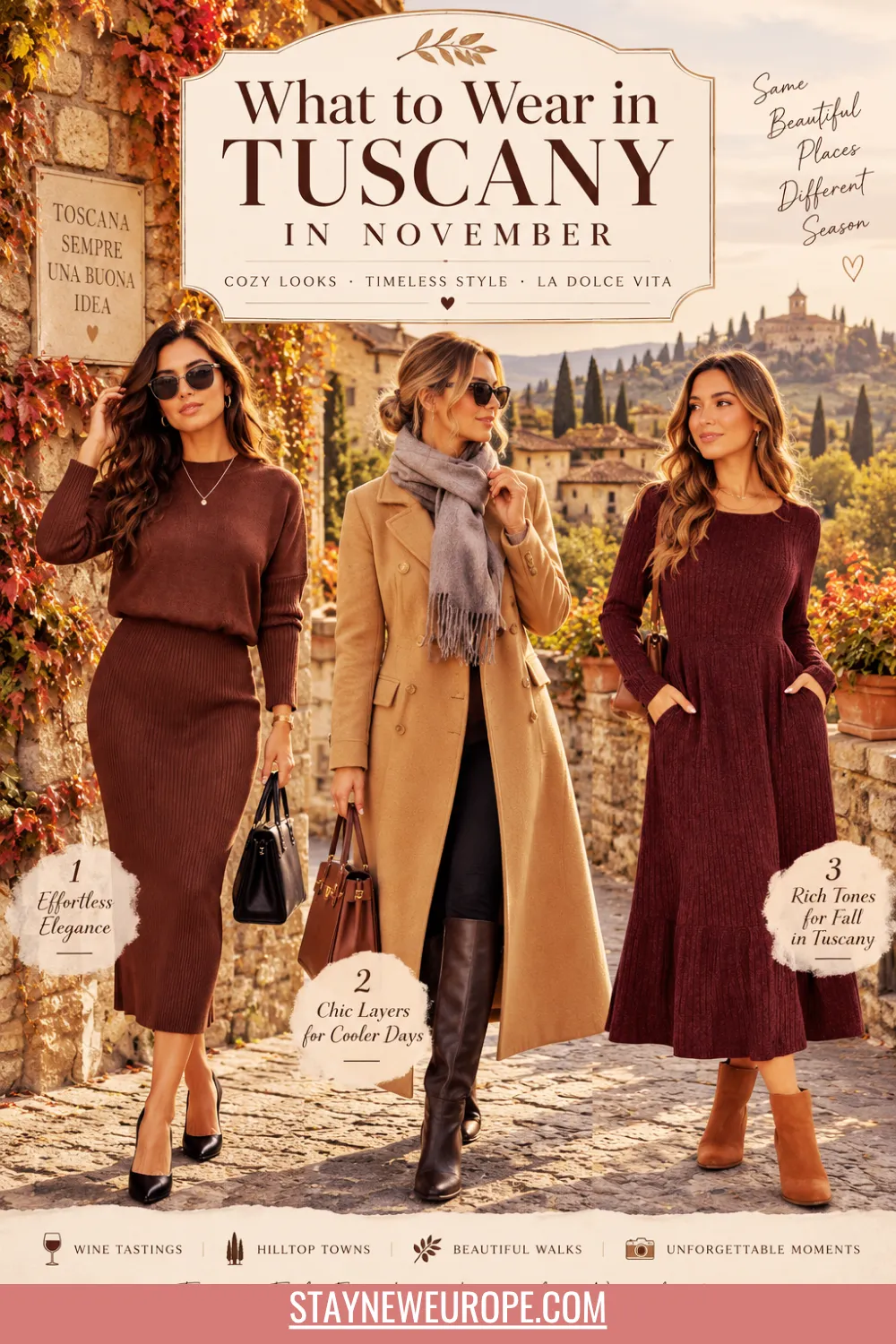
Let me be honest — I almost didn’t pack a real coat for Tuscany in November, because in my head “Italy” still meant sundresses and gelato-melting heat. Big mistake. By my second morning in a hill town outside Siena, I was standing in fog so thick I couldn’t see the valley below, wrapped in every layer I’d brought, silently apologizing to my suitcase for underestimating it.
This is the season nobody puts on a postcard, and that’s exactly why it’s worth going. The tourist buses have thinned out, the vineyards have gone the color of rust and wine, and the towns feel like they belong to the people who actually live in them again. But the weather has opinions of its own, and dressing for it takes a bit more thought than you’d expect from a country famous for sunshine.
This surprised me the most: Tuscany in November isn’t cold in the dramatic, bundle-up-or-die way. It’s damp-cold, sneaky-cold, the kind that gets into your bones on a cobblestone street at 8am and then completely disappears by 1pm when the sun finally breaks through. Pack for one season and you’ll be wrong twice a day.
Before We Dive In
Weather: Tuscany in November sits somewhere between “mild autumn” and “please don’t be smug about it.” Daytime highs hover around 13–15°C (55–59°F), nights drop to 5–8°C (41–46°F), and rain shows up uninvited more often than not. Fog rolls through the countryside most mornings, especially around Val d’Orcia and the hills near Montepulciano, and it can linger well past breakfast.
Walking conditions: Florence’s streets are flat but the surrounding hill towns — San Gimignano, Montalcino, Cortona — are basically stair climbers made of stone. Add wet cobblestones to that equation and you’ve got a genuinely slippery situation. Vineyard visits often mean gravel paths and mud, not manicured walkways.
Style culture: Italians don’t stop dressing well just because it’s raining — if anything, this is when their wardrobe gets more impressive. Structured wool coats, leather boots, a scarf that’s doing actual work. Showing up in a puffer jacket and running shoes isn’t a crime, but you will feel the difference in how put-together everyone around you looks.
Your Suitcase or Duffel: Choose Based on the Towns, Not the Airport
Tuscany punishes bad luggage choices more than most destinations.
A hardshell carry-on works beautifully for Florence, where you’re mostly on flat, paved streets and hotel elevators exist. The moment you head into the countryside, though — think farmhouse stays, gravel driveways, cobbled hill towns — a soft-structured duffel with a shoulder strap becomes the smarter pick. You’ll be hauling it out of trunks, up uneven stone steps, and across surfaces no wheeled suitcase was designed for.

I switched to a mid-size duffel after watching someone drag a spinner suitcase up the ramp into San Gimignano and genuinely lose a wheel halfway up. It wasn’t dignified, and it definitely wasn’t necessary.

Local tip: if your trip mixes cities and countryside, pack a foldable tote inside your main bag. It weighs nothing and becomes your day bag for market runs and vineyard visits.
Lightweight Layers Matter More Than Any Single “Warm” Item
Here’s the thing nobody explains well: one heavy sweater will betray you the second the sun comes out.
Tuscan November days swing 8–10 degrees between morning fog and midday sun, so your wardrobe needs to breathe and layer, not just insulate.
A thin merino base layer, a lightweight knit, and something structured on top does more for you than one thick jumper ever will — because you can peel pieces off as the day warms and put them back on the second that valley fog rolls back in around 4pm.

A good combo: a fine-knit long-sleeve top, a mid-weight cardigan, and a wool coat over the top. Each piece earns its space by working with the others.

Local tip: merino wool doesn’t hold onto smells the way cotton does, which matters when you’re re-wearing the same three tops across ten days without daily laundry access.
Dresses That Actually Work for This Season (Not the Instagram Kind)
A sundress in November Tuscany is basically a costume, not an outfit.
What actually works is a midi knit dress — something with structure and a bit of weight to it — paired with opaque tights and knee-high boots. This gives you the polished, “I have my life together” look without freezing on a wine tour. Wrap dresses are particularly forgiving here because they layer easily under a coat and still look intentional when you take it off indoors.

For dinner, a darker-toned knit dress with a statement coat over it reads as effortlessly Italian rather than trying-too-hard-tourist. Save the linen and cotton dresses for a different trip; this is knitwear season.

Local tip: bring one dress in a deep, wine-adjacent color — burgundy, forest green, chestnut — and it’ll photograph beautifully against the season’s actual landscape.
Jeans, Trousers, and the Case Against Shorts
Shorts are simply the wrong tool for this job, and I say that with love.
Straight or slightly wide-leg jeans handle Tuscany’s mix of cobblestones and countryside better than anything skinny or cropped — you need fabric that moves with you on uneven ground, and a bit of length that can sit over a boot.

Wool-blend trousers are the elevated alternative for dinners or wine tastings, since they resist wrinkling in a way jeans can’t.

I’d pack two pairs of bottoms max for a week: one denim, one trouser. Anything more and you’re just carrying dead weight for outfits you’ll never actually build.
Local tip: darker denim (black or deep indigo) hides road dust and travel wear far better than lighter washes, which matters after a day of vineyard walking.
Walking Shoes That Won’t Embarrass You on Cobblestones or at Dinner
This is the section where overpacking really costs you.
Ankle boots with a low, grippy heel are the single most useful shoe you can bring to Tuscany in November. They handle wet cobblestone, uneven vineyard paths, and a casual dinner out without you needing to change shoes at any point in the day.

Sneakers work for very casual days, but the wrong sole on slick stone streets is how people end up on the ground — I’ve seen it happen twice, both times on the same stretch of street in Montepulciano.

Skip anything with a thin, smooth leather sole for outdoor exploring; save those for indoor dinners only.
Local tip: break your boots in before you land. I made this mistake once on a similar trip and spent two days limping through cobbled streets in blister plasters — our full Italy packing guide covers shoe strategy for cobblestone cities in more depth if you want the deeper dive.
What NOT to Wear (Tourist Giveaways, Ranked)
Let’s get the uncomfortable ones out of the way.
Bright white sneakers with athletic socks pulled up mid-calf is tourist code that’s instantly readable from across a piazza.
So is a full head-to-toe puffer set — practical, sure, but it flattens you into “just here for the photo” territory the moment you walk into a proper restaurant.
Ponchos and disposable rain macs are functional but visually scream “wasn’t prepared,” which, fair, but there are better options below.
Leggings worn as trousers with a t-shirt is another one — comfortable, understandable, and completely at odds with how put-together everyone around you will look.
Local tip: you don’t need designer anything. You need fit, structure, and one good coat. That’s 80% of the equation solved.
Jackets for Weather That Changes Its Mind Constantly
You need two jackets, not one, and this is non-negotiable.
A structured wool coat is your daytime and evening workhorse — warm enough for the morning chill, smart enough for dinner, and genuinely flattering in a way puffer jackets rarely are.

Underneath or as backup, pack a lightweight packable rain shell for the days when Tuscany decides to actually commit to a downpour, which happens more in November than any brochure will admit.

I learned this the hard way outside Volterra, caught in a sudden downpour with only my wool coat, which then took two days to properly dry in a farmhouse with limited heating. Never again.
Local tip: a packable rain jacket that folds into its own pocket takes up almost no suitcase space — this lightweight option style is exactly the category to look for, even if you’re shopping for Tuscany rather than Spain.
Evening Outfits That Suit Candlelit Dinners and Wine Cellars
Tuscan evenings deserve a slightly elevated version of your daytime self, not a costume change.
A knit dress or wool trousers with a silk or satin top, topped with your good coat, covers most dinner scenarios — from a family-run trattoria to a proper wine cellar tasting.

Layer in a statement earring or a good scarf and you’ve upgraded the whole look without packing a single “occasion” outfit.
Boots stay on; there’s no need for heels on Tuscany’s uneven stone floors, and honestly, most cellar tastings happen on gravel or dirt anyway.
Local tip: bring one silk or satin cami top specifically for evenings — it elevates a plain trouser-and-coat combo instantly and weighs almost nothing in your suitcase.
Dressing for Churches and Chapels (The Rules Are Real)
Tuscany’s churches and abbeys are not casual about dress codes, even in the off-season.
Shoulders and knees covered is the standard across nearly every church, monastery, and abbey you’ll visit — including smaller countryside chapels that look too quiet to enforce anything.
A midi dress with sleeves or trousers with a modest top solves this without you having to think about it twice. If you’re already wearing your wool coat, you’re generally covered without extra effort.

Local tip: carry a lightweight scarf in your day bag at all times during November — cooler weather means you’re likely already dressed appropriately, but it’s your backup for the one dress that doesn’t quite make the cut.
Bags: Crossbody for Towns, Structured Tote for Everything Else
Your bag choice changes depending on whether you’re in a city or a hill town, and that’s worth planning for.
A crossbody bag with a zip closure is essential in Florence, where pickpocketing around major sights is a real, documented issue — keep it in front of your body, not swinging behind you.

In the quieter countryside towns, a structured leather tote gives you more room for market finds, a water bottle, and a folded scarf, without sacrificing the polished look Tuscany rewards.

Local tip: avoid anything with an open top or magnetic-only closure in crowded areas. A simple zip is the cheapest security upgrade you’ll make on this trip.
Accessories That Do More Work Than You’d Think
The right accessories turn three outfits into six without adding a single extra piece of clothing.
A wide wool or cashmere scarf is the November MVP — it’s a layering piece, a church cover-up, and a styling detail all in one.

Add a pair of leather gloves (your hands get cold faster than you’d expect on foggy mornings)

and a structured belt to cinch your coat when the wind picks up on hilltop towns like Montalcino.

Statement earrings do the heavy lifting for evening looks without needing a separate outfit.
Local tip: one scarf in a warm, autumnal tone — rust, mustard, deep green — works with nearly everything in your capsule and photographs beautifully against Tuscany’s landscape this time of year.
Rain Preparation Nobody Warns You About
November is genuinely one of Tuscany’s rainier months, and most first-time visitors pack like it’s a formality.
Beyond the packable rain jacket already mentioned, bring a small, sturdy umbrella — the kind that survives actual wind, not a flimsy hotel freebie.

Waterproof or water-resistant boots matter more here than in almost any other Italian region and season, since you’re combining rain with cobblestone and gravel.

A quick-dry travel towel is a genuinely underrated addition; farmhouse stays don’t always have great drying conditions for a soaked coat.
Local tip: check the forecast the night before any vineyard or countryside day — rain turns gravel paths into mud fast, and you’ll want boots over anything more delicate.
Fabrics to Pack (and the Ones to Leave at Home)
Fabric choice matters more in November than in any other Tuscan season.
Wool, merino, and heavier cotton blends handle the temperature swings and occasional rain far better than linen or lightweight cotton, which just don’t have the weight to do anything useful here. Corduroy and denim are excellent mid-layer options that photograph well against the season’s warm, earthy landscape.
Avoid anything purely synthetic close to your skin — it doesn’t breathe well across the day’s temperature range and tends to trap dampness rather than wick it away.
Local tip: a wool-cotton blend sweater dries faster than pure wool if you get caught in rain, which matters when you don’t have daily laundry access.
Building a Tuscany November Capsule Wardrobe
You genuinely don’t need as much as you think, and overpacking here backfires fast in narrow farmhouse wardrobes and limited luggage space in rental cars.
For a week-long trip: two pairs of bottoms (one jeans, one trouser), one knit dress, four tops in mixable neutrals, one cardigan, one wool coat, one packable rain shell, and two pairs of shoes — boots and a comfortable flat.
Everything should pair with at least two other pieces, or it doesn’t earn its spot in the suitcase. If you want the fuller framework for building this kind of wardrobe from scratch, our capsule wardrobe approach in the France packing guide walks through the same logic in more detail.
Local tip: lay every piece out before you pack and count actual outfit combinations. If something only works with one other item, leave it home.
Packing Smart: How Much Is Actually Enough
For most week-long trips, five to six full outfits genuinely covers everything, once you’re working from a proper capsule rather than packing complete looks.
The biggest mistake is bringing single-use pieces — an outfit “just in case” of a fancy dinner that may or may not happen, or a jacket for weather you’re not actually expecting. If a piece doesn’t connect to at least two others in your suitcase, it’s dead weight.
Plan a loose mental outline before you go (day one: jeans and the burgundy knit; day three: the wool dress for the wine tasting) so you’re not making decisions every morning in a cold farmhouse room.
Local tip: pack your heaviest shoes and coat while wearing them on travel days — it saves real suitcase space and you’ll be grateful for the warmth the second you land.
Tuscany in November has this quiet, slightly moody beauty that summer crowds never let you see properly — fog sitting low over the vineyards, chestnut smoke drifting through hill towns, dinners that stretch long because nobody’s rushing off to the next tourist stop. Dress for it properly and you stop thinking about your suitcase entirely. You’re just there, wrapped in something warm, watching the light change over a valley that’s had centuries of practice looking exactly like this. That’s the whole point of going in the off-season, and it’s worth every extra layer you pack.
