
I need to start this one with a confession:
I’ve had my phone lifted out of my hand in broad daylight in Barcelona, I’ve been “accidentally” bumped into by three separate people at once on the Rome metro, and I once handed my passport to a “police officer” in Prague before my brain caught up and told me that real police don’t ask tourists for cash on the spot. I’m still a little embarrassed about all three. But I learned something from each one, and over years of living out of a suitcase across Italy, Spain, France, Portugal, the Netherlands, Scandinavia, and the UK, I’ve built up a genuinely practical system for staying safe without turning every trip into a paranoid slog through Europe.
This isn’t a list of vague “be aware of your surroundings” advice you’ve read a hundred times. This is what I actually do, what’s actually worked, and what I wish someone had told me before my first solo trip.
Do Your Homework Before You Even Book the Flight
Safety starts long before you land. I always spend twenty minutes checking the current situation for wherever I’m headed — not to scare myself out of going, but so I know what I’m actually walking into. Government travel advisory pages (the UK’s and the US’s are both solid and free) will flag anything from ongoing protests to regional scams that have picked up recently. I also do a quick search for “[destination] common scams” right before booking, because scam trends shift year to year and city to city.
Local tip: I keep a running note on my phone with the local emergency number, the address of my country’s nearest embassy or consulate, and my accommodation’s address written in the local language. It sounds excessive until you actually need it and your hands are shaking too much to type.
Split Your Money and Cards Like You Expect to Lose Some
I never carry all my cards or all my cash in one place, and this single habit has saved me more grief than anything else on this list.
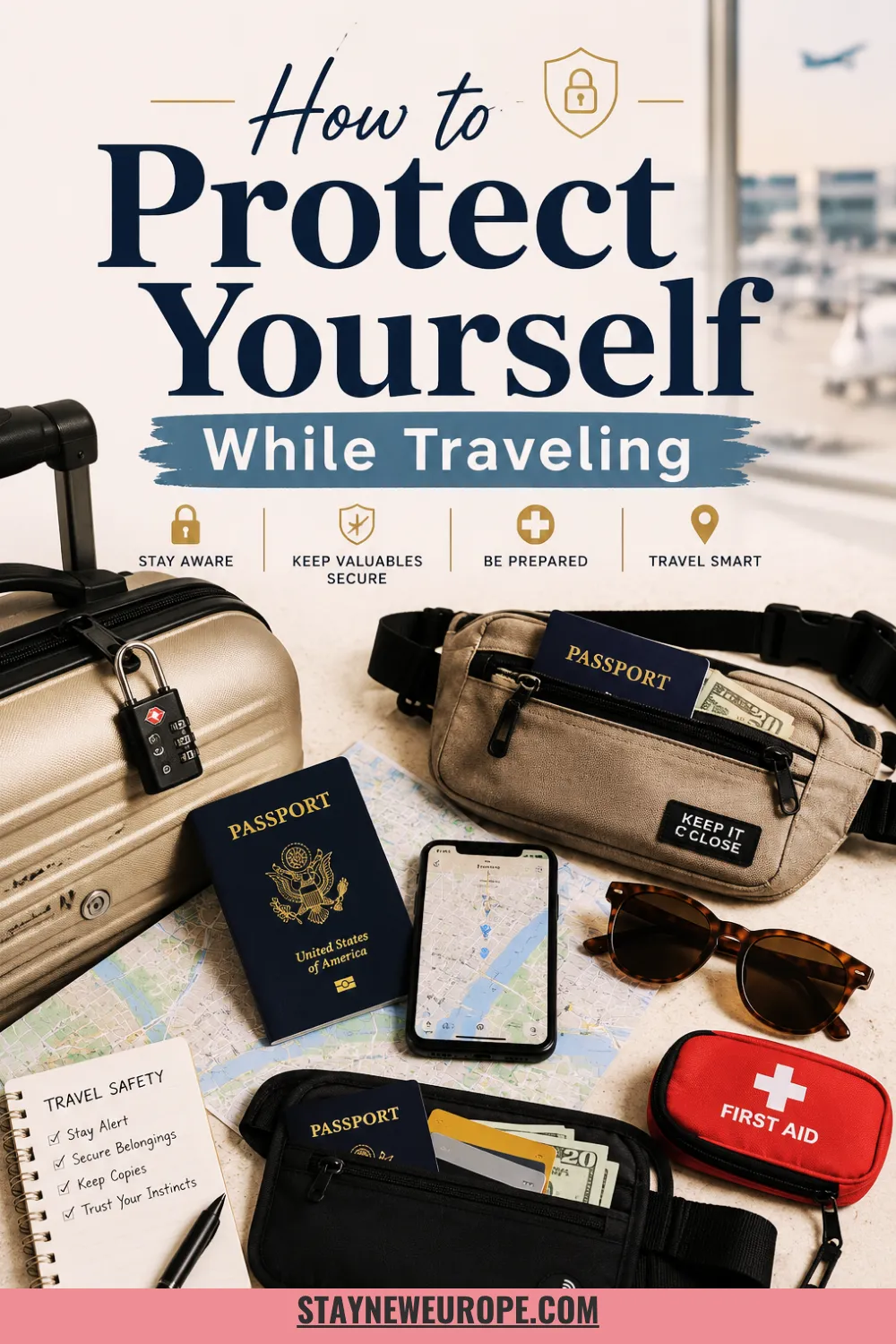
My strategy: one card and a small amount of cash in my crossbody bag for the day, a backup card and emergency cash tucked into a hotel safe or a hidden pocket in my luggage, and photos of both sides of every card stored in an encrypted note, not just my camera roll.
If something does go missing, you’re not starting from zero. You’ve still got access to money, and you know exactly which cards to cancel because you photographed the customer service numbers on the back.
Wear Your Bag Like You Mean It
Crossbody, zipped, worn in front of your body in crowds — not because Europe is uniquely dangerous, but because pickpockets go where the tourists go, and tourists cluster around the same handful of famous sights. Any bag with the zip at your side or back is an invitation. I learned this the hard way navigating the crowds around Würzburg .Würzburg’s Alte Mainbrücke at golden hour, when everyone — myself included — is a little distracted by how good the light looks on the water.
Local tip: A lot of the more stylish anti-theft bags now come with slash-resistant straps and hidden zip compartments, and they genuinely don’t look “tacticool” anymore — they look like a normal nice bag, which is exactly what you want.
Treat Public Wi-Fi Like It’s Reading Everything You Type (Because It Might Be)
I don’t log into my bank, don’t check anything financial, and don’t enter passwords on open airport or café Wi-Fi. A cheap eSIM with a local data plan has genuinely changed my travel life — it’s often cheaper than a coffee per day, it works the moment you land, and it means I’m never desperate enough to hop onto a sketchy open network just to check a map. If I absolutely have to use public Wi-Fi, I run a VPN first, no exceptions.
Know the Difference Between a Real Official and Someone Playing One
This is the mistake I made in Prague, and it’s an extremely common scam across European cities: someone flashes something that looks vaguely like a badge, claims to be police, and asks to “check” your wallet or passport, sometimes citing a fake law about counterfeit currency. Real police in most European countries do not ask you to hand over cash, and they will not mind you asking to see identification, walking to a nearby police station, or calling the local emergency number to verify. If someone gets aggressive or rushes you when you ask for verification, that’s your answer.
Local tip: Keep a photocopy or photo of your passport’s main page on your phone and, ideally, a physical copy separate from the original. You almost never need to hand over your actual passport on the street.
Blend In, Even a Little, Even If You Don’t Think It Matters
I know “dress like a local” gets thrown around a lot, but there’s real safety logic behind it, not just style points. Standing out as an obviously lost tourist — map wide open, camera swinging, valuables on full display — makes you a more visible target simply by drawing attention. This was exactly the mindset I leaned into while figuring out what-to-wear-in-sardinia-in-summer not costume-y “resort wear,” but clothes that let you move through a place looking like you know where you’re going, because half of not getting targeted is simply not looking like an easy mark.
Trust Your Gut Over Your Manners
Europeans are, generally, warm and helpful, but the scams that work best are the ones that exploit politeness. The “friendship bracelet” approached by kids in Rome or Paris, the “spilled ring” trick, the overly friendly stranger who insists on walking you somewhere — all of these rely on you feeling rude for saying no. You are allowed to say no, walk away mid-sentence, or ignore someone completely. I’ve had to train myself out of feeling guilty about this, and it’s made me noticeably safer.
Local tip: A firm “no, thank you” said while continuing to walk works better than any polite explanation. Scammers are looking for hesitation, not politeness.
Share Your Location and Itinerary With Someone Back Home
I always send a rough plan — flights, accommodation, key dates — to at least one person before I travel, and I keep live location sharing on with a close friend or family member for the whole trip. This isn’t about being tracked or controlled; it’s about someone knowing where to start looking if something ever goes wrong and you can’t reach them yourself.
I do this even on trips I feel completely comfortable on, like wandering the canals in the lake regions of Europe alone with no fixed plan — precisely the kind of trip where nobody would know to worry if I went quiet for a day.
some other articles you can read from our website to make your travel more easy-
- Best Places to Travel in Europe on a Budget (That Are Actually Worth Your Time)
- Underrated Places to Visit in Europe That Most Travelers Walk Right Past
- Things to Know Before Traveling to Europe: A First-Timer’s Real Talk Guide
- Europe Travel Itinerary 2 Weeks: 17 Destinations That Will Ruin You for Ordinary Travel
Research Your Neighborhood, Not Just Your City
“Is Paris safe” is a useless question. Every major European city has a huge range of neighborhoods, and safety can shift block by block, especially at night. Before booking accommodation, I look at exactly where it sits relative to the areas known for late-night nightlife concentration, and I check recent reviews specifically for comments about the walk from the nearest metro or train station after dark.
Local tip: Google Street View is an underrated safety tool. Before I book anywhere, I “walk” the route from the nearest station to the front door, especially if I know I’ll be arriving late.
Have a Low-Tech Backup for Everything Digital
Phones die, get stolen, or lose signal at the worst possible moments. I always carry a small paper notebook with key addresses, my accommodation’s name and address written out (bonus points if it’s in the local language, since showing a taxi driver text beats trying to pronounce a street name you’ve never seen), and a physical printout of anything I absolutely cannot lose access to, like a flight confirmation for an early departure.
I learned this lesson properly while exploring somewhere as charmingly disorienting as the canal town near Luxembourg’s Mullerthal Trail region where my phone signal dropped out completely for a stretch and I was very glad I’d written the return bus times down on paper.
Understand How Taxis and Rideshares Actually Work Locally
Every country has its own version of the “fake taxi” scam — unmarked cars claiming to be official taxis, meters that mysteriously don’t work, absurd flat rates quoted to obvious tourists. Before I land anywhere, I check whether Uber, Bolt, or a similar app operates locally, since app-based rides come with a paper trail, a set price, and a driver’s name and photo before you even get in the car. If I do need a street taxi, I look for official signage, a visible meter, and I ask the approximate fare before getting in.
Local tip: In cities famous for tourist-targeted taxi overcharging, I’ve started just asking hotel staff what a fair price to the airport should be, then quoting that number confidently before I get in. It works surprisingly often.
Keep Your Drink (and Your Attention) On You at All Times
This one matters everywhere, not just at the destinations you’d assume. Drink spiking and distraction theft both spike around nightlife-heavy areas, and the advice is the same as it would be at home: never leave a drink unattended, watch it being made if you can, and stick with people you trust when you’re out late. If something feels off about how a night is going, leaving early is always the right call, no matter how much money you’ve already spent on cover charges or drinks.
Learn a Handful of Key Phrases, Not for Politeness — For Safety
I’m not talking about ordering coffee. I mean “help,” “call the police,” “I need a doctor,” and “where is the nearest hospital” in the local language of wherever I’m going. Google Translate is great until your phone battery is at 3% or there’s no signal, which is exactly when you might need this most.
Pack a Genuinely Useful Mini First Aid and Safety Kit
Nothing dramatic — this isn’t a survivalist kit. Just: basic pain relief, any prescription medications with a doctor’s note if they could raise questions at customs, blister plasters (because European cobblestones are relentless), hand sanitizer, and a portable charger that’s always at least half full. I never travel without a doorstop alarm now either — a tiny, cheap device that wedges under a hotel door and sounds an alarm if it’s pushed open, which has genuinely helped me sleep better in unfamiliar accommodation.
Travel Insurance Is Not Optional, Full Stop
I’ve said this to friends so many times it’s become a bit of a running joke, but I mean it completely sincerely: a policy that covers medical emergencies, theft, and trip cancellation costs less than one bad night out and can save you from a genuine financial disaster. Read the policy closely — some exclude specific activities like hiking above a certain altitude or certain water sports, and those exclusions matter if your itinerary includes anything adventurous.
None of this is about being afraid of a place. It’s the opposite, really — the more prepared I am, the more relaxed I actually feel wandering somewhere new, whether that’s getting properly lost in a city center or figuring out the right outfit for a long day exploring somewhere new. Good safety habits are what let you actually enjoy being there instead of white-knuckling your way through it.

