
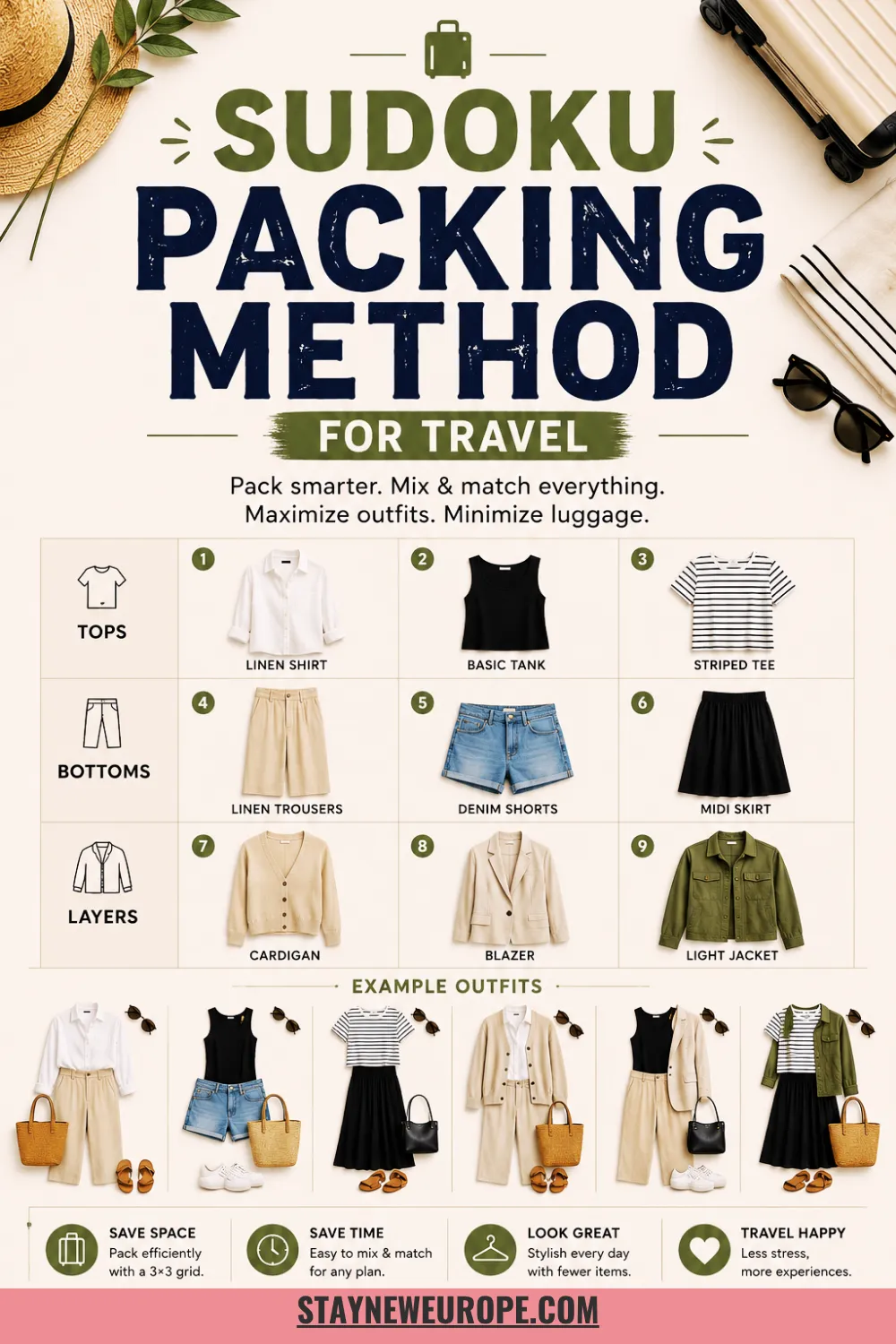
I used to pack for long trips the way most people do: pull half my closet onto the bed, panic, and shove in “just in case” outfits I’d never actually wear. Three months into a season of slow travel around Europe, I was hauling a suitcase I could barely lift and still somehow never had the “right” thing to wear. Then a friend told me about the sudoku packing method, and I genuinely rebuilt my entire approach to packing around it. It sounds like a gimmick — a puzzle-themed packing hack — but it’s the single most useful system I’ve found for long-term travel, and I want to walk you through exactly how I use it.
Before We Dive In
A few quick things before we get into the grid itself:
- This method was built for short trips originally, but it actually gets more powerful the longer you’re traveling — I’ll explain why.
- You don’t need new clothes to try this. Start with what’s already in your closet.
- This works whether you’re a carry-on purist or checking a bag — the grid just determines what goes in, not the size of the suitcase.
- If you’re packing for multiple climates on one long trip, stick around for the section on adapting the grid, because that’s where most people get it wrong.
What the Sudoku Packing Method Actually Is
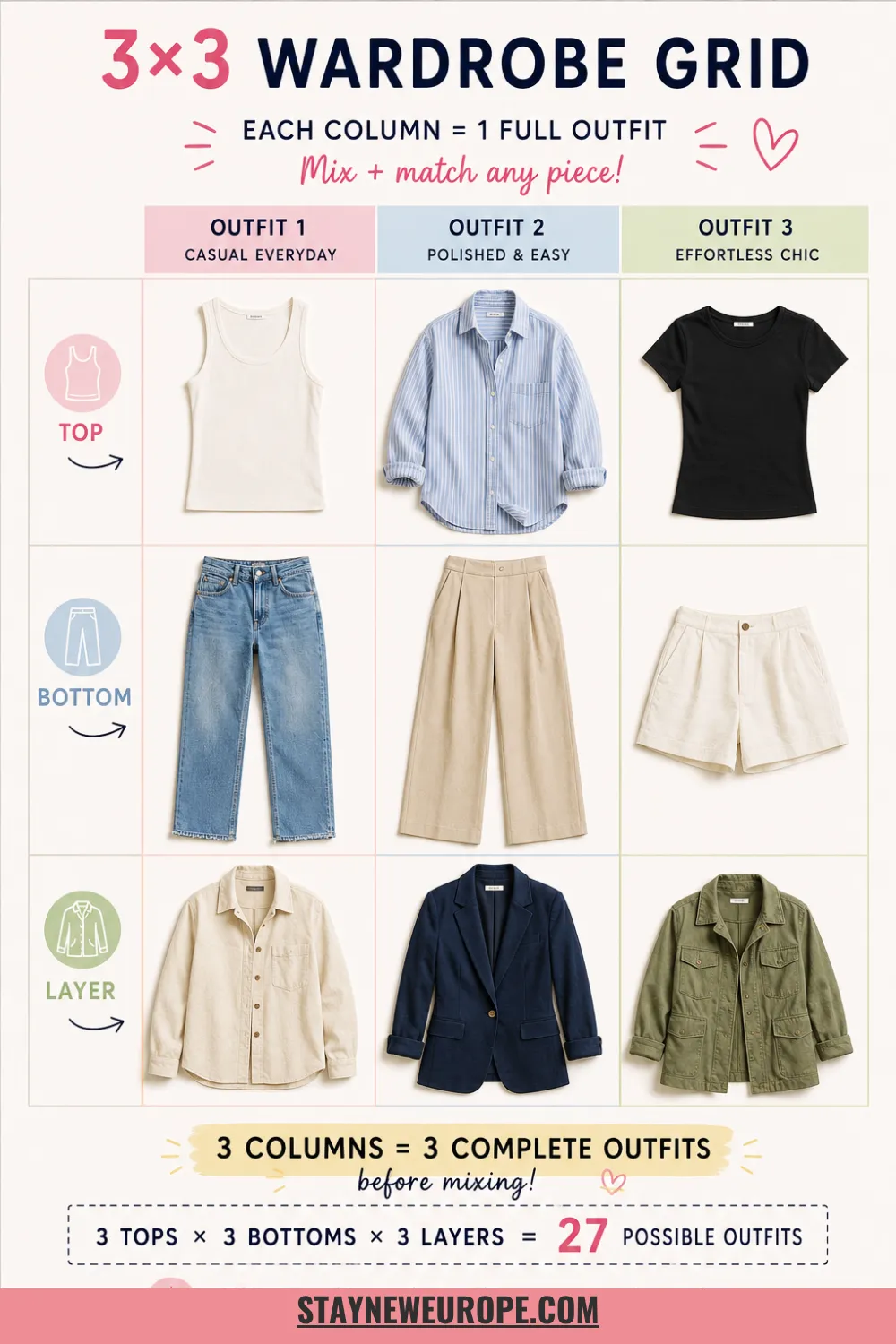
The name gets thrown around loosely, so let’s be precise. The sudoku packing method is a 3×3 grid system: you choose three tops, three bottoms, and three layering pieces — nine core items total. The rule that makes it a “sudoku” and not just a capsule wardrobe is compatibility across the whole grid: every single top has to work with every single bottom, and every layer has to work over every top. Not most combinations. All of them.
Picture an actual 3×3 grid on paper. Each column can already stand alone as a full outfit — one top, one bottom, one layer. That’s three ready-made outfits before you’ve done any mixing at all. But because every piece is cross-compatible, you can also swap pieces between columns, which is where the real math kicks in. It’s the same neutral-anchored, mix-and-match logic behind my framework for packing Italy in August — this just formalizes it into a grid.
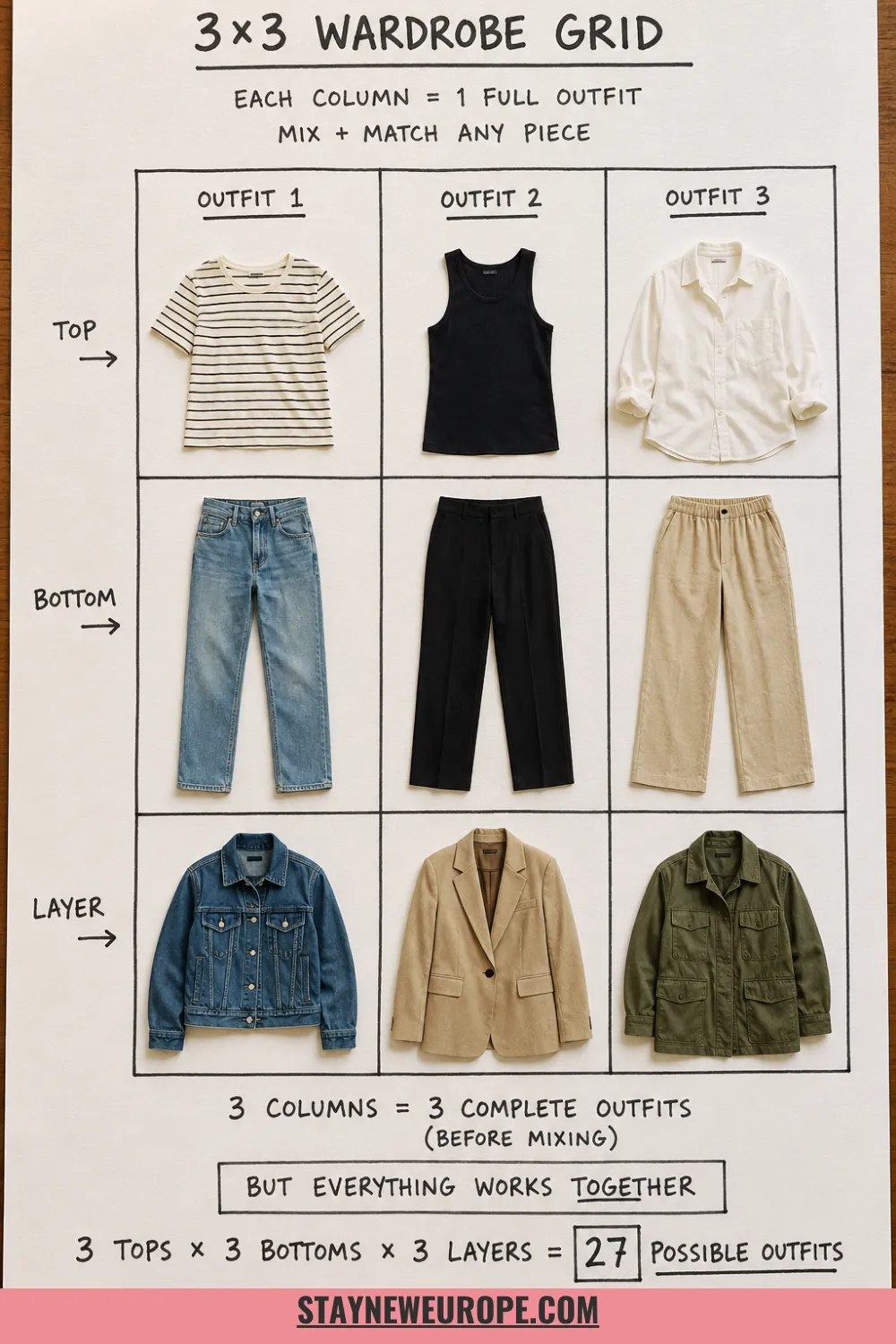
Local tip: Lay your nine pieces out on the bed or floor in an actual 3×3 physical grid before you pack a single thing. Doing this on paper in your head never works — you need to see the fabric next to the fabric.
Why This Works Even Better for Long-Term Travel Than a Weekend Trip
Most articles about this method are written for a five-day beach trip. Long-term travel is where it actually earns its keep.
When you’re gone for six weeks or six months, decision fatigue compounds every single day — and so does the temptation to overpack “for variety.” The grid solves both problems at once: because everything is interchangeable, you never feel like you’re wearing the same outfit even when you’re technically rewearing the same nine pieces, and you never stand in a hotel room debating what to wear because there’s genuinely no wrong answer within the grid.
There’s also a very physical reason this matters more on longer trips:
you’re the one carrying this bag up four flights of stairs in a walk-up apartment in Lisbon, across cobblestones in Rome, and onto a regional train with a three-minute connection window. Nine core pieces plus rotation is a bag you can actually manage for months, not just for a week.
The Rule Nobody Explains Properly: Total Cross-Compatibility
Here’s where most people misunderstand the method and end up disappointed by it. It’s not enough for a top to work with one bottom in your grid.
It has to work with all three. Same for your layers over your tops, and your bottoms with your shoes. If any single piece only works with one other piece, it’s not really in the grid — it’s dead weight you’re carrying around out of habit.
Before you pack anything, ask honestly of every piece: could I wear this with literally anything else in the pile? If the answer is “well, mostly,” that piece needs to go.
Step One: Choosing Your Three Layers
Start with layers, not tops — this is the opposite of how most people pack, and it’s the single change that made the biggest difference for me. Your layers set the tone for everything else because they’re what you’re actually seen in most of the time: a jacket, cardigan, or blazer sits over your outfit in nearly every photo and every walk through a city center.
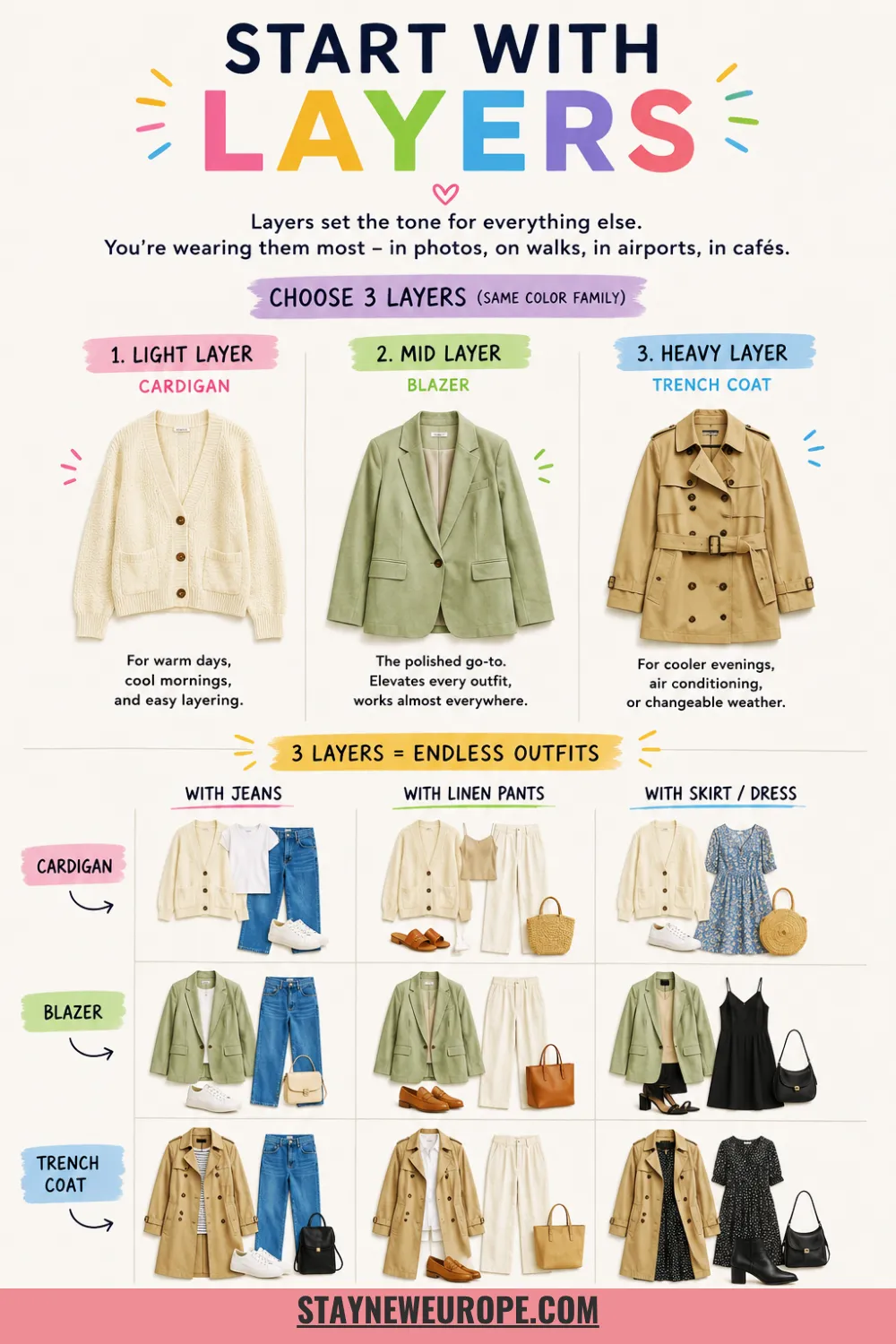
Pick three layers that span a temperature range if you’re moving between climates, but keep them in the same color family. A neutral blazer, a lightweight cardigan, and one slightly heavier layer for cooler evenings or air conditioning covers an enormous range.
Local tip: If your trip includes both a hot destination and a genuinely cooler one — say, an Aegean island followed by a few weeks in the Alps — pick one layer that’s purely functional (a packable rain shell or a merino wrap) rather than trying to make all three layers do double duty as outerwear. It’s the one place I’ll let a piece exist just to be warm rather than to be stylish.
Step Two: Your Three Tops
Tops are where the grid lives or dies, because you’ll wear them the most and see the most repetition. Go for a mix of necklines and sleeve lengths within the same palette — a simple tank, a button-down, and a fitted tee, for instance — so that even though the colors repeat, the silhouette doesn’t feel identical day to day.
check our other posts for outfit inspiration—
Resist the urge to include a “special occasion” top that only works with one specific bottom for one specific dinner you’ve imagined. That’s exactly the kind of piece the cross-compatibility rule is designed to catch.

Step Three: Your Three Bottoms
This is usually the easiest row to fill because most travelers already gravitate toward two or three go-to bottoms anyway. The trick for long-term travel is choosing fabrics that can survive repeated wear and hand-washing without looking tired by week four.
A structured trouser, a pair of well-fitting shorts or a skirt, and one comfortable everyday pair — jeans or joggers, depending on climate — usually covers it.
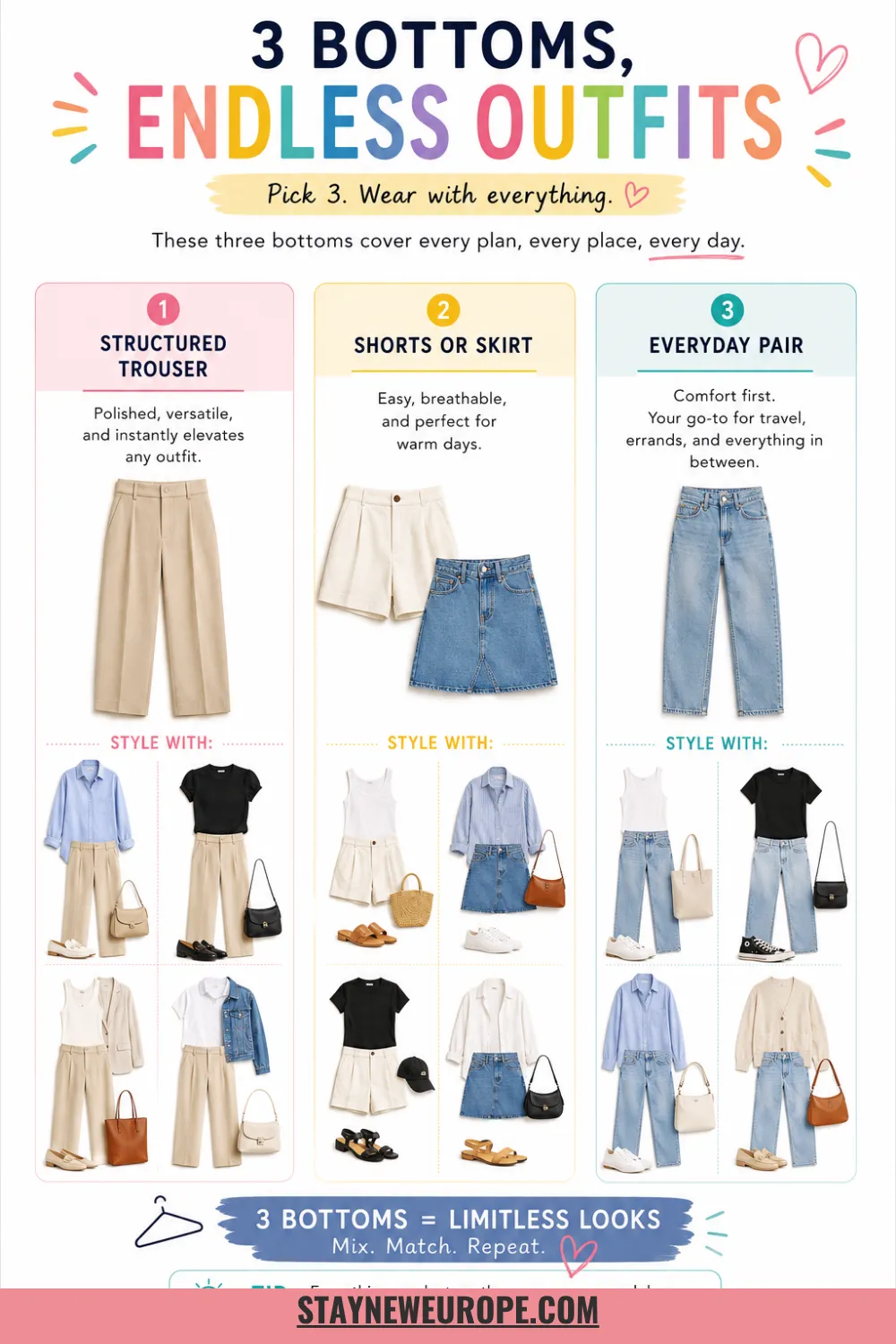
If you’re planning a trip through a country like Spain, where you might be walking cobbled streets in intense heat one afternoon and having a breezy tapas dinner that evening, this is exactly the kind of range your bottoms need to handle. I’ve written a full breakdown of what actually earns a spot in a Spain suitcase if you want a deeper dive into that specific climate swing.
The Extra Row: Shoes and How They Fit the Grid
Shoes technically sit outside the 3×3 grid, but they follow the exact same cross-compatibility rule. I stick to three pairs for long-term travel: one walking shoe that can handle full days on uneven ground.

one slightly dressier pair for evenings, and

one weather-specific pair — sandals for a hot stretch.

a closed boot for a cooler one.

Local tip: Wear your bulkiest shoes on travel days instead of packing them. It’s not glamorous, but it single-handedly frees up more suitcase space than any packing cube ever will.
Doing the Math: How Nine Pieces Actually Become 27+ Outfits
The number that gets quoted everywhere is 27 outfits from 9 pieces — three tops times three bottoms times three layers. That’s the baseline, and it assumes total cross-compatibility. Once you add three pairs of shoes and start layering pieces in combination rather than one at a time, the real number climbs well past that. The point isn’t to hit an exact figure, though — it’s the underlying shift in how you think about your suitcase. You stop packing outfits and start packing a system.
Adapting the Grid for Multi-Climate, Multi-Month Trips
This is the part most sudoku packing explainers skip entirely, and it’s the part that matters most for long-term travel. A rigid nine-piece grid works beautifully for a week in one climate. It starts to strain across a season that moves from the intense heat of somewhere like Athens in summer to a cooler stretch further north.
My workaround is to treat the grid as a rotating core rather than a fixed set. I keep the same three layers for the whole trip, since they’re the most weather-flexible category, but I allow myself to swap one top and one bottom out of the grid when I move between genuinely different climates — as long as the replacement pieces still follow the same cross-compatibility rule with everything already in the grid. You’re never carrying more than nine pieces at once; you’re just letting the grid evolve as your trip does.
Accessories: The Cheat Code That Multiplies the Grid Without Adding Luggage
Once the grid itself is locked in, accessories are how you keep outfits from feeling repetitive without adding a single extra clothing item.
A couple of scarves

one statement necklace,

a belt to make your normal outfits for classy and elegant.

and a crossbody bag change the entire read of an outfit while weighing almost nothing. This is especially true for evenings — the same daytime top and trouser combination reads completely differently with a scarf swapped for jewelry and a change of bag.

Local tip: A woven tote for daytime and a small crossbody for evenings is genuinely all you need bag-wise for most of Europe. It’s the exact approach I’d use for packing for somewhere like Sardinia in summer, where the beach-to-dinner transition happens fast and you don’t want to be carrying two full bags to manage it.
Packing the Grid Into Your Suitcase
Once your nine pieces are chosen, how you actually pack them matters. Roll your layers and anything prone to wrinkling, fold structured pieces like blazers flat, and use packing cubes to keep each grid row separate — one cube for tops, one for bottoms, one for layers. This isn’t just about space; it’s about being able to open your suitcase mid-trip and see your whole grid at a glance instead of digging through a jumbled pile.
Laundry Strategy: Why Long-Term Travel Makes This Non-Negotiable
Nine pieces obviously can’t carry you through months of daily wear without washing, so laundry becomes part of the system rather than an afterthought. I do a sink wash every three to four days for smaller items and use a laundromat or hotel service roughly once a week for everything else. Choosing quick-drying fabrics for at least a few grid pieces makes this dramatically easier, since you can wash something in the evening and have it wearable by morning.
Mistakes That Break the Grid
The most common mistake is smuggling in “just one” extra piece that doesn’t actually fit the cross-compatibility rule — a printed top that only goes with one bottom, or a pair of shoes that only works with one outfit. Every exception you allow quietly turns your carefully built system back into a regular overstuffed suitcase. The second most common mistake is choosing pieces you love individually rather than pieces that work together — this method rewards restraint over personality, at least within the base grid, and that’s genuinely an adjustment if you’re used to packing by favorites.
My Real Grid for a Season of European Travel
For a multi-month stretch that moved through warmer and cooler cities, my grid ended up looking like this: a cream blazer, an olive utility jacket, and a lightweight merino wrap for layers; a white tee, a black silk-blend tank, and a striped button-down for tops; and tailored trousers, denim shorts, and a midi skirt for bottoms. Every single piece was chosen in the same narrow neutral palette on purpose, which is honestly the quiet trick behind why this method works as well as it does — the grid isn’t really about the number nine, it’s about ruthless color and fabric discipline.

