
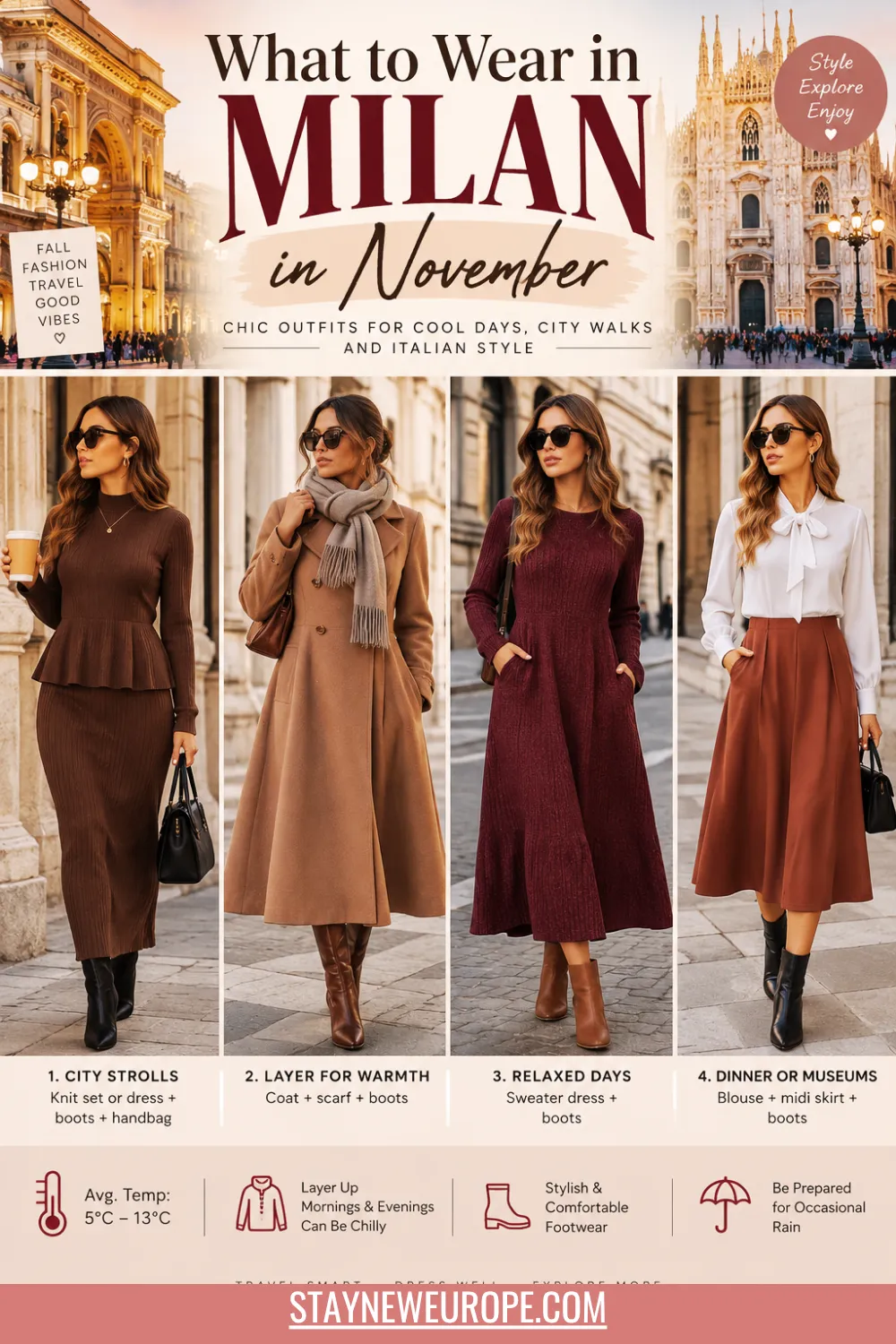
Milan in November is not the postcard version of Italy. There’s no gelato-melting sun, no linen dresses fluttering past the Duomo. Instead you get grey skies that sit low over the rooftops for days at a time, a damp cold that gets into your bones faster than you’d expect, and a city full of people who somehow still look effortlessly put together while you’re standing there in a puffer jacket that makes you look like you’re going skiing, not shopping on Via Monte Napoleone.
Let me be honest — I underestimated Milan in November the first time I went. I packed like I was heading to a generically “chilly European city” and completely missed that Milan isn’t just cold, it’s a fashion capital that happens to be cold, and the two things are not the same packing problem. Italians here dress for the weather without ever looking like they dressed for the weather, and once you notice that, you can’t unsee it.
This surprised me too: November in Milan is genuinely one of the more unpredictable months. You can get a crisp, dry, almost pleasant day with pale sunlight bouncing off the Galleria’s glass roof, and then two days later it’s raining sideways and the fog rolls in off the Po Valley so thick you can barely see the top of the Duomo’s spires. Packing for one version of Milan and getting the other is how most people end up cold, damp, and underdressed for dinner.
Before We Dive In
Weather: Milan in November sits somewhere between “properly autumn” and “sneaking into winter.” Daytime temperatures typically hover around 8–13°C (46–55°F), with nights dropping to 3–7°C (37–45°F). Rain is common — not constant, but frequent enough that you’ll want a real plan for it — and Milan’s famous fog (the nebbia) can settle in for a full day, especially early in the month. Humidity makes the cold feel sharper than the number on your phone suggests.
Walking conditions: Milan is flatter and more walkable than Rome or Florence, but November adds its own obstacles — wet cobblestones around the historic centre, slick tram tracks, and puddles that pool fast on the pedestrian streets near the Duomo. You’ll be doing a lot of walking between the Duomo, the Galleria, the Brera district, and the Navigli canals, so your feet need to survive both distance and damp.
Style culture: here’s the thing about Milan specifically — Italians dress well everywhere, but Milan is the fashion capital, so the bar is genuinely higher. This isn’t a city where athleisure blends in. Locals wear tailored coats, good leather shoes, and a small handful of quality accessories rather than a lot of cheap ones. You don’t need to dress like you’re attending Fashion Week, but showing up in head-to-toe technical outerwear will mark you as a tourist faster than a map in your hand.
Lightweight Layers (Why They Matter More Than Any Single Item)
Here’s what surprised me most: no single “warm item” saves you in Milan in November — it’s the layering system that does the work.
A day here can start at 4°C with fog, warm slightly by 1pm to something almost pleasant, and then drop again by evening. If you pack one heavy sweater and call it done, you’ll either be sweating on the metro or freezing the second you step outside. The trick is thin, stackable layers: a fine merino or cotton base layer, a mid-layer like a lightweight knit or shirt, and then your outer coat. Each piece pulls its own weight, and you can add or remove pieces through the day without ever being uncomfortable.
I learned this the hard way on a trip where I packed exactly two “warm enough for anything” outfits and nothing in between. By day two I was either overheating in a café or shivering waiting for a tram, with nothing to adjust. Layering isn’t about packing more clothes — it’s about packing smarter combinations of thinner ones.
A good combo: a merino long-sleeve top, a fine wool or cotton-blend shirt over it, and a knit cardigan or light jumper on top of that, all under your coat. On a milder day you shed the cardigan. On a cold, damp one, you keep everything and add a scarf.

Local tip: Milanese locals almost never wear puffy, obviously “outdoorsy” layers underneath their coats — they favour flatter, more tailored knitwear that doesn’t add bulk. If your base layers make your coat look stuffed, swap for something slimmer.
The Right Coat (Milan’s Actual MVP)
Your coat is doing more work in Milan in November than every other item in your suitcase combined, so don’t skimp on this decision.
A wool or wool-blend coat in a mid-to-long length is the single best investment for this trip. It needs to be warm enough for a genuinely cold, damp day, structured enough to look intentional (not sporty), and versatile enough to wear over both a casual daytime outfit and a slightly dressier evening one. Camel, charcoal, black, and deep navy all work beautifully and go with everything else you’re packing.

I’d steer you away from bringing a big technical parka unless you genuinely run cold — they’re warm, but they read as “hiking trip” rather than “Milan trip,” and in a city this fashion-conscious, that mismatch stands out more than you’d think. A well-cut wool coat with a scarf underneath will actually keep you just as warm while looking like you belong.
If you’re combining Milan with other Italian cities on the same trip, the layering logic carries over well — the same coat-and-knitwear approach that works for what to wear in France in September applies here too, just with a heavier coat and warmer base layers underneath.
Local tip: buy — or bring — one coat you genuinely love the look of. You’ll be photographed in it constantly, and it needs to earn its suitcase space by working for both a museum morning and a dinner reservation.
Knitwear (Your Real Workhorse)
Sweaters and jumpers do more heavy lifting in Milan in November than almost anything else you’ll pack, and they deserve more thought than “grab whatever’s warm.”
Fine-knit merino or wool-blend sweaters in neutral tones — cream, camel, grey, black, burgundy — work with everything else in your suitcase and layer beautifully under a coat without adding bulk. Chunky, oversized knits look cosy at home but tend to fight with a structured coat, making you look bigger than you are and limiting what you can layer underneath them.

A turtleneck deserves a specific mention here. It’s genuinely one of the most useful pieces for Milan in November — warm around the neck (which is where the cold actually gets you), works under a blazer for dinner, and pairs with trousers or a skirt without needing much else. I now pack at least two on any autumn Italy trip.

For an outfit that works from a morning at the Duomo through an afternoon in the Brera galleries: a fine merino turtleneck, tailored trousers, ankle boots, and your wool coat over the top. Swap the turtleneck for a soft crewneck sweater with a collared shirt underneath for a slightly more polished daytime look.
Local tip: pack sweaters that layer easily under a coat rather than over one — you’ll wear the coat far more often than you expect, and a sweater that’s too bulky to fit underneath becomes dead weight in your suitcase.
Trousers or Jeans (What Actually Holds Up)
Dark, well-fitted jeans are genuinely fine for Milan in November — this isn’t a city that looks down on denim, as long as it’s not distressed, faded, or overly casual.
That said, I’d argue for packing at least one or two pairs of tailored trousers alongside your jeans. Milan’s style leans slightly more polished than a lot of other European cities, and a good pair of wool-blend trousers in navy, charcoal, or camel photographs better against the city’s grand architecture and works effortlessly from a daytime museum visit into an evening dinner without a full outfit change.

Straight-leg or slightly wide-leg cuts in a heavier fabric hold up best against the cold and the occasional rain.

Skip shorts entirely — this isn’t a shorts month in Milan, whatever the forecast app says on a rare sunny afternoon. If your legs get cold easily, a pair of thin thermal leggings under trousers on the coldest days solves the problem invisibly.
Local tip: dark denim paired with a blazer and ankle boots is a genuinely Milanese combination — it reads as intentional rather than lazy, which is the whole trick with jeans here.
Dresses (What Actually Works This Time of Year)
A breezy dress that’s perfect for Italy in August is the wrong energy entirely for Milan in November — but that doesn’t mean dresses are off the table, they just need reinforcements.
A midi dress in a heavier knit, wool-blend, or corduroy works beautifully layered under a coat, with tights and boots doing the seasonal translation. Think rust, olive, chocolate, burgundy, or charcoal rather than anything summery — the same silhouette you might’ve worn all summer, just recast in an autumn palette with opaque tights underneath.

I packed a simple black knit dress on my last November trip here and wore it more than anything else — with tights, ankle boots, and a denim jacket during the day, then swapped the jacket for my wool coat and added a statement necklace for dinner. One dress, two completely different outfits, almost no extra suitcase weight.

Local tip: pack one dress that can go from a gallery afternoon to a dinner reservation with just a coat and shoe swap — it saves an outfit’s worth of packing space.
Comfortable but Stylish Walking Shoes
Cobblestones, tram tracks, and long stretches between the Duomo and the Navigli mean your shoes need to survive real mileage — but Milan will notice if they look like trainers you packed as an afterthought.
Leather ankle boots are the single best footwear decision for this trip. They’re warm, they handle wet pavement far better than fabric sneakers, and they work with jeans, trousers, and dresses alike. Look for a pair with a slightly grippy sole — Milan’s marble and stone surfaces get genuinely slick when wet, and I’ve watched more than one tourist skate across the Galleria floor in smooth-soled boots.

If boots aren’t your thing, a clean pair of leather or suede sneakers in a neutral tone works too, though I’d avoid anything bright white by day three of city walking in wet weather — they show every splash mark.

Local tip: break in any new boots before you leave home. Milan in November is not the place to discover a blister two hours into your first full day of walking.
What NOT to Wear (Tourist Mistakes I’ve Actually Seen)
A few genuinely common mistakes, because avoiding them will do more for how you feel in Milan than any single “right” purchase.
Bulky technical hiking jackets are the biggest `offender — warm, sure, but they scream tourist in a city built on tailoring, and they don’t layer well under anything.
Bright white sneakers that have clearly never seen rain are the second — they’ll be filthy and slippery within a day.
And flip-flops or sandals of any kind have no place here in November; I mention it because I’ve genuinely seen people try.
Skip anything overly athleisure-coded too — full matching tracksuits or leggings-as-trousers read as loungewear here in a way they might not elsewhere. Milan doesn’t require formality, but it does reward a bit of intention.
Local tip: if you’re unsure whether an item fits, ask yourself if you’d wear it to a nice coffee shop at home. If the answer’s no, it probably doesn’t belong in your Milan suitcase either.
Jackets for Unpredictable Weather
Beyond your main wool coat, one lighter jacket earns its space for the milder, drier days that do genuinely happen in November.

A denim jacket or a lightweight quilted jacket works well layered over a sweater on days that don’t call for the full coat treatment, and it’s far easier to carry when you’re in and out of warm restaurants and shops all day.

I always bring one alongside my main coat — Milan’s temperature swings within a single day mean you’ll want the option to lighten up without actually getting cold.
Local tip: a packable, water-resistant jacket that folds into a tote bag is a genuinely smart backup for a day when the forecast looks uncertain and you don’t want to commit to your heavy coat all day.
Evening Outfits in Milan
Milan takes its evenings seriously, and dinner here — even a casual trattoria — tends to be a slightly more dressed-up affair than you might expect.
A dark, well-fitted outfit does the most work: think a knit dress with boots and a statement coat, or tailored trousers with a silk or satin blouse and a blazer.

Add gold or silver jewellery, a good bag, and you’re dressed for aperitivo through to a late dinner without needing a separate “going out” wardrobe.

Milanese women lean toward polished rather than flashy — one strong piece (a great coat, a good bag, sharp boots) rather than an outfit trying to do too much at once.

Local tip: aperitivo happens early evening, around 6–8pm, and locals dress for it properly — it’s not a casual post-work drink here, it’s practically its own occasion.
What to Wear for Churches (Dress Codes That Actually Get Enforced)
The Duomo di Milano and most churches here genuinely enforce dress codes, and I’ve watched people get turned away at the door, so this isn’t a “just in case” section.
Shoulders and knees need to be covered for both men and women — no sleeveless tops, no shorts, no short skirts.
A midi dress or trousers with a scarf you can drape over bare shoulders solves this instantly, and a scarf is worth carrying anyway given the cold. Hats generally need to come off indoors too.

Local tip: keep a lightweight scarf in your daily bag specifically for this — it doubles as a neck warmer outside and a shoulder cover inside, so it’s never wasted weight.
Bags: Crossbody vs Tote vs Backpack
A crossbody bag is genuinely the most practical option for a Milan day — hands-free, secure, and small enough not to fight with your coat while you’re moving through crowded metro cars or the Galleria.

A structured tote works well for days that mix sightseeing with shopping (and in Milan, that’s most days), giving you room for purchases without needing to carry extra bags.

A backpack is fine for comfort but reads more casual — if you’re carrying one, a smaller, more structured leather or canvas style blends in better than an obviously sporty one. Whichever you choose, keep zips accessible only to you in crowded areas like the metro and around the Duomo.

If you’re planning a day trip out to Lake Como — a very popular add-on from Milan and one of the most beautiful lakes in Europe — a slightly bigger tote that can hold a packed layer and a water bottle is worth having on hand for the extra hours outdoors.
Local tip: leather crossbodies with a top zip are the local standard here for a reason — they’re the hardest bag type to pickpocket in a crowd, and they still look intentional rather than purely functional.
Accessories That Elevate Simple Outfits
Milan rewards a small number of good accessories over a lot of average ones, and November gives you a genuine excuse to lean into this.
A quality scarf is close to essential — not just for warmth, but because it’s the easiest way to add colour or texture to what’s otherwise a lot of neutral knitwear and outerwear.

A leather belt, and one or two pieces of good jewellery round things out.
Sunglasses still earn their space even in November — Milan gets genuinely bright, low-angle winter sun on clear days, and it catches you off guard.

Local tip: one statement scarf in a rich colour — burgundy, mustard, deep green — can make three or four otherwise-identical neutral outfits feel completely different from each other.
Rain Preparation (More Important Than People Expect)
Rain in Milan in November isn’t dramatic, but it’s frequent, and showing up without a real plan for it is one of the most common mistakes I see.
A compact umbrella that fits in your bag is non-negotiable — Milan’s rain tends to arrive without much warning, and you don’t want to be caught between the Duomo and your hotel without one.

Water-resistant boots matter more than a waterproof jacket, honestly, since your feet spend the most time in contact with wet pavement.
A packable rain jacket is a smart backup for days when you don’t want to risk your good wool coat.

Local tip: avoid suede shoes entirely if rain is forecast — I ruined a pair here once, and it genuinely wasn’t a cheap lesson to learn.
Fabrics to Choose (and Avoid)
Wool, cashmere, corduroy, and heavier cotton blends are your friends this month — warm, breathable enough to layer, and forgiving of a full day’s wear without looking crumpled.
Avoid anything purely synthetic as a base layer; it traps damp cold against your skin rather than wicking it away, which makes you feel colder than the actual temperature. Linen, which works so well for Italy in the summer months, has no real place in a November suitcase here — save it for a trip like Italy in August instead.
Local tip: merino wool is worth the investment if you don’t already own any — it’s warm without bulk, doesn’t hold odour over multiple wears, and packs down small.
A Simple Capsule Wardrobe for Milan in November
If you want the shortcut version: one wool coat, two sweaters, one turtleneck, two pairs of trousers or dark jeans, one knit midi dress, one blazer, tights, one scarf, and ankle boots.
Mix and match those pieces across a week and you’ll have outfits for daytime sightseeing, gallery visits, church stops, and evening dinners without repeating a single combination exactly.
How Much to Actually Pack
For a five-to-seven-day Milan trip in November, you genuinely don’t need more than four or five daytime outfit combinations and two evening ones — the layering system means the same handful of pieces recombine constantly. Overpacking here specifically punishes you, because a wool coat and a couple of sweaters already take up real suitcase space before you’ve packed anything else.
If you’re building a lighter kit, a well-organised carry-on genuinely works for this trip — the kind of packing approach in our carry-on essentials guide applies just as well here, just swapped for heavier, warmer pieces. Plan your outfits before you pack rather than during — lay out combinations on your bed and count them, because it’s far easier to spot a gap (or a redundant fourth black sweater) that way than mid-suitcase.
The single biggest mistake people make packing for Milan in November is bringing too many “just in case” bulky items instead of a proper, thought-out layering system. One good coat and a smart rotation of knitwear will outperform a suitcase full of separate warm things every time.
Milan in November has this way of rewarding you the moment you stop fighting the weather and start dressing for it properly. There’s something genuinely lovely about walking into the Galleria out of the cold, coat still buttoned, and feeling like you fit right into the scene instead of standing out from it. Pack the coat you actually love, keep your layers thin and stackable, and let the city’s grey light and golden shopfronts do the rest. You’re going to look brilliant in the photos, I promise.

