
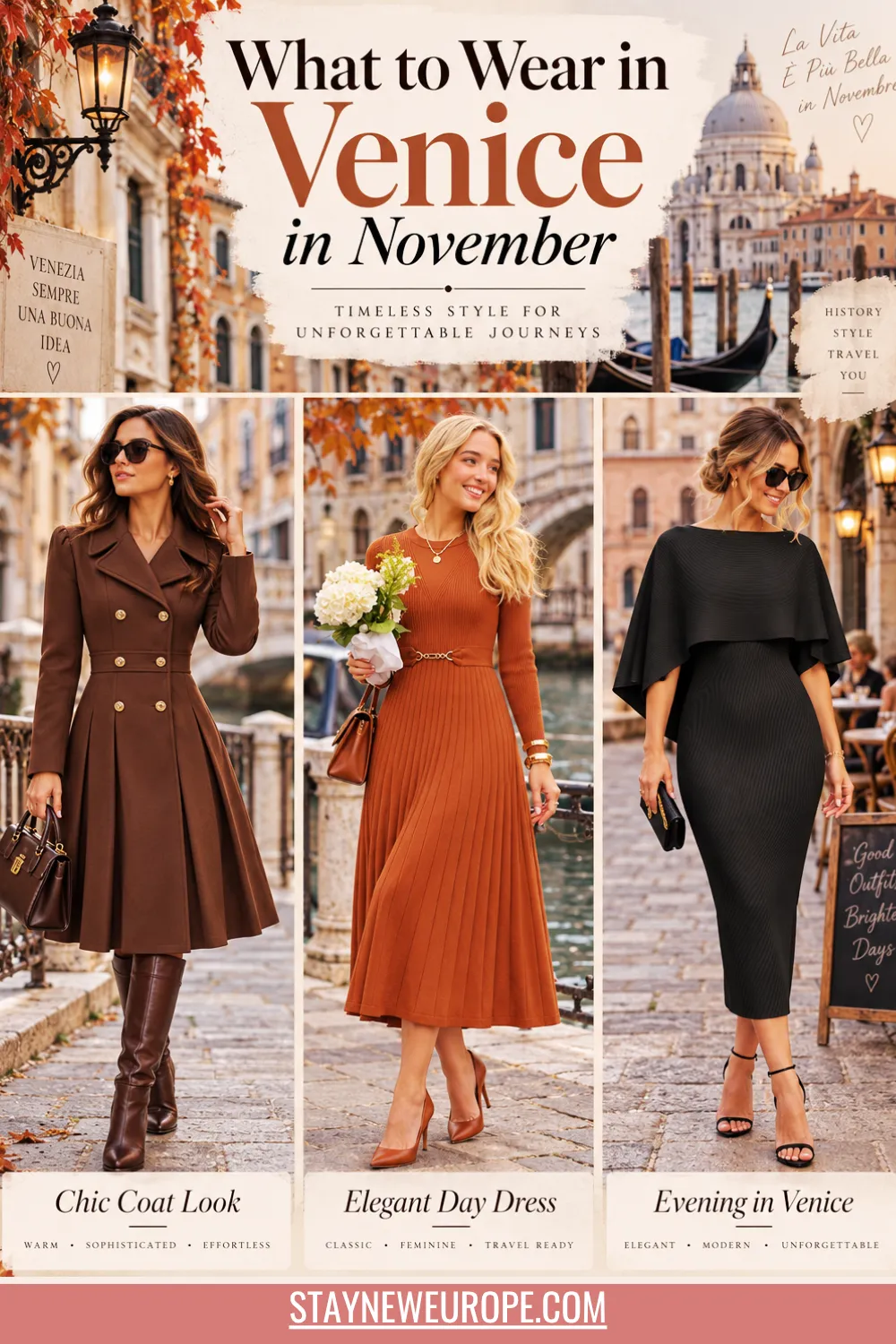
Let me be honest — the first time I visited Venice in November, I packed like I was going to Rome in October. Big mistake. I stepped off the vaporetto at San Marco into a wall of damp, salty air, grey light bouncing off water that was creeping over the pavement, and a wind that seemed to come from three directions at once.
Venice in November isn’t cold in the dramatic, snow-globe way people imagine Northern Europe to be. It’s something trickier: damp cold, the kind that lives in your bones after an hour of wandering, made worse by canal humidity and the very real chance of acqua alta (the seasonal high tide flooding) turning your afternoon stroll into a game of “spot the dry cobblestone.” I learned this the hard way, standing in a queue for the Doge’s Palace with soaked ankles and a coat that simply wasn’t built for the job.
This surprised me too: despite the weather, Venice in November still feels romantic — foggy, quiet, almost cinematic, with a fraction of the summer crowds. You just have to dress for it properly, and that’s a very different exercise than dressing for a “European city break.” So here’s what actually works, from someone who’s done the soggy-boots walk of shame more than once.
BEFORE WE DIVE IN
Weather: Venice in November sits somewhere between 7°C and 13°C (45–56°F), and it rarely feels warmer than the number suggests because of the humidity coming off the lagoon. Rain is frequent — not constant, but frequent enough that you should assume at least one soggy day. Fog rolls in most mornings and can linger, giving the city that moody, painterly look it’s famous for in shoulder season.
Walking conditions: Venice has zero flat, dry, predictable ground. You’re crossing dozens of small humpback bridges a day, walking on centuries-old cobblestones that get slick when wet, and occasionally wading through a few centimetres of lagoon water if acqua alta hits during your trip. This isn’t a city for delicate shoes or a wardrobe that can’t handle getting a little wet.
Style culture: Italians dress well, and Venetians are no exception — even in the rain, you’ll see locals in tailored wool coats, good leather boots, and scarves that look effortless rather than functional. This matters because it changes what “practical” should look like here. You don’t need to sacrifice style for warmth; you just need to choose smarter pieces.
Lightweight Layers (Why They Matter More Than You Think)
Here’s the thing about Venice in November: the temperature swings more than you’d expect between a foggy 8am and a sunnier 2pm, and stepping from outdoor cold into an overheated café or museum can leave you sweating in a heavy coat within minutes.
This is why I always tell people to think in layers rather than one “big warm outfit.” A thin base layer, a mid-layer like a fine merino jumper, and an outer coat gives you far more control than a single thick sweater ever will. You can shed the middle layer in a crowded church or trattoria and put it back on the second you step outside into the damp air again.

For a typical day, I’d wear a long-sleeve cotton or merino top, a lightweight cardigan or knit over it, and my coat on top. Evenings call for adding the cardigan back once the sun (what little there is of it) goes down. If you’re building out your full trip wardrobe and want a broader framework for layering across an Italy itinerary, the ultimate printable Italy travel checklist is a genuinely useful starting point.
Local tip: Venetians layer wool over cotton, never synthetic fleece over cotton — fleece traps the damp lagoon humidity against your skin and you’ll feel clammy by midday.
A Coat You Actually Love (Because You’ll Live in It)
I’ll say this bluntly: your coat is the single most important item you’ll pack for Venice in November. You will wear it every single day, probably from breakfast until you fall into bed, so this is not the item to compromise on.
What works is a wool or wool-blend coat that hits somewhere between the hip and the knee, ideally with some water resistance built in. A trench coat looks gorgeous in photos but genuinely struggles once the rain sets in for more than twenty minutes — I found this out wearing one on a bridge near Rialto and regretting every step back to my hotel. A proper wool coat with a water-repellent finish, or a technical rain coat with a wool-look finish, handles both the cold and the damp far better.

Colour-wise, camel, charcoal, navy, and forest green all photograph beautifully against Venice’s muted stone-and-water palette, and they layer easily over whatever you’re wearing underneath. Bring one great coat rather than two mediocre ones — you genuinely won’t need a backup if you choose well.

Local tip: Locals often carry a small foldable rain shell in their bag even when wearing a wool coat, purely for sudden downpours — it’s a Venice habit worth stealing.
Jeans, Trousers, or Leggings — What Actually Survives the Weather
Shorts are, obviously, a hard no in November Venice, but the jeans-versus-trousers debate is one I get asked about constantly, and the honest answer is: it depends on how much walking-through-puddles you’re prepared to do.
Dark denim is fine for most days and hides splashback well, but it gets heavy and slow to dry if it gets properly wet, which is a real risk during acqua alta season.

Wool or wool-blend trousers are my actual favourite here — they insulate even when slightly damp, drape better under a coat, and look more put-together for dinner without needing to change.

Thermal-lined leggings under a longer coat or dress are a brilliant, packable option too, especially for women who want mobility for all those bridge steps.

A combo I wore on repeat: dark wool trousers, a fine-knit jumper, ankle boots, and my coat — it worked for museums, lunch, and an evening spritz without any outfit changes. If you’re comparing this against warmer-month Venice dressing, it’s a completely different formula from what you’d pack for Venice in June or even Venice in September, where linen and light cotton still make sense.
Local tip: Roll your trouser or jean hems slightly if acqua alta is forecast — even an inch of clearance keeps you out of soaked fabric for the rest of the day.
Dresses That Match Venice’s November Mood
You’d think dresses are off the table in November, but this surprised me — a well-chosen dress, worn with the right layers underneath and over, actually suits Venice’s slightly gothic, atmospheric November mood beautifully.
The trick is building it like an outfit system rather than a single piece. A midi or knee-length dress in wool, ponte knit, or a heavier jersey works as a base layer, then you add opaque tights, an oversized cardigan or knit blazer, and your coat on top.
This gives you the elegant silhouette that photographs so well against Venice’s canals and stone bridges, without leaving your legs exposed to the cold air coming off the water.

I wore a rust-coloured knit midi dress with black tights, ankle boots, and a long camel coat for an evening walk near the Accademia Bridge, and it remains one of my favourite outfit photos from any trip — moody light, warm tones, completely weather-appropriate.

Local tip: Choose dresses in darker, richer tones (burgundy, forest, rust, charcoal) rather than pastels — they suit the low November light and hide any splashback far better.
Comfortable but Stylish Walking Shoes
Nothing will ruin your trip faster than the wrong shoes, and Venice in November is uniquely unforgiving — wet cobblestones, humpback bridge steps, and the occasional flooded calle all demand footwear that’s genuinely waterproof, not just “water resistant” on the box.

Leather or treated suede ankle boots with a low block heel or flat sole are the sweet spot. They look polished enough for dinner, grip well on wet stone, and sit high enough on the ankle to handle shallow acqua alta puddles without soaking your socks.

Trainers are tempting for comfort, but unless they’re a genuinely waterproof pair, they’ll be soggy by lunchtime and stay that way.
I made the mistake of wearing suede loafers on my first trip — gorgeous, useless, ruined within a day. On my second trip, I wore treated leather Chelsea boots the entire week and never once had a wet-foot moment, even during a mild acqua alta afternoon near Piazza San Marco.
Local tip: Pack a small tin of waterproofing wax or spray and treat your boots the night before you fly — it makes a genuine difference over a week of daily wear.
What NOT to Wear in Venice in November
This is the section I wish someone had sent me before my first trip, because tourist mistakes here are extremely visible and extremely avoidable.
Skip anything white or pale-coloured on the bottom half — between splashback and the general dampness of cobblestones, pale trousers or skirts get grubby fast.
Avoid canvas sneakers or anything without proper soles; they simply weren’t built for wet stone.
And please, resist the plastic disposable rain ponchos sold near every tourist stop — they’re fine in an emergency,
but wearing one for a full day marks you as unprepared in a city where locals genuinely dress well, rain or not.
Also worth noting: overly bulky puffer jackets, while warm, don’t layer well under a bag strap or handle the wind coming off the lagoon gracefully — they’re better suited to alpine trips than to Venice’s specific brand of damp cold.
Local tip: If you see a shop selling plastic ponchos for five euros outside a major attraction, that’s your cue you’re in a heavily touristed spot — a good sign to wander two streets further for better food and fewer crowds too.
Jackets for Unpredictable Weather
Beyond your main coat, a packable, genuinely waterproof jacket earns its space in your suitcase for Venice in November, because the weather can shift from misty-but-dry to proper rain within the same afternoon.
A lightweight rain shell that folds into its own pocket is ideal — you can stuff it into a daybag and pull it out the moment the sky turns, without needing to carry a second full coat all day. Look for one with a hood, since umbrellas and Venice’s narrow calles are not a good combination; you’ll be constantly dodging other people’s umbrella spokes in the crowded stretches near Rialto and San Marco.

I now travel with a slim olive-green rain shell that layers easily over a jumper, and it’s saved more than one afternoon that started sunny and ended in a proper downpour by the Grand Canal.
Local tip: Umbrellas are genuinely impractical on Venice’s narrow bridges and alleys — a hooded jacket will serve you far better than fighting for space with an open umbrella.
Evening Outfits in Venice
Venice at night in November has its own particular magic — fog settling over the canals, warm light spilling from bacari (wine bars), and streets that empty out enough to actually hear your footsteps on stone. Dressing for it is less about the cold and more about matching that atmosphere.

A knit dress or wool trousers with a silk or satin top under your coat strikes the right note — elevated but not stiff, and warm enough for the walk between your hotel and dinner. Venetians tend to dress a notch smarter for evenings than many other Italian cities, so this is where a slightly polished coat and good boots really pay off, rather than looking like a daytime sightseeing outfit dragged into dinner.
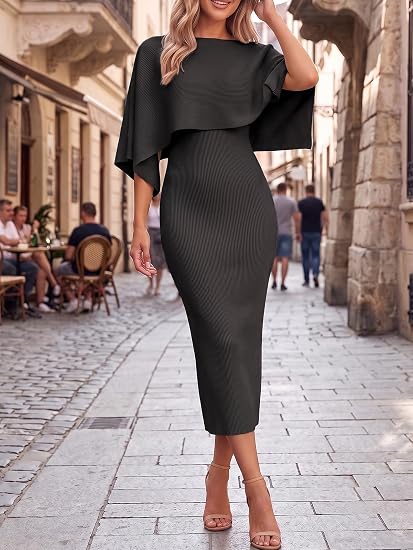
For a proper evening out — a nice dinner near Campo Santa Margherita or a spritz-and-cicchetti crawl through the bacari — I’d add a statement earring or a silk scarf to elevate the same trousers-and-jumper combo I wore all day. Small changes, big difference.

Local tip: Many of the best bacari have no dress code at all — it’s the walk there in the cold, not the venue itself, that dictates what you’ll want to be wearing.
What to Wear for Churches (Dress Code)
Venice’s churches — St. Mark’s Basilica chief among them — enforce dress codes seriously, and November’s layered wardrobe actually makes this easier than summer does, when bare shoulders are a constant temptation in the heat.
Shoulders and knees need to be covered to enter most churches, and in November you’ll already be wearing long sleeves and trousers or a longer dress most days anyway, so this rarely requires extra planning.
The one thing to watch is hooded jackets or scarves worn as headcoverings-in-waiting — pack a lightweight scarf specifically for this purpose, since some churches still expect (though don’t always strictly enforce) head coverings for women.

I keep a thin patterned scarf permanently in my daybag for exactly this reason — it doubles as neck warmth on the walk over and a quick shoulder cover if I’m wearing anything slightly more open underneath my coat.
Local tip: St. Mark’s Basilica staff do turn people away for bare shoulders even in cold weather if a coat is removed at the door, so keep something with sleeves on underneath, not just a coat over a strappy top.
Bags (Crossbody vs. Backpack)
Venice’s crowded bridges, narrow calles, and constant vaporetto queues make bag choice more practical than aesthetic, though thankfully you can have both here.
A crossbody bag worn in front, rather than at your hip, is genuinely the best choice — it’s harder to pickpocket in dense crowds near Rialto or San Marco, and it’s far easier to navigate narrow bridge steps and crowded doorways without a bag swinging into someone.

Backpacks are fine for full-day excursions but become genuinely awkward in packed vaporetto cabins and tight bacaro doorways, where you’ll find yourself apologising to strangers every few minutes.
I switched from a backpack to a structured leather crossbody on my second Venice trip and noticed an immediate difference — easier to move through crowds, easier to keep an eye on, and it looked considerably better in every evening photo too.

Local tip: Choose a bag with a zip closure, not a magnetic snap or open top — Venice’s crowds are dense enough in peak tourist zones that easy-access bags are simply asking for trouble.
Accessories That Elevate Simple Outfits
November in Venice rewards a slightly maximalist approach to accessories, mostly because your base outfit is often just a jumper, trousers, and a coat — and accessories are what stop that combination from looking repetitive across a five- or six-day trip.
A good wool or cashmere scarf does double duty as warmth and styling, and you can rotate two or three scarves across the same coat to create entirely different looks each day.

Leather gloves matter more than people expect too — Venice’s wind off the lagoon makes bare hands genuinely uncomfortable by your second or third day of sightseeing.

A structured hat, whether a beret or a simple wool cap, adds warmth and a distinctly Venetian, slightly old-world elegance to grey, foggy days.

My go-to rotation was one camel coat with three different scarves — a burgundy plaid, a cream cable knit, and a black silk — and it genuinely felt like I’d packed three different coats.
Local tip: Buy a scarf from one of Venice’s small textile shops rather than a souvenir stall — you’ll get genuinely better quality, and it becomes a piece you’ll actually wear again long after the trip.
Rain Preparation (Unexpected but Important)
I mentioned acqua alta already, but it deserves its own section because it genuinely changes how you dress, not just what you carry. When the sirens sound (yes, there’s a warning siren system) announcing rising tides, entire piazzas can be under several centimetres of water within an hour.
Beyond waterproof boots, pack a few pairs of quick-dry socks and consider tucking a spare pair in your daybag — nothing derails a day faster than wet feet with no backup.

Many hotels and shops provide free raised walkways (passerelle) during acqua alta, but you’ll still need footwear that can handle a splash or two getting to them. If your trip falls during a particularly high tide forecast, even ankle-height waterproof boots may not be quite enough, so checking the tide forecast each morning becomes a genuine part of getting dressed here.

I now check the Venice tide app before choosing shoes each morning, which sounds excessive until you’ve had one afternoon of walking back to your hotel in soaked socks. For broader smart-packing habits that carry across any European city with unpredictable weather, the tips in packing tips and hacks that actually work are worth a quick read before you go.
Local tip: The Comune di Venezia has a free tide-forecast app and website that locals check every morning in autumn and winter — download it before your trip, not after your boots are already wet.
Fabrics to Choose (and Avoid)
Fabric choice matters more in Venice in November than almost anywhere else I’ve travelled, purely because of the combination of damp air, frequent rain, and genuine cold.
Wool, in all its forms, is your best friend — it insulates even when slightly damp and doesn’t hold odour the way synthetics do over a multi-day trip without laundry access. Merino base layers are brilliant for the same reason, plus they pack down small. Avoid pure cotton as an outer layer, since it soaks up moisture and stays wet for hours rather than wicking it away, and skip anything heavily embellished or delicate, since Venice’s crowds, bridges, and narrow spaces are hard on fragile fabric.

I switched my entire outer-layer wardrobe to wool and wool-blends for this trip specifically, and the difference in comfort over a rainy Tuesday afternoon was honestly dramatic compared to the cotton-heavy wardrobe I’d packed for Venice in May on an earlier visit.
Local tip: If you’re buying anything Venetian to wear on the trip itself, look for local wool or cashmere blends — the Rialto market area has small, genuinely local shops selling scarves and knitwear worth the slightly higher price over the mass-produced souvenir stalls.
Carry-On Luggage or Duffle Bag for This City
Venice’s bridges and narrow streets make luggage choice a genuinely practical decision, not just a preference — this is not a rolling-suitcase-friendly city, no matter how smooth the wheels claim to be.
A soft-structured duffle bag with backpack straps, or a proper carry-on with sturdy in-line wheels and a reinforced handle, both work far better than a standard hard-shell spinner suitcase, which will bounce and rattle over every single bridge step between the train station and your hotel. If you’re staying somewhere in the quieter sestieri like Cannaregio or Dorsoduro, a lighter bag you can genuinely carry for a few minutes matters even more, since water-taxi drop-offs don’t always land you right at your door.
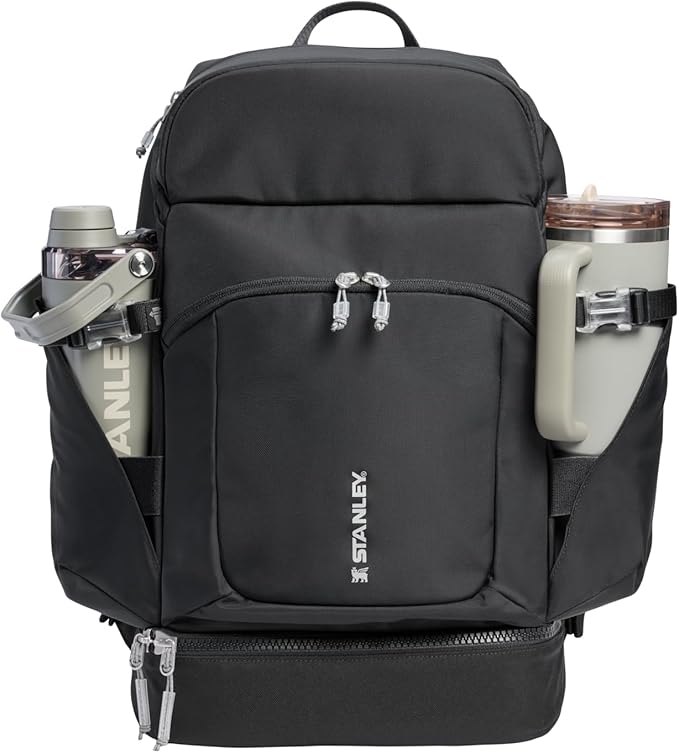
I switched to a 45-litre duffle with detachable backpack straps for my last trip and it made the fifteen-minute walk from the vaporetto stop to my hotel dramatically easier than the hard-shell case I’d dragged (loudly, apologetically) over Venice’s bridges the first time.
Local tip: If you must bring a wheeled suitcase, choose one with four spinner wheels rather than two — it handles uneven cobblestones with noticeably less strain on your wrist and shoulder.
Capsule Wardrobe for Venice in November
By this point you’ve probably noticed a pattern — wool trousers, a couple of knit jumpers, one great coat, boots, and a handful of accessories cover almost every scenario Venice in November throws at you. That’s genuinely the point of a capsule approach here.
For a five-to-seven-day trip, I’d pack:
- two pairs of trousers (one dark denim, one wool),
- one knit midi dress,
- three jumpers in different weights,
- one silk or satin top for evenings,
- thermal leggings as a layering option,
- your main coat,
- a packable rain shell,
- one pair of waterproof ankle boots,
- and a rotation of two or three scarves.
Everything mixes with everything else, which matters enormously when you’re navigating narrow hotel rooms and Venice’s famously tiny wardrobes.
This capsule mindset isn’t unique to autumn travel, either — if you’re building out a wardrobe system for other seasons too, it’s worth comparing against a broader capsule wardrobe framework to see how the same principles shift with the weather.
Local tip: Pack one “hero” piece — for me it’s always the coat — and build everything else around not competing with it. It keeps your suitcase smaller and your outfits more cohesive without any extra effort.
Practical Packing: How Much to Actually Bring
For a week in Venice in November, you genuinely don’t need more than five to six full outfit combinations, thanks to the mixing power of a good capsule wardrobe. Overpacking here is a real risk, mostly because people assume “cold weather” means “bulky,” when in reality it means “layered and considered.”
Plan your outfits around your coat and boots first, since those two items will appear in nearly every single photo and outfit of the trip — build everything else to complement them rather than compete. Avoid packing more than one pair of jeans; they’re heavy, slow to dry, and rarely necessary when wool trousers do the job better in this climate. And always pack one spare pair of waterproof socks and a spare scarf — small, light items that solve real problems if acqua alta or an unexpected downpour catches you off guard.
The single biggest mistake I see (and made myself, the first time) is packing for the destination’s name rather than its actual climate — treating “Italy” as one packing list rather than recognising that November Venice needs an entirely different approach from, say, Venice in August. Plan for damp and cool, not “Italy is generally warm,” and you’ll pack far smarter.
Venice in November rewards the traveller who dresses like they mean it — not in a fussy, overthought way, but in the quietly confident way Venetians themselves move through their own foggy, watery streets every day. Pack your one great coat, your waterproof boots, a few good scarves, and trust that the layers will do their job. Once you’re actually there, wandering an empty Campo San Barnaba in the mist with a coffee in hand, you’ll understand why this slightly damp, slightly moody version of Venice is the one so many travellers end up loving the most.

