
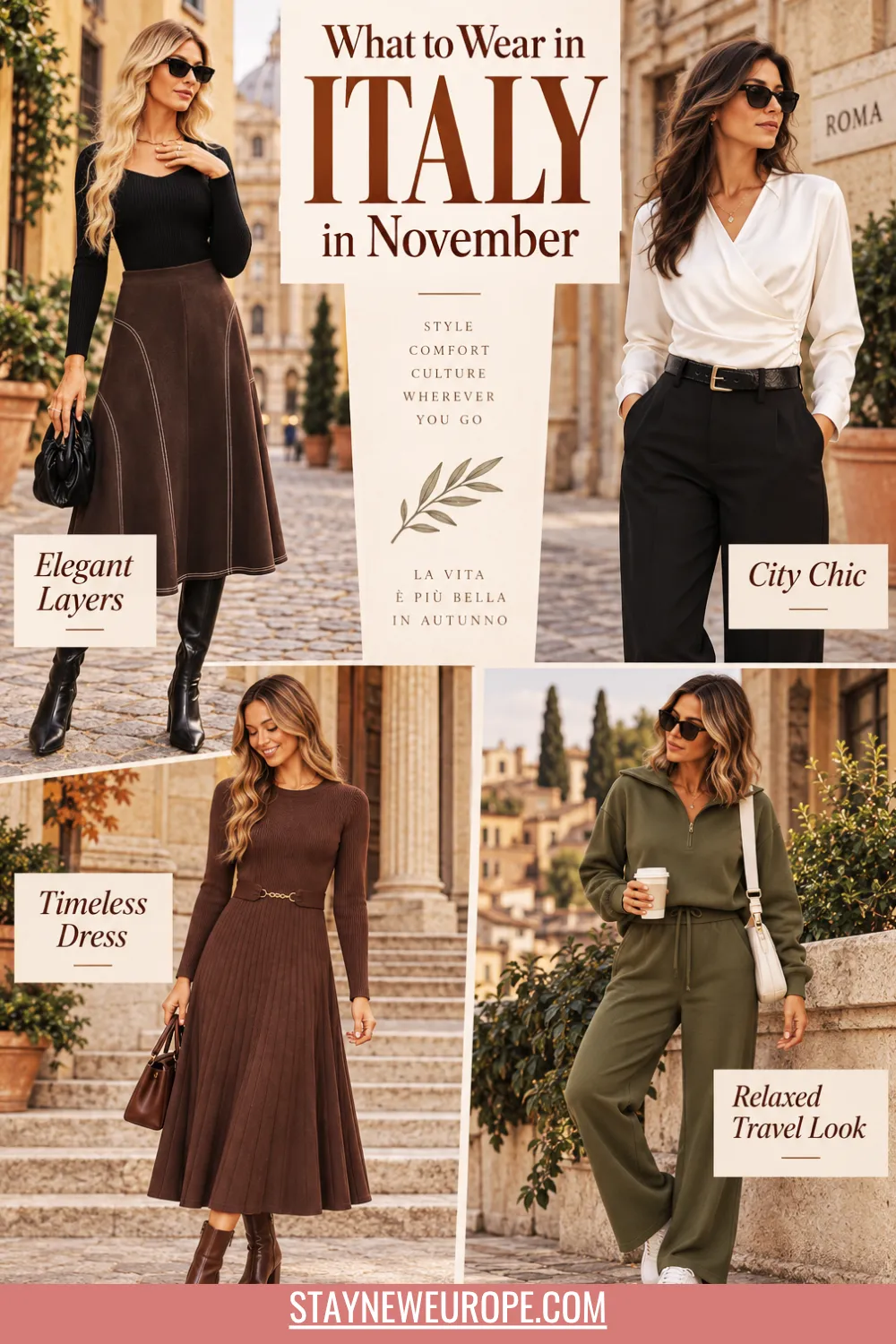
Let me be honest with you: November is the month people underestimate. They see “Italy” and picture golden light, a glass of wine outside, maybe a linen something. Then they land in Milan at 4pm, the fog rolls in off the Po Valley, it’s 6°C, the sky goes dark before dinner, and they’re standing outside the Duomo in a denim jacket wondering what went wrong.
Here’s the thing, though — November in Italy is quietly one of the best months to go. No queues at the Uffizi. Truffle season in Tuscany. Restaurants that actually have a free table. Cities that belong to the people who live in them again. You just have to dress for it properly, and “properly” is not the same as “warmly.” I learned that the hard way, sweating inside an enormous puffer on a packed Rome bus, then freezing ten minutes later because I’d built my whole outfit around one giant coat instead of layers.
So here’s everything I’d tell a friend before a November trip — what actually works, what’s a waste of suitcase space, and the small stuff that makes the difference between cold-and-miserable and cosy-and-smug.
Before We Dive In: What November in Italy Is Actually Like
Weather: Italy is long, and November proves it. Milan and the north sit around 10–12°C by day and 3–5°C at night, with fog that turns the whole city soft and grey. Florence and Venice run 12–15°C. Rome is the sweet spot at 16–17°C in the afternoon, dropping to 8°C after dark. Naples and Sicily stay mild, sometimes 18–19°C and genuinely pleasant. And rain: November is one of the wettest months nearly everywhere in the country. Not constant drizzle — Italian rain arrives fast, empties the sky for an hour, then clears.
Walking conditions: Wet cobblestones are slippery cobblestones. Rome’s sampietrini, Florence’s stone slabs, Venice’s bridges — all of them get glossy and treacherous when it rains. Add fallen leaves and you have a genuinely slidey surface. Smooth-soled boots are a bad idea in November in a way they simply aren’t in June.
Daylight: This one catches people out. The clocks have gone back, so it’s properly dark by 5pm. Your “afternoon” outfit is really your evening outfit, and evenings are noticeably colder than the daytime high suggests.
Style culture: Autumn is when Italians dress best, and they know it. Wool coats, scarves knotted with unreasonable precision, good boots, nothing bulky. Bella figura doesn’t relax in winter — it gets sharper. You don’t need to compete. You just need to look like you chose your clothes rather than grabbed them.
Start With the Bag: Carry-On or Nothing
I’ll say this early because it shapes everything else. November tempts you to overpack — knitwear is bulky, coats are heavy, and “what if it’s cold” is a very persuasive voice at 1am the night before a flight.
Resist it. Italian train stations have stairs. Venice has forty bridges between you and your hotel. Cobblestones eat cheap wheels. A carry-on that you can lift over your head on a regional train beats a big case every single time, and you will feel smug about it roughly four minutes after arriving.
A hard-shell four-wheel carry-on is my default for Italy in November, specifically because it protects against rain in a way soft fabric doesn’t. Look for spinner wheels that are large rather than tiny — small wheels and cobblestones are a miserable combination.

A weekender duffle with a trolley sleeve works better for shorter trips or multi-city routes where you’re hopping trains every two days. It squashes into overhead racks that a rigid case won’t fit, and you can carry it on your shoulder over bridges and steps.
A packable tote or foldable duffle flattens into your case and comes out on the way home for whatever you bought in Florence. You will buy something in Florence.
Local tip: Wear your bulkiest items on the plane — coat, boots, heaviest knit. That single decision frees up about a third of your case and costs you nothing but a slightly warm flight. The carry-on packing method for a 10-day trip walks through the rest of the system if you want the full version.
Layers: The Actual Secret to November in Italy
Everyone says “layers.” Almost nobody explains why it matters so much here specifically.
It’s this: Italian buildings are heated with enthusiasm. Churches are cold, museums are warm, restaurants are very warm, trains are tropical, and the street is cold again. In a single afternoon you might swing 15 degrees, four or five times. One thick coat means you’re either sweating or shivering, with no middle setting.
The system that works is three thin layers instead of two thick ones: a base (long-sleeve tee or thin merino), a middle (fine-gauge knit or a shirt), and a coat. Each piece is light enough to carry when you peel it off, and the combinations give you five or six different warmth levels out of three items.

A merino base layer is the piece most travellers skip and most regret skipping. It’s thin enough to wear under anything, it doesn’t smell after two wears, and it adds more warmth per gram than anything else you can pack.
A fine-gauge knit in a neutral — camel, grey, navy, cream — is your workhorse middle layer. Fine-gauge rather than chunky, because chunky knits eat suitcase space and look bulky under a tailored coat.

Local tip: Buy your knits in a tight colour family so any top works with any bottom. Three colours, maximum. This is boring advice that will make every single one of your photos look better.
The Coat: The One Thing Worth Getting Right
If you spend money on one item for this trip, spend it here. Your coat is in every photograph, it’s on your body eleven hours a day, and it determines whether you look like you live in Europe or like you’re visiting it.
The Italian November coat is tailored, not technical. Think structure and a bit of length — mid-thigh or longer. A big glossy ski puffer will keep you warm and will also mark you as a tourist from a hundred metres away, especially in Milan, where the standards are frankly unfair.
A wool or wool-blend longline coat in camel, charcoal, or black is the classic answer. It layers over knitwear, dresses up for dinner without any effort, and photographs beautifully against wet stone.

A belted trench with a removable lining is the smarter pick if rain is your bigger worry than cold — which it is in Rome, Naples, and most of the south in November. It handles a downpour, cinches at the waist so it never looks shapeless, and folds flatter than wool.

A slim quilted or lightweight down jacket earns its place in the north, where fog and damp cold are real. Go for a matte finish, a slim cut, and a dark colour, and it reads as considered rather than sporty. If Milan is on your route, the Milan in November guide gets into how sharp that city actually dresses.
Local tip: Check that your coat fits comfortably over a knit before you leave. A coat that only works over a t-shirt is useless in November, and there’s no fixing it once you’re there.
Jeans, Trousers, and the Shorts Question
Let’s deal with shorts first: no. Not in November, not even on a mild 19°C day in Palermo. Italians treat shorts as summer-and-seaside clothing, and in November you’ll be the only person on the street wearing them, in a way that feels less charming than you’d hope.
Jeans are absolutely fine — Italians wear them constantly — but the cut matters more than you’d think. Straight-leg or wide-leg in a dark wash looks current and pairs with boots. Distressed, very pale, or heavily embellished denim skews casual in a way that clashes with an otherwise nice coat.

The one real drawback of denim: it’s miserable when wet and takes forever to dry. On a genuinely rainy day, trousers are the better call.
Dark straight-leg jeans are the everyday base. One pair is enough. Two if you’re travelling ten days or more.
Tailored wool or ponte trousers are the upgrade that quietly does the most work — warmer than denim, smarter for dinner, dry faster, and completely acceptable for churches.

A midi skirt with opaque tights is an underrated November option, especially in Rome and the south. Tights are warmer than bare legs obviously, but also warmer than most people expect, and a skirt-plus-boots outfit looks intentional in a way jeans never quite do.

Local tip: Pack one pair of trousers that you’d happily wear to a nice dinner. It saves you from bringing a separate “evening” outfit that you’d only wear twice.
Dresses in November: Yes, Really
People assume dresses are a summer item and leave them at home. I’d argue the opposite — a dress is the single most efficient thing in a cold-weather suitcase, because it’s a whole outfit in one piece and takes up less room than the top-and-bottom combination it replaces.
The trick is treating it as a layering base rather than a standalone. Dress plus opaque tights plus boots plus coat is warm, it’s easy, and it looks far more pulled-together than the effort it required. Add a knit over the top of a slip dress and you’ve created something entirely different from the same two pieces.
A long-sleeve midi dress in a heavier knit or ponte fabric is the one I’d bring first. It’s warm enough on its own, covers shoulders and knees for churches automatically, and works from morning coffee straight through to dinner.

A slip or shirt dress in a darker tone layers under a fine knit or over a long-sleeve tee, giving you two or three looks from one packed item. In November, choose a fabric with some weight — floaty summer viscose will feel flimsy and cold.

Local tip: Dark colours aren’t just a style choice in November — they hide rain splashes, mud from wet cobblestones, and the espresso you’ll inevitably spill on a moving train.
Shoes: Waterproof, Broken In, Not Negotiable
This is where November trips are won or lost. Wet feet at 10am ruin a day in a way that very little else does, and there’s no recovering from it until you’re back at the hotel.
And please, please break them in at home. Italian sightseeing is a 20,000-step day, minimum. New boots plus cobblestones equals blisters by lunchtime on day one, and you spend the rest of the trip limping around the most beautiful cities in the world.
Leather ankle boots with a rubber lug sole are the ideal November Italy shoe. They look right with jeans, trousers, and dresses, they handle rain, and they grip. If you buy one new thing for this trip, this is a strong candidate.

Waterproof Chelsea boots are the easiest slip-on option and a genuine favourite for city days — no laces to deal with, and the elastic panel makes them quick at airport security.
Leather sneakers in white or off-white work well as a second pair for drier days and long walking stretches. Leather rather than canvas, minimal rather than chunky — the bulky running shoe is the single most recognisable tourist tell in Italy.

Local tip: Spray everything with a waterproofing treatment before you go, and pack a spare pair of wool socks in your day bag. If your feet do get soaked, dry socks in a café bathroom will rescue the afternoon.
Rain Prep: The Part People Skip and Then Regret
November rain in Italy isn’t the gentle kind. It arrives suddenly, falls hard for forty minutes, and stops. Which means you don’t need to be dressed for rain all day — you need to be able to become dressed for rain in about eight seconds.
Venice adds its own wrinkle: acqua alta, the seasonal high water that floods St Mark’s Square and low-lying streets, most commonly between October and January. The city raises walkways and shops sell rubber boots on every corner, but knowing it’s a possibility changes how you pack your shoes.
A compact windproof umbrella lives in your day bag from the moment you land. The cheap ones sold outside train stations when it starts raining will invert within one gust; bring your own.

A packable rain jacket or hooded shell that folds to the size of a paperback slips over your coat for a downpour and disappears again after. Far more useful than a bulky waterproof you’d have to wear all day.

Local tip: If you’re in Venice, check the tide forecast each morning — it’s published daily and widely available. And if acqua alta is on the cards, the wellies sold locally cost about €15 and are honestly worth it. The Europe in autumn packing guide has more on wet-weather layering across the continent.
Fabrics: What Works and What Will Betray You
Fabric choice is doing more work than colour or cut in November, and it’s the least glamorous thing to think about, so most people don’t.
Choose: merino wool (warm, light, doesn’t hold smell), lambswool and cashmere blends (warm without bulk), a wool-blend coat fabric, cotton twill, corduroy, and ponte knit for trousers. These regulate temperature between a freezing church and an over-heated restaurant, which is the entire November challenge.
Avoid: thin cotton as a base layer (it holds sweat and then chills you), acrylic knits (warm for ten minutes, then clammy), and anything heavily synthetic that traps damp. And skip the summer linen and viscose — they’ll feel thin and wrong, however much you love them in July.
Local tip: If a knit feels slightly scratchy in the shop, it will feel unbearable on hour six of a museum day. Test everything against your neck before it goes in the case.
What NOT to Wear in Italy in November
A short list, said with love, because getting these right genuinely improves how you’re treated in restaurants and shops.
Skip the head-to-toe technical outdoor gear. Hiking trousers with zip-off legs, bright waterproof shells, and rucksacks with dangling straps are for the Dolomites, not for Rome. In the city it reads as very obviously visiting.
Skip flip-flops and open sandals. Even on a mild day in the south. Nobody does it, and your feet will be cold.
Skip the enormous shiny puffer if you can help it, particularly in Milan or Florence. A slim quilted jacket does the same job and looks a hundred times better.
Skip the money belt worn outside your clothes. It signals exactly what it’s protecting. A zipped crossbody worn in front does the same job invisibly.
Local tip: If you’re unsure whether something is too casual, ask whether you’d wear it to a nice lunch at home. Italians dress for the street the way many people dress for going out. Matching that energy costs nothing.
Evening Outfits: Dinner Is a Proper Event
Italians eat late and dress up a touch for it — not dramatically, but noticeably. And in November, dinner happens in full darkness in a cold, atmospheric city, which honestly makes it better.
The good news is you don’t need a separate evening wardrobe. You need one swap. Change the knit for a silk blouse, or the sneakers for boots, or add jewellery — one adjustment tips a daytime outfit into evening without carrying an extra outfit around Italy.
A silk or satin blouse packs to nothing, tucks into the trousers you already have, and looks instantly dressier under the same coat you wore all day.

A pair of heeled ankle boots with a block heel covers dinner without the suicide mission of stilettos on cobblestones. Block or chunky, always — thin heels and sampietrini are a documented ankle hazard.

Local tip: Gold jewellery is the Italian evening shortcut. Hoops and a fine chain will do more for a simple outfit than a whole extra bag of clothes. For Rome-specific evening dressing, the what to wear in Rome guide covers neighbourhood-level differences.
Church Dress Codes (Easier in November, But Still Real)
The rule is simple and applies to everyone: shoulders covered, knees covered. In November you’re almost certainly already compliant, since you’re wearing a coat and long trousers anyway — which is one of the quiet pleasures of an autumn trip.
The catch is temperature. Italian churches are stone boxes that have been cold since roughly 1400, and they do not heat up. St Peter’s, the Duomo in Florence, the Frari in Venice — all of them are noticeably colder inside than the street. You’ll want the layer you just took off.

A large wool or cashmere-blend scarf is the multi-tool here: warmth in a freezing nave, a shoulder covering if you’re in a sleeveless dress for dinner, and a blanket on a cold train.
Local tip: Some major sites make you check large bags and, in winter, sometimes bulky coats. Wear layers you’re happy to carry rather than one huge coat you’ll have to hand over.
Bags: Crossbody Wins, With One Exception
Pickpocketing is real in tourist-dense parts of Rome, Florence, Naples, and Milan, and November crowds around the big sights are still substantial even in the low season. Your bag choice is a security decision as much as a style one.
A zipped leather crossbody worn across your body and sitting in front is the answer for city days. Structured, mid-sized, a neutral tone — tan, cognac, black. It holds a phone, wallet, umbrella, and scarf, which is genuinely everything you need.

A small structured backpack is the exception, and only if you’re carrying a camera, a laptop, or doing a long day trip. Wear it on your front in crowds, choose leather over nylon, and keep the straps tidy.

Local tip: Keep a second, smaller pouch inside your bag for your passport and one backup card, and leave it at the hotel most days. Nothing important should ever live in an outer pocket.
Accessories That Do the Heavy Lifting
Accessories are where November dressing actually gets fun. Your clothes are mostly neutral and mostly practical, so this is your personality.
A big wool scarf is the single most Italian thing you can wear in autumn. Bought there, ideally. It adds visible warmth, breaks up a plain coat, and gives you something to do with your hands in photographs.

Leather gloves matter in the north — Milan, Venice, and Turin get genuinely cold once the sun drops, and thin leather gloves look far better than anything technical.

A beret or a wool cap is optional but effective, and unlike a puffy winter hat, it doesn’t destroy your hair or your outfit.

Local tip: If you’re heading into Tuscany or the hill towns, where evenings get colder than the cities, the Tuscany in November guide is worth a read — countryside dressing is a slightly different equation.
The Capsule Wardrobe for Italy in November
Here’s the actual list I’d pack for a week to ten days, built so everything works with everything:
- Two pairs of trousers — one dark jeans, one tailored.
- One midi dress. Three or four tops, mixing long-sleeve tees and fine knits.
- One merino base layer. One cardigan or overshirt as a middle layer. One good coat.
- Two pairs of shoes — waterproof boots plus leather sneakers.
- One large scarf, one crossbody bag,
- one packable rain layer, and opaque tights if you’re bringing the dress or a skirt.
Colour palette: pick two neutrals and one accent. Camel, navy, and rust. Or grey, black, and cream. Everything then mixes without thought, which matters more than you’d expect when you’re getting dressed in the dark at 7am in an unfamiliar hotel room.
That’s seven to nine pieces of clothing generating roughly a dozen distinct outfits, and it fits in a carry-on with room left over. If you’re moving between several cities, the printable Italy travel checklist is a useful thing to run through before you zip the case.
Practical Packing: How Much Is Actually Enough
The honest rule: pack for four days and do laundry, no matter how long you’re going. Nobody in Rome is tracking whether you’ve worn those jeans three times. You will wear the same coat every day regardless — that’s just what coats are.
Plan outfits rather than items. Lay out complete looks, including shoes, and photograph each one on your phone. It sounds fussy, and it takes twenty minutes, and it’s the single best packing habit I’ve ever adopted. It also reveals the things that don’t actually go with anything, which are always the first things people pack.
The mistakes to avoid: bringing two coats (one is enough, layer underneath), bringing shoes you haven’t walked in, packing “just in case” pieces you’ve never worn at home, and leaving no room for what you’ll buy. Italy in November has excellent sales, beautiful leather goods, and knitwear you will not be able to walk past.
Local tip: Bring a few laundry detergent sheets. Most Italian accommodations don’t have an iron in the room, but a sink wash and an overnight hang covers you completely, and it’s what lets four days of clothing stretch to ten.
One Last Thing
November in Italy has a particular kind of magic that July simply doesn’t offer. Empty churches where you can actually hear the space. Chestnuts roasting on street corners in Florence. Fog sitting low over the canals in Venice at eight in the morning with nobody else around. That first glass of something red at a table where the waiter has time to talk to you.
You’re going in the version of Italy that the people who live there actually get to enjoy. Bring the good coat, the boots that grip, the scarf you’ll want to keep forever — and then stop thinking about your clothes entirely, because there’s an awful lot more to look at.
Buon viaggio. It’s going to be wonderful.

