
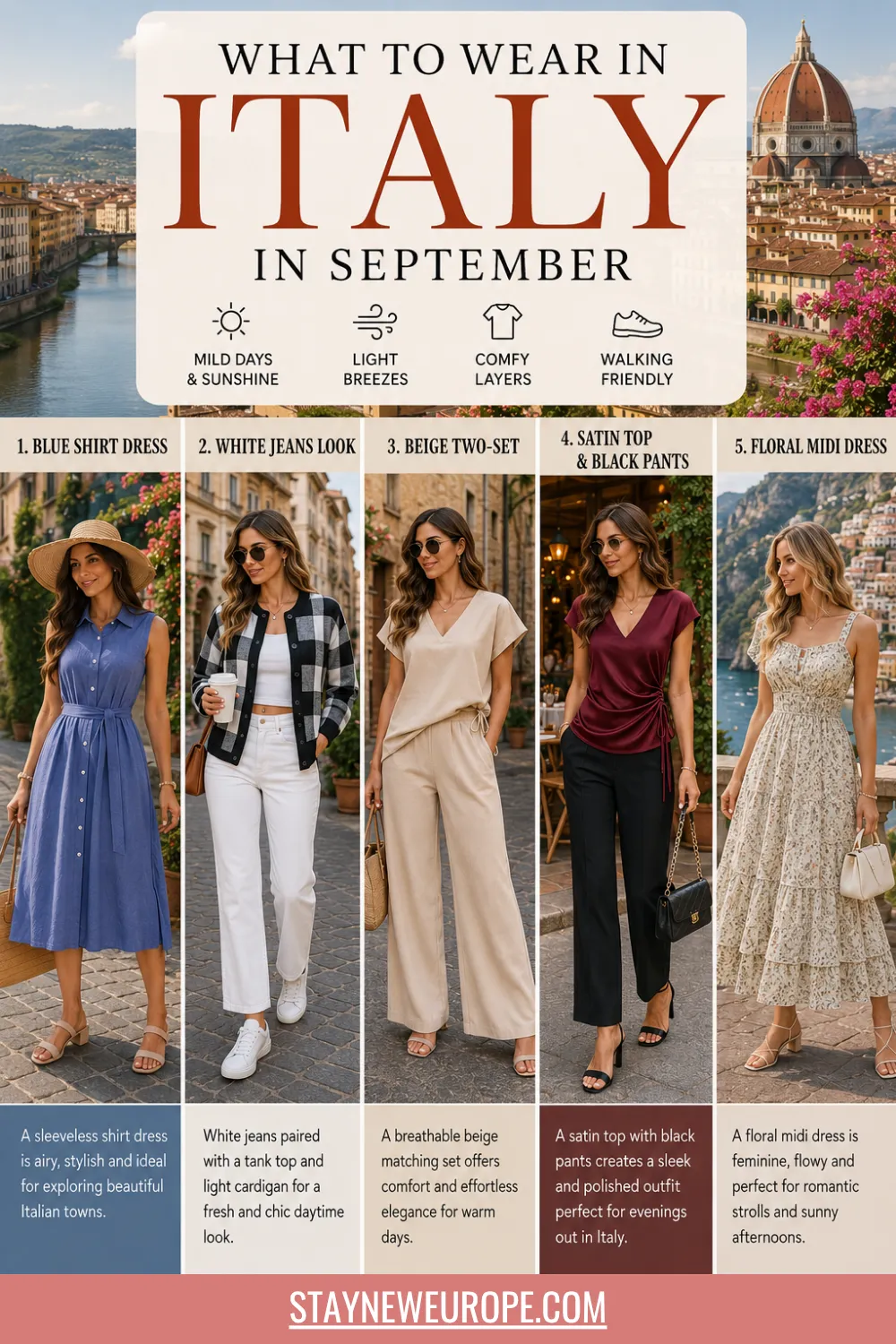
September in Italy is one of those months that feels almost unfairly beautiful. The summer crush has eased, the light has turned golden and thick, and the temperature is that perfect sweet spot — warm enough for sundresses, cool enough to actually enjoy walking. Rome’s cobblestones don’t try to kill you quite as aggressively. Florence’s piazzas have breathing room. The Amalfi Coast stops feeling like a theme park.
But here’s the thing: I’ve seen so many people arrive underprepared for September’s little tricks. They pack as though it’s August, then get caught in a surprise evening chill without a layer. They bring one pair of cute sandals and destroy their feet. They show up at the Vatican in a strappy sundress and get turned away at the gate. September is generous, but it rewards those who’ve thought ahead.
This is what I wish someone had told me before my first September trip — real outfit advice, not a list of generic items.
There are more articles of ours related to ITALY that may help—
- The Ultimate Printable Italy Travel Checklist (Everything You Actually Need)
- Things to Know Before Traveling to Italy: A First-Timer’s Real Talk Guide
- How to Travel to Italy on a Budget (Without Missing a Single Thing)
- How to Pack a Carry On for 10 Days Italy Summer (Without Sweating Through Everything You Own)
Before We Dive In: Italy in September at a Glance
Weather: September in Italy means warm days (22–28°C in most cities, hotter in the south) and noticeably cooler evenings that can drop to 16–18°C. Northern Italy — Milan, Venice, the lakes — tends to feel the autumn shift earlier. Southern Italy and Sicily stay sunnier and warmer for longer. Rain is more likely than in July or August, particularly in the second half of the month, and it often comes as short, sharp afternoon showers rather than all-day drizzle.
Walking conditions: Italian cities are not kind to unprepared feet. Whether you’re in Venice navigating bridges and narrow calli, Rome crossing ancient stone streets, or Florence walking between the Duomo and the Uffizi — your footwear matters more than almost anything else you pack. Cobblestones, uneven surfaces, and long daily distances (15,000+ steps is not unusual) will punish the wrong shoes without mercy.
Style culture: Italians dress intentionally. Not in an intimidating way, but in a way that makes it obvious someone thought about what they were putting on. September especially — when Italians themselves return from summer holidays refreshed — is the season of good blazers, proper loafers, and dresses that look like they were made for the city rather than the beach. You don’t need to match them, but you’ll feel more at ease, and frankly more confident, if you’ve put a little thought into your wardrobe.
Linen: Your Non-Negotiable Foundation
If there’s one thing I want you to take away from this entire article, it’s this: pack linen. Not as a nice-to-have, but as your actual base layer strategy.
September days in Italy still reach the high 20s, and walking around Rome in non-breathable fabric is genuinely unpleasant. Linen breathes in a way cotton simply can’t match at that temperature. It wicks moisture, dries fast, and — this is the part people don’t expect — it somehow looks more polished the more it wrinkles. The relaxed drape of a linen shirt or linen trousers reads as intentional in Italy in a way it wouldn’t necessarily elsewhere. Italians wear a lot of linen, and it shows.
Stick to neutral colours — cream, beige, sand, olive, and white — because they pair with everything else and photograph beautifully against Italian architecture. A white linen shirt is probably the most hardworking item you can pack: it works over a bikini on the Amalfi Coast, tucked into tailored trousers for a museum visit, or knotted at the waist over a midi skirt for dinner.
Local tip: Don’t pre-iron your linen. It will wrinkle the moment you put it on anyway, and in Italy, slightly rumpled linen looks like a deliberate aesthetic choice. Embrace it.
Dresses That Actually Work for Italy in September
A well-chosen dress is the single most efficient packing decision you’ll make for Italy in September. One piece, instantly an outfit. No matching required. And the Italian city backdrop makes almost every dress look better than it does at home.
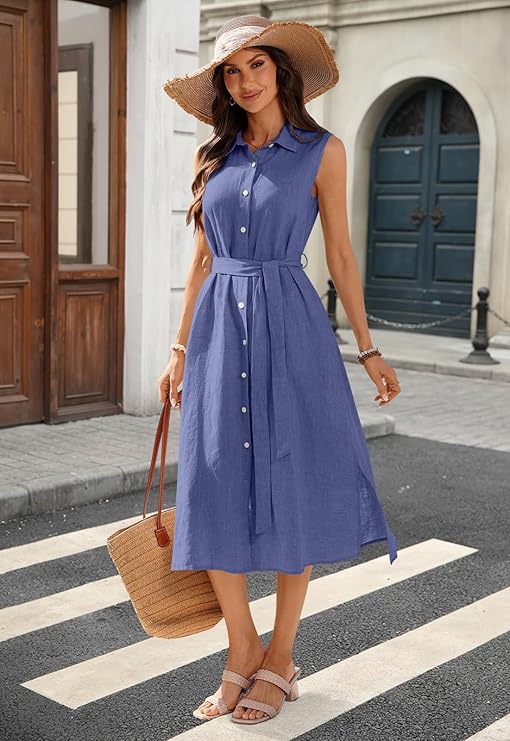
Midi and maxi lengths are your best friends — they cover you for church visits without the awkward “wrap a scarf around your legs” moment, they work for both daytime sightseeing and evening aperitivo, and they’re genuinely cooler in the heat than shorts.
A flowy midi dress in linen or viscose with a sandal in the morning, swap to block-heeled mules for dinner, and you’ve covered both halves of your day in one outfit.

Wrap dresses are particularly good for September because they’re adjustable. When you duck into an aggressively air-conditioned museum mid-afternoon (and Italian museums are often very cold), you can pull the wrap tighter. When you’re outside in the sun, loosen it up. That versatility is worth more than it sounds after a full day of sightseeing.

A slip dress in a warm tone — terracotta, rust, deep olive — over a white fitted t-shirt or thin long-sleeve is a classic Italian autumn look. It keeps you warm enough in the morning, and you can peel off the underlayer when the afternoon sun kicks in.
Local tip: One bold dress does more for your Italy wardrobe than three neutral ones. Italian women are not afraid of colour or print. A deep burgundy wrap dress or a printed linen midi will feel completely at home against the amber-coloured streets of Florence.
Lightweight Layers: The September Secret
This is where September trips go wrong. People pack for warmth or for heat — and September demands both, sometimes in the same day.
The morning in Venice might be 17°C with a slight mist coming off the canals. By noon it’s 26°C and golden. By 8pm, sitting outside for dinner in Rome, it’s dropped again and you’re suddenly wishing you’d brought literally anything with sleeves. This is the Italy in September experience. It’s wonderful, but you have to dress for it.
The solution isn’t more items — it’s the right items. A lightweight linen blazer is the single most useful piece I’ve ever packed for September in Italy. It takes up almost no space, adds immediate polish to any outfit, and provides enough warmth for a cooler evening without making you overheat on a sun-exposed terrace. Wear it over a slip dress with white trainers and you look like you live there.
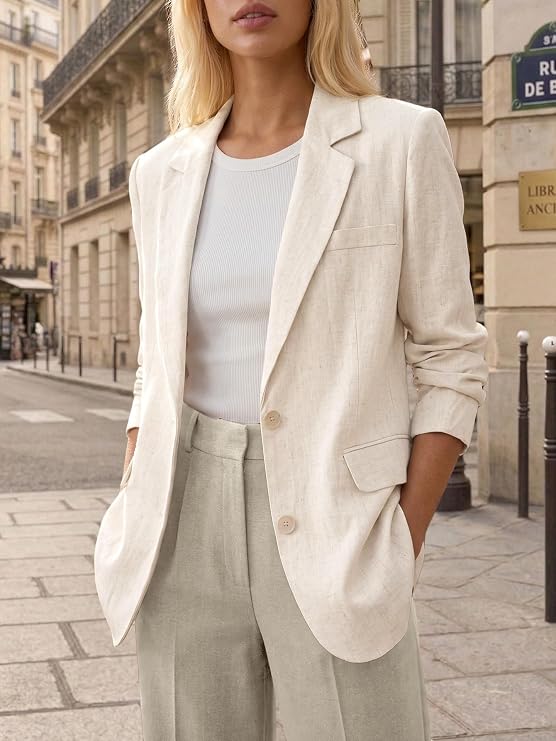
A thin cotton knit or a fine-gauge merino cardigan serves a similar function with a softer aesthetic.

Both can be tied around your shoulders (very Italian, very acceptable) or stuffed into your bag during the warmer parts of the day.

What you don’t need: a puffer jacket, a heavy wool coat, or anything you’d wear in October back home. September in Italy is not cold — it just has cool moments that a single good layer will handle easily.
Local tip: Keep your layer in your bag, not on your body. You’ll be warmer than you think during the day. Having it accessible rather than wearing it from the start is the move — I learned this after sweating my way through an entire morning in Florence still wearing the cardigan I’d needed at 8am.
The Jacket Question
You’ll want one jacket for Italy in September — just one, and it needs to be the right one.
A lightweight unlined blazer in a neutral colour (camel, olive, navy, or classic black) is the most versatile choice. It reads as polished in a way a hoodie simply doesn’t, it layers easily over everything, and it can take an outfit from casual afternoon to smart evening without any other changes. It also doubles as a cover-up for colder museums or air-conditioned restaurants, which is more useful than it sounds.

For those travelling to northern Italy or planning the second half of September, a packable light jacket with a little more substance — think a thin mac or a cotton-blend utility jacket — adds genuine warmth without bulk. Venice in late September evenings can be genuinely chilly, especially near the water.

A denim jacket is the one exception to the linen rule — it works well for September because it bridges that casual-but-intentional look, especially paired with a linen dress or wide-leg trousers. Just make sure it’s a slim or regular fit; an oversized denim jacket with an oversized linen outfit starts to look more shapeless than chic.

Local tip: Italy in September is still very much an outdoor dining culture. Evenings at a terrace restaurant or a rooftop bar can get cool quickly. A blazer rolled into your bag is not optional — it’s the thing that makes the evening comfortable.
Trousers, Jeans, and the Shorts Debate
Let me be honest: full denim in September in southern Italy or on the Amalfi Coast is still going to be warm. If jeans are a non-negotiable part of your travel identity, pack one pair of straight-leg or wide-leg jeans in a lighter wash — they’re slightly cooler than dark denim and they look brilliant with sandals or loafers.
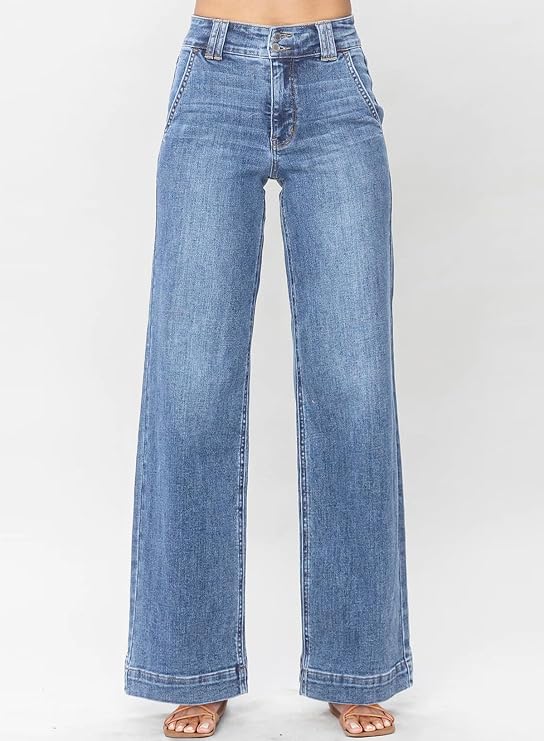
But the smarter choice for most of September? Wide-leg linen or cotton-blend trousers. They’re cooler than denim, they photograph beautifully in Italian settings, and in neutral colours they pair with everything you’ve packed. Beige linen trousers with a white linen shirt and tan leather sandals is an outfit that will carry you through almost any situation Italy throws at you — morning museum, afternoon piazza, early dinner aperitivo.

As for shorts — they’re perfectly appropriate for the Amalfi Coast, Sicily, or a beach day in early September.

But in city centres, shorts tend to look more tourist-on-holiday than the Italians-in-September aesthetic. Mid-thigh or longer bermuda shorts in linen are the acceptable middle ground if you run hot or are in coastal destinations.

Local tip: Tailored wide-leg trousers in a warm neutral are the closest thing to a universal Italy outfit bottom. Wear them for six days straight and no one will notice because they’ll look different every time depending on what’s on top.
Shoes That Won’t Ruin Your Trip
This section matters more than any other. I will not let you make a shoe mistake in Italy.
Italy is not gentle on footwear decisions. The cobblestones in Rome’s Trastevere neighbourhood, the bridges in Venice, the steep switchbacks of the Cinque Terre, the wide stone-paved streets of Florence — all of them will extract revenge on the wrong shoes by day two. I’ve watched people limp through Pompeii in wedge heels and it’s genuinely painful to witness.
Here’s what you actually need:

White leather trainers or well-worn sneakers are the backbone of your footwear for Italy in September. They’re comfortable for full sightseeing days, they look intentional rather than lazy (Italians wear white trainers constantly), and they pair with dresses, trousers, and jeans equally well. Make sure they’ve been broken in before you leave home.

Leather sandals with proper support — a Birkenstock, a good Italian leather sandal, or anything with a contoured footbed — for warm days, coastal towns, and evening walks. Flat sandals are fine; wedge heels on cobblestones are a liability.

Low-heeled leather mules or block-heeled sandals for evenings when you want to look more dressed up without committing to a heel that will make you miserable on uneven ground.

What you don’t need: stilettos, thin-soled ballet flats, brand-new shoes of any kind, or flip-flops for anything other than the beach.
Local tip: Venice specifically requires extra care. The paths around the canals can be wet and slippery, and some water taxi landings are genuinely slick. Anything with grip on the sole is your friend. Leather soles on wet Venetian stone are a cautionary tale I’ll tell you about another time.
What to Wear for Churches (This Is Not Optional)
Italy is full of churches. Italy’s most stunning buildings are churches. You will want to go inside them. And the dress code is real.
The rule is consistent across all Italian religious sites: covered shoulders and covered knees, for everyone. This applies to the Vatican, the Sistine Chapel, St. Mark’s Basilica in Venice, Florence’s Duomo, every cathedral you’ll pass — no exceptions, no “just this once,” no “but it’s hot.” Vending machines outside selling disposable paper coverings are a tourist tax I’d rather you avoid.
The practical solution is a lightweight scarf. A single large linen or cotton scarf doubles as a shoulder cover, a knee cover when draped over your lap in a cool church, a layer for cold evenings, and a beach cover-up in coastal towns. It weighs almost nothing and earns its packing weight six times over.

If you’re in a dress with thin straps, carry the scarf in your bag or tie it at your waist — easy to pull up when you arrive at the entrance. Midi dresses that cover the knee remove the lower half of the problem entirely.
Local tip: Some churches in busy tourist areas now have free disposable ponchos at the entrance — but they’re not reliable. Bring your own scarf and you’ll never be turned away. The satisfaction of breezing through while others scramble is genuinely worth the 30 seconds of packing effort.
Bags: Crossbody Is the Right Answer
Your bag choice in Italy is as much a safety decision as a style one. Pickpocketing in tourist-heavy areas — Rome’s Colosseum, Florence’s central market, Naples, Venice’s vaporetto stops — is real and consistent. Large tote bags, open backpacks, and anything that hangs loosely behind you are invitations.
A structured crossbody that sits against your body and zips or clasps securely is the practical and stylish standard. Italian women wear crossbody bags constantly; it looks natural and intentional. Choose something small enough to carry comfortably all day but large enough for your wallet, phone, sunscreen, scarf, and a water bottle.

A small leather bag with a zip top in tan, black, or dark brown will work with every outfit in your suitcase and not age badly across five days of sightseeing.

If you need more carrying capacity for day trips or long museum visits, a slim packable tote that folds into your crossbody for the journey and unfolds when needed gives you flexibility without the vulnerability of a large open bag.
Local tip: Wear your crossbody in front in extremely crowded spaces — around the Trevi Fountain, on the Rome metro, on any busy vaporetto in Venice. The back-clasp pickpocket technique is fast and the crowds are helpful cover for it.
Evening Outfits for Italy in September
Italians take evening seriously. Aperitivo hour, dinner that starts at 8pm, a passeggiata through the piazza after — these are not casual occasions, even when they’re casual occasions, if that makes sense.
You don’t need to pack a formal dress for September in Italy. But you do need something that’s a step above what you wore hiking the Borghese Gallery all afternoon.
A midi dress in a warm, rich tone — terracotta, deep rust, burgundy, forest green — with leather sandals or block-heeled mules and gold jewellery covers almost every evening scenario. The tonal depth of those autumn-adjacent colours looks stunning against September Italy’s warm light, and they read more intentional than pastels or brights.

Alternatively: linen wide-leg trousers, a silk or satin camisole top, a linen blazer draped over the shoulders. This combination is effortlessly Italian and adapts between quite casual and genuinely smart depending on the accessories.

Local tip: Italian restaurants rarely have strict dress codes, but they do notice. You’ll be treated with more attentiveness and warmth if you look like you’ve made an effort. A blazer over any outfit does most of the heavy lifting.
Fabrics to Choose (And the Ones to Leave at Home)
September in Italy calls for natural fabrics that breathe. This is not a preference — it’s a practical reality when you’re walking 12+ kilometres a day in 25°C heat with high humidity in Venice or Rome.
Pack: linen, cotton, silk, viscose (technically semi-synthetic but breathes beautifully), and fine merino wool for cooler evenings.
Avoid or limit: heavy cotton jersey (gets damp and stays damp), polyester (the enemy of any warm day), and thick denim in anything other than a light wash.
Silk and satin deserve a particular mention for evenings — a simple silk camisole or slip dress looks expensive and luxurious with almost no effort, packs completely flat, and dries quickly if you hand-wash it. It’s one of the most weight-efficient items you can bring.
Local tip: Check the fabric composition of anything before you pack it. A label that says “100% polyester” on a dress you’re planning to wear while walking seven hours through Rome in September is a trap. I’ve been in that trap. It is not worth it.
Accessories That Make a Simple Outfit Look Intentional
September in Italy is the moment to wear the jewellery. Gold hoops, a delicate chain, a few rings — the Italian aesthetic is warm metals against golden end-of-summer skin, and it doesn’t take much.
Sunglasses are essential, not optional. The September light in Italy is glorious and it is relentless. A pair you actually like — not a backup pair, not a gas station purchase — because you’ll be wearing them constantly.

A hat for the hottest days: a structured wide-brim straw hat or a packable canvas hat with a brim for daytime sightseeing. The sun is still strong in early September across southern Italy, and a good hat protects you without sacrificing the outfit.

Scarves work overtime in September Italy: as a layer, a church cover-up, a beach wrap, a way to add colour to a neutral outfit without rethinking the whole look. Pack one in a colour or print you love.

Local tip: One or two statement accessories — a good pair of sunglasses, a leather crossbody bag, a silk scarf — do more for your Italy look than a suitcase full of new clothes. Invest in the accessories and keep the clothing simple.
Rain: It Will Happen. Here’s How to Handle It
September rain in Italy comes quickly and usually passes just as quickly — a 20-minute downpour that soaks through if you’re caught unprepared, then sunshine again like nothing happened. In northern Italy and along the Adriatic coast, September rain is more persistent.
A compact packable rain jacket that folds into its own pocket is worth every inch of suitcase space it takes up. Look for something lightweight and not parka-adjacent — a thin mac or packable rain layer in a neutral colour won’t look out of place as a top layer on cooler days even when it’s not raining.

Don’t bring an umbrella from home — they’re bulky, and compact umbrellas are sold everywhere in Italy for a few euros. Buy one there if you need it.

What you don’t need: waterproof hiking gear, rubber boots, or anything that makes you look like you’re braced for a storm. September rain in most of Italy is a brief interruption, not an all-day event.
Local tip: The most useful rain preparation isn’t actually about the jacket — it’s about your footwear. Slippery wet cobblestones in Venice or Rome in sandals with flat leather soles are genuinely dangerous. Make sure at least one pair of your shoes has grip.
What NOT to Wear (Please Spare Yourself)
This section is given with love.
Flip-flops in the city. They’re uncomfortable on cobblestones, inappropriate for churches, and quietly mark you as someone who hasn’t done any research. Beach-only.
Active wear for sightseeing. Leggings and running trainers on the Rome metro, full gym kit in the Uffizi — it happens and it’s fine safety-wise, but it’s a visual mismatch that will make you feel out of place the longer you’re in Italy.
Logo-heavy tourist gear or heavily branded sports clothing. Italy is not the place for it.
Overly revealing outfits in the city centre. Very short shorts, crop tops, visible bralettes on their own — not for church areas, and in some southern Italian towns, considered inappropriate in general. A thin layer on top takes you from street-acceptable to universally appropriate in three seconds.
Brand new shoes. Please. I’m begging you. Every pair of shoes on your Italy trip should have been worn for at least several weeks before the trip. A brand new shoe on a cobblestone city street will have you limping by day two.
Local tip: Look at what Italian women your age are wearing in the area you’re visiting. Not to copy them, but to calibrate — they’re dressed for the actual weather, the actual culture, and the actual walking conditions. They’ve been doing this their whole lives.
Your Italy in September Capsule Wardrobe
For a 7–10 day trip, this is the core:
Tops: 2 linen shirts (one white, one in a warm neutral), 1 silk or satin camisole for evenings, 1 fitted cotton t-shirt, 1 thin cotton or merino knit for cooler days
Bottoms: 1 pair of linen wide-leg trousers, 1 pair of well-worn straight-leg jeans (light wash), 1 pair of comfortable walking shorts if you’re in coastal areas
Dresses: 2–3 midi dresses (one linen for day, one slightly dressier for evenings, one wrap for versatility)
Layers: 1 lightweight linen blazer, 1 packable light jacket or rain layer
Shoes: 1 pair broken-in white leather trainers, 1 pair leather sandals with support, 1 pair of low-heeled mules for evenings
Accessories: 1 large scarf, good sunglasses, a structured crossbody bag, gold jewellery basics, a wide-brim hat
This covers churches, coastal towns, city sightseeing, rainy afternoons, and dinner without overpacking. If you’re heading to multiple cities — Rome then Venice then the Amalfi Coast, for example — the same wardrobe works across all of them with minor adjustments in how you style each piece.
For more ideas on building a travel capsule for Italian destinations, our guide to what to wear in Italy in July breaks down the hotter summer months with similar principles. And if you’re planning a beach-focused leg of your trip, the Sardinia summer packing guide goes deep on coastal Italian dressing.
Packing Smart: The Practical Bit
Italy in September does not require a large suitcase. I’d argue it actively punishes one — rolling a large case over Roman cobblestones, hauling it onto the Venice vaporetto, carrying it up a flight of stairs in a Florentine pensione. A carry-on suitcase or a medium-sized duffle bag is genuinely sufficient for 10 days in Italy if you’ve packed well.
Outfit planning approach: Aim for 8–10 outfits for a 10-day trip, planned on the principle that most items work with at least three other pieces. Two dresses, one pair of trousers, two shirts, and a blazer can produce around 10+ outfits with variation. Don’t pack outfit-specific pieces — pack ingredients.
Mistakes to avoid: Packing for every scenario (you will not need an all-weather hiking kit and a formal gown), bringing full-sized toiletries in checked luggage when a carry-on is faster, and packing backup outfits “just in case.” Italy has laundry services, beautiful markets, and, in a genuine emergency, shops.
If you’re building a packing strategy from scratch for broader European travel, the Spain packing list uses the same capsule logic and has some excellent crossover items worth considering.
Local tip: Roll everything. Not just for space — rolling reveals how little of your wardrobe you actually need. If you can see your whole suitcase contents in one layer, you’ve packed well.
A Note on Individual Cities
September Italy isn’t uniform. Here’s a fast calibration:
Rome: Warmest of the major cities in September. Linen stays essential. The Vatican church rules apply across the entire Centro Storico — carry your scarf.
Florence: Slightly cooler than Rome, especially in the evenings. Your blazer will earn its keep here. The fashion in Florence is slightly more polished than other cities — this is, after all, where Italian fashion came from.
Venice: The most atmospheric city in September and the one most affected by cooler evening temperatures near the water. Pack the extra layer seriously here. Canal-adjacent evenings can genuinely drop to 15°C by late September.
Amalfi Coast and Sicily: Still warm and beach-appropriate in September, especially early in the month. Your beach capsule overlaps heavily with city wear; a good cover-up bridges both. Check the Sardinia summer guide for Italian coastal dressing principles that translate directly.
Milan: The most fashion-conscious city in Italy and the one where making an effort is most noticed. September is Fashion Week season — the city is full of stylish people. You don’t need to attend the shows, but showing up in your best linen blazer outfit will feel entirely right.
September in Italy is one of those travel experiences that stays with you — the amber light, the slower pace, the sense that the city has exhaled after summer. You’ll look back at your photos and remember not just what you saw, but how it felt to be there. Pack intentionally, wear with confidence, and let the country do the rest. Italy in September doesn’t need much from you — just curiosity, good shoes, and the presence of mind to put something beautiful on.


One Response